-
-
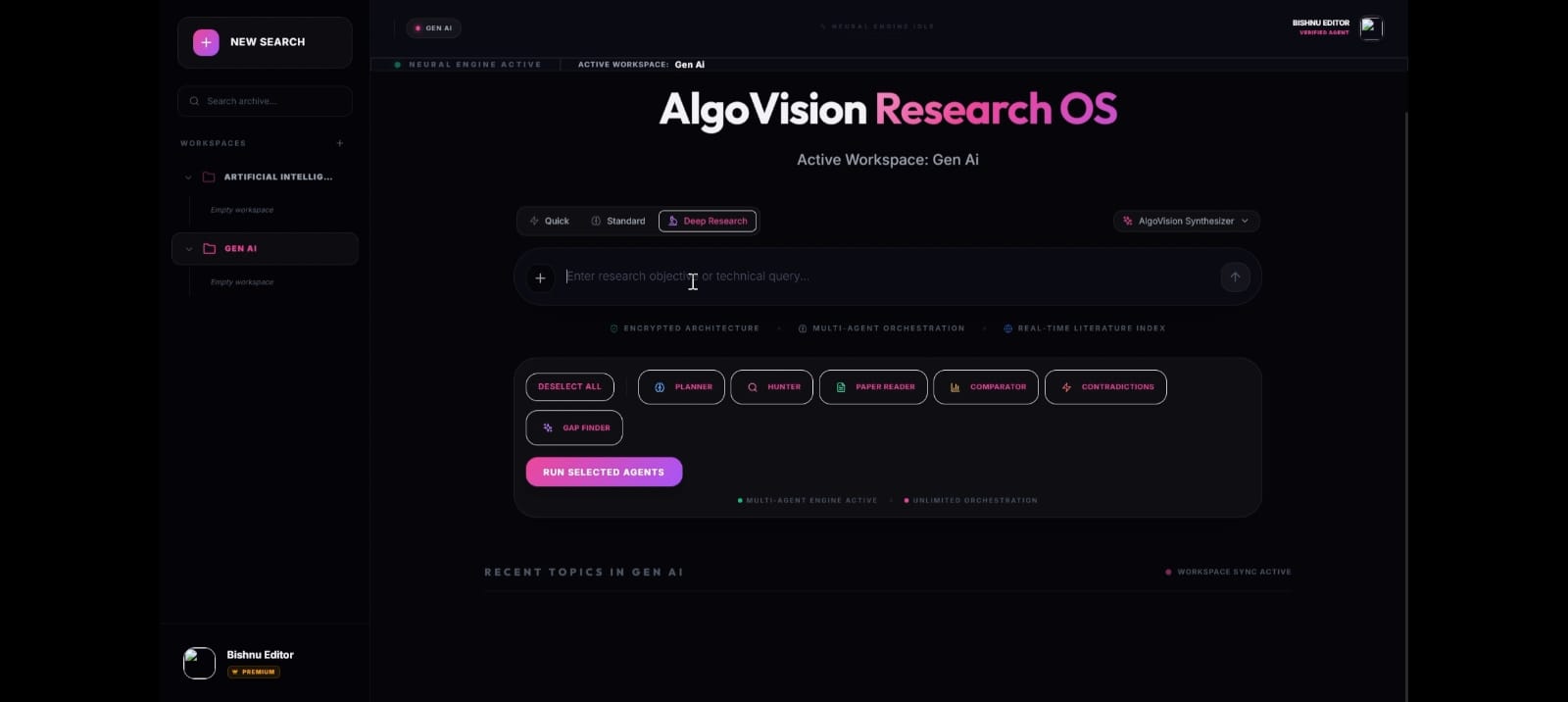
Main Page of Website
Inspiration
Every year, thousands of groundbreaking research papers are published, but researchers, students, and developers spend countless hours just doing manual literature reviews. The process of reading, extracting methodologies, and cross-referencing claims across multiple PDFs is tedious and error-prone. We were inspired to build AlgoVision to solve this bottleneck. We wanted to create a system that doesn't just "summarize" a paper, but acts like a team of dedicated AI research assistants working in parallel to give you a "Clear Vision Through Algorithms."
What it does
AlgoVision is a Multi-Agent AI Research Platform designed to accelerate literature reviews. When a user uploads a research paper (PDF, DOCX, or even audio/video), AlgoVision orchestrates several specialized AI agents:
- Paper Reader: Extracts the core methodology, datasets, results, and limitations.
- Comparator: Generates structured comparison tables across multiple research approaches.
- Contradiction Detector: Actively scans for conflicting claims or methodologies to ensure academic rigor.
How we built it
We built AlgoVision using a robust MERN stack (MongoDB, Express.js, React, Node.js) combined with a highly modular agentic backend.
- Frontend: We used React with Vite for lightning-fast compilation, styled with Tailwind CSS and Framer Motion for a premium, dynamic user interface.
- Backend & DB: Node.js and Express handle the API routing, user authentication (JWT), and file processing (
pdf-parse,mammoth, andFFmpeg). For data storage, we utilized MongoDB for user and document state, alongside Neo4j to potentially map complex graph relationships between research concepts. - AI Orchestration: Instead of relying on a single LLM prompt, we built a custom agent orchestrator. We utilized Google's Gemini 2.0 Flash and OpenRouter (GPT-4o-mini) to power our distinct AI agents, allowing them to run in parallel and synthesize data efficiently.
Challenges we ran into
- Handling Complex File Formats: Academic papers are notoriously difficult to parse due to multi-column layouts, mathematical formulas, and charts. We had to implement robust text-extraction pipelines before feeding data to the LLMs.
- Agent Orchestration: Coordinating multiple AI agents to run asynchronously without hitting API rate limits or timing out was a significant architectural challenge. We had to build a fallback mechanism (routing between OpenRouter and Gemini) to ensure 100% uptime.
- Context Windows: Processing massive documents requires strict token management to ensure the AI doesn't lose focus on the methodology and results.
What we learned
Building AlgoVision taught us the true power of Agentic AI. We learned that breaking down a massive task (literature review) into smaller, specialized agents (Reader, Comparator, Contradiction Detector) yields exponentially better and more accurate results than standard zero-shot prompting. We also deepened our knowledge of full-stack performance optimization and building resilient AI API pipelines.
What's next for AlgoVision
We plan to introduce deeper Neo4j Knowledge Graph integration so users can visually navigate how different research papers cite and contradict each other. We also want to implement real-time collaborative workspaces where research teams can chat directly with the synthesized data.
Built With
- express.js
- google-gemini-api
- jwt
- mongodb
- neo4j
- node.js
- openrouter-api-(gpt-4o)
- pdf-parse
- react
- tailwind-css
- vite

Log in or sign up for Devpost to join the conversation.