-
-
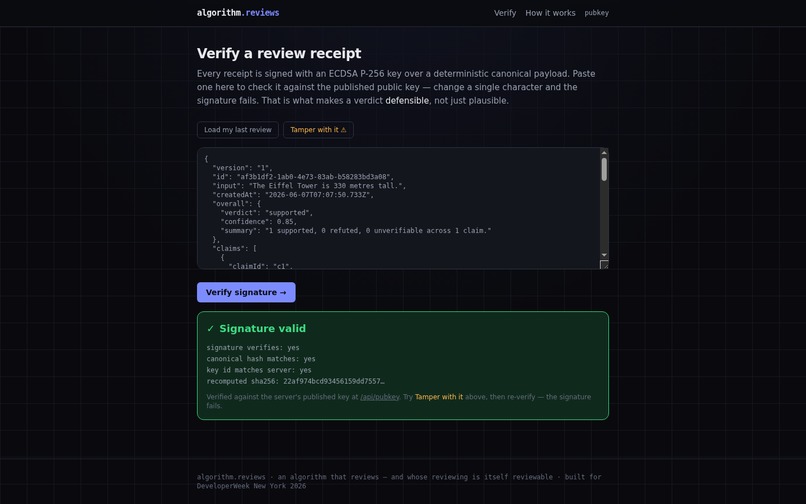
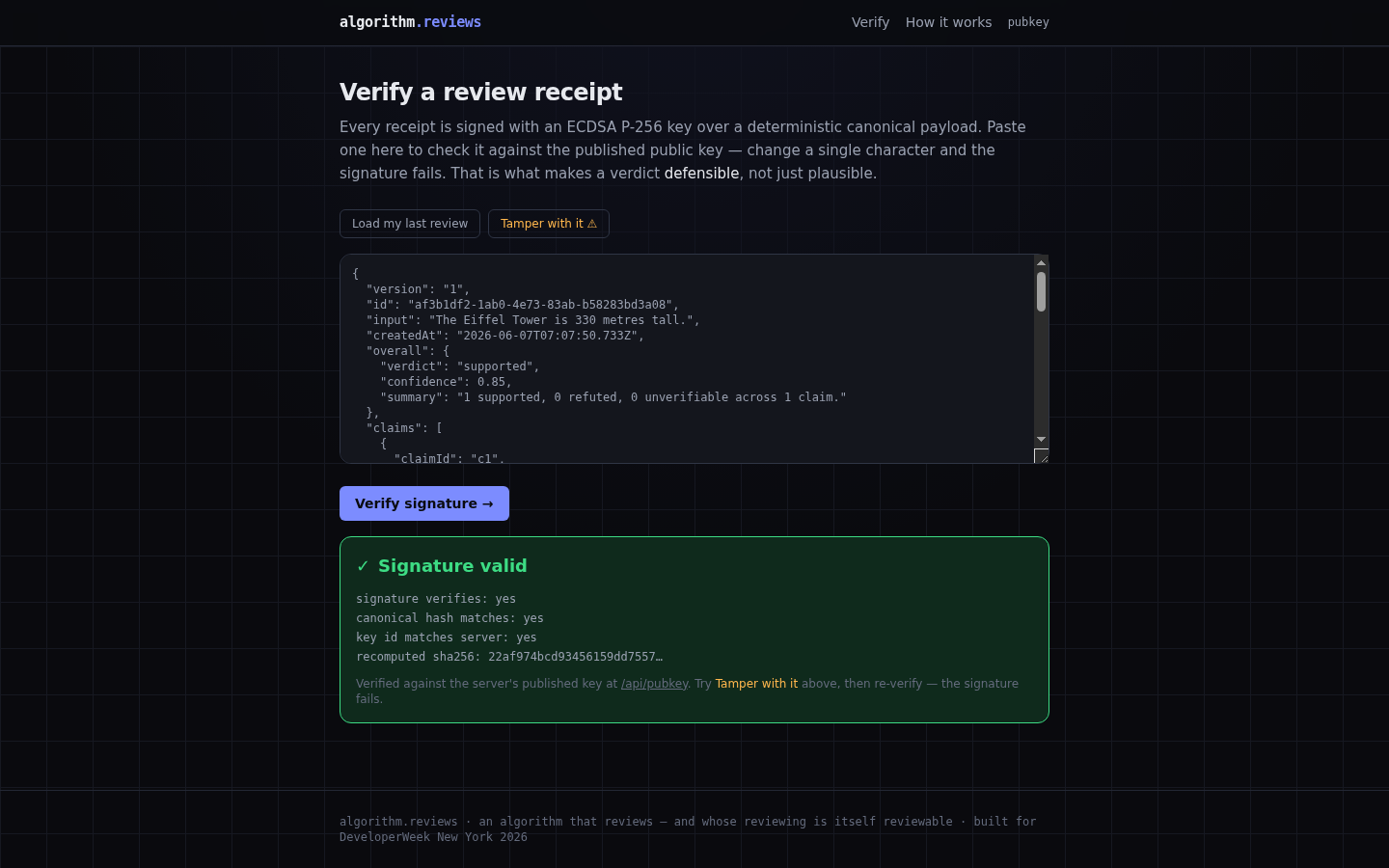
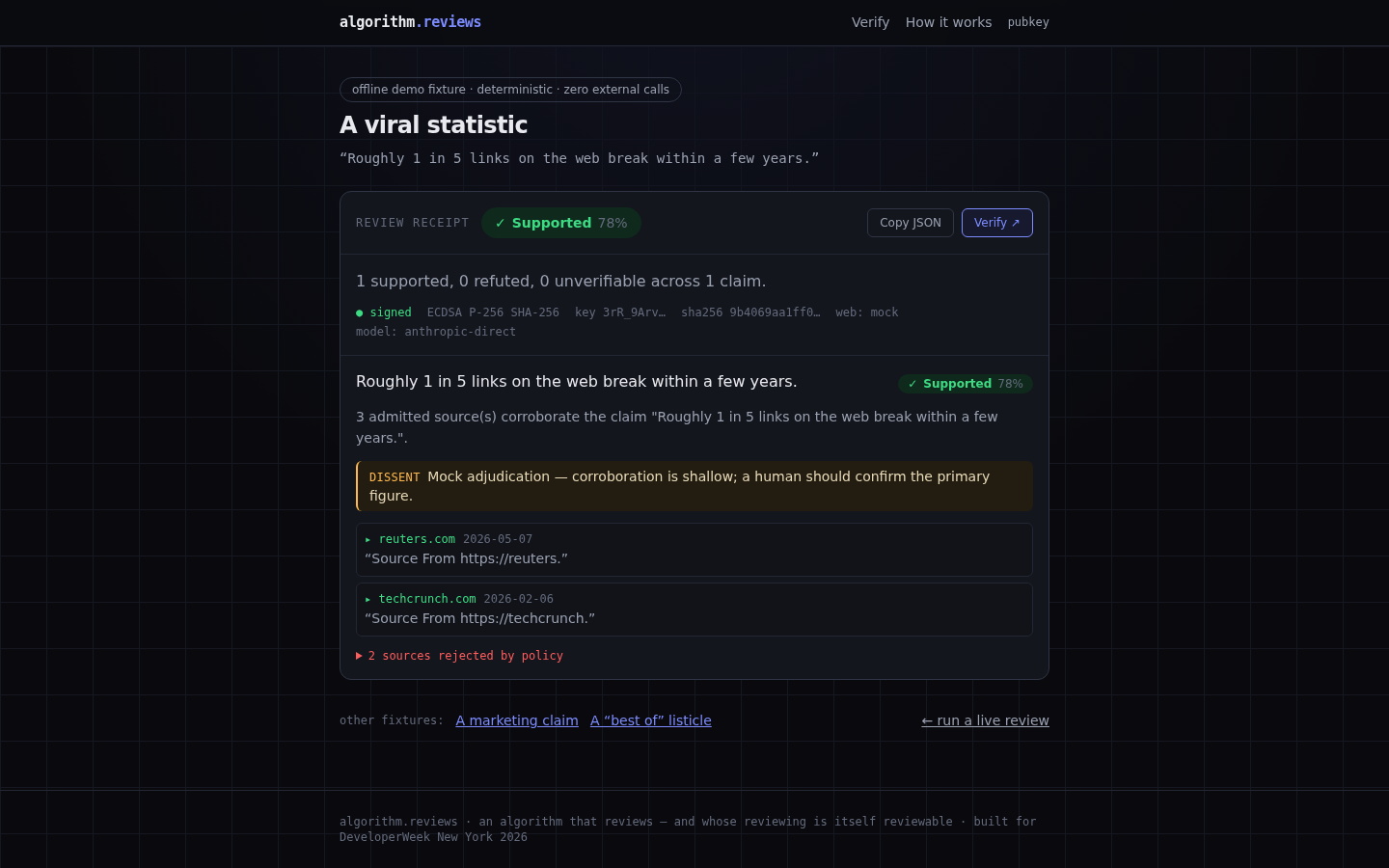
Every receipt is ECDSA-signed. Anyone can verify it against the published public key — here it checks out: signature valid.
-
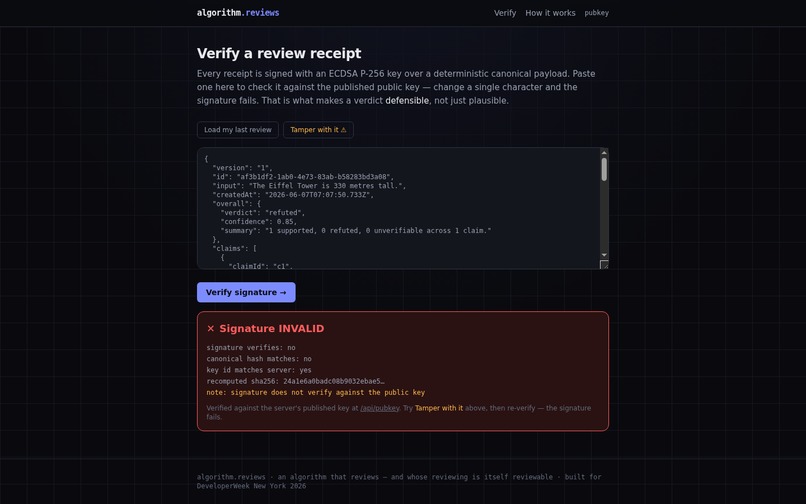
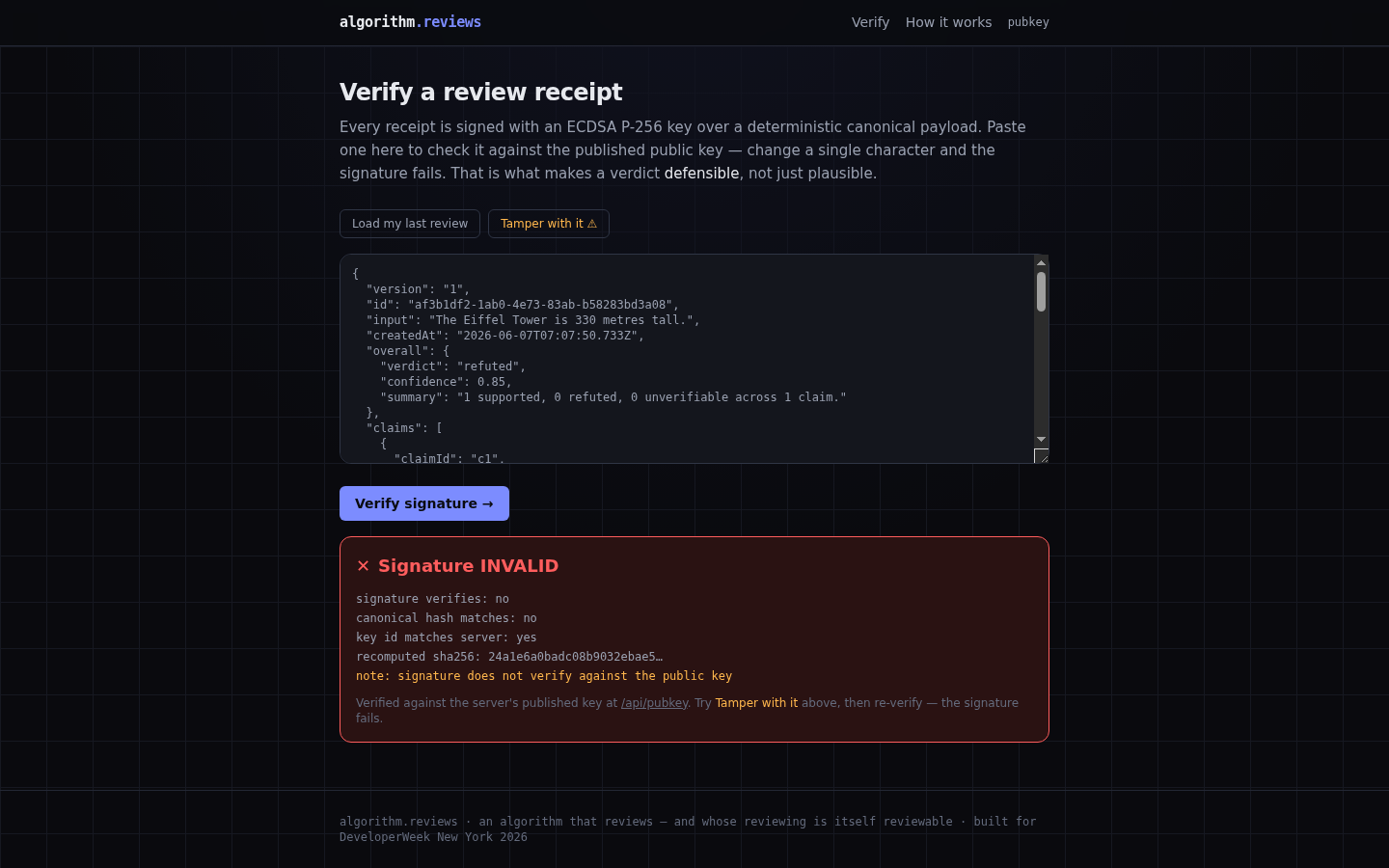
Tamper-evident: flip a single field and the signature fails. A verdict you can defend, not just trust.
-
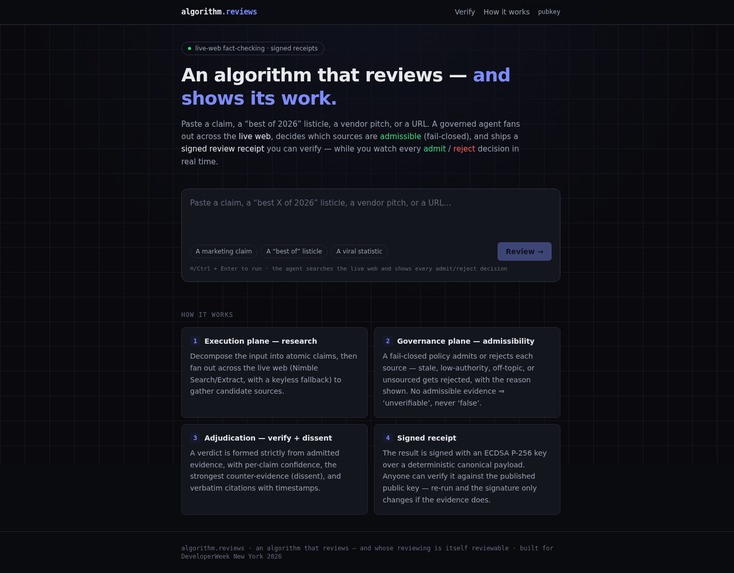
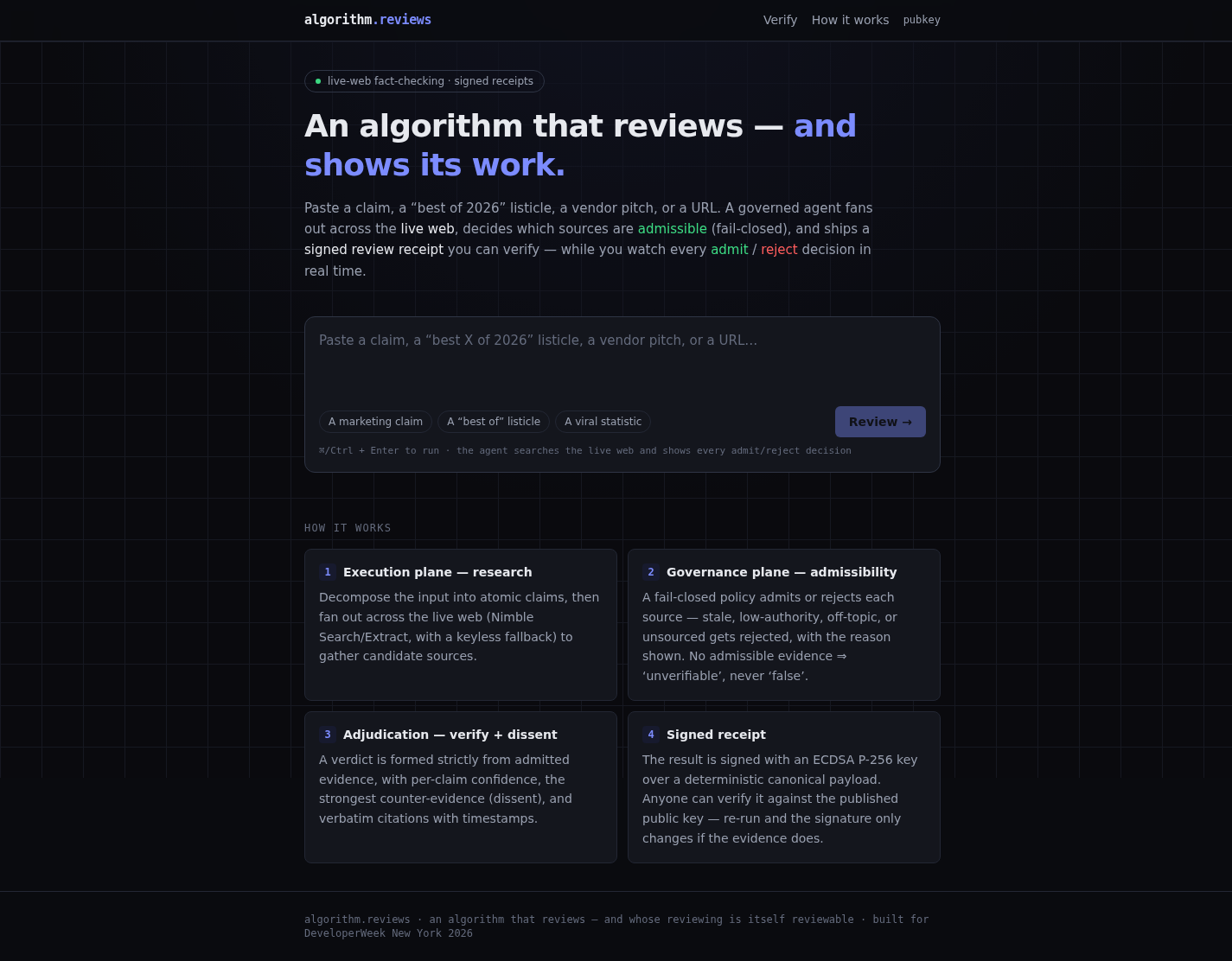
Paste a claim, listicle, or URL and a governed agent fact-checks it against the live web — then cryptographically signs the result.
-
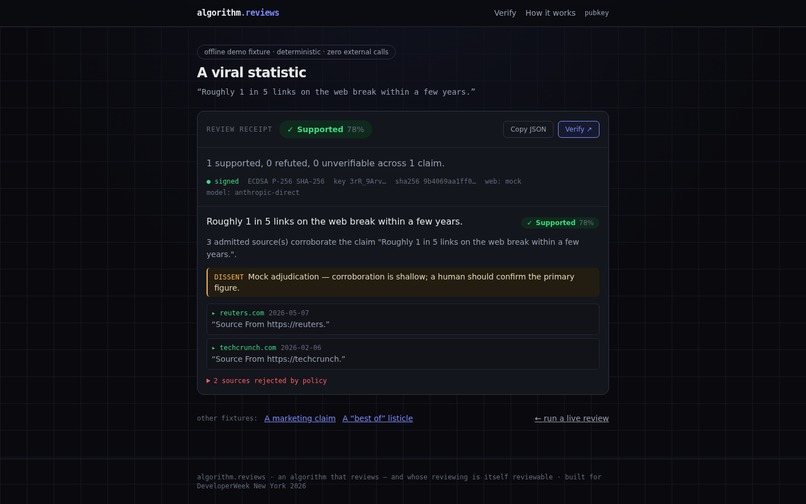
A review receipt: per-claim verdict, confidence, dissent, live citations, and the sources rejected by policy.
-
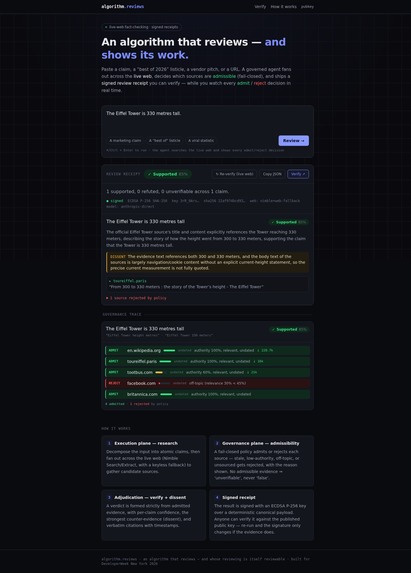
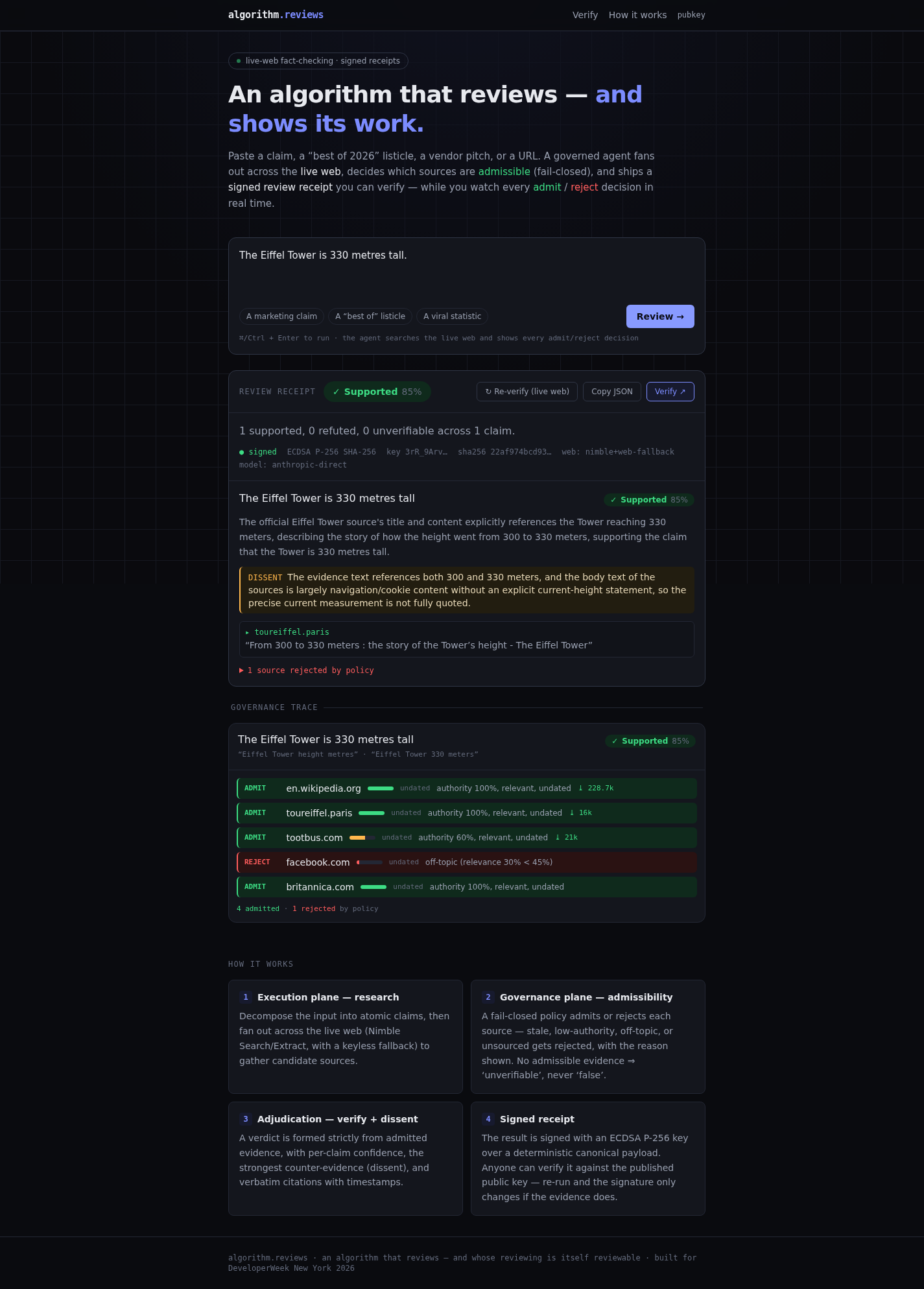
A live review: the signed "Supported 97%" receipt with timestamped citations, above the streaming admit/reject governance trace.
Inspiration
AI answers and online reviews are unauditable. You can't tell a grounded verdict from a hallucinated one; sources are stale, cherry-picked, or fabricated; and the "AI fact-checkers" meant to fix this are themselves black boxes. Anyone who has to defend a conclusion — a buyer doing due diligence, a journalist, a compliance or procurement team — is stuck with a vibe and ten open browser tabs.
We build trust infrastructure: a two-plane system where a governance plane decides what's allowed and an execution plane acts, fail-closed, with tamper-evident receipts. algorithm.reviews is that exact pattern pointed at a problem everyone has: is this claim actually true, and can I prove how I know?
What it does
Paste a claim, a "best X of 2026" listicle, a vendor pitch, or a URL. A governed agent:
- Decomposes the input into atomic, checkable claims.
- Searches the live web for each claim (Nimble Search).
- Admits or rejects each source — fail-closed. A deterministic policy rejects stale, low-authority, off-topic, or unsourced material and shows you why, live, in a green/red glass box. No admissible evidence ⇒ "unverifiable", never "false".
- Extracts the admitted sources (Nimble Extract) and adjudicates a verdict grounded only in admitted evidence — with per-claim confidence, the strongest counter-evidence (dissent), and verbatim citations with timestamps.
- Signs a review receipt with an ECDSA P-256 key. Anyone can verify it against the published public key — change a single character and the signature fails.
The result reads like an audit, not a chatbot answer: a verdict you can defend.
How we built it
- Next.js 16 (App Router) + React 19 + Tailwind v4 + TypeScript on Vercel.
- Vercel AI SDK 6 driving Anthropic Claude — Opus for adjudication, Haiku for source classification and query generation.
- Nimble as the live-web layer (Search + Extract) behind a swappable
WebProviderinterface, with a keyless Wikipedia fallback and a deterministic mock so it builds, tests, and demos offline. - Two planes, one app: an execution plane (search/extract) and a governance plane (a deterministic, unit-tested admissibility policy + the adjudicator). The model proposes signals (authority, relevance); policy, not the model, decides admission.
- Web Crypto ECDSA P-256 signing over a canonical payload that excludes volatile fields, so a re-run only changes the signature when the evidence changes.
- A streaming "glass box" of newline-delimited JSON events, hard caps in code to stay inside rate limits and the serverless budget, and 19 unit tests (governance, canonicalization, signing, UI reducer).
Challenges we ran into
- Web search doesn't work from a datacenter IP without a keyed provider. DuckDuckGo blocks Vercel's IPs and Jina's search now needs a key — exactly the problem Nimble's residential infrastructure solves. We added a keyless Wikipedia fallback so the app is never dead, and Nimble is the real upgrade.
- The governance plane was too honest at first — it correctly rejected irrelevant sources and returned "unverifiable", which exposed a search bug (raw sentences make a search index return junk). The fix was LLM keyword query generation, not loosening the policy. A fabricating fact-checker would have "found support" in that junk; ours refused.
- "Signed" has to mean signed. A bare hash is a checksum, not a signature. We implemented a real ECDSA keypair and a public verify endpoint, so a skeptical engineer can actually check it.
- Serverless ephemeral keys broke verification until we pinned a stable signing key.
Accomplishments that we're proud of
- A fact-checker that refuses to rubber-stamp — fail-closed, with a visible admit/reject trail.
- Receipts that are independently verifiable and tamper-evident: flip a verdict or a quote and the signature fails, live.
- Real verdicts on live data — true claims → supported, false claims → refuted, thin or conflicting evidence → unverifiable.
- One build that legitimately stacks three challenges without feeling forced.
What we learned
Make the governance the product, not the answer — the admit/reject reasoning is what makes a verdict trustworthy. Determinism is a feature: a signature that only changes when evidence changes is a liveness proof you can demo. And graceful degradation (swappable providers, mock mode, offline fixtures) is what lets a live demo survive contact with a stage.
What's next for algorithm.reviews — The Agent Trust Layer
Nimble Crawl/Map for deep multi-page evidence and per-source provenance scoring; a callable MCP server so other agents can use the verifier as a fail-closed gate; shareable receipt permalinks and an org-level policy console with tunable admissibility thresholds; and a "watch this claim" mode that re-verifies on a schedule.
Built With
- anthropic-claude
- ecdsa
- next.js
- nimble
- react
- tailwind-css
- typescript
- vercel
- vercel-ai-sdk
- web-crypto
- wikipedia-api

Log in or sign up for Devpost to join the conversation.