Inspiration
Algorithms are normally presented as static equations, diagrams, or lines of code. I wanted to explore a different question: what if an algorithm felt like a place you could enter?
Algorithm Mind Lab was inspired by astronomy, orbital mechanics, experimental laboratories, and the fluid way computational systems continuously search for balance. Instead of explaining intelligence through a conventional dashboard, I imagined it as a neon deep-space research facility where thought becomes something spatial, luminous, and alive.
What it does
Algorithm Mind Lab is an interactive 3D experience that transforms abstract computational processes into a living cosmic laboratory.
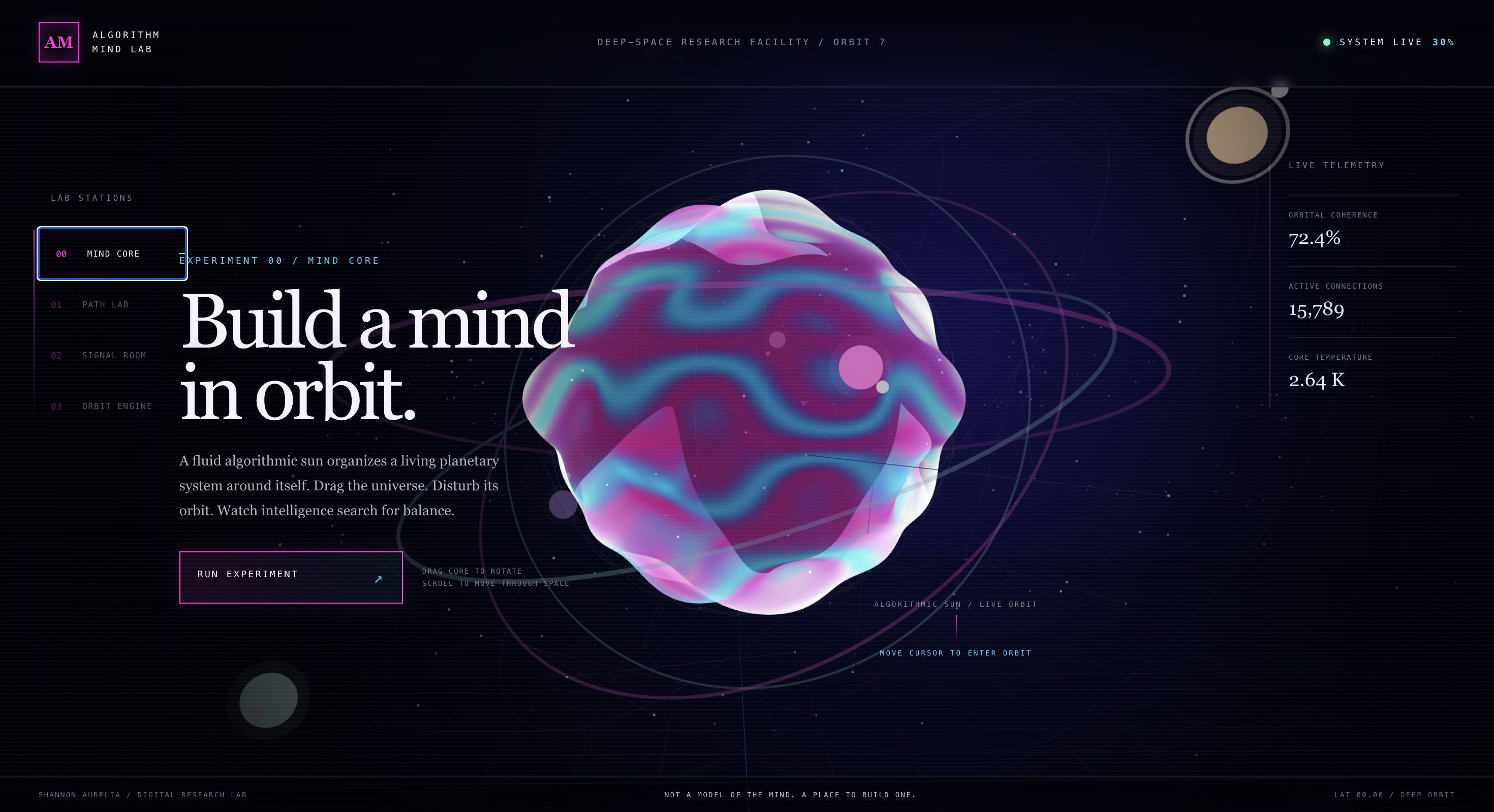
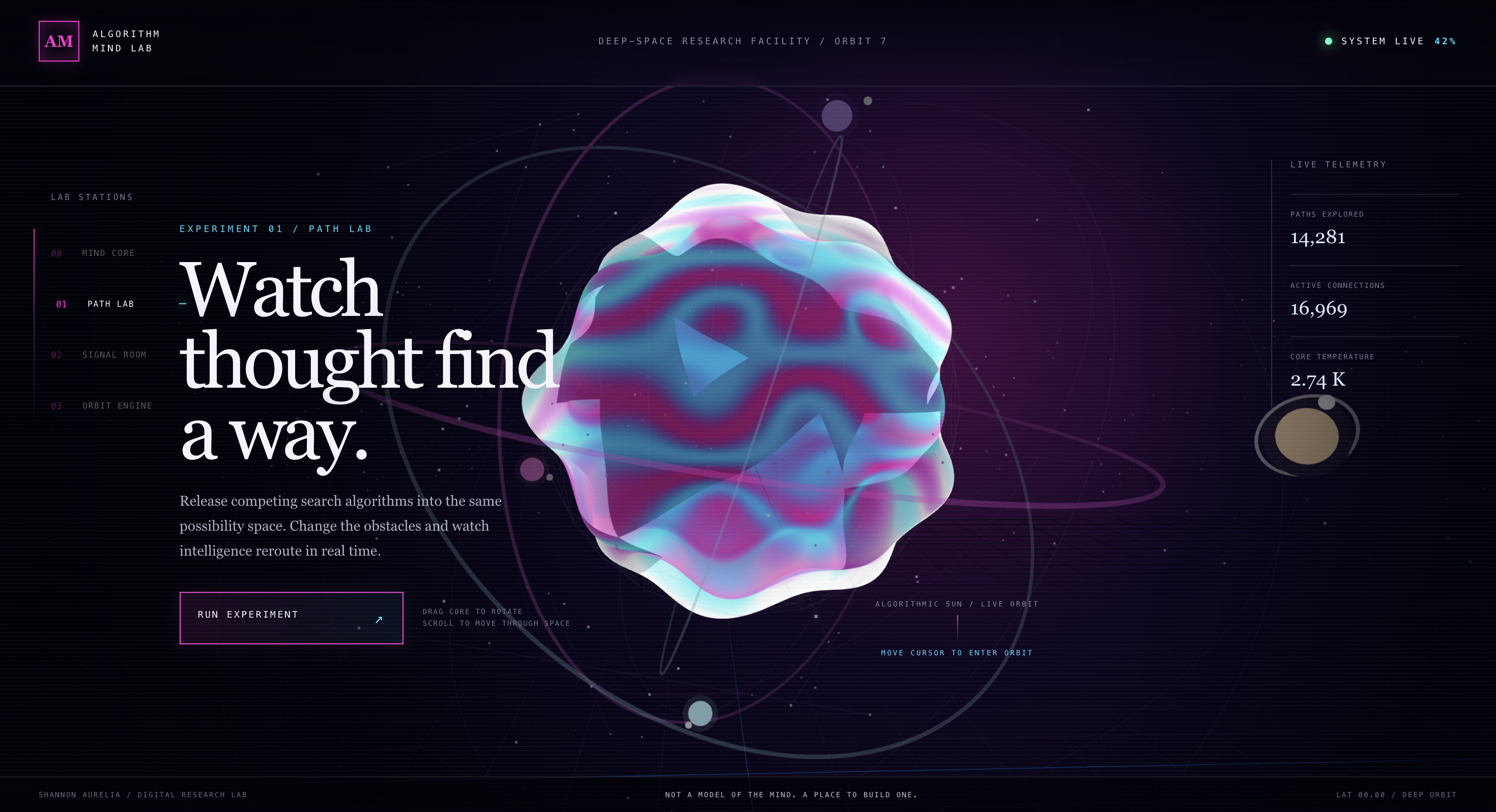
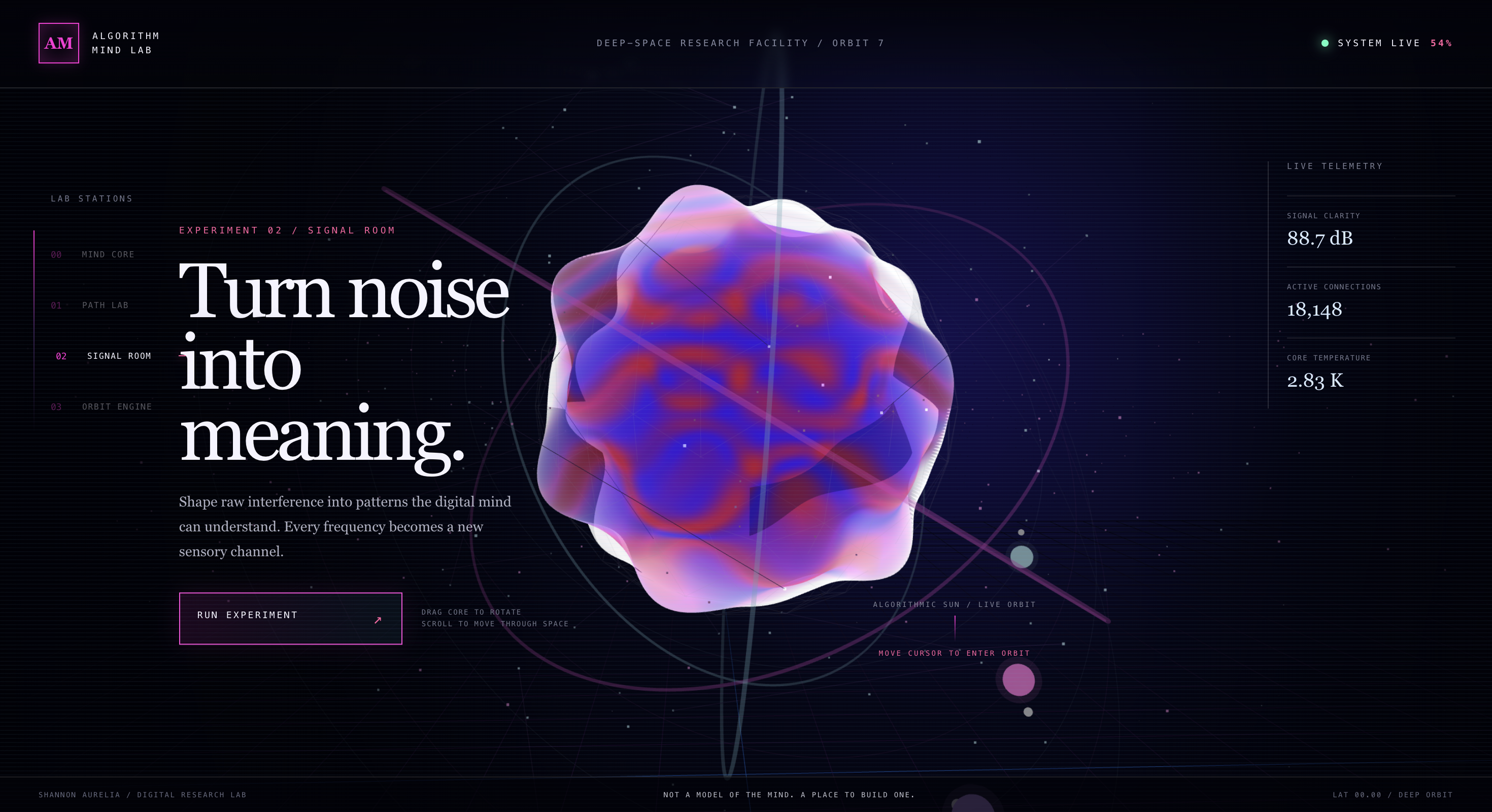
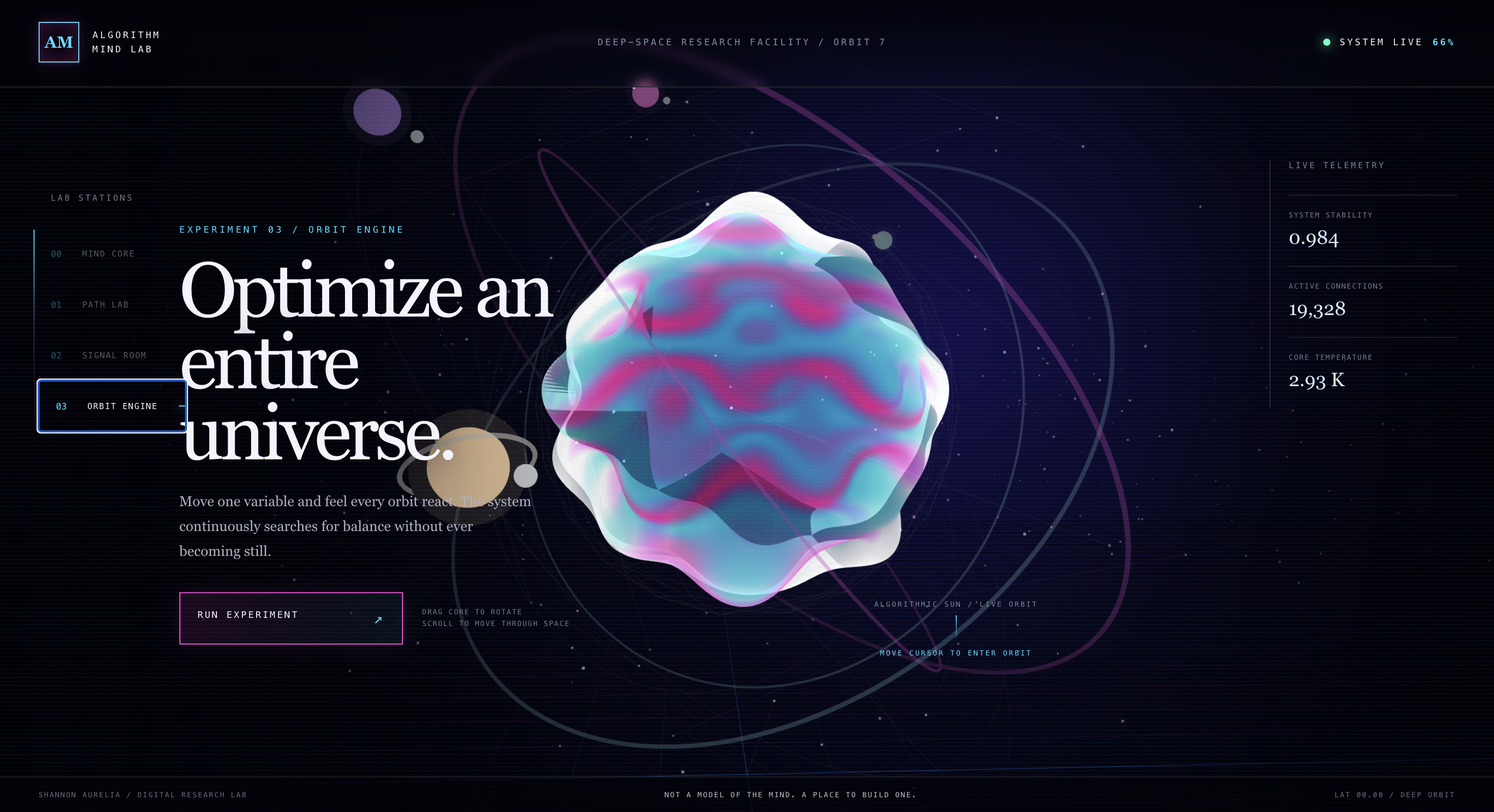
At the center is a continuously deforming algorithmic sun surrounded by five tilted orbital systems, moving planets, a moon, a ringed planet, circulating signals, and a deep traveling star field.
Visitors can explore four experimental stations:
Mind Core presents intelligence as a fluid system organizing a universe around itself.
Path Lab visualizes the process of thought searching, rerouting, and finding a way through possibility space.
Signal Room explores how noise can be transformed into patterns and meaning.
Orbit Engine presents optimization as an interconnected universe in which changing one variable affects the entire system.
The environment is not a static image or prerecorded video. Visitors can drag to rotate the universe, scroll to travel through space, hover over the core to disturb its gravity field, switch between laboratory stations, and run experiments that change the system’s computational activity, colors, movement, and energy.
How I built it
I built Algorithm Mind Lab with Next.js, React, TypeScript, Three.js, WebGL, and custom GLSL shaders.
Three.js manages the 3D environment, orbital systems, particles, lighting, raycasting, camera movement, and pointer interactions. Custom shader code generates the fluid central core and its evolving pink, magenta, and cyan energy field.
The interface uses responsive CSS for the laboratory navigation, live telemetry, scan lines, transitions, typography, and experimental result panels. I also created an animated fallback so the visual concept remains accessible in environments where WebGL is unavailable.
Challenges I ran into
The greatest challenge was making the experience feel fluid and alive without sacrificing clarity.
The universe needed to respond to dragging, scrolling, hovering, station changes, and experimental activity while still behaving like an understandable website. Balancing cinematic movement with usable navigation required careful decisions about composition, camera behavior, animation speed, contrast, and visual hierarchy.
Another challenge was making 3D an essential part of the experience instead of using it as a decorative background. Every major interaction therefore affects the laboratory’s universe directly.
Accomplishments that I’m proud of
I am especially proud that Algorithm Mind Lab feels like a digital instrument from an imagined future rather than a conventional website with a 3D object placed inside it.
The laboratory controls and the universe are connected. When visitors change an experiment, the movement, color, activity, and energy of the system respond with it.
I am also proud of the contrast between the clean editorial interface and the complex orbital environment. The restrained typography and negative space allow the luminous core to remain the visual focus while still giving visitors meaningful controls and telemetry.
What I learned
Building Algorithm Mind Lab taught me that interaction design can communicate abstract technical ideas emotionally.
Algorithms do not always need to be represented through code, flowcharts, or numerical graphs. Motion, light, spatial depth, orbit, and responsive behavior can make computation feel intuitive and memorable.
I also learned how important restraint is in immersive design. A visually complex 3D environment becomes more powerful when it is supported by a clean interface and a clear interaction language.
What’s next
The next version could allow visitors to construct their own orbital algorithms, compare search strategies visually, create planets from code, and save experiment states as shareable computational worlds.
I would also like to develop more educational experiments in which orbital relationships represent real graph algorithms, optimization processes, signal systems, and models of intelligent decision-making.

Log in or sign up for Devpost to join the conversation.