-
-
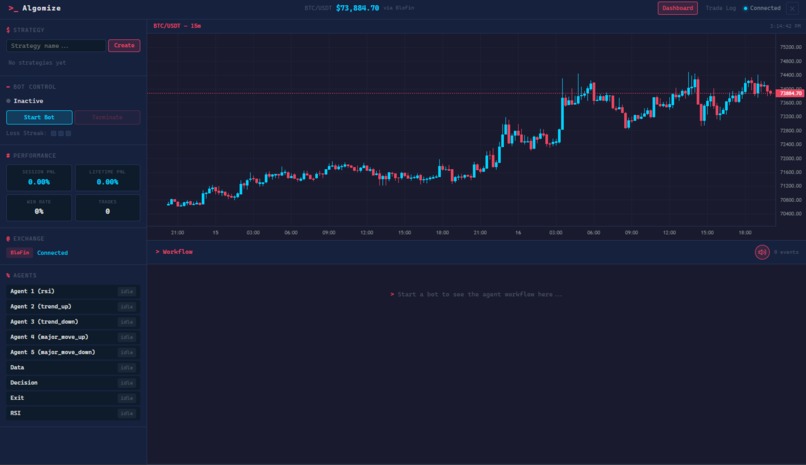
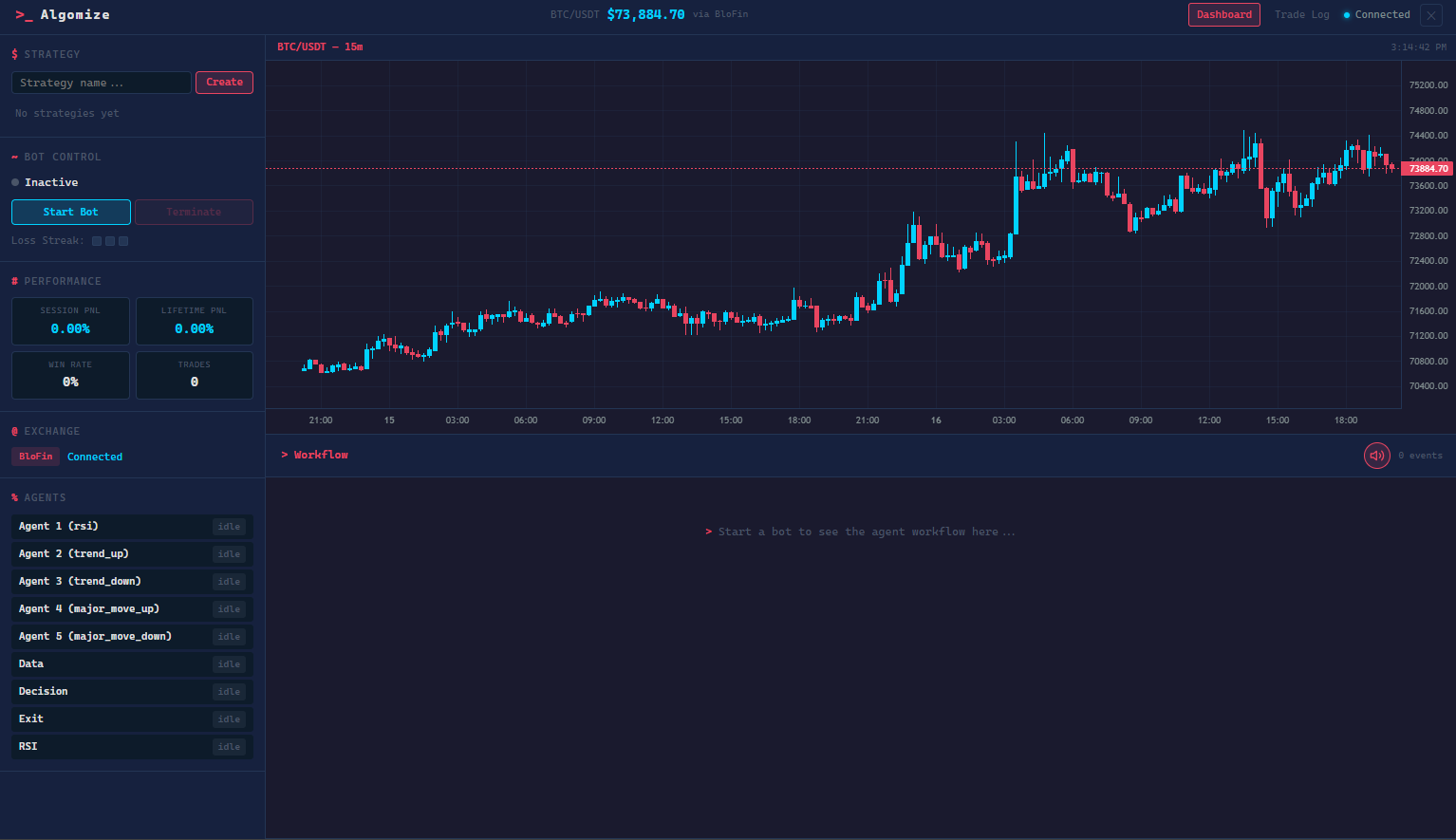
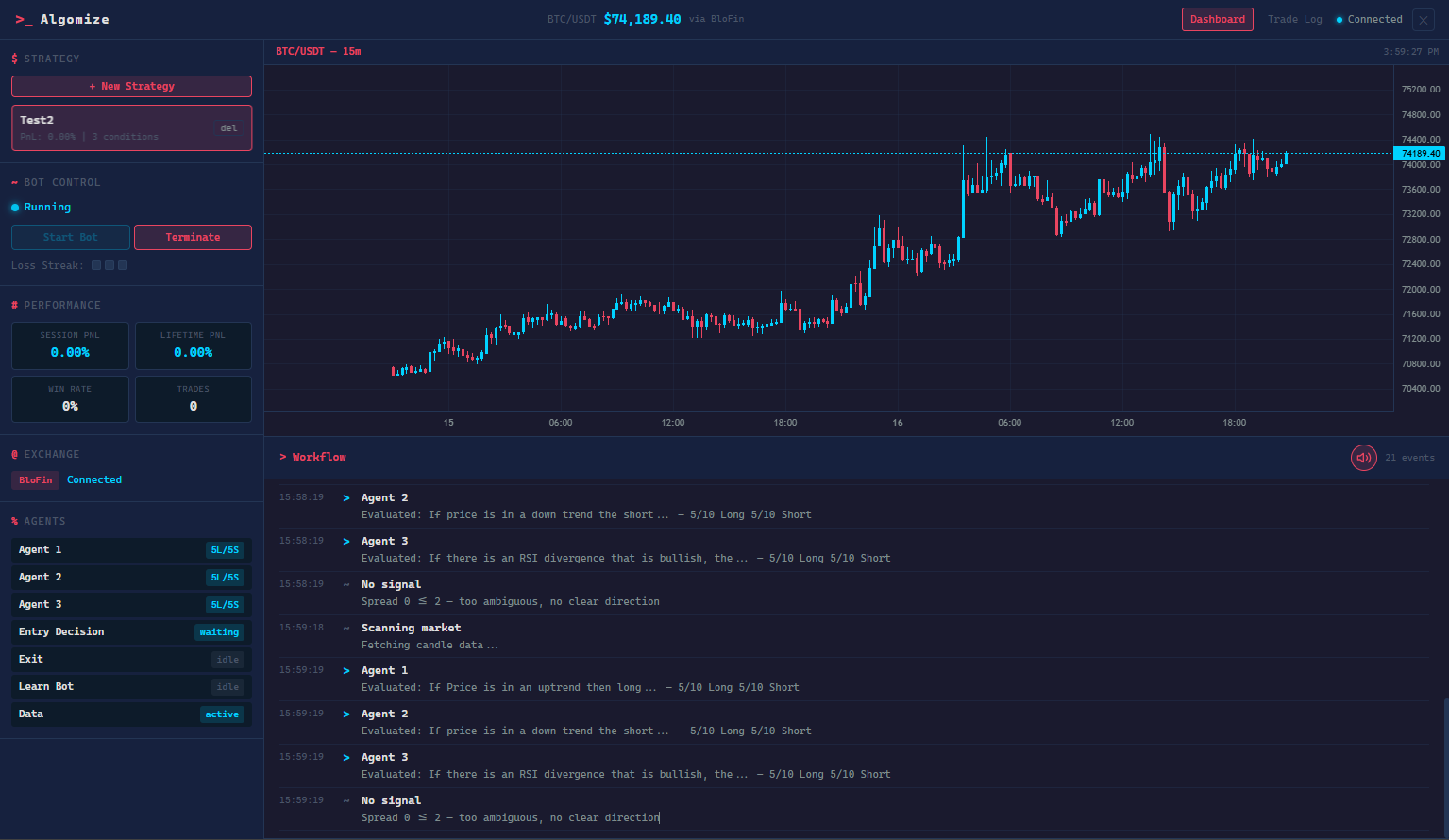
What the main trading dashboard looks like to a user
-
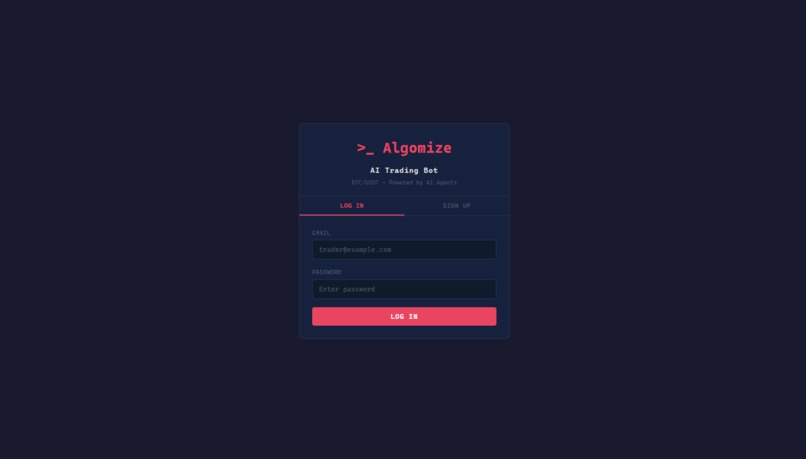
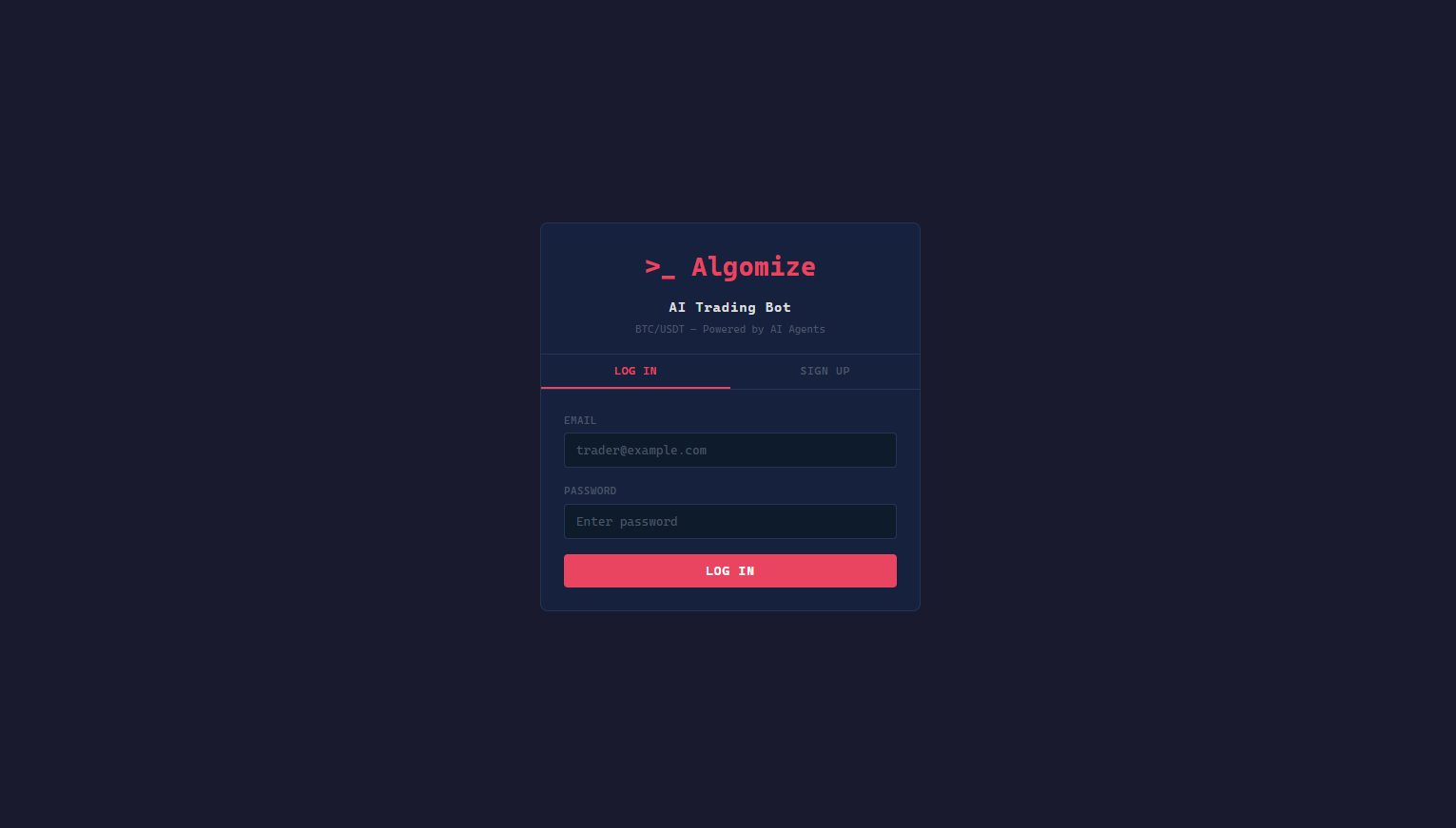
User Log-in Page
-
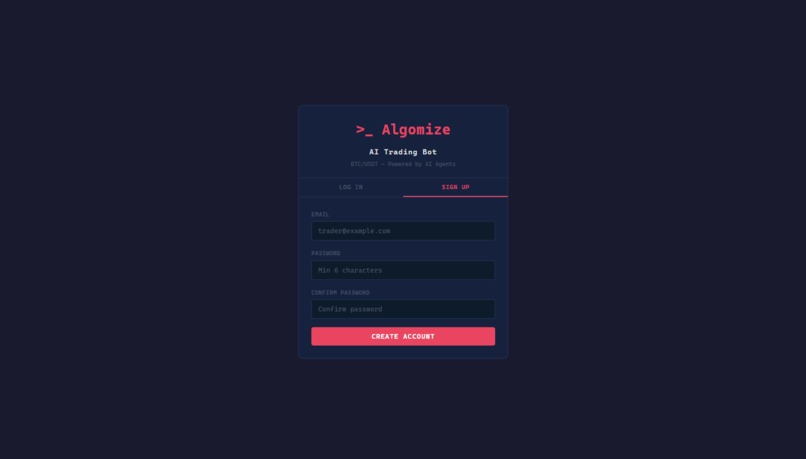
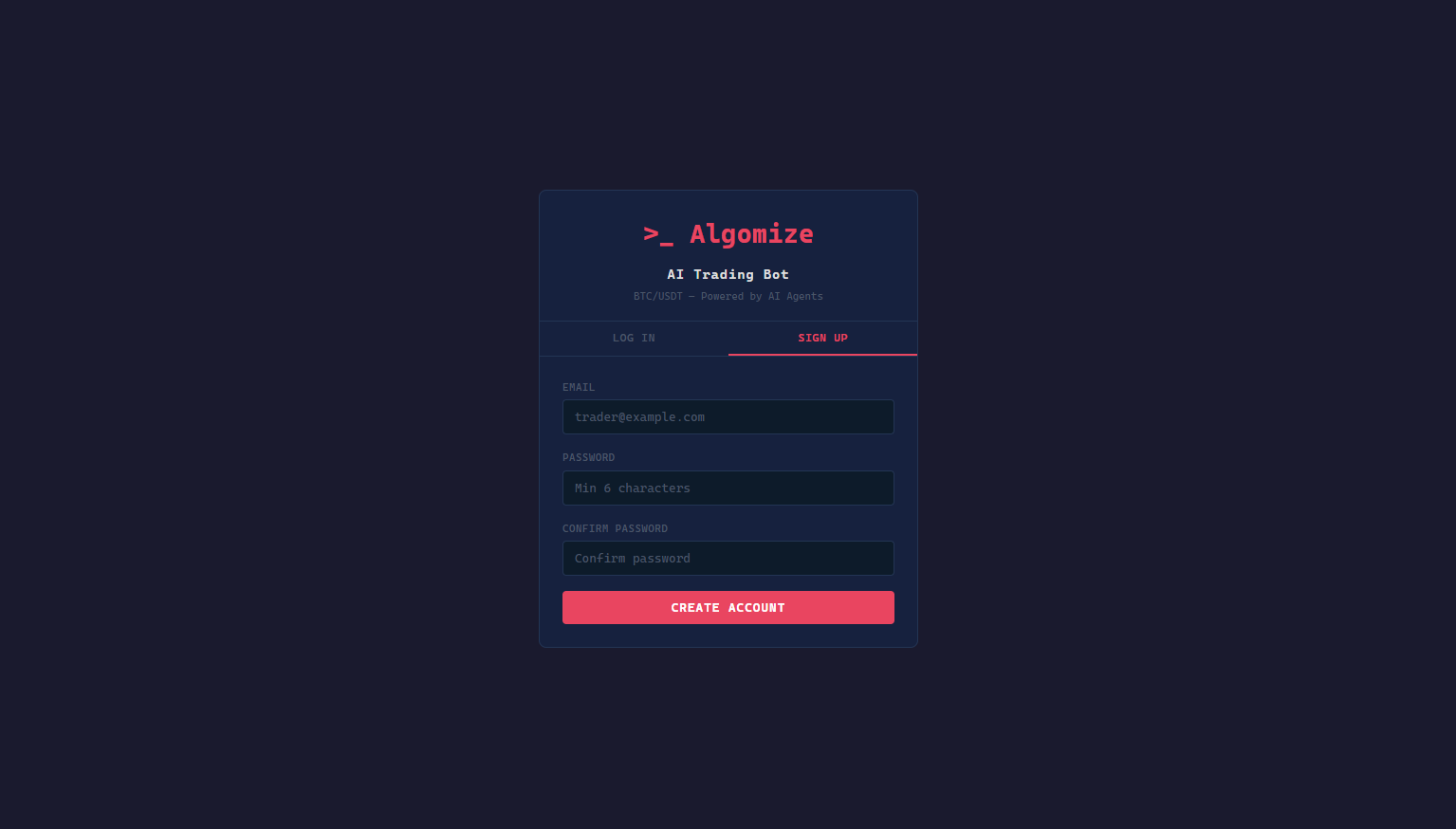
User Sign-up Page
-
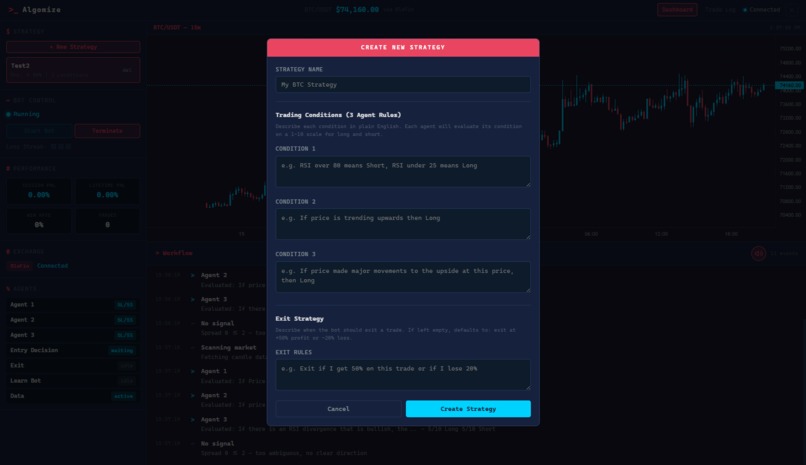
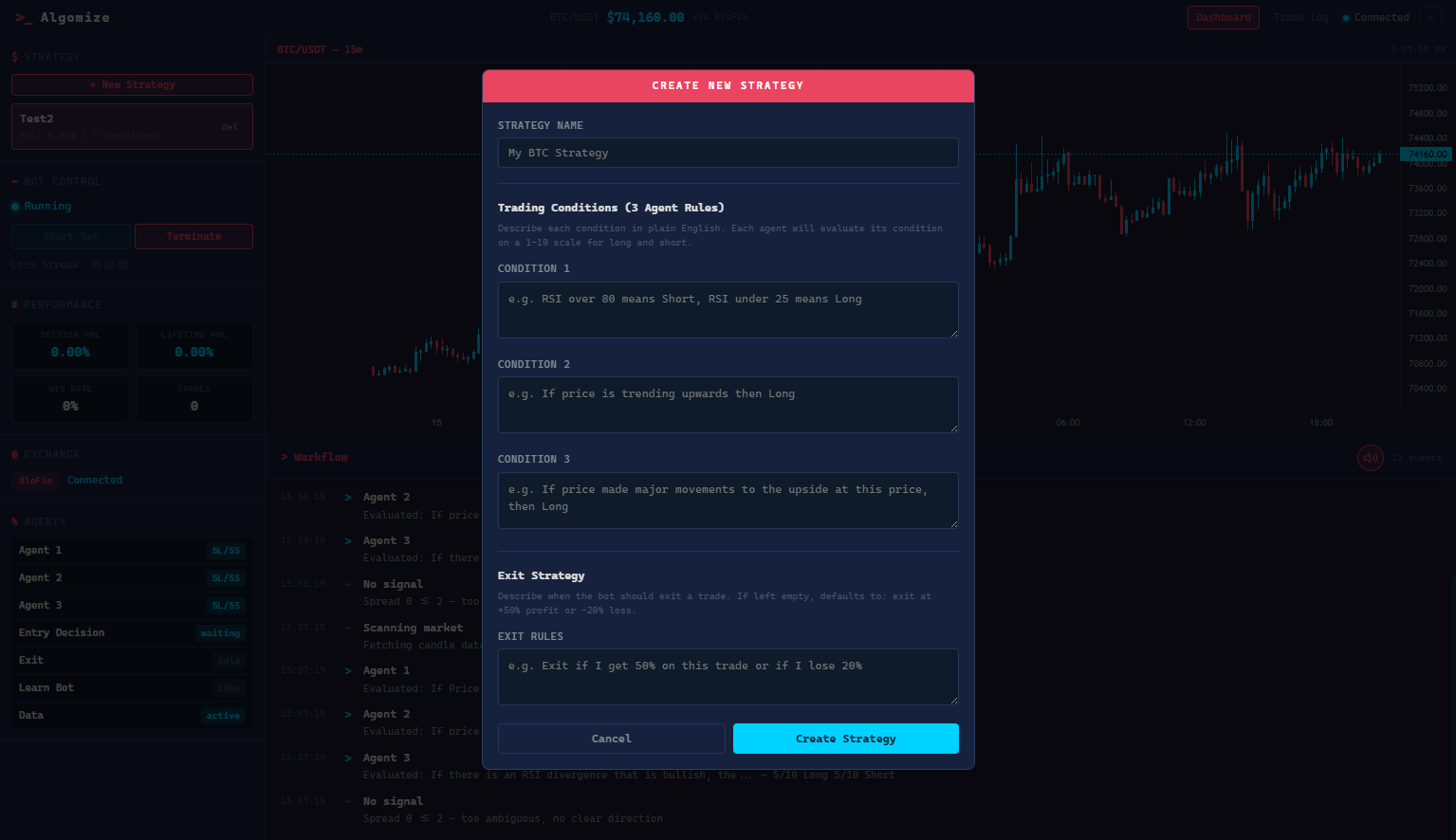
Trading Strategy Creation
-
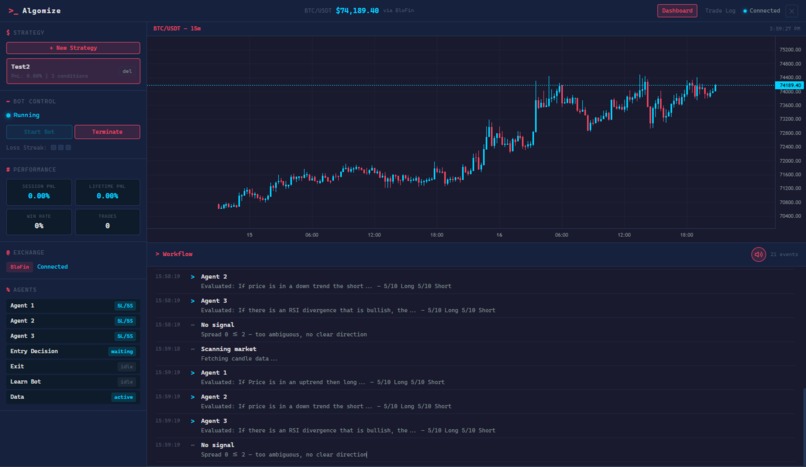
Active Trading Strategy Workflow
-
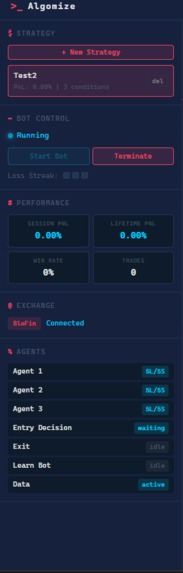
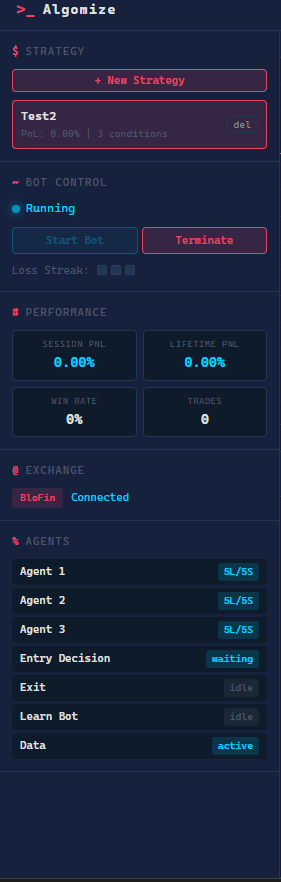
Trading Strategies, Strategy Performance, Connection to Blofin Exchange, and Currently Active Agents
-
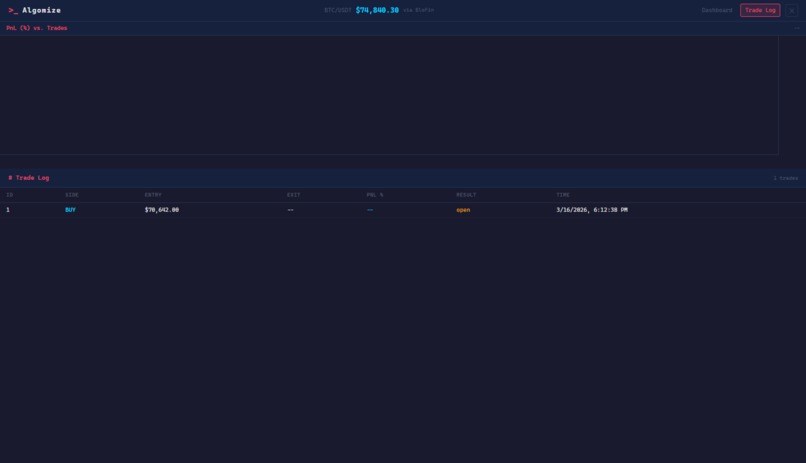
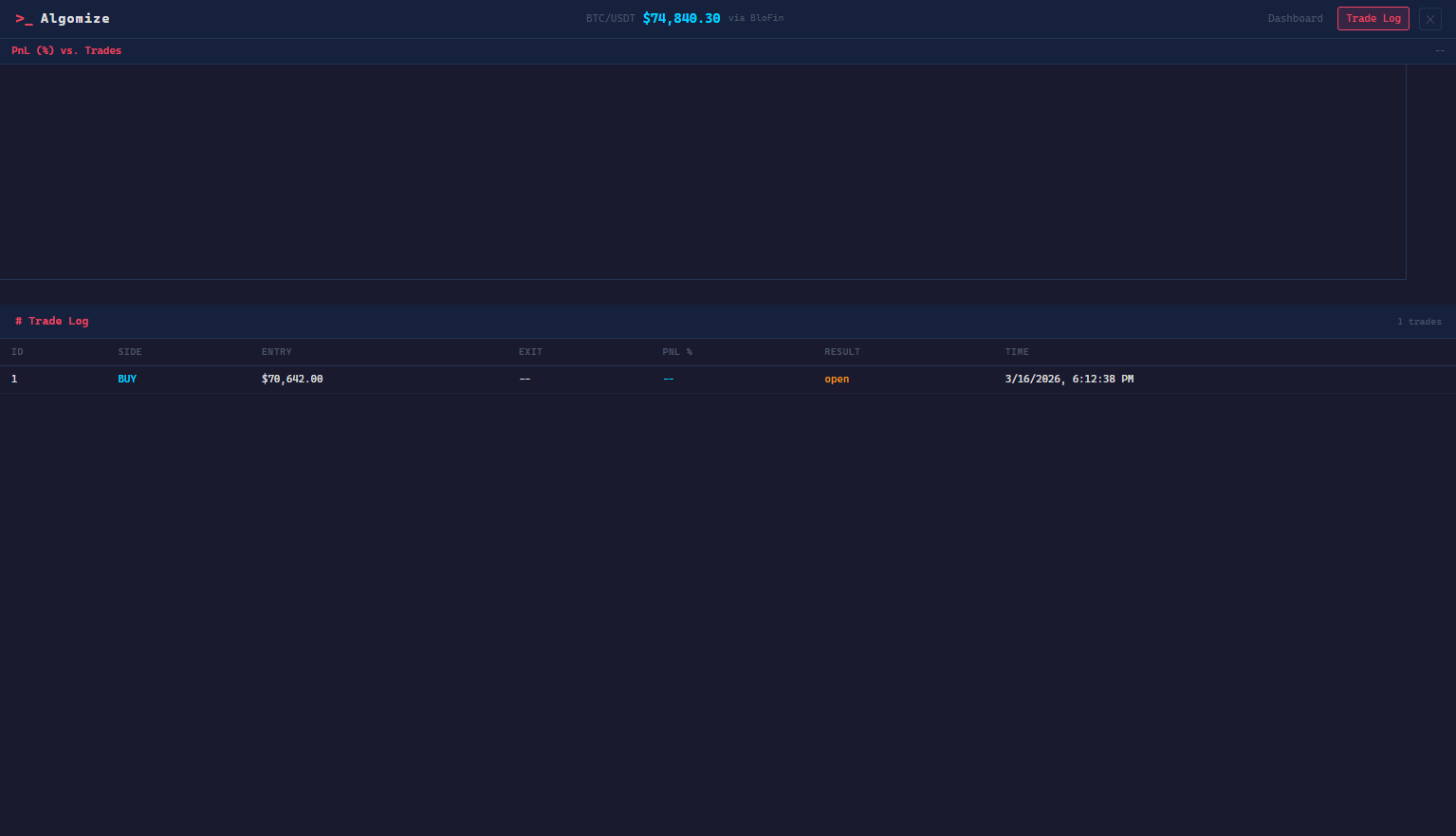
Trades and PNL vs. Trades Line chart (no chart generated yet because only one trade was made and is still running)
Inspiration
I was inspired to build Algomize because of the lack of effective high-frequency trading applications that use AI-powered agents to make meaningful, strategy-specific insights. Many trading bots and algorithms are prone to failure — a strategy might stop working, the bot can't learn from past trades, and it will always follow a fixed ruleset that never adapts, making it vulnerable to the volatile markets of Bitcoin and equities. As a hobby, I have a strong interest in high-frequency trading across Bitcoin, the S&P 500, and other instruments, which led me into fields like AI and quantitative finance, and ultimately to the creation of this project.
What it does
Algomize is an AI-powered Bitcoin (BTC/USDT) trading bot that lets users define trading strategies in plain English. Users create a strategy by describing three market conditions (e.g., "RSI over 80 means Short") and an exit rule (e.g., "Exit at 50% profit or 20% loss"). Three AI condition agents evaluate each rule against live market data on a 1–10 scale for both long and short positions. An entry decision agent aggregates the scores and only opens a trade when conviction is high. An exit agent parses the user's natural-language exit strategy to manage take-profit and stop-loss. After each trade closes, a learn agent analyzes the trade history and generates insights to help refine the strategy over time. The entire system runs on a 60-second workflow loop against live BTC/USDT data from BloFin, with a real-time dashboard featuring candlestick charts, agent workflow logs, performance metrics, and an AI voice analysis powered by ElevenLabs.
How we built it
We built Algomize with a Node.js/Express backend following an MVC architecture, backed by PostgreSQL for persistent storage of users, strategies, and trades. The AI agents are powered by Amazon Nova Lite via AWS Bedrock, which evaluates market conditions using live price data, technical indicators (RSI, EMA, support/resistance), and ASCII chart representations. The frontend is a terminal-themed single-page dashboard using TradingView Lightweight Charts for candlestick rendering and Socket.io for real-time updates. Authentication is handled through JWT with bcrypt password hashing. The BloFin exchange API and WebSocket feed provide live market data and trade execution. ElevenLabs provides text-to-speech for an AI voice summary of the current market analysis. The API is fully documented with Swagger.
Challenges we ran into
One of the biggest challenges was designing an AI agent architecture that could reliably interpret open-ended, user-written trading conditions. Getting Amazon Nova to consistently return structured JSON scores from natural-language prompts required careful prompt engineering and robust fallback logic. Database schema migration was another hurdle, evolving the schema while preserving existing data required implementing ALTER TABLE ADD COLUMN IF NOT EXISTS patterns with auto-migration on server startup. Coordinating seven agents in a real-time 60-second loop while handling edge cases like partial AI failures, WebSocket disconnections, and concurrent trade states also required careful state management in the orchestrator.
Accomplishments that we're proud of
We're proud of building a system where anyone can describe a trading strategy in plain English and have AI agents autonomously evaluate and execute it against live markets. The learn agent's ability to analyze trade history and generate actionable insights creates a feedback loop that makes the system smarter over time, something most trading bots completely lack. The natural-language exit strategy parser that converts phrases like "exit if I get 50% or lose 20%" into actual trade management logic is a feature we're particularly proud of. The polished, terminal-themed UI with real-time agent workflow visualization also brings transparency to what the AI is doing at every step.
What we learned
We learned how to architect a multi-agent AI system where each agent has a specific role and the orchestrator coordinates them into a cohesive workflow. We gained hands-on experience with AWS Bedrock and prompt engineering for structured outputs, real-time WebSocket data streaming, and integrating multiple third-party APIs (BloFin, ElevenLabs, AWS) into a single application. We also learned the importance of fallback mechanisms, every AI call has a deterministic fallback so the system remains functional even when external services are unavailable.
What's next for Algomize
Next, we plan to expand beyond BTC/USDT to support multiple trading pairs and asset classes. We want to enhance the learn agent to automatically adjust strategy parameters based on its analysis, creating a truly self-improving system. Adding backtesting capabilities so users can test their plain-English strategies against historical data before going live is a high priority. We also plan to support more AI model providers, add a mobile-responsive interface, and build a strategy marketplace where users can share and discover community-created strategies.
Built With
- amazon-nova-2-lite
- blofin
- css
- elevenlabs
- express.js
- html
- javascript
- node.js
- postgresql
- swagger


Log in or sign up for Devpost to join the conversation.