-
-
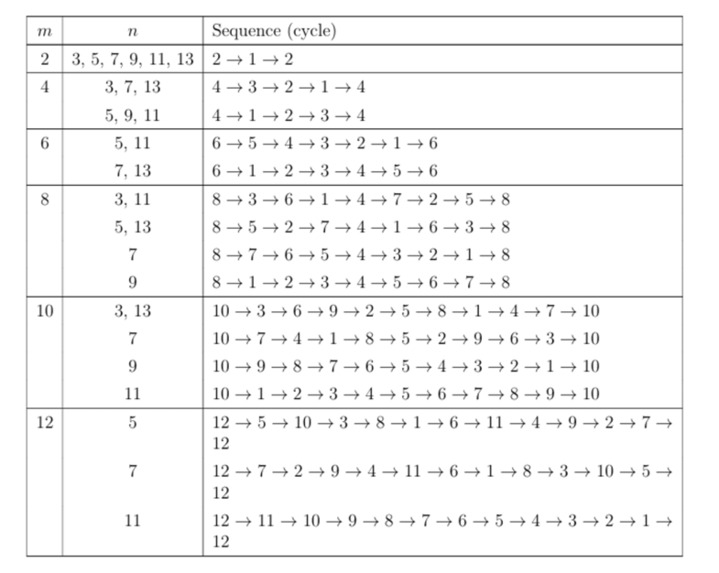
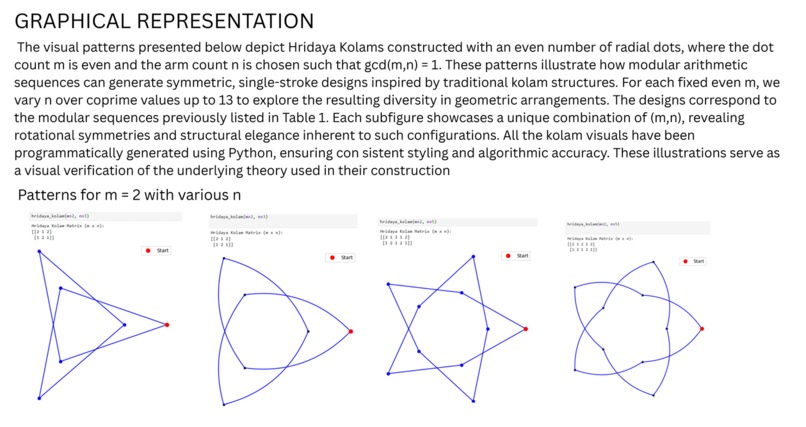
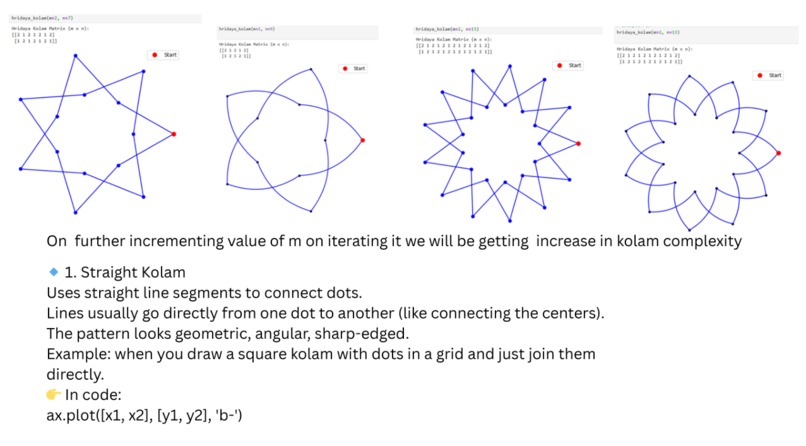
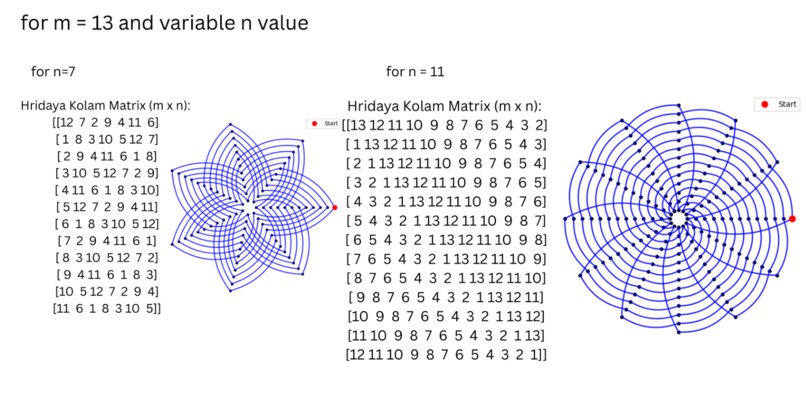
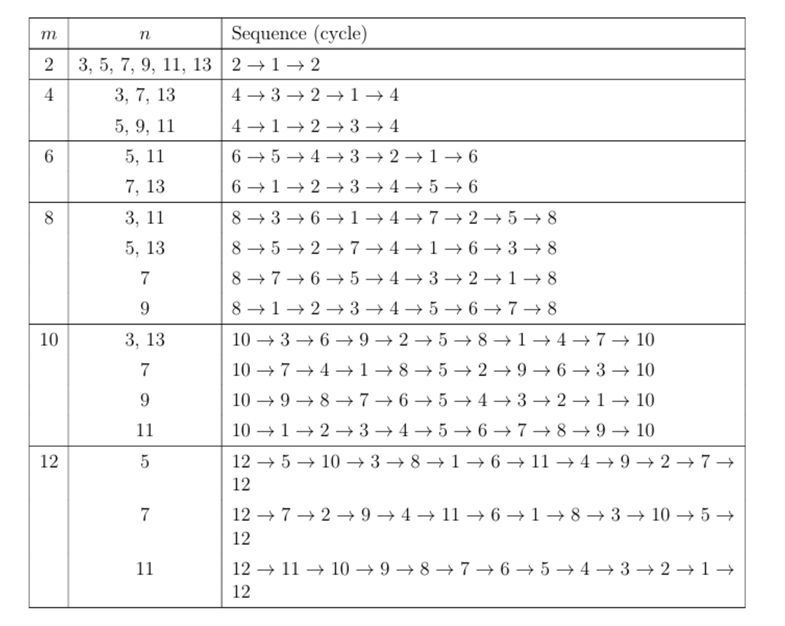
sequences generated for various m and n . The final term is made identical to the initial one to ensure looping of the design.
-
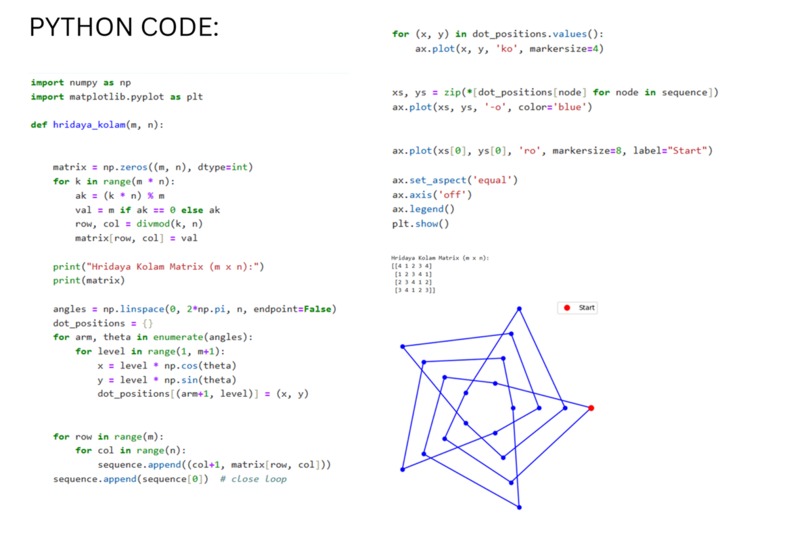
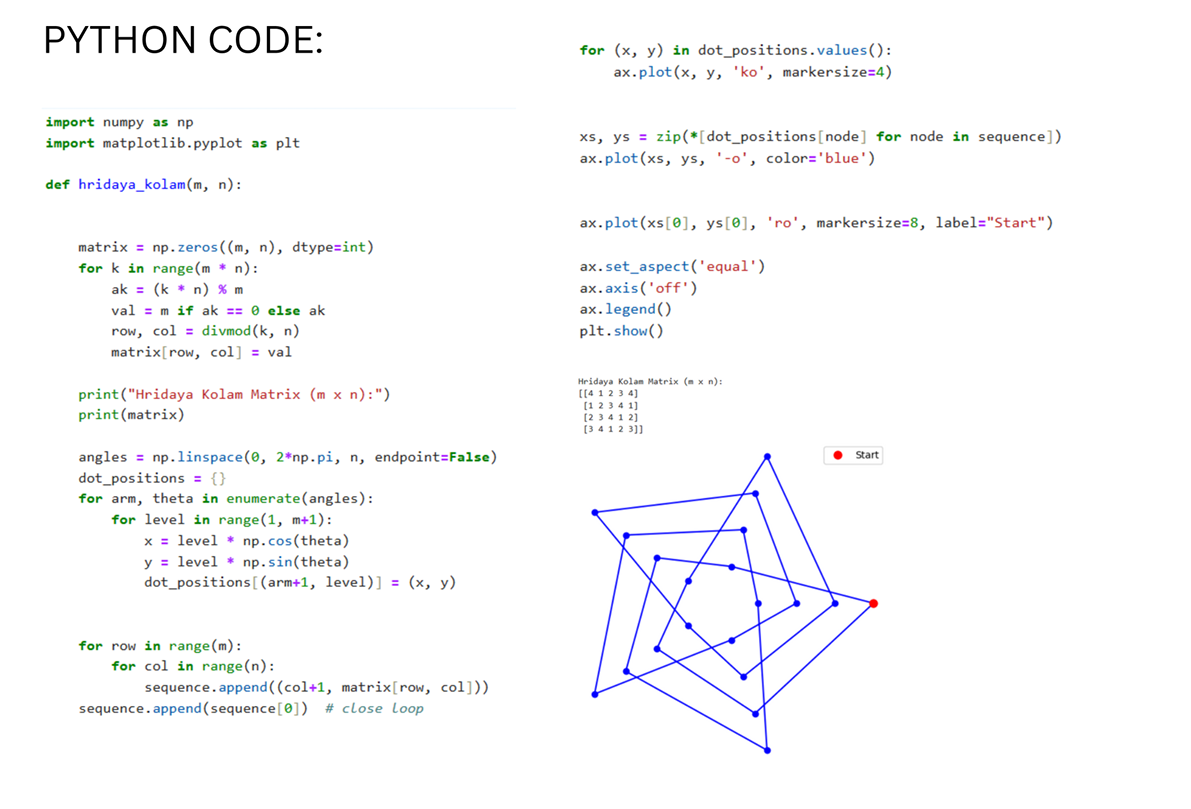
code for straight line hridaya kolam patterns
-
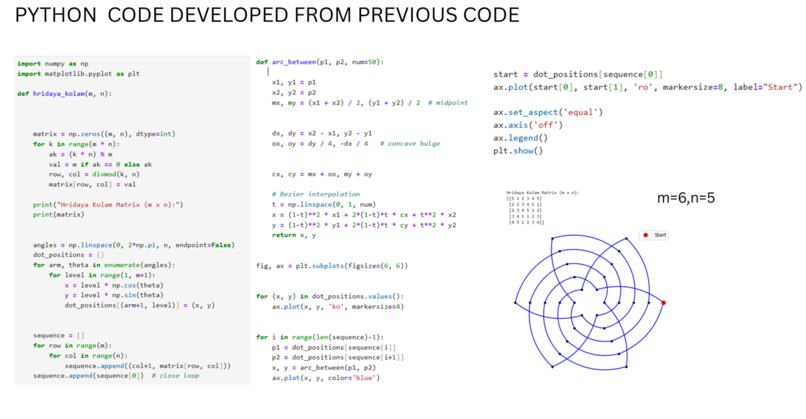
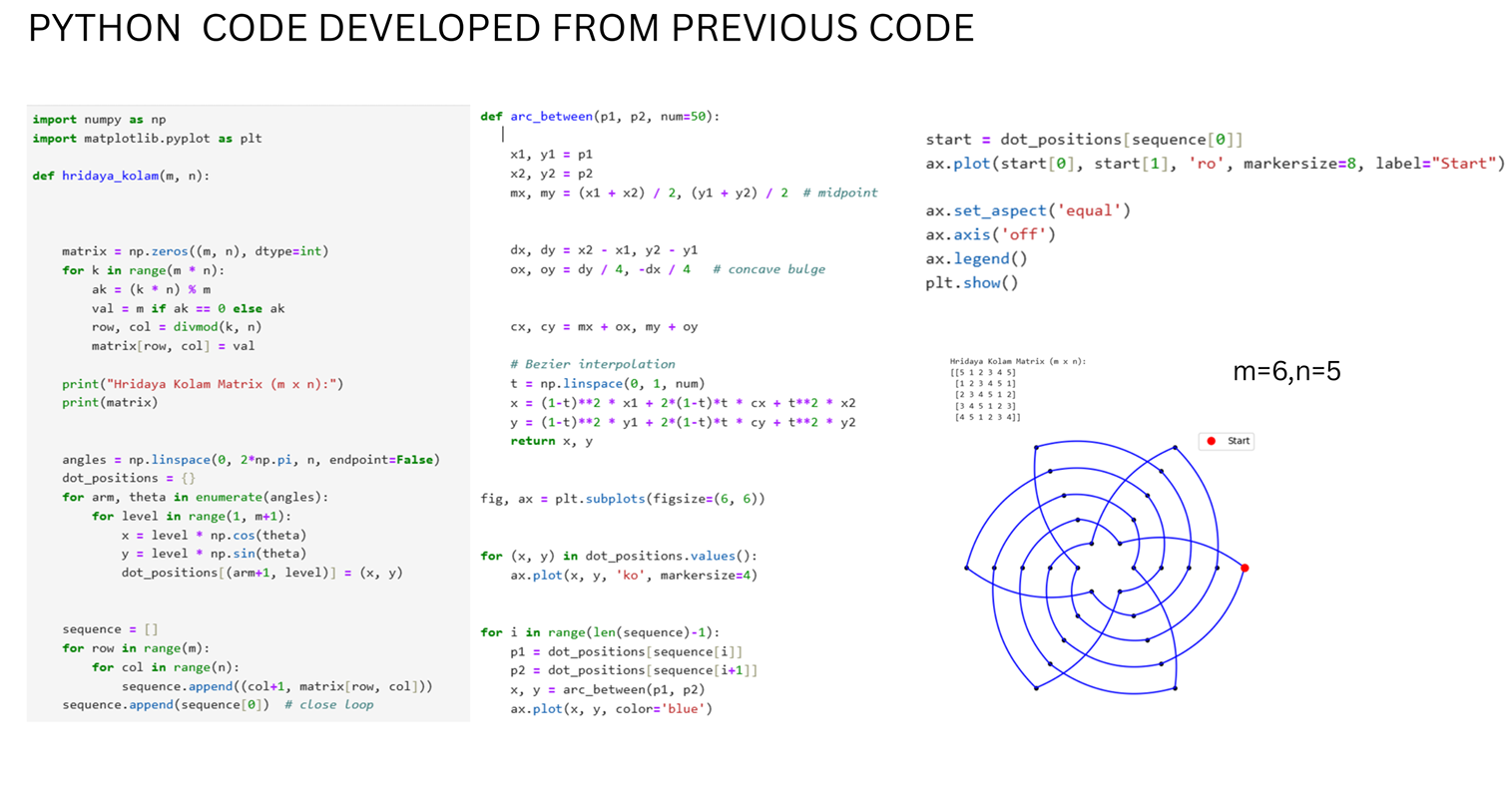
code for curved line hridaya kolam patterns
-
-
-
-
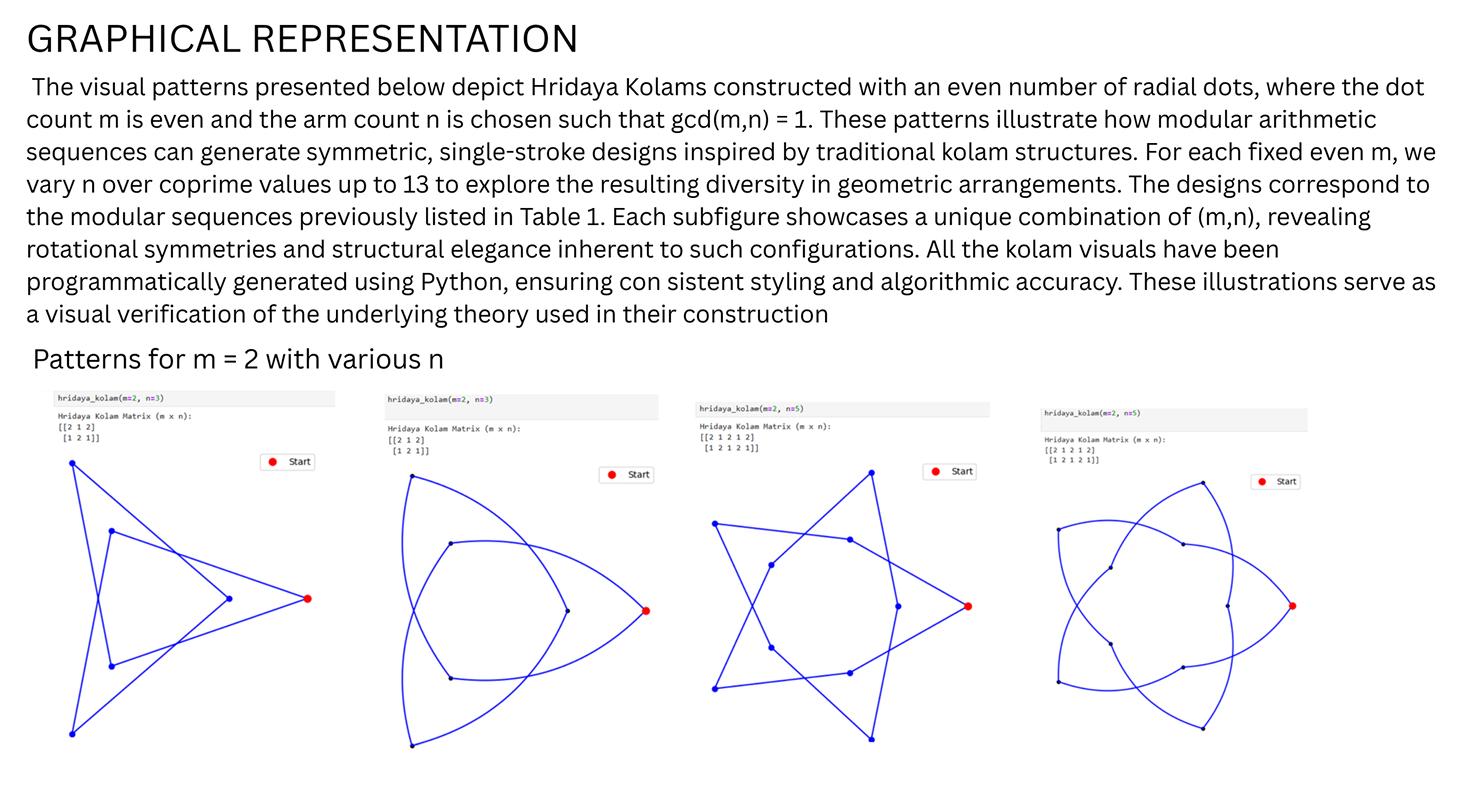
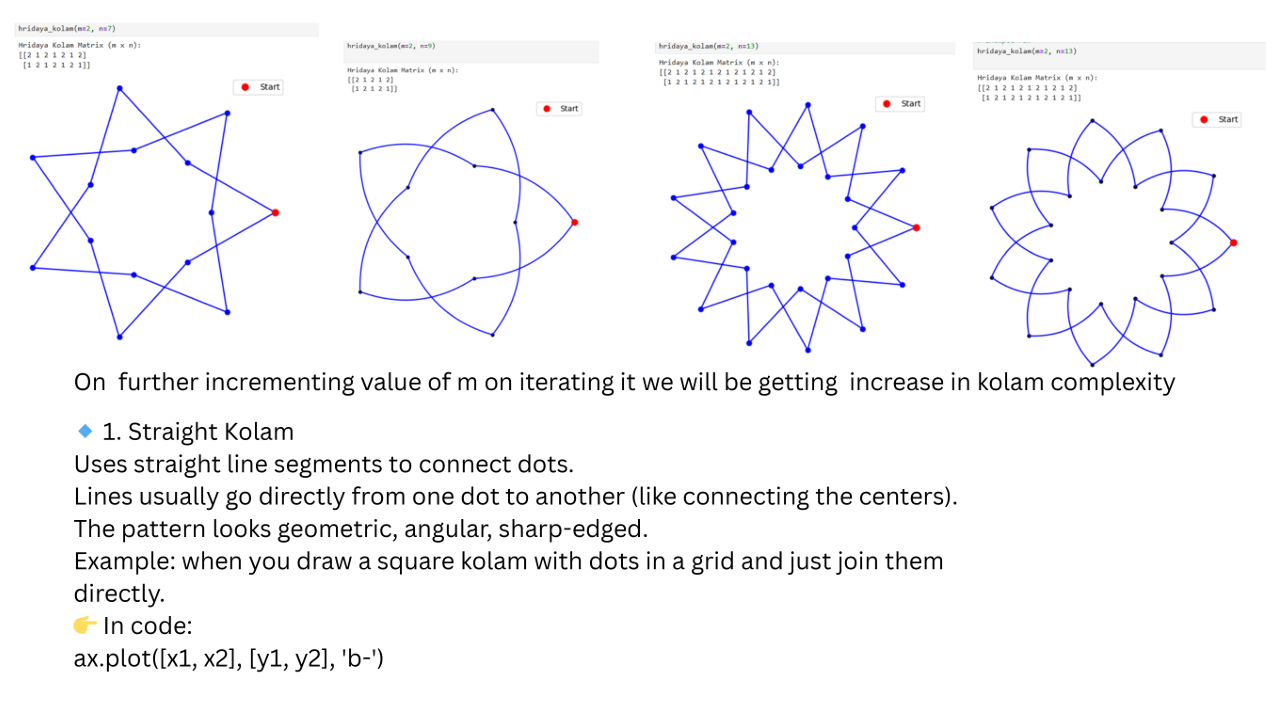
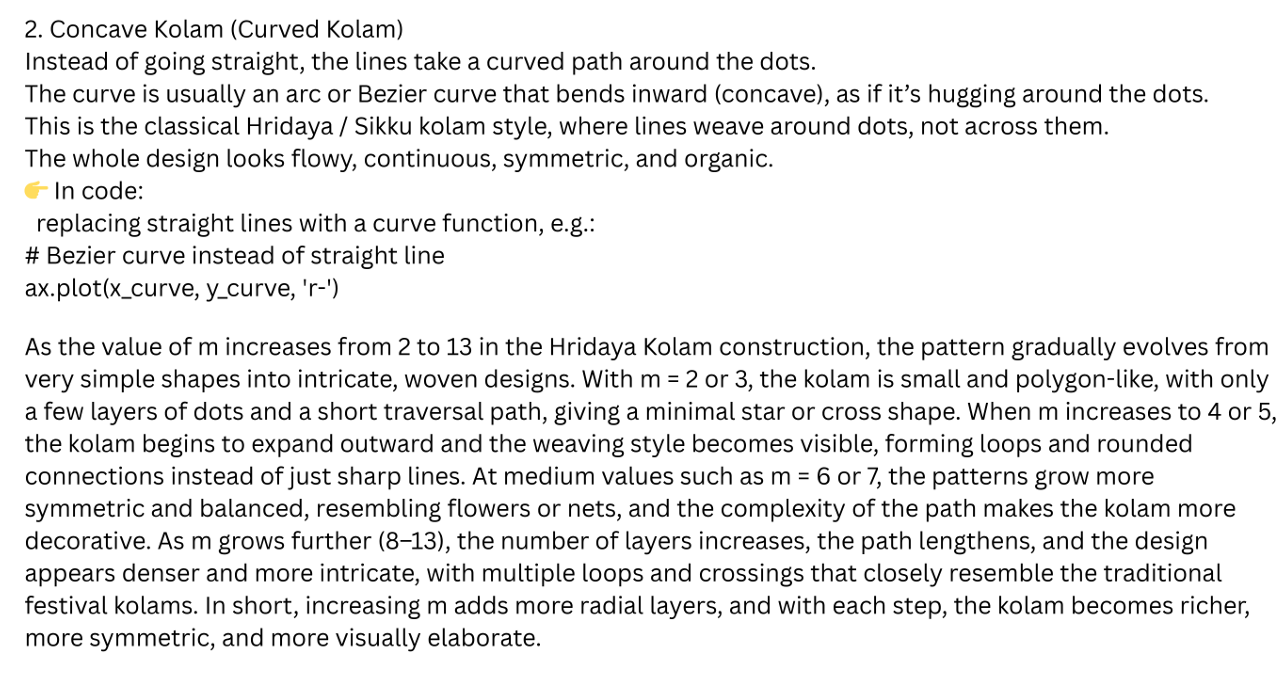
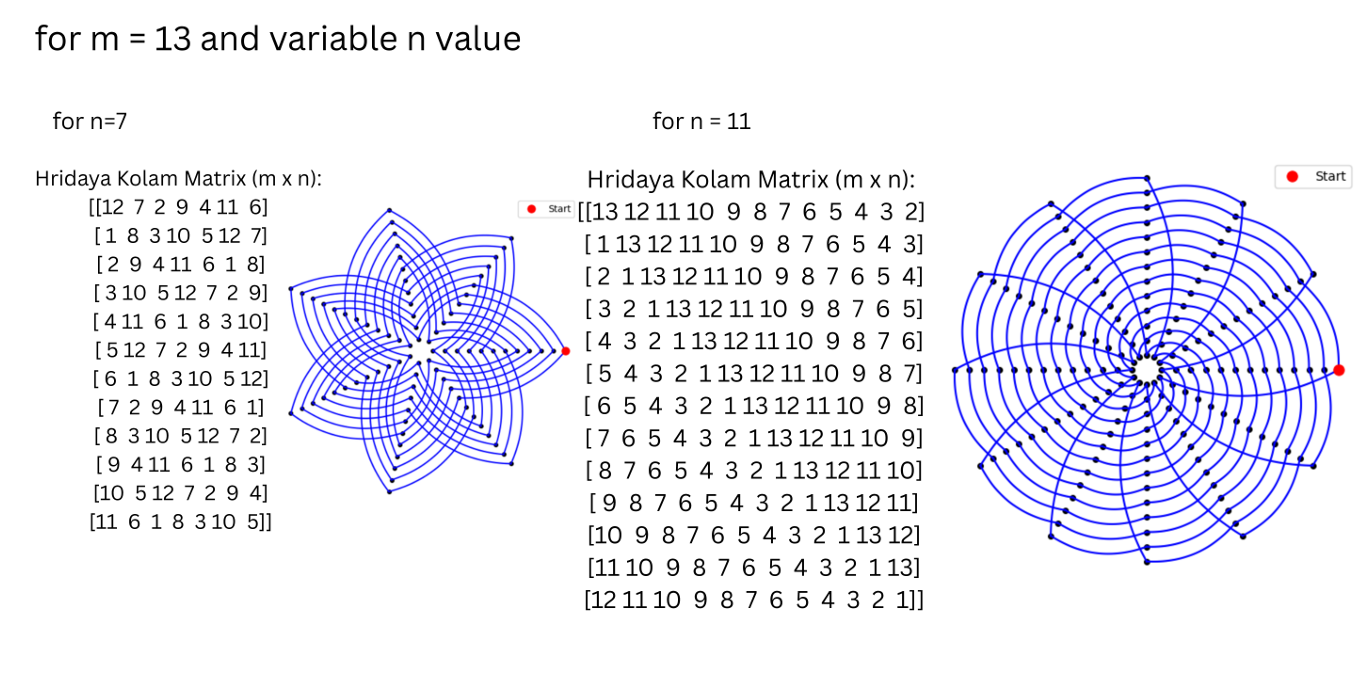
Inspiration
Kolam is one of the oldest living mathematical art forms practiced across South India. Traditionally drawn using rice flour and symmetric dot patterns, Kolams represent harmony, continuity, geometry, and cultural identity. However, with modernization and reduced daily practice, many traditional Kolam styles are slowly fading from collective memory.
We were inspired by the idea that ancient art forms already contain deep computational intelligence. The repetitive symmetry, modularity, graph traversal, and cyclic structures present in Hridaya Kolams closely resemble modern concepts in mathematics, computer graphics, and algorithm design.
Our goal was not only to preserve Kolam digitally, but also to transform it into a scalable computational framework capable of generating entirely new artistic structures through mathematics and programming.
This project explores how cultural heritage can evolve through technology instead of being archived passively.
What it does
AlgoKolam is an algorithmic system that generates traditional and novel Hridaya Kolam patterns using:
Modular arithmetic Cyclic group theory Directed Eulerian graphs Symmetry analysis Computational geometry Python-based visualization
The system accepts:
m = number of radial dots n = number of arms
and generates:
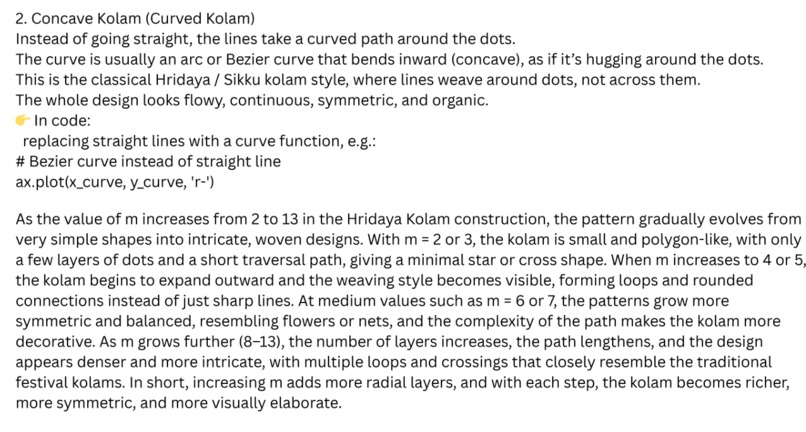
mathematically valid Kolam traversal sequences, polar coordinate mappings, continuous single-stroke Kolam paths, symmetric geometric structures, and both straight-line and curved Kolam renderings.
Unlike previous approaches restricted mainly to odd-dot structures, our system also supports even-order radial Kolams, making the framework more generalized and scalable.
The project additionally explores:
rotational and mirror symmetries, graph-theoretic path construction, exponential Kolam design-space growth, and procedural generation of artistic patterns.
Applications include:
AI-driven generative art Educational geometry tools Computational design systems Textile and architecture pattern generation AR/VR cultural experiences Pattern-recognition datasets Interactive digital heritage platforms
How we built it
We built AlgoKolam using Python and mathematical modeling.
The complete pipeline works as follows:
1. Modular Arithmetic-Based Sequence Generation
We define:
m = number of dots per arm n = number of radial arms
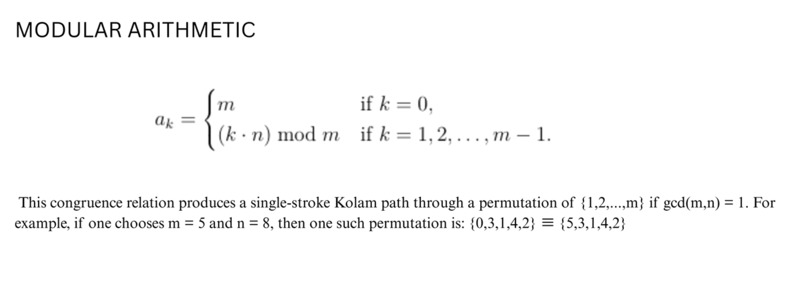
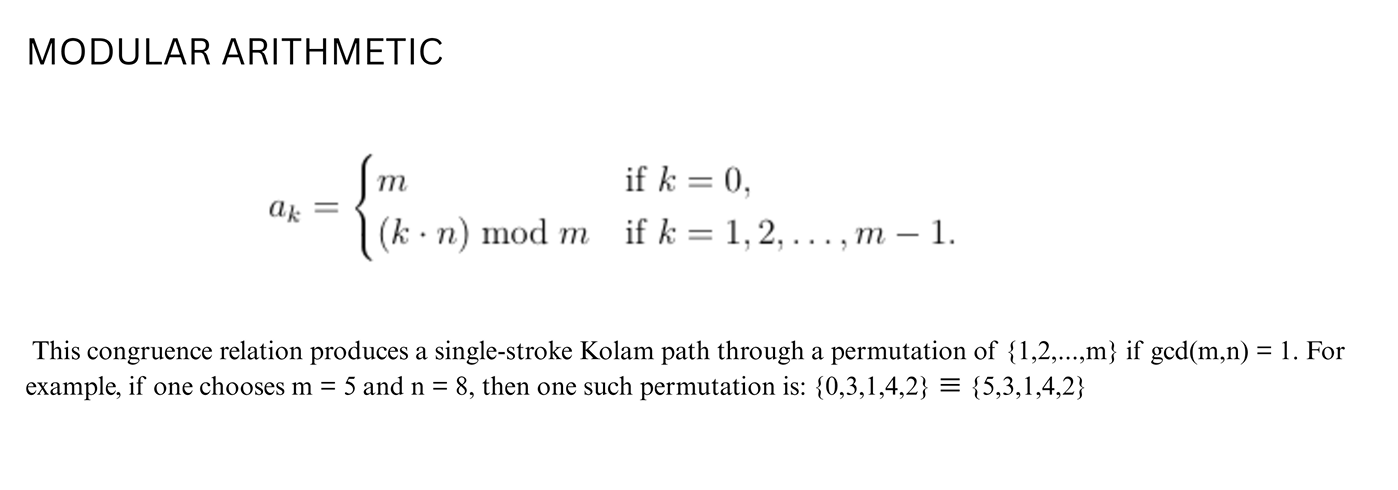
Using modular congruence: $$ak=(kn)modm$$
When: $$gcd(m,n)=1$$
the generated sequence becomes a complete cyclic permutation that guarantees continuous traversal through all dot positions.
This creates the foundation for constructing valid Hridaya Kolam paths.
2. Polar Coordinate Transformation
The generated modular sequence is converted into polar coordinates:
radius = modular sequence value angle = radial arm angle
This transforms abstract numerical sequences into geometric radial structures.
3. Directed Eulerian Graph Construction
Each dot becomes a graph vertex.
Connections between dots become directed edges.
The graph is constructed such that:
every vertex has equal in-degree and out-degree, ensuring existence of an Eulerian circuit.
This allows the entire Kolam to be drawn continuously without lifting the pen.
4. Symmetry Analysis
We explored:
rotational symmetry, diagonal reflection symmetry, edge-parallel mirror symmetry, square-tile Kolam symmetry groups.
The project studies all eight symmetry classes including:
4mmd 2mm 2mdm m md and others.
This creates highly balanced and visually elegant Kolam structures.
5. Python Visualization Engine
We developed Python scripts using:
NumPy Matplotlib
The engine:
generates Hridaya Kolam matrices, computes traversal paths, renders radial dot systems, plots straight-line Kolams, and creates curved Sikku-style Kolams using Bézier interpolation.
We also implemented:
dynamic complexity scaling, variable m,n exploration, and automated pattern evolution.
Challenges we ran into
One of the biggest challenges was translating traditional artistic intuition into strict mathematical rules.
Traditional Kolams are often learned visually and culturally rather than algorithmically. Converting them into:
modular arithmetic systems, graph traversal logic, and scalable computational models required extensive experimentation.
Other major challenges included:
Supporting Even Dot Counts
Most existing studies focused mainly on odd-dot Kolams. Extending the framework to even values while preserving symmetry and continuity required redesigning the traversal logic.
Maintaining Single-Stroke Continuity
Ensuring that every generated pattern formed a valid Eulerian traversal without broken paths was computationally challenging.
Curved Kolam Generation
Straight-line patterns were easier to compute, but generating smooth, woven Sikku-style curves required custom Bézier-based interpolation systems.
Balancing Mathematics and Aesthetics
Some mathematically correct patterns did not appear visually balanced. We had to iteratively tune geometric relationships to preserve artistic elegance.
Accomplishments that we're proud of
We are proud that AlgoKolam successfully demonstrates how traditional cultural art can evolve into a computational design engine.
Key achievements include:
Generalized Hridaya Kolam generation for both odd and even dot counts Automated modular arithmetic-based pattern synthesis Eulerian graph interpretation of Kolam traversal Dynamic symmetry-driven design generation Programmatic creation of highly intricate Kolam structures Scalable procedural art generation framework Integration of mathematics, art, and computation into a unified system
We are especially proud that the project does not merely digitize Kolam, but transforms it into a living algorithmic design language.
What we learned
This project taught us that traditional art forms already contain sophisticated mathematical structures hidden within them.
We learned:
how modular arithmetic creates cyclic artistic structures, how graph theory explains continuous Kolam traversal, how symmetry governs visual balance, and how computational systems can preserve cultural heritage.
On the technical side, we gained experience in:
computational geometry, procedural generation, graph algorithms, polar-coordinate systems, Bézier interpolation, and generative visualization.
Most importantly, we learned that technology can become a tool for cultural preservation rather than cultural replacement.
What's next for AlgoKolam: Algorithmic Heritage Engine
We envision AlgoKolam evolving into a full computational cultural-design platform.
Future developments include:
AI-Assisted Pattern Generation
Using machine learning models to:
learn traditional Kolam styles, generate hybrid patterns, and classify symmetry families automatically. Interactive AR/VR Kolam Experiences
Users could:
walk through immersive Kolam environments, draw Kolams interactively in AR, or generate real-time procedural designs. Enterprise Design Applications
The generated patterns could be adapted for:
textiles, architectural facades, digital branding, packaging, gaming assets, and generative UI themes. Educational Platforms
We aim to develop:
interactive geometry-learning tools, computational mathematics visualizers, and algorithmic art learning systems. API & Generative Design Engine
Eventually, AlgoKolam could become:
a generative cultural design API, enabling designers and developers to integrate algorithmic heritage patterns into modern digital products.


Log in or sign up for Devpost to join the conversation.