Inspiration
Algebrium was inspired by the limitations of traditional chatbots when solving mathematical problems. They can often produce convincing explanations while making calculation errors, especially in multi-step derivations, symbolic transformations, and complex formulas.
Mathematical answers need more than plausible language: they require clear reasoning, reliable verification, and accurate visualization. We wanted to build an open-source mathematics agent that helps users understand not only the final answer, but also the process used to reach it.
What it does
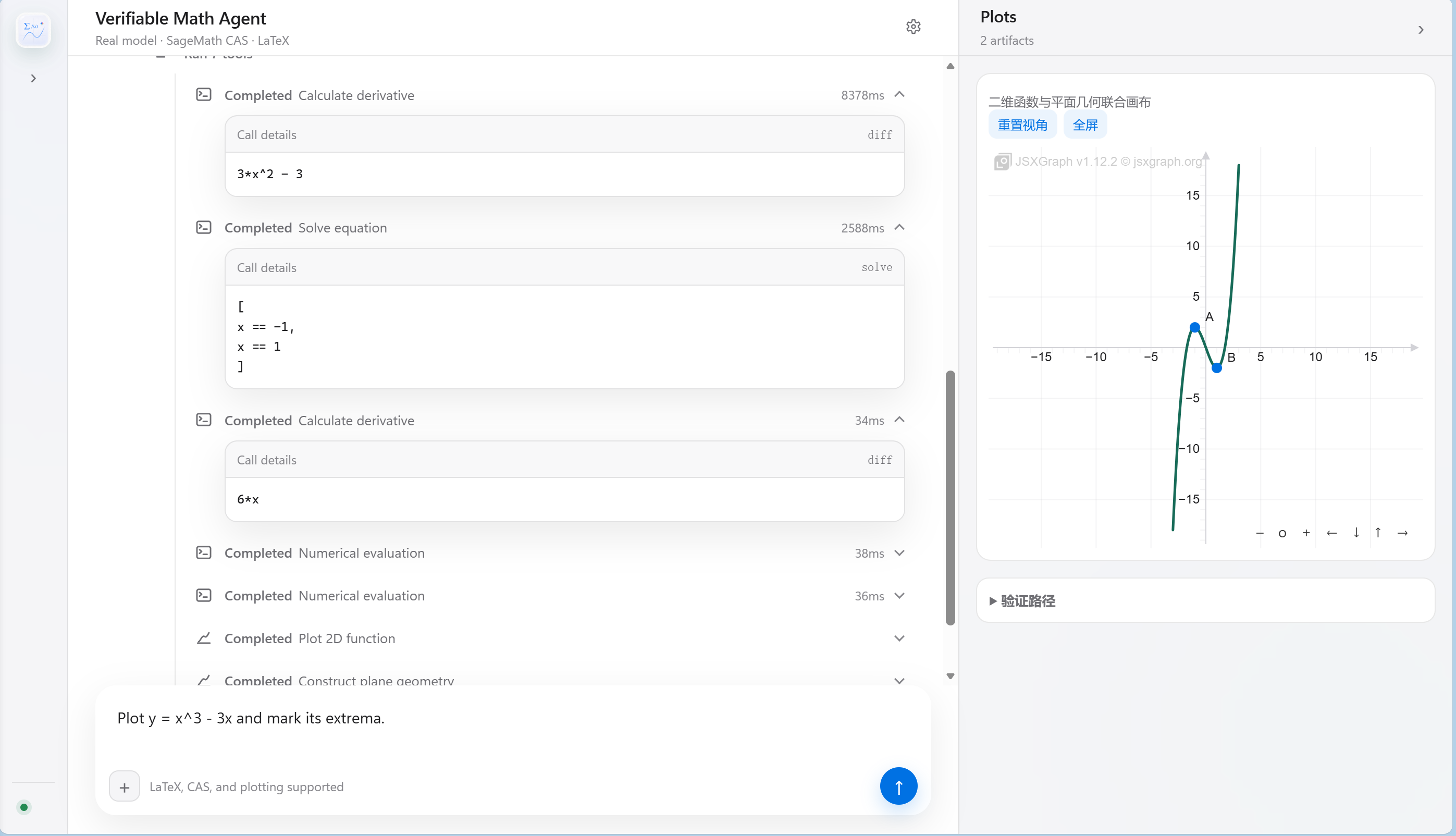
Algebrium allows users to describe mathematical problems in natural language. It combines language-based reasoning with specialized mathematical tools and computer algebra capabilities.
It can:
- Solve and explain mathematical problems.
- Show intermediate derivation steps.
- Integrate mathematical expressions.
- Verify results symbolically.
- Plot functions and surfaces.
- Draw formal geometric objects such as circles.
- Identify mistakes and explain their mathematical consequences.
How we built it
Algebrium is designed as a modular mathematics-agent system. The core agent interprets user requests and coordinates specialized subject modules and mathematical tools.
Computer algebra workloads can be delegated to a sandboxed CAS environment, helping separate symbolic computation from language-model reasoning. Formal mathematical objects are represented with structured data so that they can be rendered accurately and reused across different interfaces.
The system is organized around several layers:
- Natural-language interaction.
- Subject-specific mathematical modules.
- Tool contracts for computation and visualization.
- Computer algebra verification.
- Structured mathematical artifacts.
- Interactive 2D and 3D rendering.
Challenges we ran into
One major challenge was maintaining trust in AI-generated mathematics. A language model may produce a convincing explanation even when a calculation is incorrect, so symbolic verification and clear derivation steps had to be treated as core capabilities.
Another challenge was connecting different mathematical representations. Expressions, plots, geometric objects, and CAS results need consistent schemas so that the same result can be computed, verified, and visualized reliably.
We also had to balance flexibility with safety. The main agent should remain focused and controlled, while computation and external operations should be isolated behind explicit tool boundaries.
Accomplishments that we're proud of
- Designed a modular architecture for mathematical reasoning.
- Integrated symbolic computation and verification into the workflow.
- Added structured support for functions, geometry, and surfaces.
- Used formal geometric primitives for accurate rendering.
- Separated reasoning, computation, and visualization responsibilities.
- Built the project as an open-source foundation for future mathematical tools.
What we learned
We learned that reliable mathematical AI needs a combination of language reasoning and formal computation. Explanations are more useful when users can inspect the derivation and verify the result independently.
We also learned that mathematical data should be structured from the beginning. A well-defined representation makes it easier to support multiple renderers, subject modules, and computation providers.
Finally, we learned that modular boundaries are essential. Subject-specific behavior should enter through clear contracts instead of becoming tightly coupled to the agent core.
What's next for Algebrium
Future development will focus on expanding the mathematical capabilities of the system and improving the overall user experience.
Planned directions include:
- More subject-specific mathematical modules.
- Stronger CAS verification and error reporting.
- Support for additional geometric primitives.
- Richer function, geometry, and 3D visualizations.
- Improved explanations for different learning levels.
- Better documentation and onboarding for contributors.
- More robust sandboxing and permission boundaries.
Algebrium aims to make mathematical reasoning clearer, more verifiable, and easier to explore.

Log in or sign up for Devpost to join the conversation.