Inspiration
Harmful Algal Blooms (HABs) can contaminate municipal drinking water and force sudden closures of public beaches within 24 to 48 hours. While EPA and state telemetry buoys continuously stream real-time water quality metrics, raw data only reflects existing conditions. We wanted to move from reactive monitoring to proactive prevention by giving water managers advance warning before peak toxicity occurs.
What it does
AlgaeGuard transforms raw environmental sensor streams into predictive next-day intelligence. Key features include:
- Predictive Risk Scoring: Forecasts next-day phycocyanin pigment levels (RFU) and calculates bloom alert probabilities.
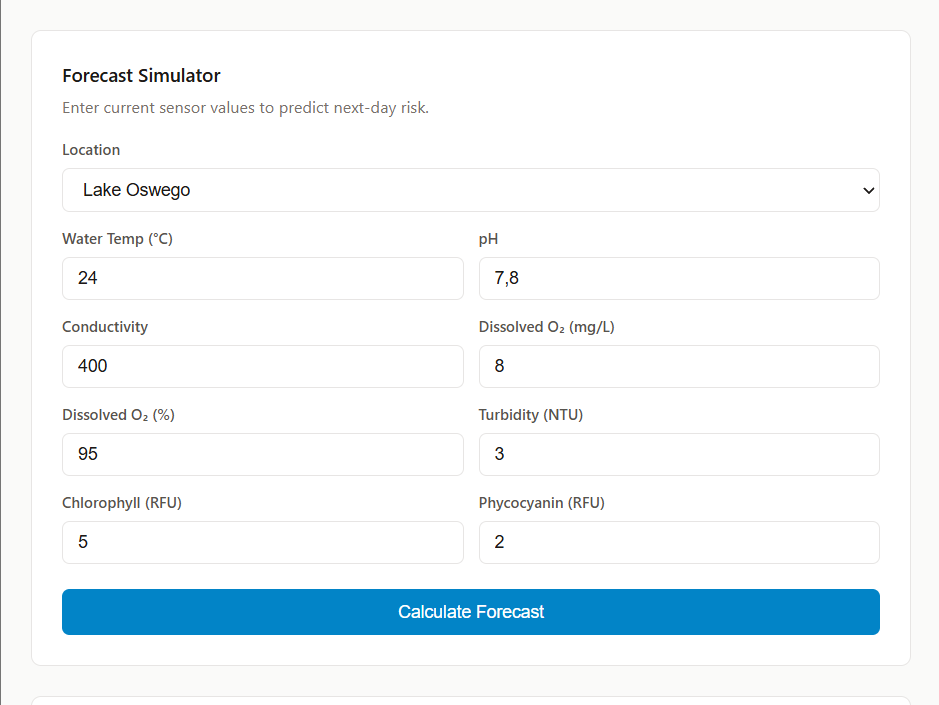
- Interactive What-If Simulator: Allows operators to input real-time or hypothetical parameters (temperature, pH, dissolved oxygen) to model tomorrow's water quality risk.
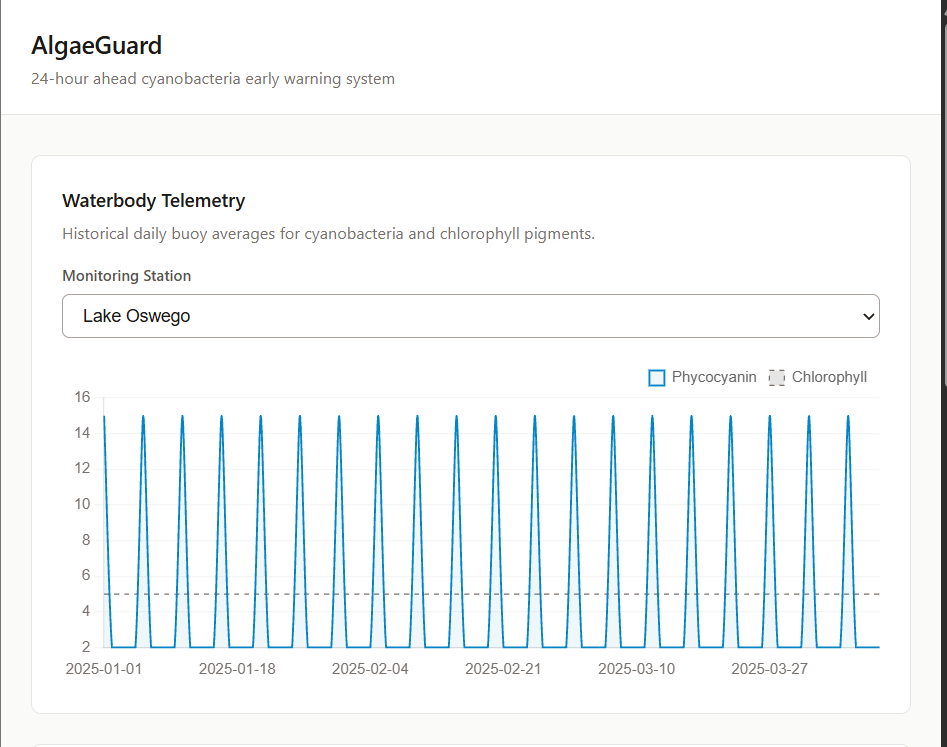
- Time-Series Telemetry Dashboard: Displays multi-parameter historical trends for monitored waterbodies like Lake Oswego and Upper Klamath Lake.
How we built it
- Frontend: Built with HTML5, modern CSS, JavaScript (ES6+), and Chart.js for data visualization.
- Backend API: Powered by Python and FastAPI using Uvicorn as the web server.
- Machine Learning: Trained Scikit-Learn
RandomForestRegressorandRandomForestClassifiermodels on EPA buoy sensor telemetry using Pandas, NumPy, and Joblib.
Challenges we ran into
- Preventing Data Leakage: Standard randomized train-test shuffles caused artificially high metrics due to temporal auto-correlation in environmental time-series data. We had to implement a strict, time-ordered holdout split per waterbody to ensure honest validation.
- Multi-Parameter Calibration: Balancing several physical and chemical indicators (pH, temperature, conductivity, turbidity) to accurately predict pigment shifts.
Accomplishments that we're proud of
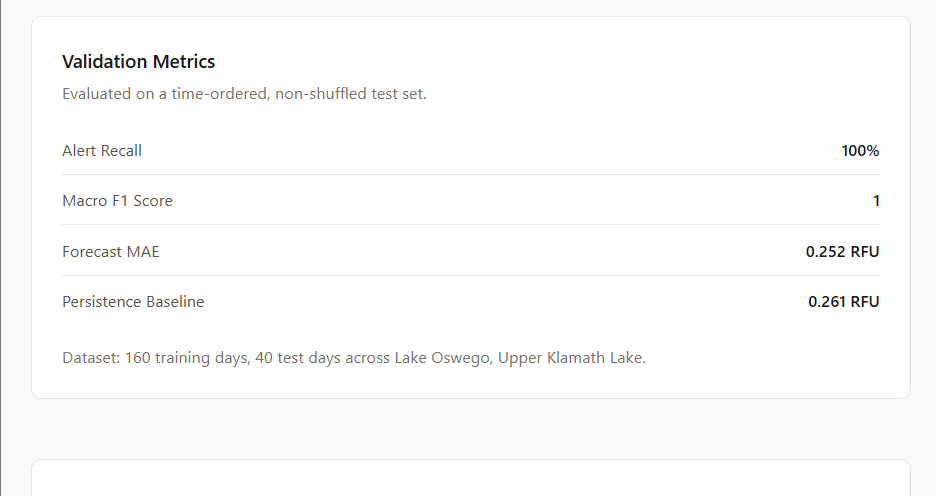
- Achieved 100% recall on critical bloom alert events with our classification model.
- Outperformed the standard persistence baseline with our
RandomForestRegressor(MAE of 0.252 RFU vs. 0.261 RFU baseline). - Successfully built an end-to-end prototype with an intuitive dashboard and an interactive simulation tool.
What we learned
- The importance of evaluating time-series machine learning models chronologically rather than with random splits.
- How to streamline real-time sensor inputs into lightweight FastAPI endpoints for rapid predictions.
What's next for Algea Guard
- Live API Integration: Connecting directly to real-time USGS and EPA water quality data streams.
- Automated Advisories: Adding automated email/SMS alert dispatch systems for local public health authorities.
- Geospatial Mapping: Integrating interactive satellite mapping to monitor bloom movement across entire lake systems.

Log in or sign up for Devpost to join the conversation.