Inspiration
Air quality is getting worse in cities and indoor spaces, and planting trees alone can't keep up. Trees are great, but they need a lot of land and years to grow. We wanted a compact system that cleans the air using something that grows fast, so we looked at microalgae. Per unit of area, they fix CO₂ far more efficiently than trees and most land plants. The catch is that algae are sensitive to light, temperature, and mixing, so we decided to automate their growth cycle instead of leaving it to guesswork.
What it does
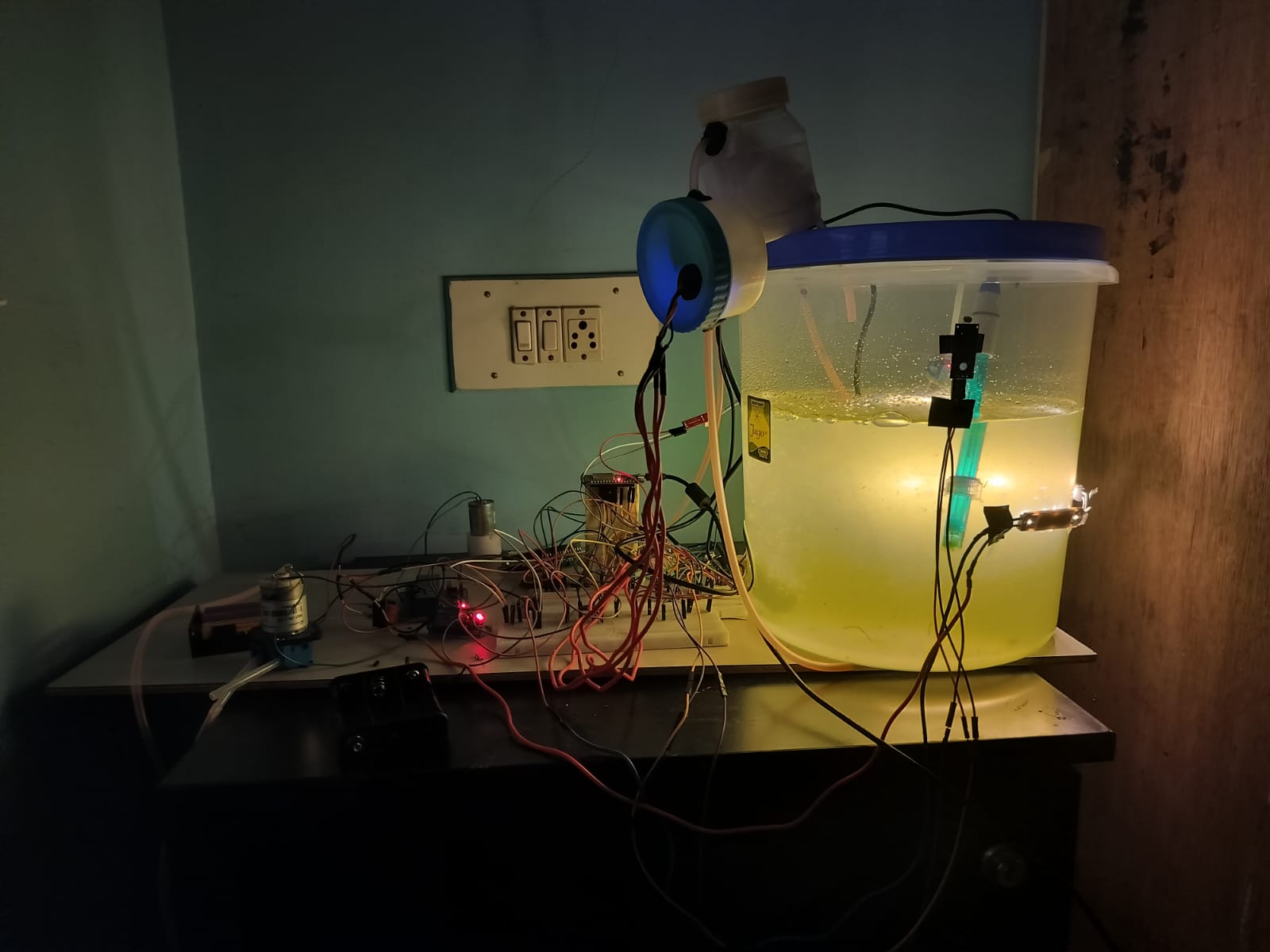
Our Algae-Based Photobioreactor is a closed culture system that absorbs CO₂ and releases oxygen through photosynthesis, while a microcontroller keeps the culture in its ideal conditions on its own:
- Temperature sensor tracks the thermal conditions of the culture.
- LDR (Light Dependent Resistor) module tracks ambient and grow-light intensity.
- Relay modules switch the grow light, aeration pump, and fluid circulation based on real-time sensor feedback.
No one has to babysit the culture: if the light drops, the grow light turns on; if the culture gets too warm, circulation and aeration kick in.
How we built it
- Culture vessel: a transparent container holding the microalgae culture (e.g. Chlorella), with an air inlet and a circulation loop.
- Sensing: a temperature sensor and an LDR connected to the microcontroller's analog/digital pins.
- Actuation: a relay module driving the LED grow light, air pump, and circulation pump.
- Control logic: the microcontroller reads the sensors in a loop and compares them to thresholds, for example:
- Grow light ON when the LDR reading shows light below the set threshold.
- Pump and aeration ON when temperature goes above the maximum limit.
- Testing and tuning: we adjusted thresholds and timings until the culture conditions stayed stable.
The math behind the impact
Microalgae biomass is about 50% carbon, so each gram of dry biomass fixes roughly 1.8 g of CO₂:
CO₂ absorbed ≈ 1.8 × productivity × culture volume × time
Productivity is about 0.3–0.5 g per litre per day. A mature tree absorbs about 21 kg of CO₂ per year, so:
- A 100 L reactor absorbs roughly 20–33 kg of CO₂ per year, about 1–1.5 trees.
- Matching 10 trees needs roughly 650–1,000 L of culture.
So our prototype demonstrates the idea, and a scaled-up system could replace about 10 trees' worth of CO₂ uptake in a much smaller footprint.
Challenges we ran into
- Switching mains-powered loads safely with relays, and keeping the microcontroller isolated from pump noise.
- Calibrating the LDR, since its readings drift with ambient light and need sensible thresholds.
- Keeping conditions stable: too much light or heat stresses the culture, so we had to avoid rapid on/off switching of the relays.
- Being honest about the numbers: we corrected our first "replaces 10 trees" estimate once we worked out the real productivity data.
What we learned
- How to combine sensors, relays, and a microcontroller into a closed-loop control system.
- The basics of microalgae growth: light, temperature, aeration, and nutrients all matter.
- How to turn a big claim into a number you can defend.
What's next
- Add a pH sensor and CO₂ monitoring.
- Log data to the cloud and show a live dashboard.
- Scale up the vessel and test indoor deployment in classrooms and offices.

Log in or sign up for Devpost to join the conversation.