-
-
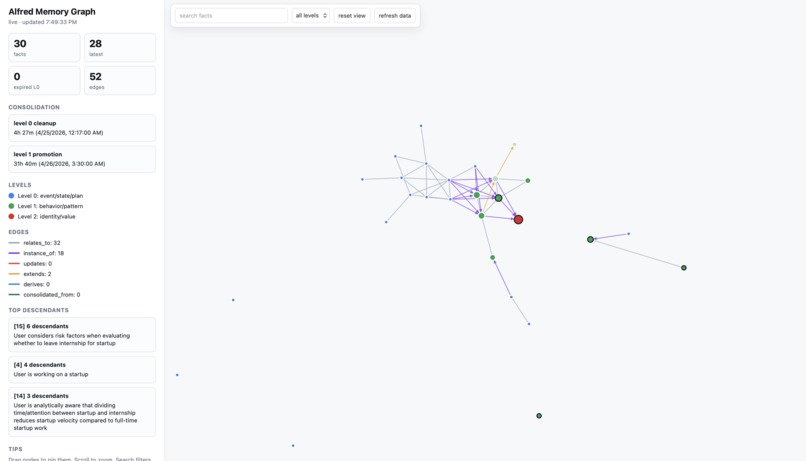
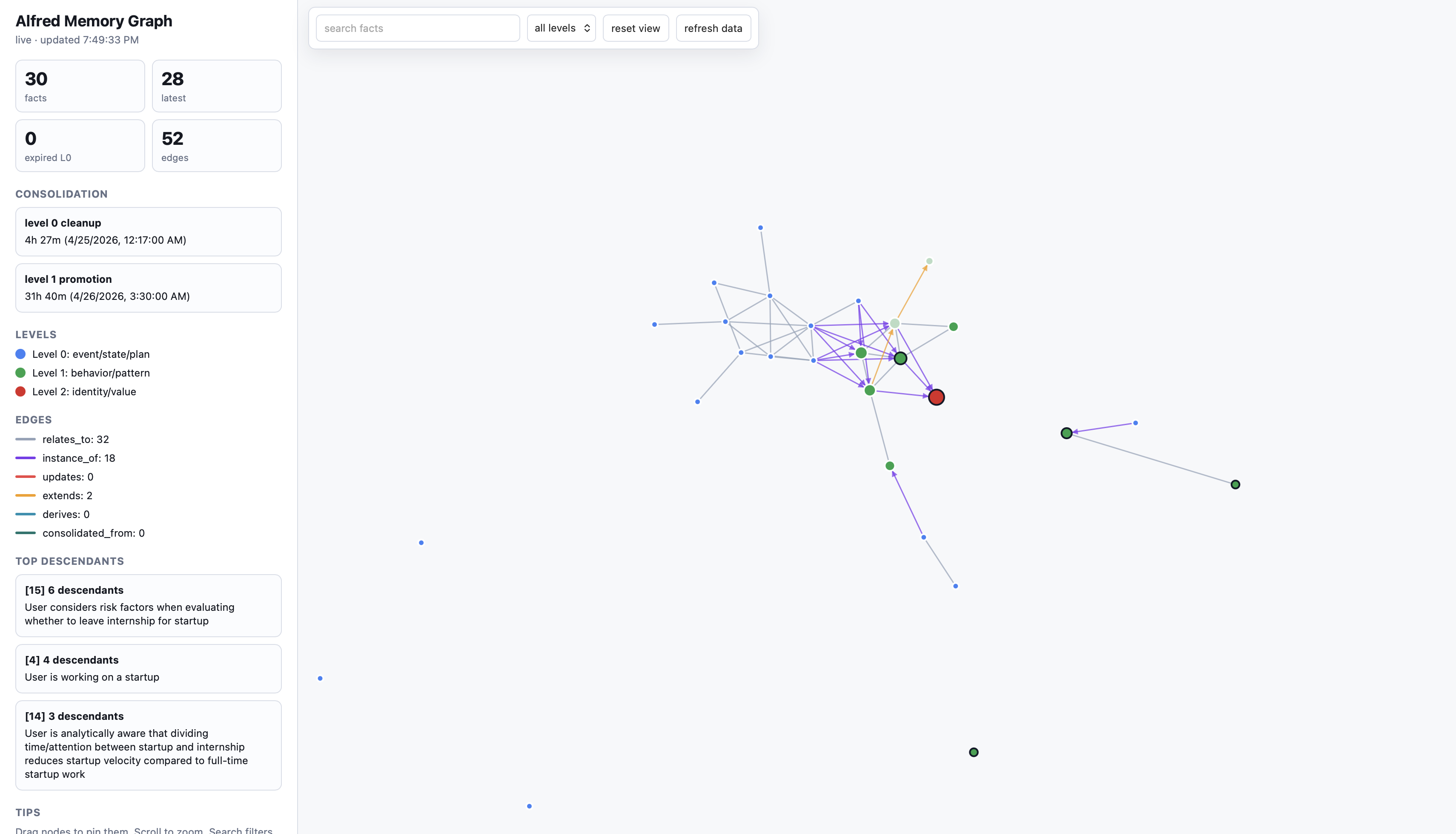
This shows the memory graph created over time, also keeping track of fact history via contradiction + fact-extending + fact-deriving edges
-
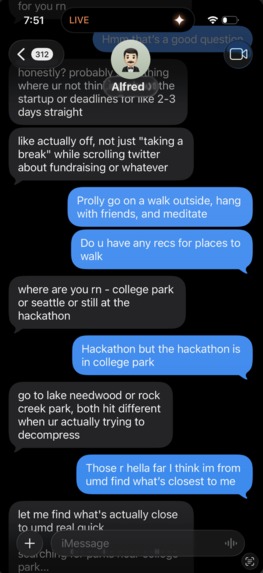
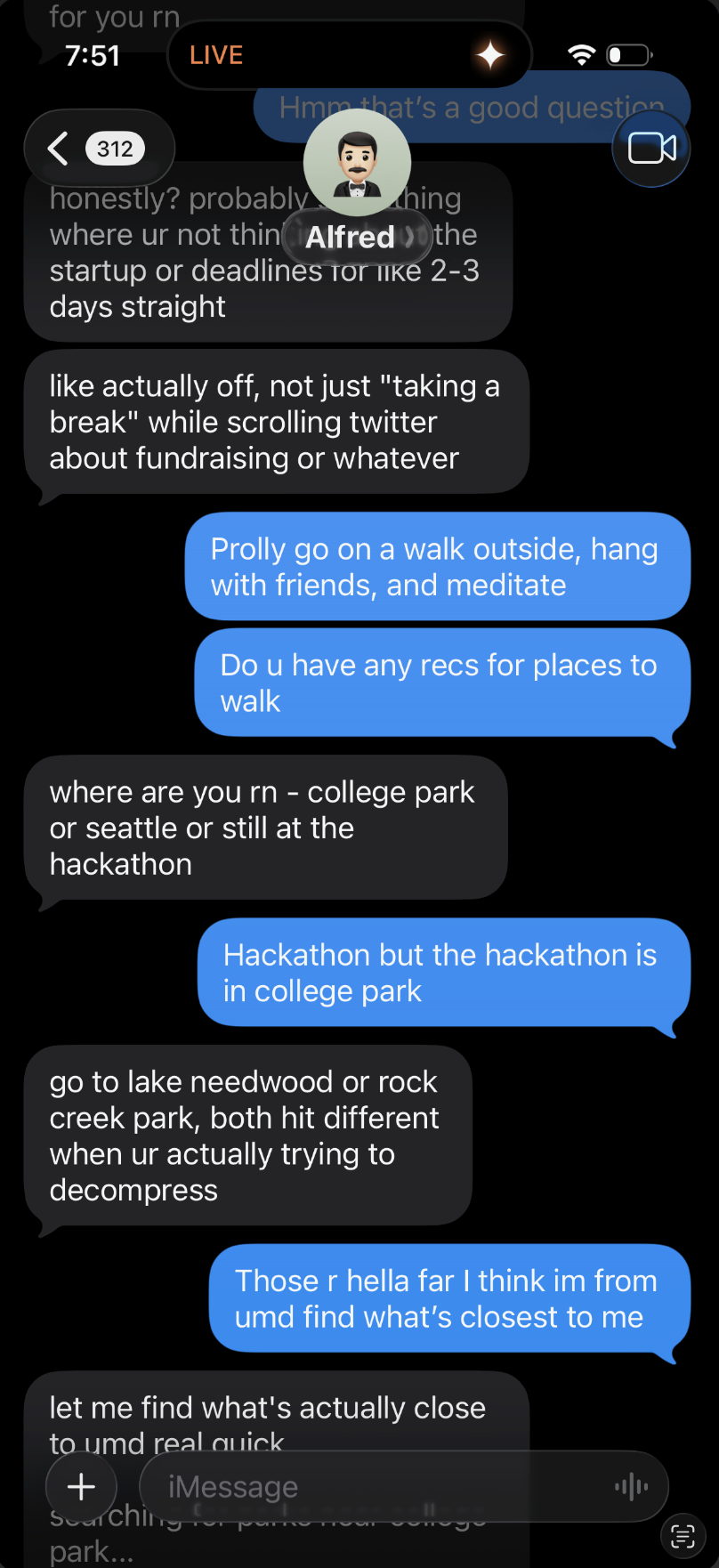
conversation with Alfred about taking a break - he remembers where Ive been despite the conversation being a long time ago
Inspiration
Alfred started from a very personal problem: a lot of the thoughts that matter most do not arrive when I am sitting down to journal, plan, or reflect. They show up randomly: in a text, a voice memo, a screenshot, a late-night idea, or a quick note I assume I will remember later.
Most wellbeing tools ask users to stop what they are doing, open an app, and neatly log how they feel. That is not how people actually process stress, burnout, relationships, goals, or mental clutter. The important context is usually scattered across tiny moments.
I built Alfred as a wellbeing companion that lives natively in iMessage. The idea is simple: text Alfred the thought before it disappears. Alfred remembers the useful parts, connects them over time, and brings them back when they matter.
The health and wellbeing angle is not that Alfred replaces therapy, coaching, or clinical care. It does not. Instead, Alfred helps with the space between support systems. It gives people a lightweight way to capture emotional context, notice recurring stress patterns, remember personal commitments, and bring better context into conversations with friends, mentors, therapists, or themselves.
What it does
Alfred is an AI journal and second brain that works through iMessage.
Users can send Alfred:
- text notes
- voice memos
- screenshots or images
- files like PDFs, docs, and text files
Alfred processes those inputs and turns them into useful memory.
For wellbeing, Alfred can help users:
- capture anxious or scattered thoughts before they disappear
- notice recurring stressors and emotional patterns
- remember personal goals, routines, and commitments
- resurface context before therapy, mentoring, or difficult conversations
- check in about things the user said mattered
- reduce mental load by remembering small but important details
- support neurodivergent users who struggle with task switching, memory, or organizing thoughts
A user might text:
random thought but what if I built smt for ppl who overthink at night is that crazy
Alfred can remember that as a real idea, connect it to earlier notes about mental clutter and overthinking, and bring it back later when the user is working on the project.
A user might also text:
I have to spend more time with my sister, I miss her
Alfred can remember that as an emotional priority, not just a task, and check in later when it becomes relevant.
How we built it
We built Alfred around a simple pipeline:
Capture Users send notes, voice memos, images, or files through iMessage.
Understanding Alfred processes each input depending on the format:
- text is parsed directly
- voice memos are transcribed
- images are described using vision models
- files are summarized and chunked
Memory extraction Each message is decomposed into smaller atomic memories: facts, preferences, goals, reminders, emotional signals, and open loops.
Storage and retrieval Memories are embedded and stored so Alfred can retrieve them later using a mix of semantic similarity, recency, and importance.
Reasoning and response When the user asks something, Alfred retrieves relevant memories and responds in a casual, supportive voice that feels more like texting a trusted friend than querying a database.
Proactive support Alfred can surface reminders, check in on open loops, and connect old thoughts to new moments.
The product concept uses LLM APIs, transcription, vision processing, embeddings, and a memory store.
Challenges I ran into
The hardest challenge was deciding what Alfred should be.
It would have been easy to make a generic AI notes app, but that misses the real problem. The real problem is not note-taking. It is that people have meaningful thoughts, emotional patterns, and personal commitments scattered across their lives, and most tools do not preserve that context in a useful way.
Another challenge was trust. A product that “remembers everything” can quickly feel creepy if it is framed incorrectly. We had to design Alfred as something transparent and user-controlled: it remembers what the user gives it, shows what it saved, and should allow memories to be edited or deleted.
We also had to balance personality with seriousness. Alfred should feel warm, funny, and opinionated, but it is still operating in the wellbeing space. That means it cannot pretend to be a therapist, diagnose users, or overstep. The goal is support, reflection, and context, not clinical treatment.
Accomplishments that we're proud of
We are proud that Alfred feels emotionally different from most AI productivity tools.
Instead of building another dashboard, we designed Alfred around an interaction people already use every day: texting. That makes it feel lightweight and natural.
We are also proud of the memory concept. Alfred does not just store raw notes. It turns messy inputs into useful memories that can compound over time. That means the product can answer questions like:
- what am I avoiding right now?
- what did I promise people this week?
- what should I bring up with my therapist or mentor?
- what stress patterns keep showing up?
- what am I forgetting that actually matters?
Those are questions that Google, Maps, Notes, and Calendar cannot answer alone because they require personal context.
What we learned
We learned that the most powerful wellbeing tools may not look like healthcare tools at all.
For many people, support starts with capturing what is happening in their life clearly enough to reflect on it. A lot of mental load comes from trying to hold too many thoughts, emotions, reminders, and commitments in your head at once.
We also learned that memory is only valuable if it is contextual. A reminder is useful, but a reminder connected to why something matters is much more powerful.
For example, “call your sister” is a task. But “you said you wanted to spend more time with your sister because you felt like you were drifting” is emotional context. Alfred is designed to preserve that second layer.
What's next for Alfred
Next, we want to build Alfred into a working iMessage-native prototype with a real memory backend.
The next steps are:
- finish the iMessage/SMS interaction flow + make it richer
- create user controls for editing, deleting, and reviewing memories
- add proactive check-ins for stress, goals, and open loops
- build optional “therapy prep” and “weekly reflection” modes
- test with users who struggle with scattered thoughts, burnout, overthinking, or task follow-through
Longer term, Alfred could become a personal wellbeing layer that helps users understand their own patterns over time and bring better context into therapy, coaching, journaling, and everyday life.
Built With
- chromadb
- sqlite
- typescript

Log in or sign up for Devpost to join the conversation.