About the Project
💡 Inspiration
We wanted to explore what an AI personal assistant could look like when it can do more than simply answer questions. Traditional voice assistants often depend on rigid intents and separate integrations, making multi-step tasks difficult to coordinate.
Alexa+ LifeOS was inspired by the idea of combining an agentic AI assistant with the open Model Context Protocol (MCP) so an assistant can dynamically discover tools, access contextual information, and safely perform actions.
Instead of simply responding to a request such as “Plan my day,” the assistant can understand multiple intents, retrieve calendar events and tasks, use user preferences, discover relevant places, create reminders, and present a complete response.
🚀 What We Built
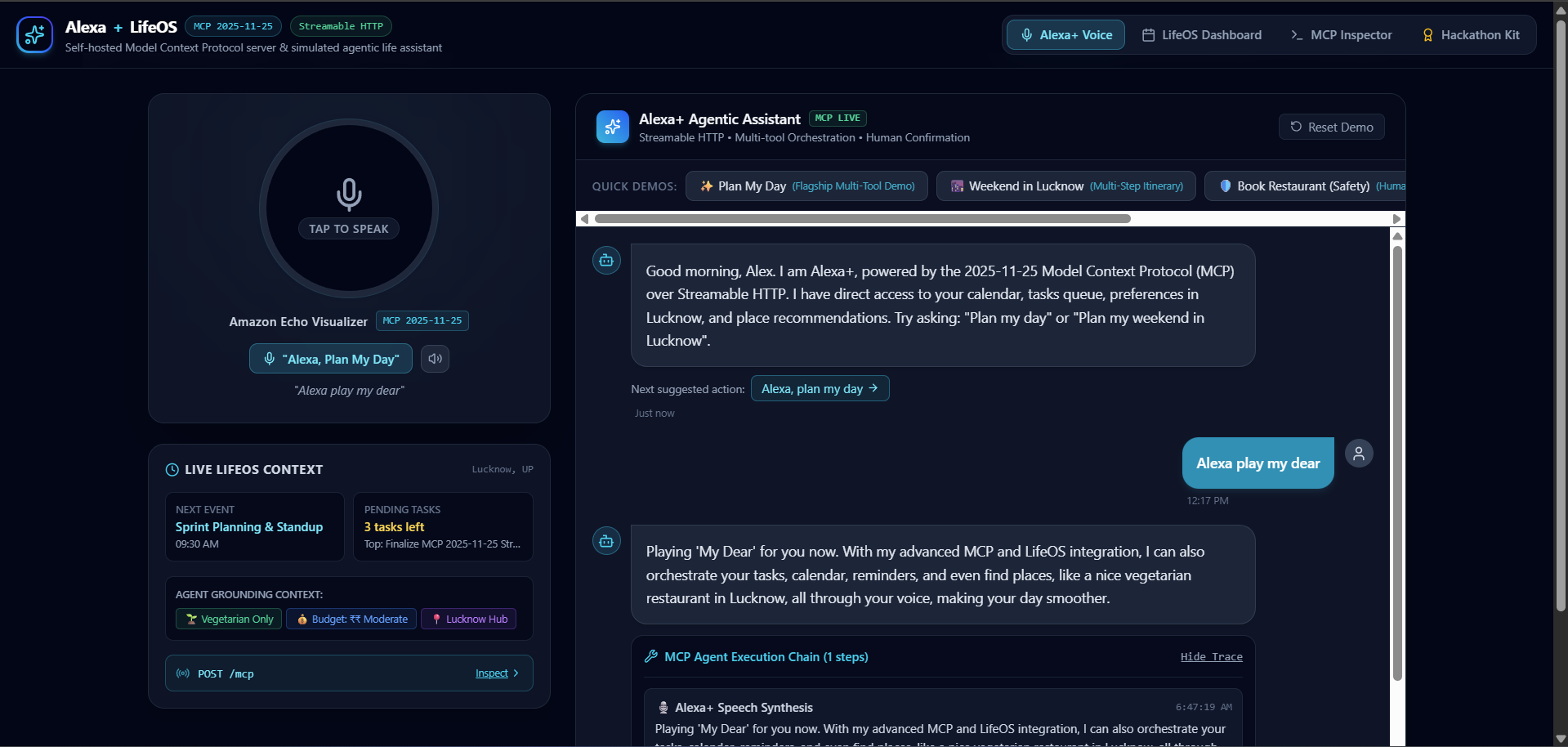
Alexa+ LifeOS is a self-hosted MCP server implementing MCP 2025-11-25 over Streamable HTTP, combined with an agentic personal assistant and an interactive Alexa/Echo-style web experience.
The MCP server exposes 13 tools, 5 resources, and 3 prompt templates for tasks, calendar events, reminders, shopping lists, places, itineraries, and reservations.
The system supports workflows such as:
- Plan My Day — combines calendar events, pending tasks, user preferences, dinner discovery, and reminders.
- Plan My Weekend — creates a multi-stop itinerary based on location, interests, dietary preferences, and budget.
- Safe Reservations — pauses high-impact actions such as restaurant bookings and requires explicit user confirmation before execution.
We also built an MCP Developer Inspector that allows developers to monitor protocol activity, execute tools, inspect parameters, view latency, and test the server using JSON-RPC/cURL.
🛠️ How We Built It
The backend was built with Node.js, Express, TypeScript, and the Model Context Protocol SDK. The MCP endpoint uses Streamable HTTP and JSON-RPC 2.0 for communication.
The frontend uses React, Vite, Tailwind CSS, and Lucide Icons. It provides a LifeOS dashboard, voice interaction, an Echo-style LED visualizer, task and calendar management, and the MCP developer console.
For AI reasoning, the architecture supports Amazon Bedrock and Google Gemini. PostgreSQL with Drizzle ORM is used for persistent LifeOS data, while AWS services such as ECS Fargate, RDS, S3, CloudFront, Secrets Manager, and CloudWatch provide a path toward cloud deployment.
The voice simulation uses the browser's Web Speech API, while the Web Audio API generates wake and confirmation sounds without relying on copyrighted audio assets.
🧠 What We Learned
Building the project taught us how MCP can provide a standardized interface between an AI agent and external tools.
We learned how to:
- Implement MCP tools, resources, and prompts.
- Build a self-hosted MCP endpoint using Streamable HTTP.
- Manage MCP sessions and JSON-RPC requests.
- Design agentic workflows involving multiple sequential tool calls.
- Separate read-only contextual resources from state-changing tools.
- Implement human-in-the-loop safety for high-impact actions.
- Build an interactive developer inspector for debugging MCP requests.
- Design a voice-first experience around an agentic backend.
- Prepare an MCP server for cloud deployment using AWS infrastructure.
One important lesson was that tool design matters as much as model intelligence. Clear schemas and well-defined tools make agent actions more predictable and easier to debug.
⚙️ Challenges We Faced
One of the biggest challenges was implementing Streamable HTTP while maintaining MCP session state and supporting server-sent event communication.
We also encountered challenges around reconnecting clients during long-running interactions and designing confirmation behavior for sensitive actions. MCP provides the tool execution mechanism, but human authorization for high-impact actions required an application-level safety layer.
To address this, we created a confirmation workflow where actions such as reservations return a pending confirmation state instead of executing immediately. The Echo visualizer also changes to an amber confirmation state while waiting for user authorization.
🌟 Why It Matters
Alexa+ LifeOS demonstrates how an open protocol can connect an agentic assistant to a growing ecosystem of tools without requiring every integration to be built as a proprietary voice skill.
Our goal is to show a practical model for safe, contextual, and interoperable agentic assistants where AI can discover capabilities, combine multiple tools, and take meaningful actions while keeping the user in control.
Built With
- agentic-ai
- ai-agents
- alexa+
- amazon-bedrock
- amazon-rds-relational-database-service
- amazon-web-services
- aws-cloudwatch
- aws-ecs-fargate
- cloudfront
- drizzle-orm
- express.js
- google-gemini
- json-rpc
- mcp
- model-context-protocol
- node.js
- postgresql
- react
- streamable-http
- tailwind-css
- typescript
- vite
- web-audio-api
- web-speech-api


Log in or sign up for Devpost to join the conversation.