-
-
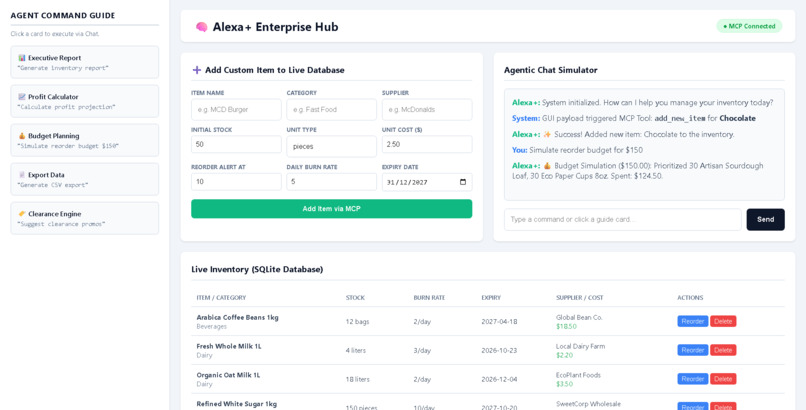
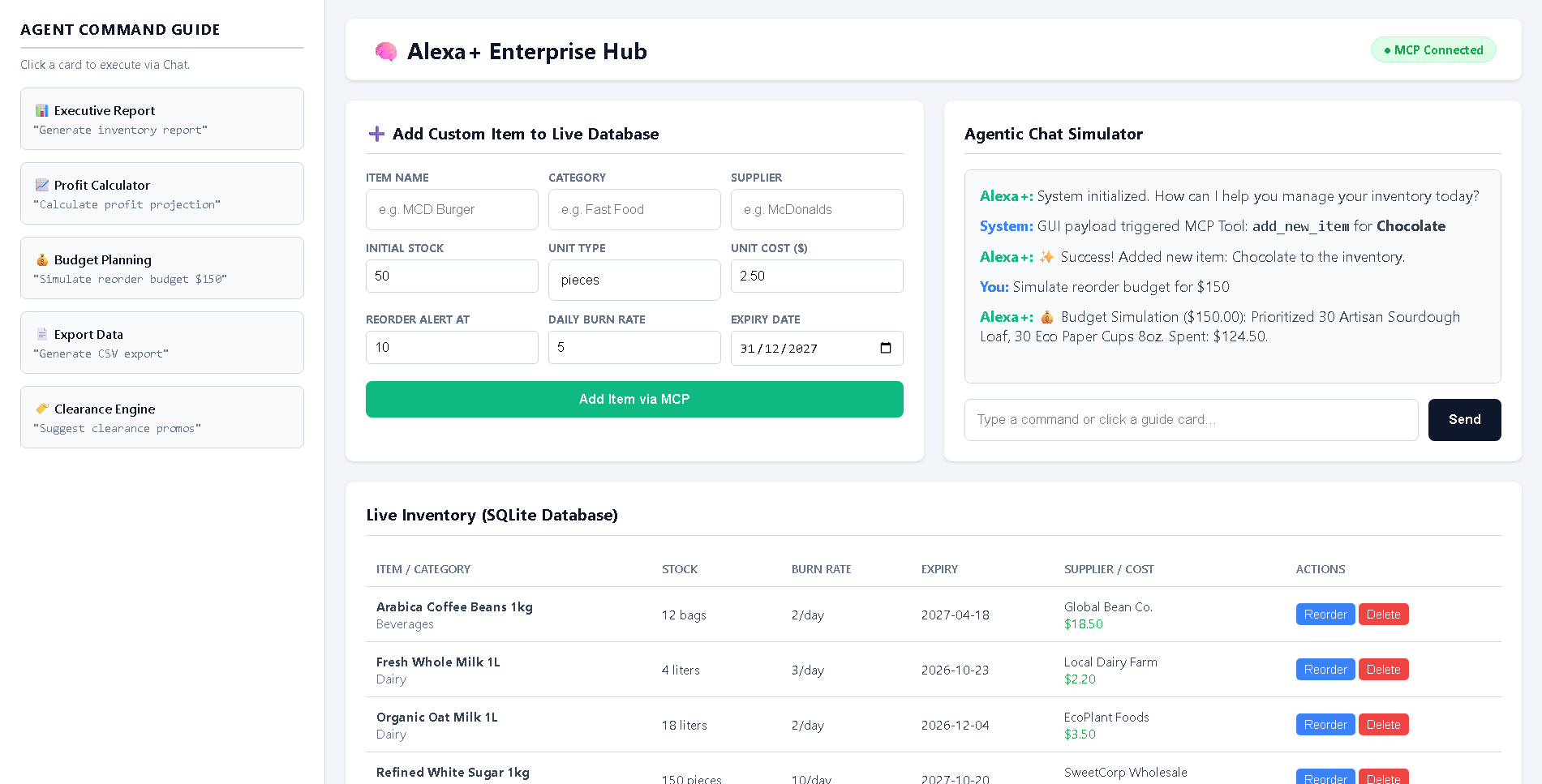
Alexa+ Enterprise Hub dashboard featuring the custom item form and live chat simulator.
Inspiration
Small shopkeepers, hawker stalls and local cafe owners constantly fight a battle against dead capital and inventory spoilage. They rely on pen-and-paper tracking, making it incredibly difficult to predict stockouts or optimize reorder budgets. I wanted to bring enterprise-grade supply chain intelligence to local vendors. The idea was simple which was to make complex logistics as easy as having a conversation with an assistant.
What it does
The Alexa+ Enterprise Hub is a predictive Small Business Inventory & Order MCP Server. It acts as an autonomous supply chain assistant. Key capabilities include:
Predictive Stockouts: Tracks dynamic daily burn rates and warns the owner before high-velocity staples run out.
Smart Budget Planning: Simulates the most critical reorders needed to stay operational under strict cash-flow constraints.
Automated Purchase Orders: Aggregates low-stock items by supplier and generates dispatch-ready payloads.
Clearance Engine: Scans for near-expiry items and generates promotional discount strategies to recoup costs.
How we built it
To fulfill the Alexa+ Track requirements, I built a self-hosted Model Context Protocol (MCP) server that strictly adheres to the 2025-11-25 Streamable HTTP specification.
Backend: Powered by Python, FastAPI, and SQLite, exposing 15+ highly specialized enterprise tools via JSON-RPC.
Frontend Simulation: Because I am new to MCP, I utilized the allowed "simulated Alexa+ experience" path. I built an embedded, browser-based Agentic Chat Simulator that executes complex MCP tool invocations natively from a clean dashboard.
Mathematical Core: The backend utilizes algorithmic thresholds to automate logic.
Challenges we ran into
Schema Migration Friction: While expanding the MCP tool definitions to support new financial calculations, I added a unit_cost column to the Python database initialization. I expected SQLite to automatically append the new schema, but the application threw persistent 500 Internal Server Errors. I resolved this by manually clearing the local .db file to force a clean recreation, highlighting the need for built-in migration utilities in local-first AI apps.
Natural Language Parsing: Initially, the simulated chat client used basic regex to parse complex commands like "Add new item KFC Bucket, Fast Food, 15...". The parser frequently broke on missing fields. I pivoted to building a dedicated structured GUI form that bypasses the text parser and sends a perfectly formed JSON-RPC payload directly to the MCP endpoint, ensuring deterministic reliability.
Accomplishments that we're proud of
Mastering the MCP Specification: I am incredibly proud of successfully building a self-hosted Model Context Protocol (MCP) server from scratch that fully complies with the latest 2025-11-25 Streamable HTTP specification. Decoupling the complex backend supply-chain logic from the conversational UI was a huge milestone.
Building a Seamless Alexa+ Simulator: Since I am new to MCP, creating a robust, browser-based Agentic Chat Simulator was a major achievement. I successfully bridged the gap between natural language commands and strict JSON-RPC schemas, allowing users to interact with the tools natively in the browser without needing to configure external desktop clients.
Enterprise Logic for Local Shops: I successfully translated complex enterprise-grade supply chain mathematics like dynamic daily burn rates, safe runway thresholds, and real-time profit margin projections into a lightweight, lightning-fast SQLite architecture that any small shopkeeper can run locally.
Resilient User Experience: When I realized that basic text parsing was too brittle for adding complex custom items (which required 9 distinct data points like expiry dates and supplier names), I quickly pivoted. I am proud of engineering a hybrid UI that combines the magic of a conversational agent with the rock-solid reliability of direct GUI-to-MCP JSON payloads.
What we learned
Building to the MCP specification was a paradigm shift. I learned how standardizing tool-calling via JSON-RPC completely decouples business logic from the conversational UI. It makes the backend incredibly scalable and agnostic to whichever client or LLM is consuming it.
What's next for Alexa+ Enterprise Hub
I plan to integrate real-world wholesale supplier APIs so that the "Generate Purchase Order" tool actually dispatches an email or EDI payload to distributors. I also want to port the client-side simulator into a native Fire OS application to bring this dashboard directly to storefront displays.
Built With
- css
- fastapi
- html
- javascript
- mcp
- python
- sqlite
- uvicorn

Log in or sign up for Devpost to join the conversation.