-
-
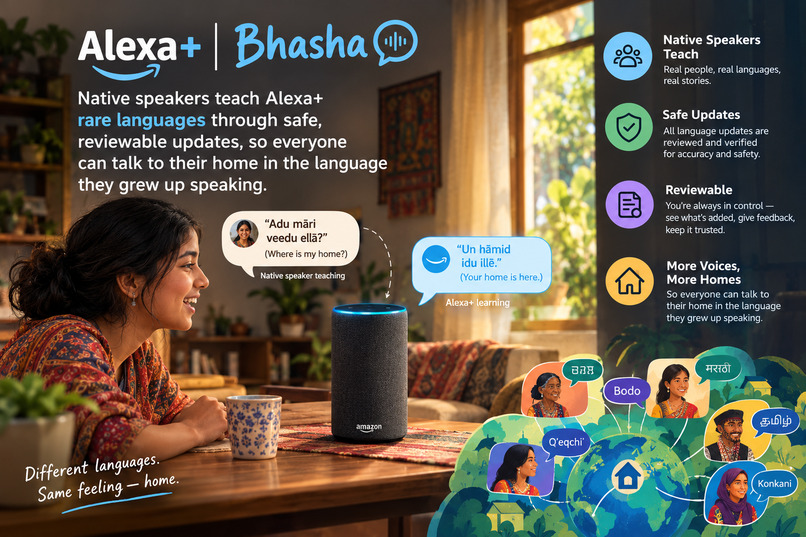
alexa-plus-bhasha
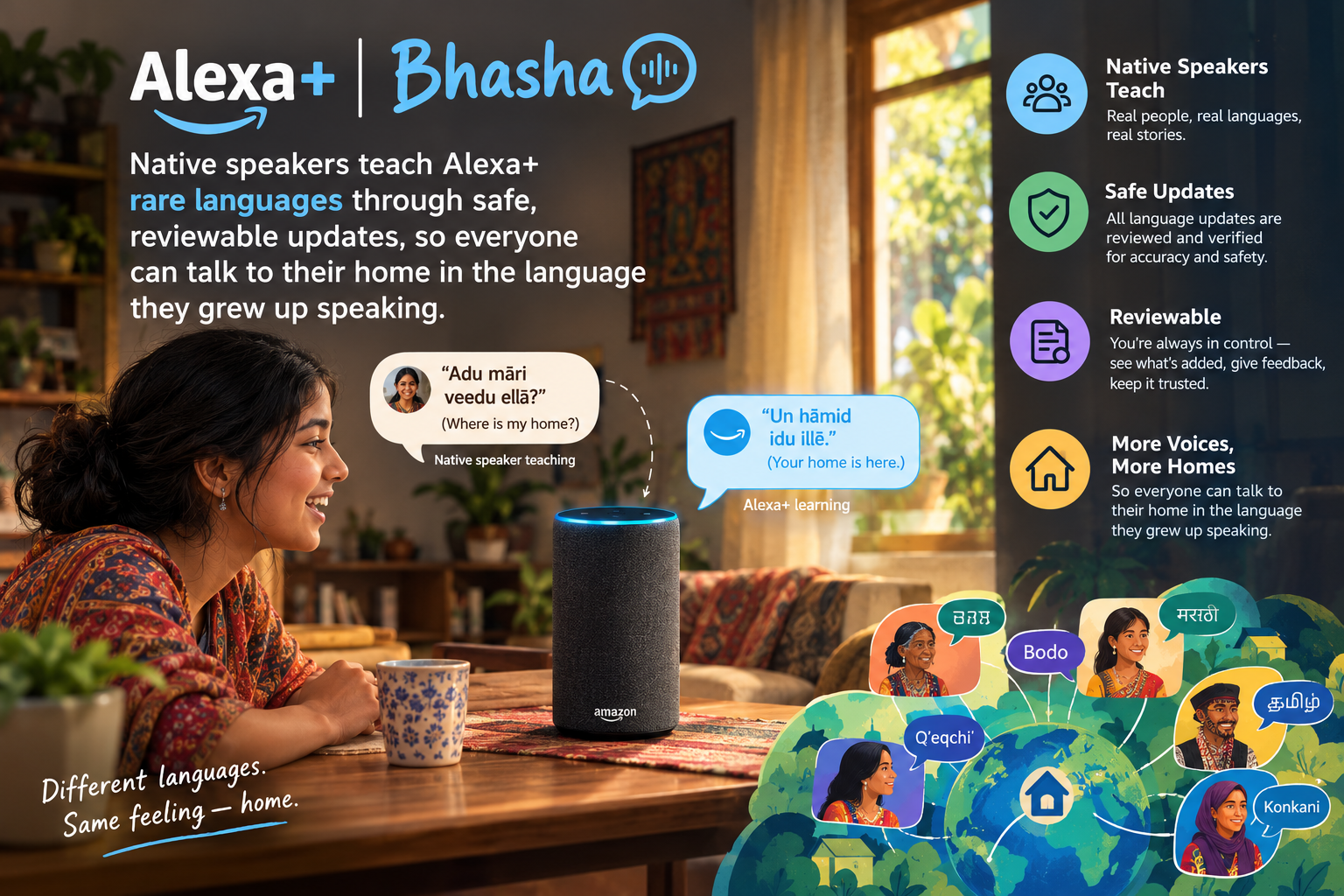
Inspiration
Alexa+ launched in India with English, Hindi and Hinglish, and Amazon has said more Indian languages are coming, but without a timeline. That left us thinking about everyone whose home language isn't on the list yet: grandparents, people with low literacy, and families who speak a regional or rare language every day. For them, voice is the easiest way to use technology, and it still doesn't speak their language.
A simple way to see the gap:
$$ \text{Language coverage} = \frac{\text{languages Alexa+ supports}}{\text{languages people actually speak at home}} $$
For rare languages, this ratio is close to zero. We wanted to push it up without waiting for a full rebuild every time.
Alexa+ Bhasha — Every language deserves a voice.
What it does
Alexa+ Bhasha is an MCP-style "change maker" that lets an AI model propose language changes for Alexa+ in a safe, reviewable way:
- A model drafts a change, such as a routine, a response style, or a set of phrases in a new language.
- A human previews exactly what the change would do.
- The change goes live only after explicit approval.
- Any change can be rolled back.
A native speaker of a rare language can help teach Alexa+ their language through reviewed updates, instead of waiting for a large release.
How we built it
- Python and the Model Context Protocol (MCP) SDK (
FastMCP) for the server. - Six tools exposed to the model:
list_change_kinds,create_change,list_changes,preview_change,apply_changeandrollback_change. - A draft → confirm → apply → rollback flow. A change is applied only when
$$ \text{apply}(c) = \begin{cases} \text{run} & \text{if } \texttt{confirm} = \text{true} \ \text{reject} & \text{otherwise} \end{cases} $$
- Changes are stored as JSON with status and history, so every action is traceable.
- An
AlexaAdapterlayer isolates the Alexa+ side. In this version it is simulated, and it is designed to be swapped for real Alexa developer API calls.
[Add here: the rare language you chose for the demo and the commands you showed.]
Challenges we ran into
- No direct Alexa+ access. We couldn't change Alexa+ itself, so we built the adapter as a clean boundary and simulated the apply and rollback steps.
- Safety. Letting a model change a voice assistant is risky, so we made human approval and rollback core to the design instead of an add-on.
- Rare-language data is scarce. There are few datasets and fewer verified speakers, so the design relies on native-speaker review rather than trusting the model alone.
- Scope. Language support is huge, so we focused on a small set of everyday commands for one language to keep the demo honest.
Accomplishments that we're proud of
- A working MCP server with a complete draft, preview, approve and rollback cycle.
- A safety-first design where nothing changes without human confirmation.
- A clear, evidence-based problem: Alexa+ in India covers English, Hindi and Hinglish, and other Indian languages have no announced timeline.
- A design that can grow from one language to many without redesigning the system.
[Add here: anything you actually achieved, such as a working demo in your chosen language or feedback from a native speaker.]
What we learned
- How MCP lets a model call well-defined tools instead of taking free-form actions, which makes AI-driven changes easier to control and audit.
- That the hard part of rare-language support isn't only the model, it's trust: who verifies a language pack, and how to undo a mistake.
- How Alexa+ currently handles languages, and where the real gaps are.
- To design for review first: draft, preview, approve, rollback.
What's next for Alexa+ Bhasha
- Connect the adapter to real Alexa and Alexa+ developer APIs.
- Add a
create_language_packtool and a native-speaker review screen. - Grow from one language to many, with community contributors verifying each pack.
- Add voice-first onboarding so low-literacy users can contribute and review by speaking.
Built with: Python, MCP (Model Context Protocol), JSON storage
Built With
- accessibility
- alexa
- alexa-plus
- amazon-alexa
- indian-languages
- low-resource-languages
- multilingual
- natural-language-processing
- rare-languages
- voice-ai


Log in or sign up for Devpost to join the conversation.