-
-
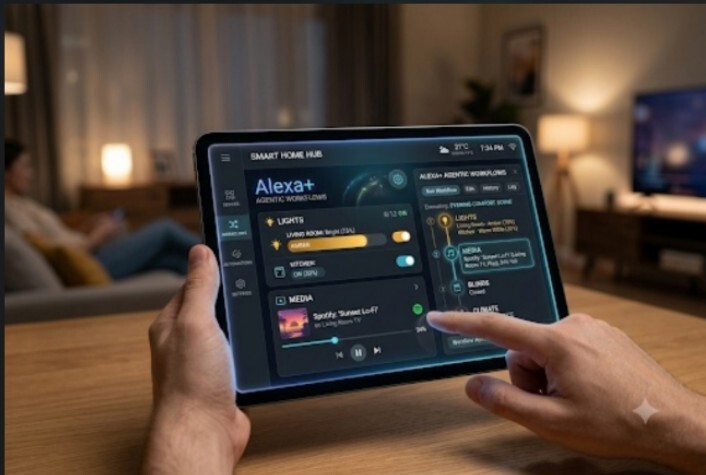
Alexa+
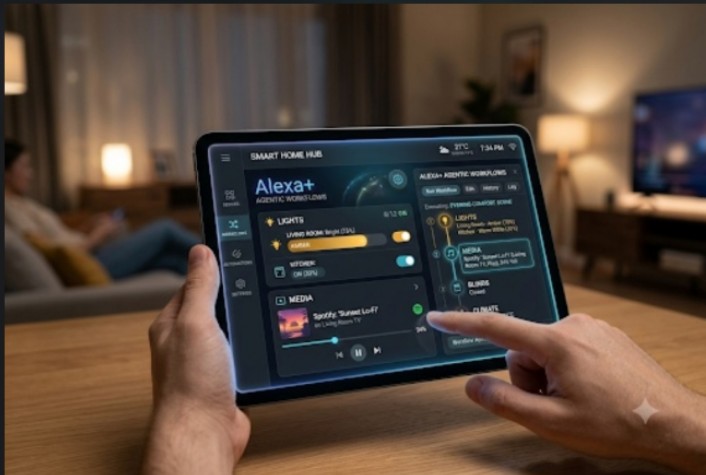
Inspiration Traditional voice assistants often struggle with multi-step tasks, requiring repetitive manual commands for every action. We were inspired to reimagine Alexa as a truly proactive, agentic assistant—moving beyond simple command-and-response mechanics toward autonomous problem-solving. By integrating generative AI with function-calling capabilities, we aimed to transform Alexa into an intelligent agent capable of understanding complex user intents, breaking them down into dynamic execution plans, and carrying them out seamlessly across smart home devices and external APIs. What it does Alexa+ Agentic Workflows turns natural voice instructions into autonomous multi-step execution plans. Instead of executing isolated actions, the system breaks complex goals—such as "Prepare my home for movie night and order dinner"—into a structured dependency graph. It coordinates smart lighting, climate controls, media systems, and third-party services sequentially or in parallel. The assistant proactively monitors task execution, handles edge cases dynamically, and remembers context across interactions to anticipate user needs without requiring constant manual intervention. How we built it We built the solution using a modular, event-driven architecture powered by modern LLMs and function-calling agent frameworks:
- Natural Language Understanding & Intent Planning: Input voice streams are processed to extract complex intents. An LLM agent parses these into an acyclic task graph G = (V, E), where V represents individual API or device actions, and E represents execution dependencies.
- Agentic Execution Engine: Developed using Python and asynchronous microservices to trigger parallel functions while enforcing ordering constraints.
Context & Memory Store: Integrated a vector database using cosine similarity to retrieve past preferences and user habits:
API & IoT Integration: Connected mock smart home controllers (MQTT/REST APIs) and external service integrations to demonstrate real-world execution. Challenges we ran into
Latency Management: Coordinating multiple LLM reasoning calls and API requests created noticeable delay. We resolved this by streaming partial responses and executing independent tasks in parallel.
Cascading Failures: If an intermediate API step failed (e.g., a service timeout during ordering), downstream tasks stalled. We implemented dynamic recovery loops and fallback routing to renegotiate failed steps gracefully.
Context Drift: Maintaining consistent state across multi-turn, multi-device workflows required careful state serialization and memory indexing to avoid execution errors. Accomplishments that we're proud of
Successfully demonstrated autonomous multi-step execution from a single, unstructured voice command.
Engineered a flexible, fault-tolerant orchestrator that dynamically adjusts plan steps when external APIs fail.
Built a lightweight memory module that delivers highly personalized workflow execution based on historical user interactions. What we learned
Tool-Use Reliability: Designing clear, unambiguous tool schemas for LLM function calling is critical to preventing agent hallucination and misfire.
Asynchronous Orchestration: Asynchronous execution and dependency graphing are essential for keeping real-time voice interactions responsive.
User Safety in Agentic Systems: Multi-step autonomous actions require guardrails and explicit confirmation prompts for high-stakes actions like financial transactions or security adjustments. What's next for Alexa+ Agentic Workflows
Edge Intelligence: Deploying lightweight local models to reduce latency and allow offline execution for localized smart home workflows.
Cross-Agent Collaboration: Enabling Alexa+ to coordinate directly with third-party specialized agents (e.g., calendar schedulers, travel agents) via standardized protocols.
Predictive Workflow Triggering: Moving from reactive voice triggers to proactive ambient suggestions based on real-time sensor data and routines.


Log in or sign up for Devpost to join the conversation.