-
-
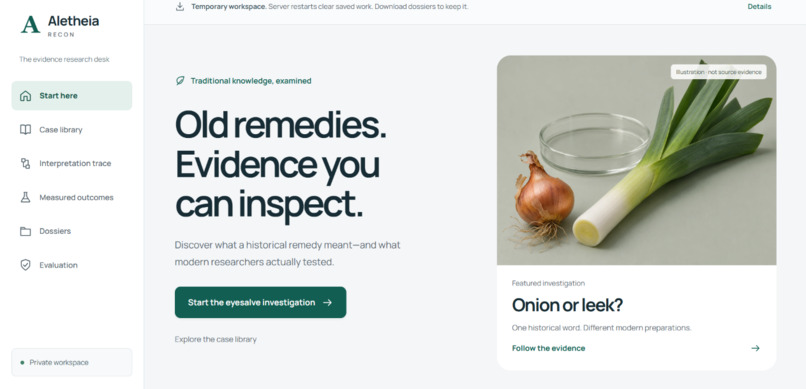
Hero
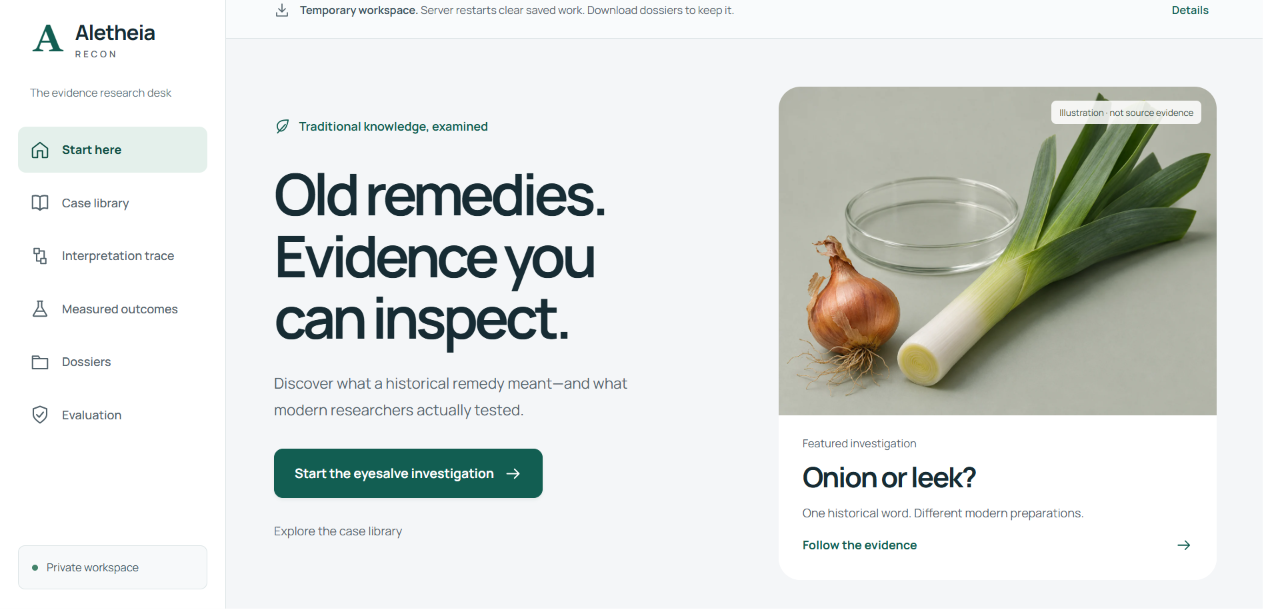
Inspiration
An old remedy and a modern study may use the same name. But did the study test the same plant, prepared the same way?
That question inspired Aletheia RECON.
Historical recipes reach us through different languages, editions and interpretations. An uncertain ingredient name can become a definite plant choice in a modern experiment. Other details, such as the plant part, preparation method or experimental setting, can change too.
We wanted to help researchers examine those connections carefully. Before relying on a study, they should be able to see what the historical source says, what the researchers tested, and which assumptions connect them.
What it does
Aletheia RECON is a research workbench that connects historical remedies with modern scientific evidence while keeping the sources and unresolved questions visible.
Our featured investigation explores the onion and leek readings of Bald’s eyesalve. A researcher can:
- Open the historical passage and inspect its source details.
- Explore competing plant interpretations and the passages supporting them.
- Temporarily exclude a source contribution and see which readings lose recorded support.
- Compare published measurements when the selected experimental records support that calculation.
- Save an analysis with its assumptions, references and results for later inspection and replay.
One interaction makes the idea especially clear: excluding an editor’s note removes the remaining recorded support for the third plant reading, while onion and leek retain their other support. Restoring the note restores that connection.
The measurement view follows the same care. Values link to their exact published table cells. Switching to an incompatible experiment produces “Ratio unavailable,” making the limit of the comparison visible.
How we built it
We built the interface with React and TypeScript, the server with Node.js and Fastify, and the saved-record system with SQLite.
The scientific checks use explicit rules over recorded preparation and experiment details. Source references, assumptions and missing information remain separate throughout the workflow.
Our examples use selected passages from public-domain historical editions and three open research papers. Records retain source locations, credits and permission details.
Saved analyses preserve the inputs and policy version behind a decision. Researchers can download a structured file and use the supplied replay tool to run that decision again without the live server.
We used Codex during research, implementation and testing.
Challenges we ran into
The hardest challenge was defining what a meaningful match should require. A shared plant name is only one detail. The preparation, other ingredients, experimental conditions and measured outcome also matter.
We had to preserve uncertainty without making the product difficult to use. A researcher needed to understand why a result changed, or why the available records could not establish a match.
Reproducibility brought another challenge. A saved analysis must remain tied to its original inputs, even when records later change. At the same time, exports must respect permissions that may prevent us from including an original source text.
We also redesigned the interface around a guided investigation so people could understand the purpose before opening the deeper research tools.
Accomplishments that we're proud of
We built and deployed a working journey from historical source inspection to interpretation tracing, experiment comparison and a downloadable analysis.
We also tested our source lookup against comparison methods. On a small development fixture with known query fields, RECON located all 16 expected cells from one published table and rejected all 16 deliberately mismatched requests. It tied BM25 with the same exact context filters.
The verified release passed 268 software tests. We also checked the public application in Chromium, Firefox and WebKit.
These results demonstrate specific software capabilities. Independent expert review of our historical annotations is still pending, and the lab comparisons do not establish clinical benefit.
What we learned
A useful research result can be a clearly explained gap. Knowing which source or preparation detail needs checking can help a researcher decide what to investigate next.
We also learned why strong baselines matter. Comparing against filtered BM25 helped us identify what our small evaluation actually showed: enforcing known context prevents misleading matches within the tested records.
Building the product reinforced the importance of making those limits understandable on screen.
What's next for Aletheia RECON
Our first priority is independent review with historians and relevant scientific experts.
We then want to expand the cases and languages, build a larger independently reviewed evaluation set, and test the workflow with researchers doing real investigations.
The goal is practical: help researchers understand which evidence connections they can inspect, which assumptions remain open, and what would make the next experiment worth doing.
Built With
- fastify
- node.js
- openai
- playwright
- react
- render
- sqlite
- typescript
- vite
- vitest
- zod
