-
-
Thumbnail
Inspiration
History is often taught as facts and outcomes rather than understanding why events happened. We wanted to make history interactive by letting students explore living historical worlds where AI characters think, communicate, and make decisions.
What it does
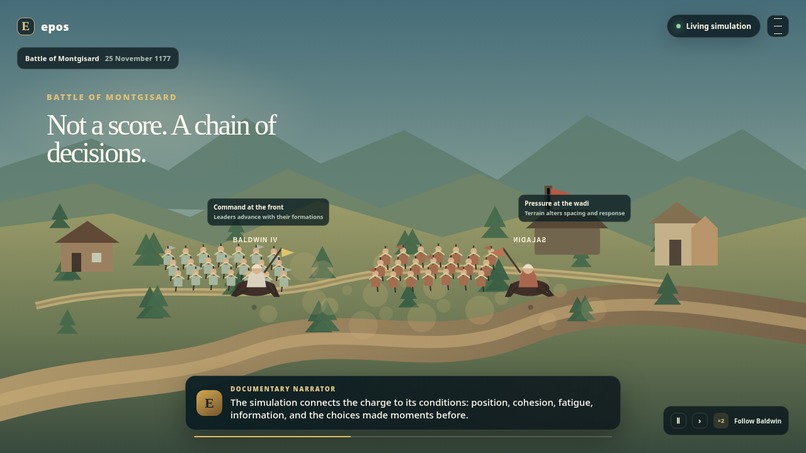
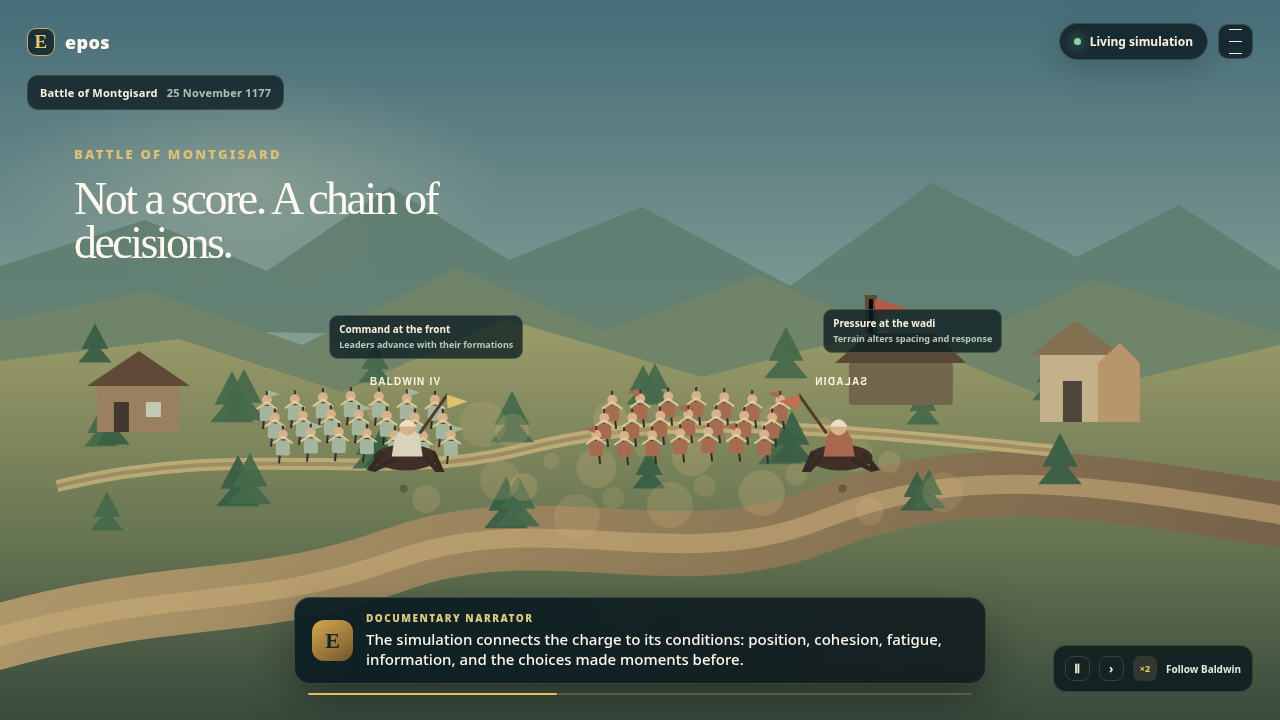
Epos is an AI-powered historical simulation platform where users explore historical scenarios through autonomous AI agents in a 3D world.
Instead of focusing on winning battles, Epos helps learners understand how logistics, weather, diplomacy, trust, incomplete information, and civilian impact shape historical outcomes. Users can also explore "what-if" scenarios and compare them with real history.
How we built it
We built Epos using Next.js, React, React Three Fiber (Three.js), TypeScript, and Tailwind CSS.
GPT-5.6 powers the historical reasoning and AI dialogue, while Codex accelerated development, architecture, and implementation of the multi-agent simulation.
Challenges we ran into
Balancing historical accuracy with dynamic AI behavior was our biggest challenge. We also had to design agents with limited knowledge so information spreads naturally instead of every character knowing everything.
Accomplishments that we're proud of
We're proud of creating a living historical world where AI agents interact autonomously, making history feel like an interconnected system instead of a sequence of events.
What we learned
We learned that embodied AI can transform history education by encouraging curiosity, systems thinking, and exploration instead of memorization.
What's next for Epos
We plan to add more historical scenarios, richer AI behaviors, teacher-created learning missions, multiplayer classrooms, and support for additional educational simulations beyond history.
Built With
- gpt5.6
- nextjs
- react
- tailwindcss
- three.js
- typescript


Log in or sign up for Devpost to join the conversation.