-
-
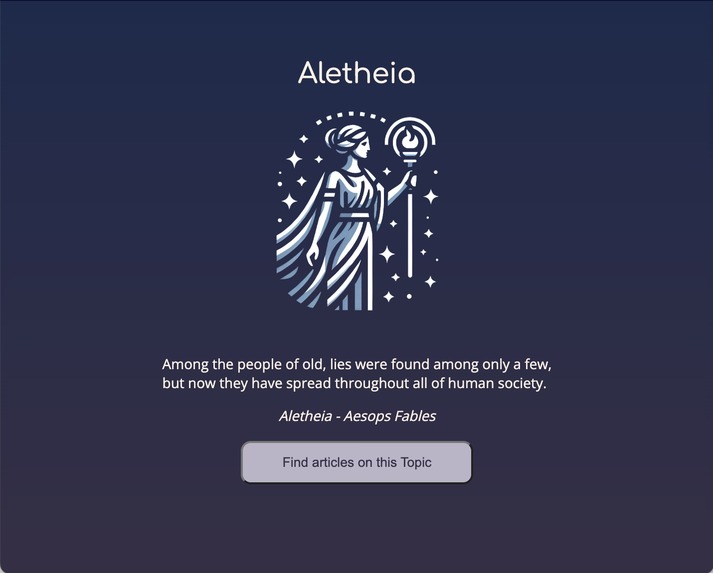
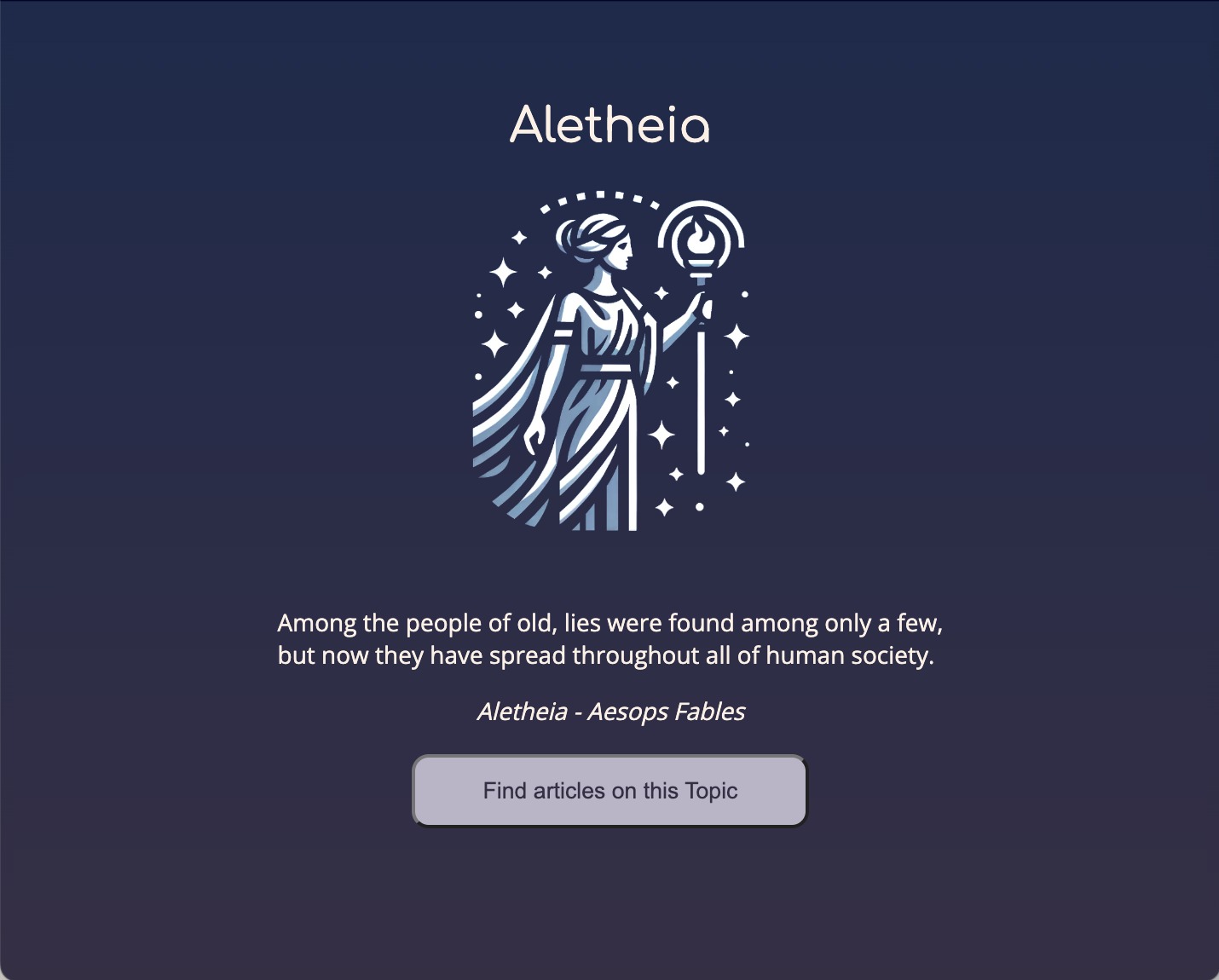
Screenshot of the web extension
Inspiration
In today's hyperconnected world, we are increasingly reliant on online information sources for our news and perspectives. The information sources online are structured to increase the number of clicks. However, this has also led to the rise of echo chambers and provocative content. This can lead to a polarised society and a decline in critical thinking.
The problem not only involves solving multiple nuanced problems on a large corpus of text, like neutral summarisation, extracting topics, and various other metrics like bias, but also using these as context for further transformations. Truly automating this entire pipeline would not be possible without cutting edge AI language models that can operate at scale like Claude.
The Application
Aletheia integrates with your web browsing experience, by first scanning the current article, identifying the key points, and then scouring the web for articles presenting diverse viewpoints. Once gathered, the application would then meticulously analyze each article, extracting its main arguments and assigning a bias rating based on its tone, language, and sources.
This carefully curated selection of diverse viewpoints is then presented to you in a concise and easy-to-understand format, allowing you to quickly grasp the different perspectives on the issue. It then also prioritizes the least biased articles, guiding you towards reliable and objective sources of information.
How we built it

Sure, here is a breakdown of how the application works:
User Interaction : The user encounters an article they wish to analyze and clicks on the browser extension button.
Article Scraping and Topic Extraction : The Python backend scrapes the content of the article and extracts the leading topic using Claude.
Topic Augmentation: To ensure diverse viewpoints, the backend performs topic augmentation by identifying related or opposing terms and phrases.
Web Search with Brave Search API: The backend utilizes the Brave Search API to conduct a web search for articles related to the original topic and its augmented versions.
Article Analysis: Each retrieved article is scraped for its content, and then summarized and analyzed for bias using natural language processing techniques.
Response Generation and Delivery: The backend compiles the analysis results, including article summaries, bias ratings, and links to the original articles. This response is sent back to the browser extension.
Impact
Breakdown echo chambers: Provides a balanced and unbiased view of any given topic, empowering individuals to make informed decisions based on a holistic understanding of the issues at hand.
Foster informed engagement: Equips people with the tools they need to navigate the complex and often misleading world of information, contributing to a more informed and engaged society.
Challenges we ran into
- Augmenting the topics and choosing the set was a hard problem to solve for all use cases. It required a bit of prompt engineering.
- Claude would sometimes output in weird format even if prompted for the desired output schema which lead to numerous breakages in between.
- Reliably parsing diverse html documents that were returned from search for processing posed challenges.
What we learned
Various prompt engineering techniques helped us make our application lot more reliable.
Building rich extensions, and hooking up interactive front end was a learning experience
What's next for Aletheia
Our next steps would involve refining our software program to improve its speed and accuracy of processing and analyses as well as reliability.
We would then work on implementing and integrating a chat interface within the browser extension. This would be an AI-powered chatbot amalgamation, empowered by Claude 2, which would provide an interactive dialogue beyond static summarisations, creating a richer, more customised experience for each user, entrusting the user with the capability to develop their opinion on articles and topics, instead of being bogged down by any echo chamber or bias.
We would also be working on retrieving overall social media perception regarding a topic that complements the article’s viewpoints so the user is made well aware of how the general public thinks about the topic under consideration.
We would also like to work on enabling the user to select specific text within any article to process and detect bias and sentiment analysis within specific statements in an article.
Built With
- brave
- claude
- flask
- javascript
- python


Log in or sign up for Devpost to join the conversation.