Inspiration
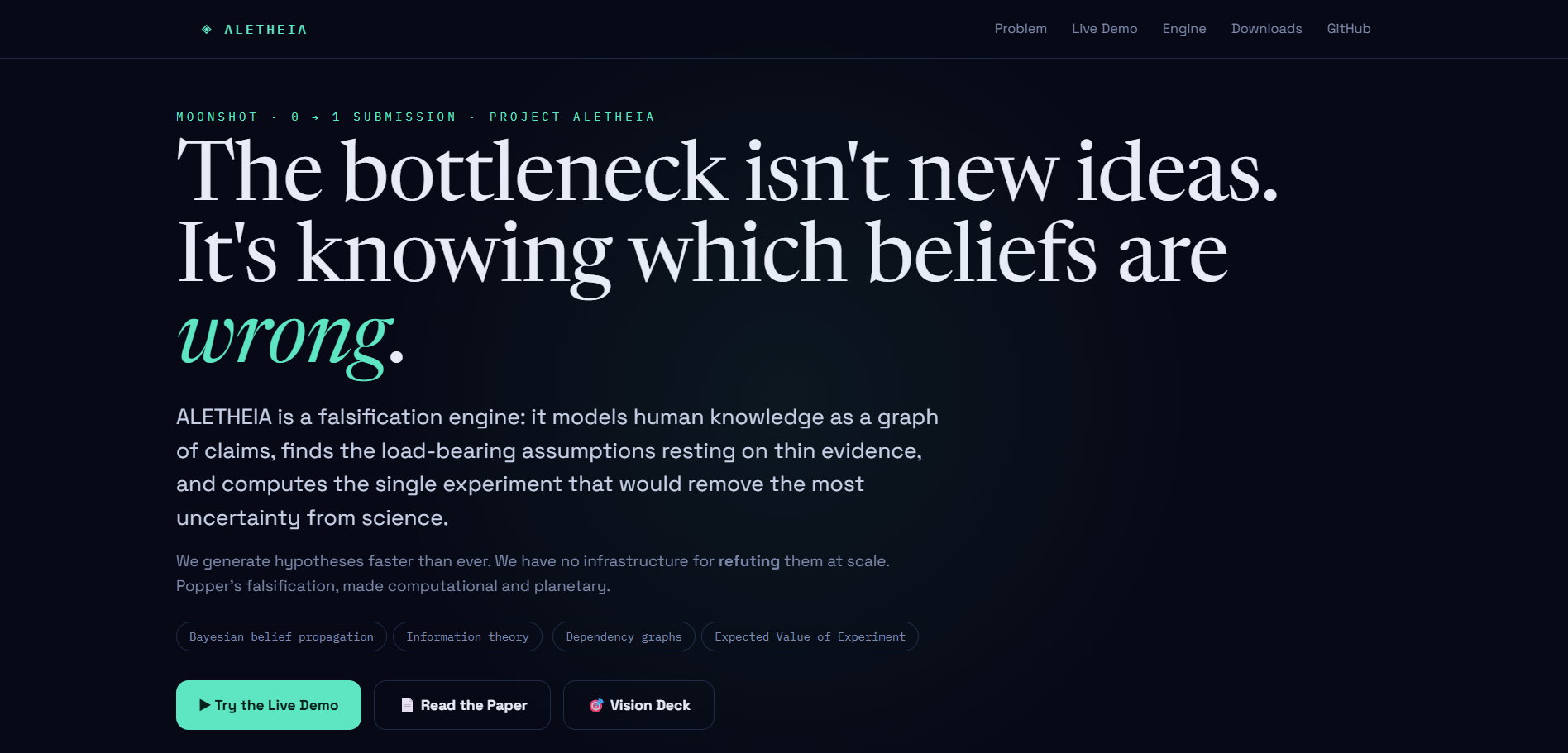
Scientific research is plagued by replication crises and a lack of systematic guidance on which experiment to run next. Researchers often rely on intuition rather than information-theoretic optimization. Popper's philosophy of science states that we can never prove a theory true, only falsify it. ALETHEIA (ancient Greek for "truth" or "disclosure") brings Popperian falsification into the computational age, treating human knowledge as a Bayesian network of claim dependencies and ranking experiments by their power to falsify or validate core assumptions.
What it does
ALETHEIA is a Falsification Engine. It:
- Models scientific or historical claims as a directed dependency graph.
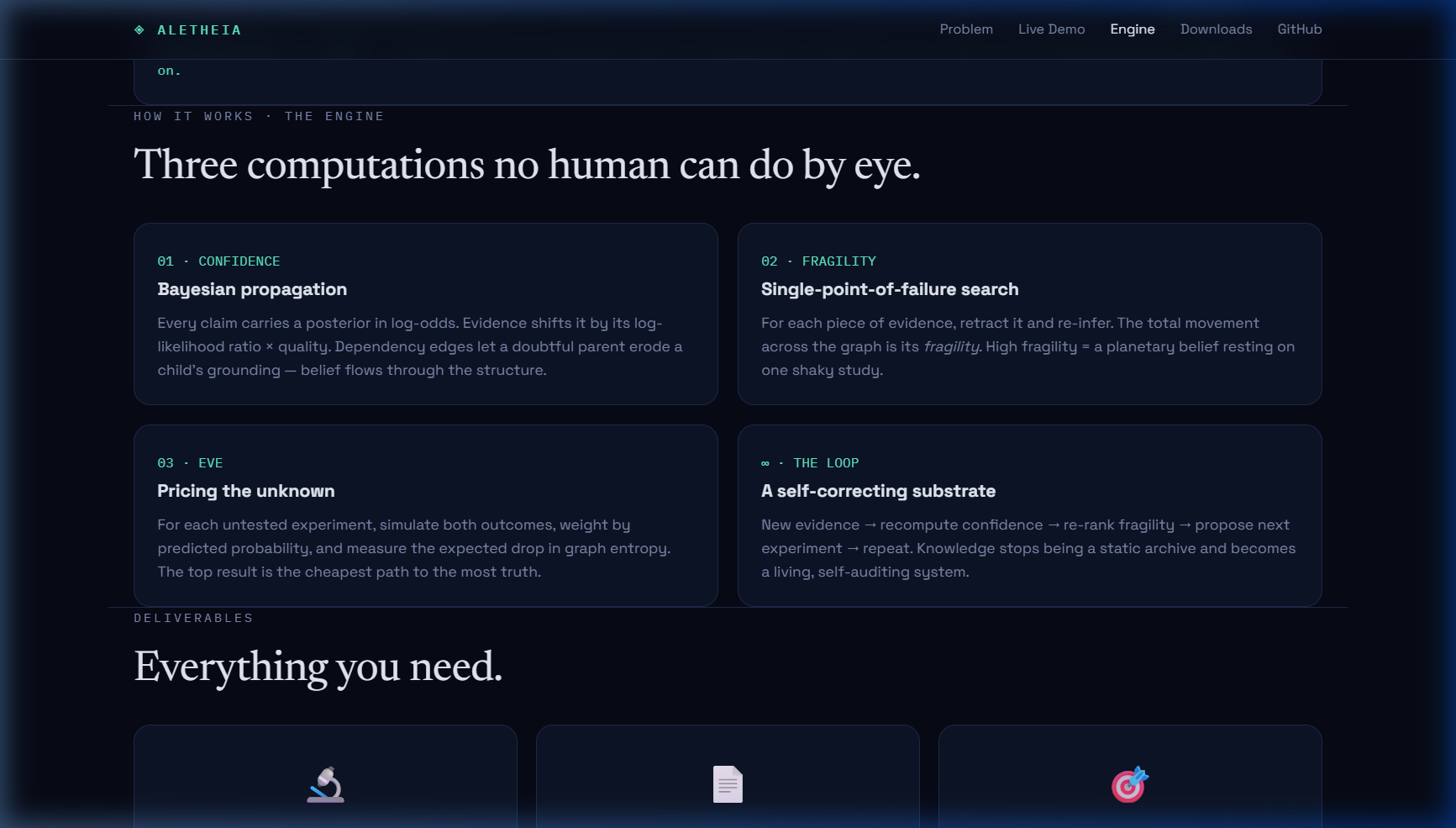
- Propagates belief probabilities using Bayesian inference and belief propagation.
- Identifies fragile claims and load-bearing assumptions that rest on thin evidence.
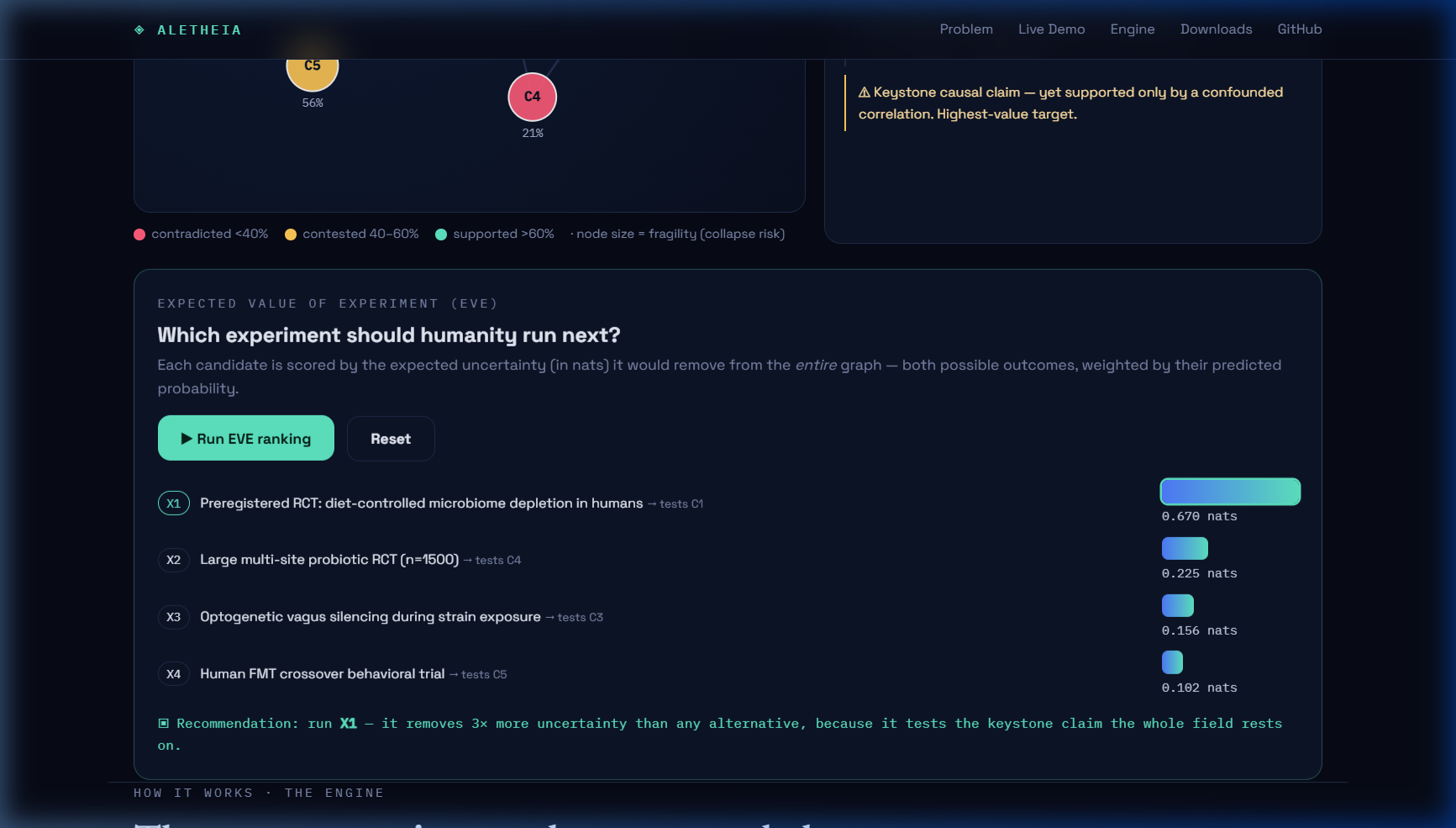
- Computes the Expected Value of Experiment (EVE) for potential experiments, ranking them by how much uncertainty (entropy) they would reduce in the network.
How we built it
- Backend: Built with Python, implementing a Bayesian belief network from scratch with exact inference for belief propagation and Shannon entropy calculations for EVE ranking.
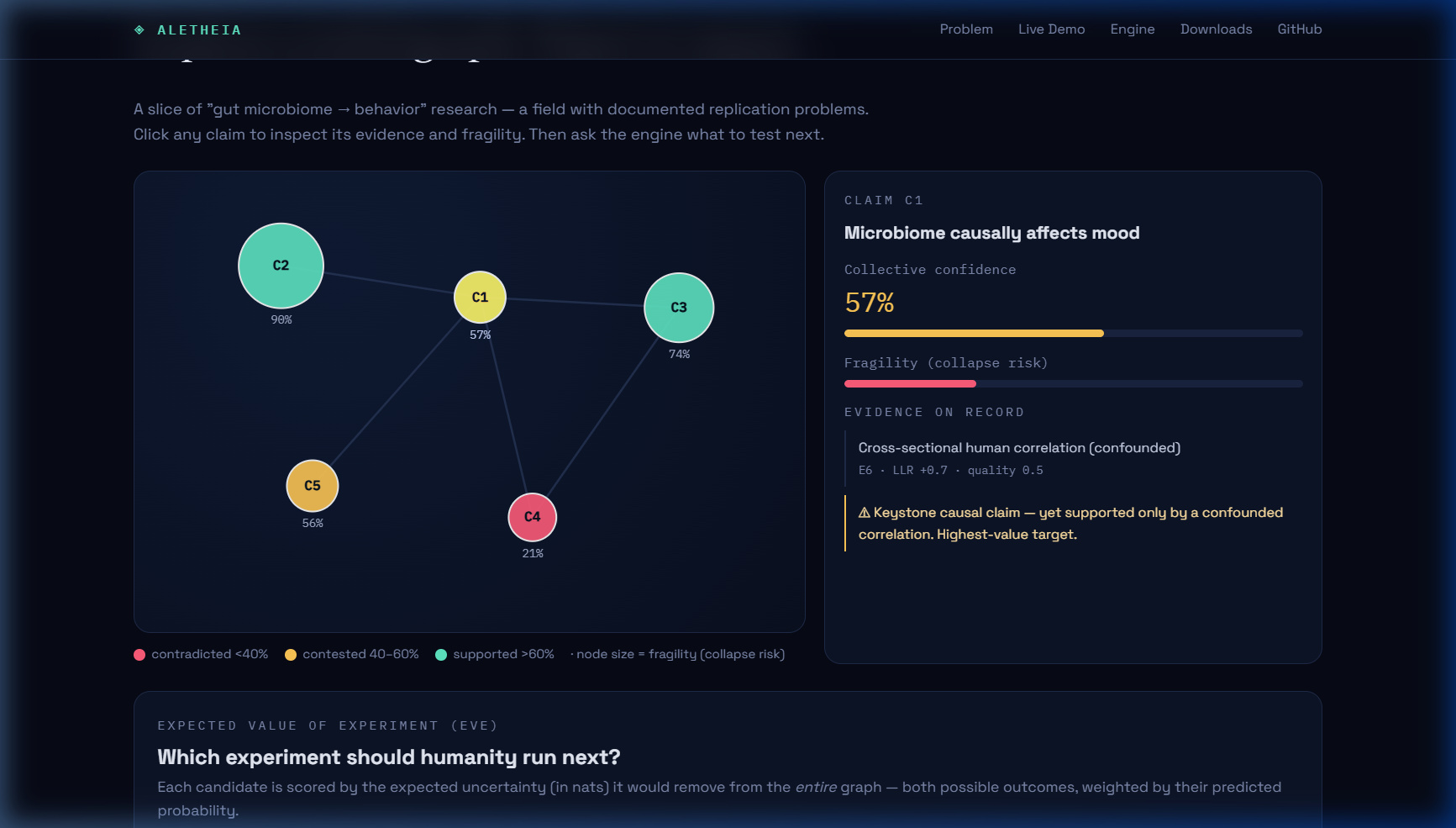
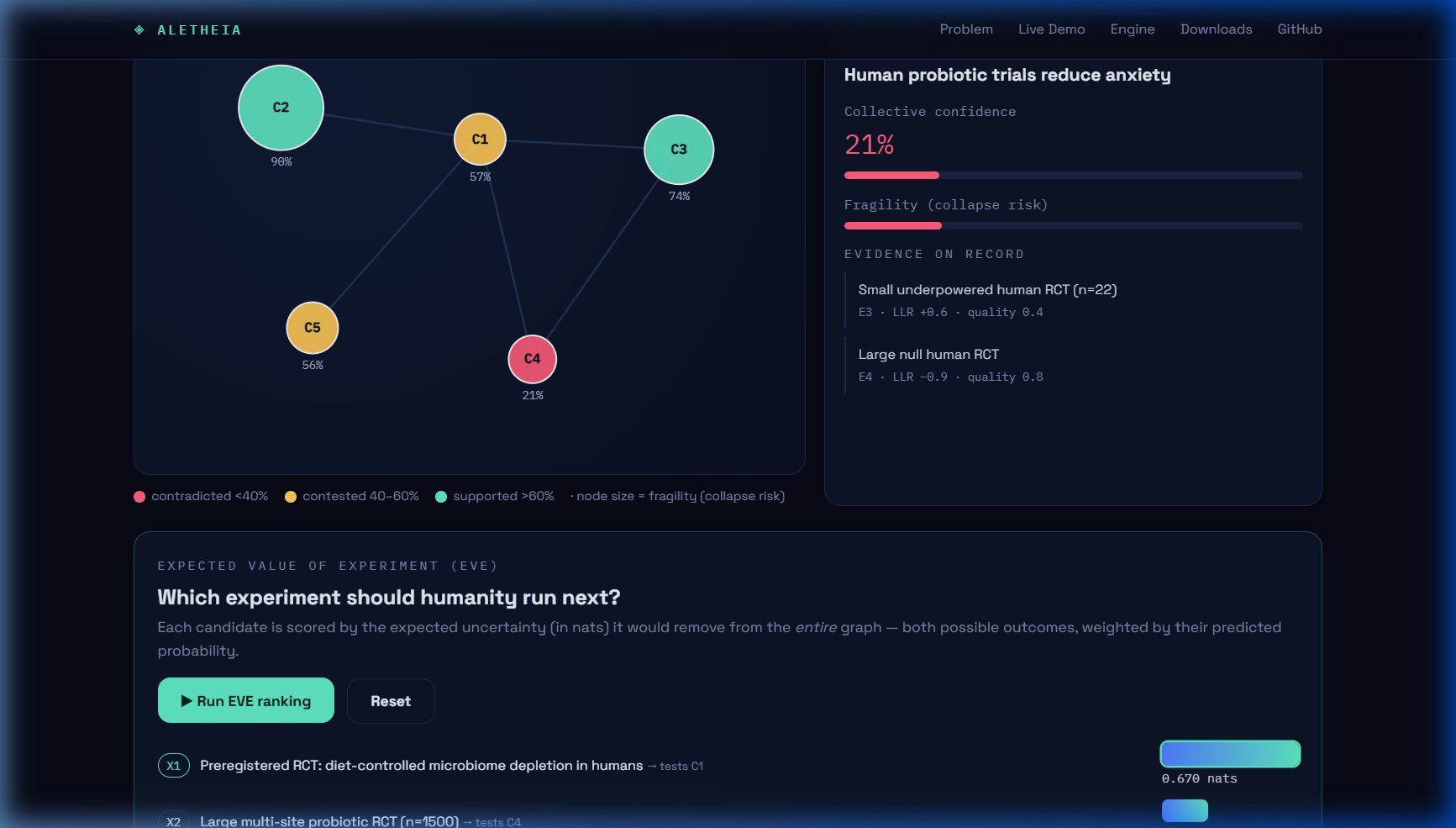
- Frontend: A highly polished, interactive HTML5/CSS3/JavaScript single-page application. We used Tailwind CSS for UI styling, and a custom interactive canvas/SVG-based graph visualization to show node states (confidence, fragility, evidence) and dynamically animate belief propagation.
Challenges we ran into
Designing a responsive, interactive claim network visualizer from scratch that clearly communicates complex Bayesian metrics (such as the difference between belief confidence, structural fragility, and evidentiary support) in an intuitive HUD-style interface. Also, ensuring that calculations of EVE for all nodes remained fast and interactive.
Accomplishments that we're proud of
We created a fully working interactive prototype that makes abstract Bayesian reasoning and information theory immediately understandable. The interface is beautiful, and clicking Claim nodes instantly updates the inspector HUD and shows where evidence is lacking. Running the EVE ranking dynamically animates the recommendations.
What we learned
How information-theoretic entropy and Popperian falsification can be beautifully unified under a single computational framework.
What's next for ALETHEIA
- Integrating LLMs to semantically parse scientific papers and automatically construct claim dependency graphs.
- Linking with real-world fact-checking databases and academic citation networks.
- Expanding the Bayesian backend to support loopy belief propagation for cyclic claim networks.
Built With
- bayesian-inference
- belief-propagation
- css3
- html5
- information-theory
- javascript
- python


Log in or sign up for Devpost to join the conversation.