Inspiration
Every day, millions of people spend hours searching across Google, documentation, research papers, blogs, GitHub repositories, and news articles just to answer a single question. Students preparing assignments, developers debugging complex issues, researchers reviewing literature, and professionals making business decisions all face the same challenge—information is abundant, but finding trustworthy and organized knowledge is difficult.
For example, a developer trying to understand the latest authentication practices might need to read official documentation, GitHub discussions, Stack Overflow answers, and blog posts before reaching a conclusion. Similarly, a student researching climate change may spend hours comparing reports from NASA, IPCC, and academic journals.
We wanted to build a system that doesn't just search—it understands the user's intent, gathers information from multiple sources, verifies it, summarizes it, and presents it in a structured way. That's how Aletheia was born: an AI-powered research assistant designed to transform hours of manual research into minutes.
What it does
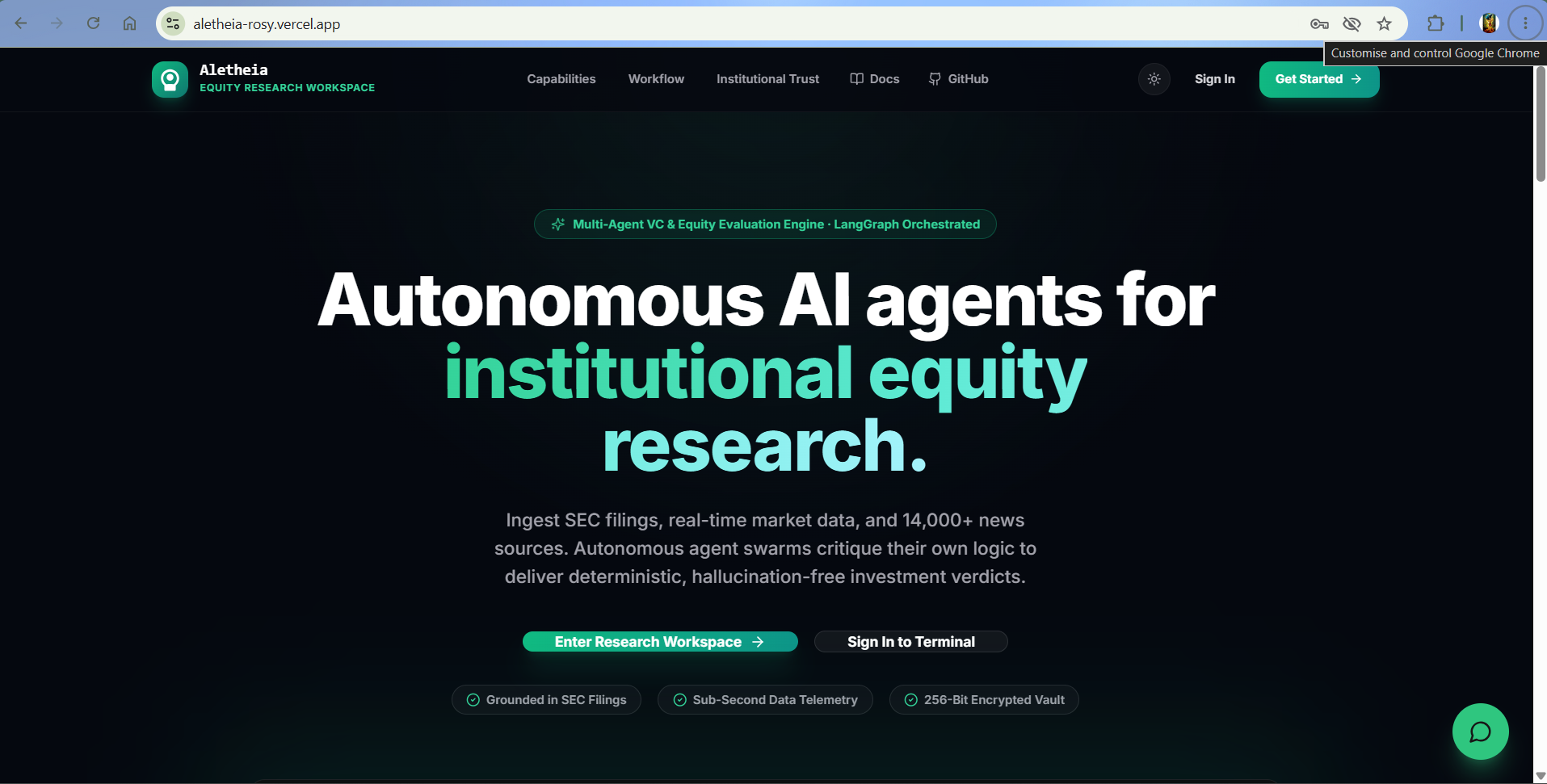
Aletheia is an AI-powered research platform that helps users discover, analyze, verify, and organize information from multiple trusted sources.
Instead of opening dozens of tabs, users can ask a research question in natural language. The platform uses AI agents to gather relevant information, summarize lengthy content, compare different viewpoints, and present concise, structured insights.
Some of the key capabilities include:
- 🔍 Intelligent research across multiple information sources
- 🧠 AI-generated summaries for lengthy documents and articles
- ✅ Source-aware responses that prioritize trustworthy information
- 📂 Organized workspace for managing research sessions
- 🤖 Multi-agent workflow where different AI agents handle searching, reasoning, summarization, and organization
Whether someone is preparing for an interview, exploring a new technology, researching market trends, or studying academic topics, Aletheia aims to simplify the entire research workflow.
How we built it
Aletheia is being built as a modern full-stack AI application.
Frontend
- React
- TypeScript
- Tailwind CSS
- Vite
The frontend provides an intuitive interface where users can ask questions, monitor research progress, and view organized AI-generated results.
Backend
- Node.js
- Express.js
- MongoDB
The backend manages authentication, user sessions, API communication, research history, and orchestrates the AI workflow.
Artificial Intelligence
- OpenAI API
- LangChain
- LangGraph
Rather than relying on a single prompt, we adopted an agent-based architecture. Different AI agents collaborate to perform specialized tasks such as searching, reasoning, summarizing, and organizing information before producing the final response.
The project is still actively evolving, and new capabilities are continuously being added.
Challenges we ran into
Building an AI research assistant involved several technical and design challenges.
One of the biggest challenges was orchestrating multiple AI agents so that they could collaborate without producing repetitive or conflicting responses.
Another challenge was ensuring that research outputs remained organized instead of overwhelming users with large blocks of generated text.
Handling long-context conversations while maintaining response quality also required careful workflow design.
On the engineering side, integrating the frontend, backend, AI services, and database into a smooth end-to-end pipeline required significant debugging and iteration.
Since Aletheia is still under active development, balancing feature development with reliability has been one of the most valuable learning experiences.
Accomplishments that we're proud of
We're proud of creating the foundation for an AI-powered research platform instead of just another chatbot.
Some achievements include:
- Successfully designing a multi-agent research workflow.
- Building a clean and intuitive research interface.
- Integrating OpenAI-powered reasoning into the application.
- Developing a scalable backend architecture for future expansion.
- Creating a platform that can eventually support students, developers, researchers, and professionals across different domains.
Although the project is still evolving, we've established a solid technical foundation that can support much more advanced research capabilities in the future.
What we learned
This project taught us that building AI applications is far more than connecting an LLM to a frontend.
We learned about:
- Designing AI agent workflows using LangGraph.
- Prompt engineering for reliable research tasks.
- Managing application state across multiple AI interactions.
- Structuring scalable full-stack applications.
- Improving user experience for AI-powered products.
- Handling API integrations and backend orchestration.
Most importantly, we learned that trustworthy AI isn't only about generating answers—it also needs to organize information, explain reasoning, and help users make informed decisions.
What's next for AletheiaOur vision for Aletheia extends far beyond its current capabilities.
Future plans include:
- 📄 Automatic citation generation with source references.
- 📚 Research paper and PDF analysis.
- 🌐 Live web research with trusted source ranking.
- 👥 Collaborative workspaces for teams and organizations.
- 🎙️ Voice-based AI research assistant.
- 📊 Visual knowledge graphs connecting related concepts.
- 🔄 Persistent research memory across multiple sessions.
- 🔌 Integrations with GitHub, Notion, Google Drive, and productivity tools.
- 📱 Mobile-friendly experience.
- ⚡ Faster agent orchestration and improved response quality.
Our long-term goal is to build an AI research companion that helps anyone—from students and developers to researchers and business professionals—find trustworthy knowledge faster, make better decisions, and spend less time searching for information.
Built With
- api
- css
- css3
- express.js
- git
- github
- html5
- javascript
- langchain
- langgraph
- mongodb
- node.js
- openai
- react
- render
- tailwind
- typescript
- vercel
- vite


Log in or sign up for Devpost to join the conversation.