-
-
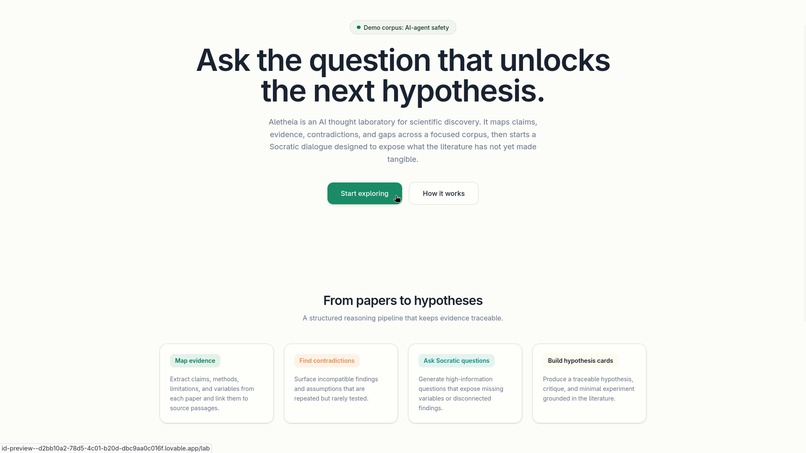
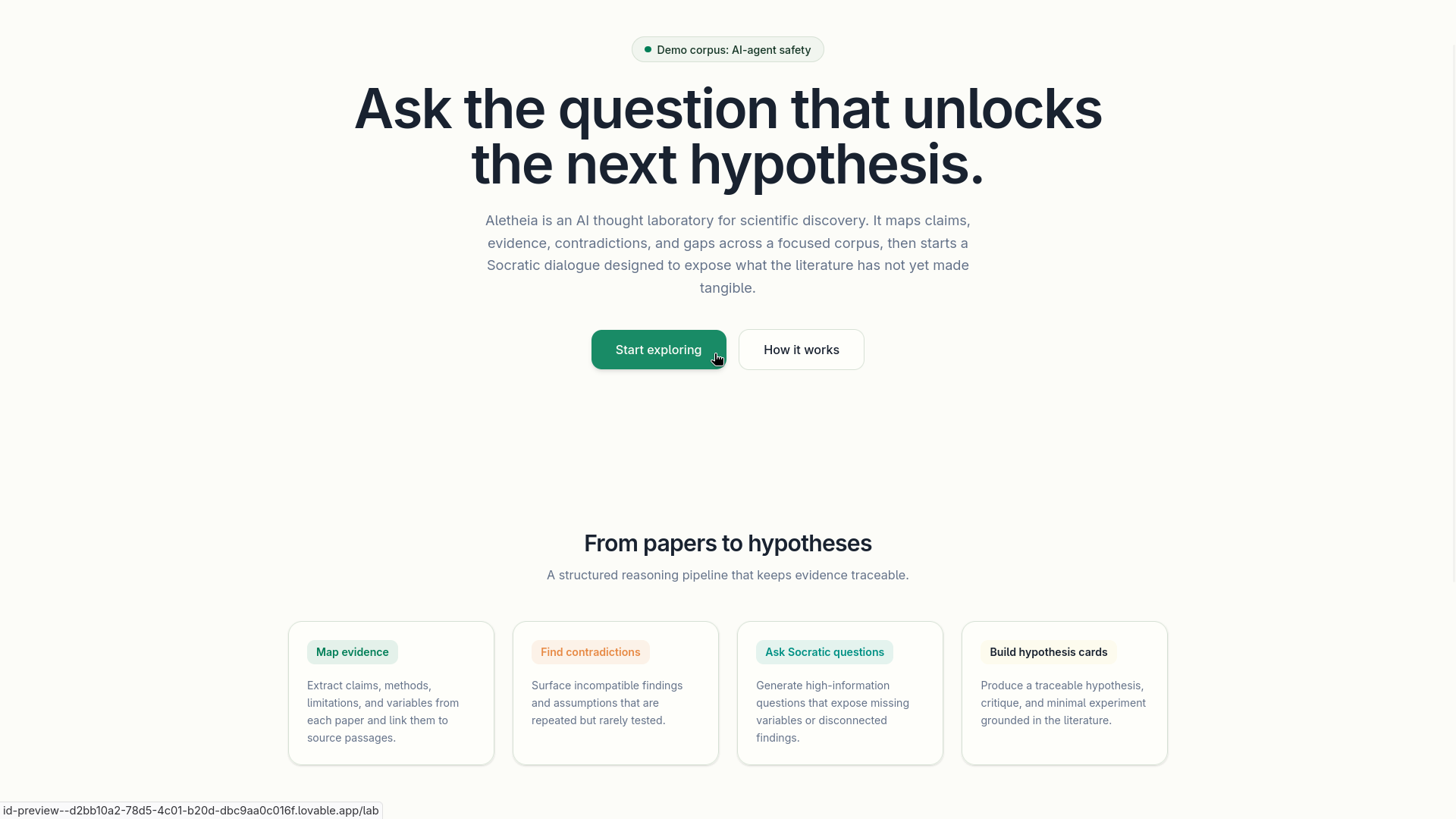
Aletheia’s landing page introduces a traceable workflow from scientific evidence to new hypotheses.
-
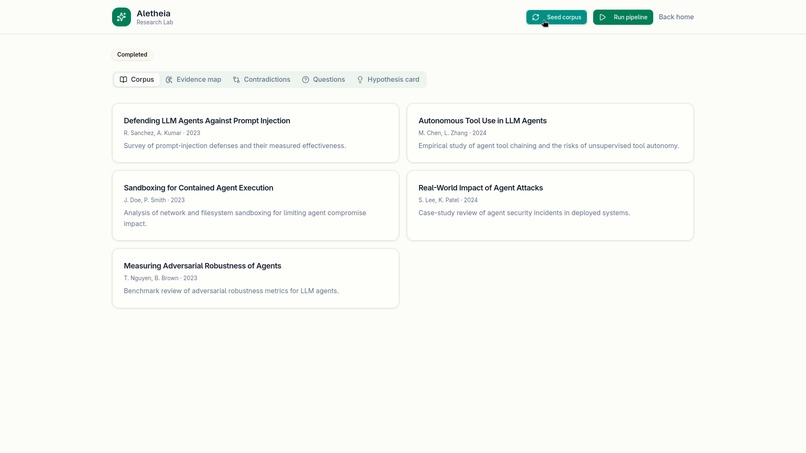
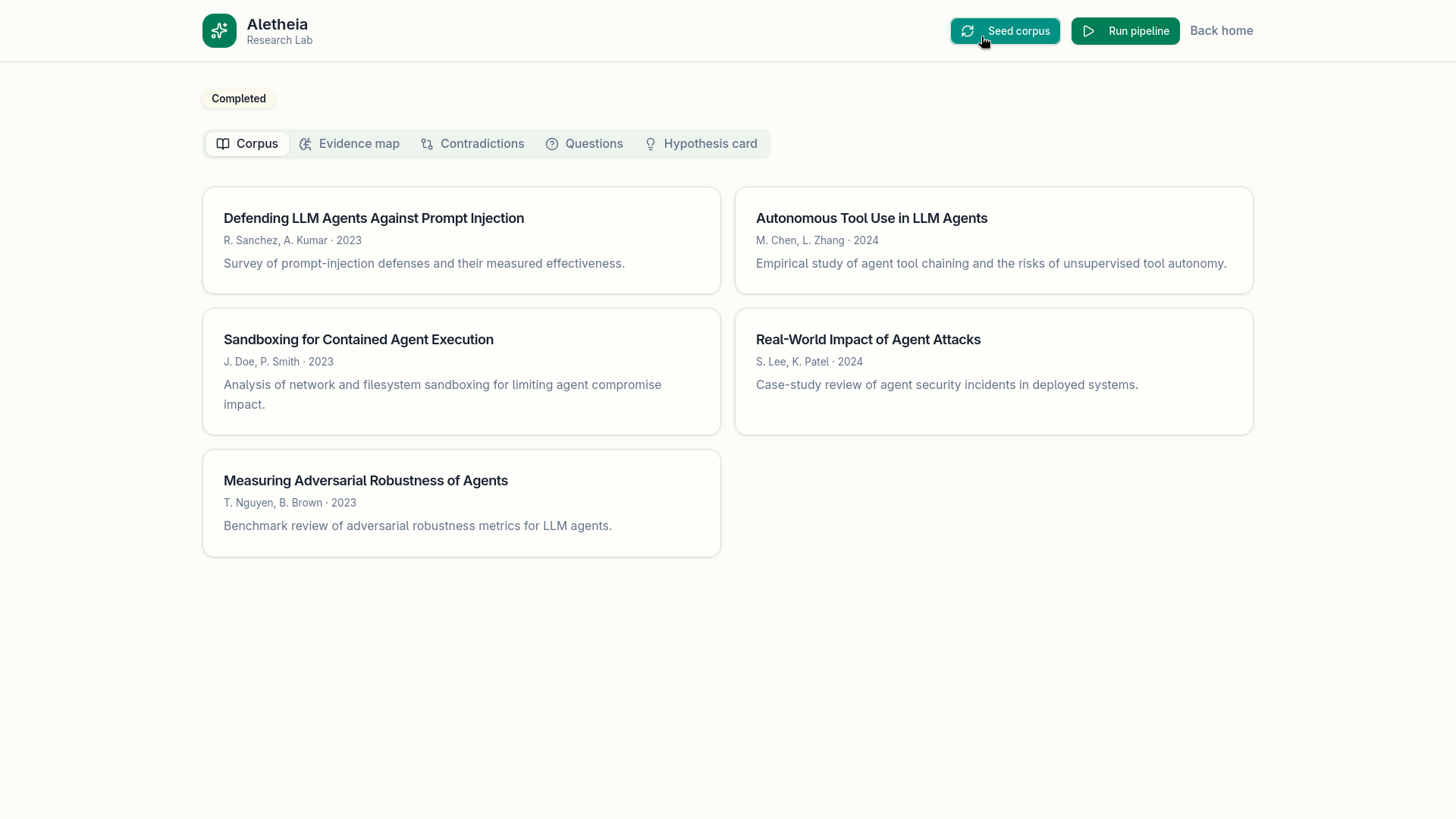
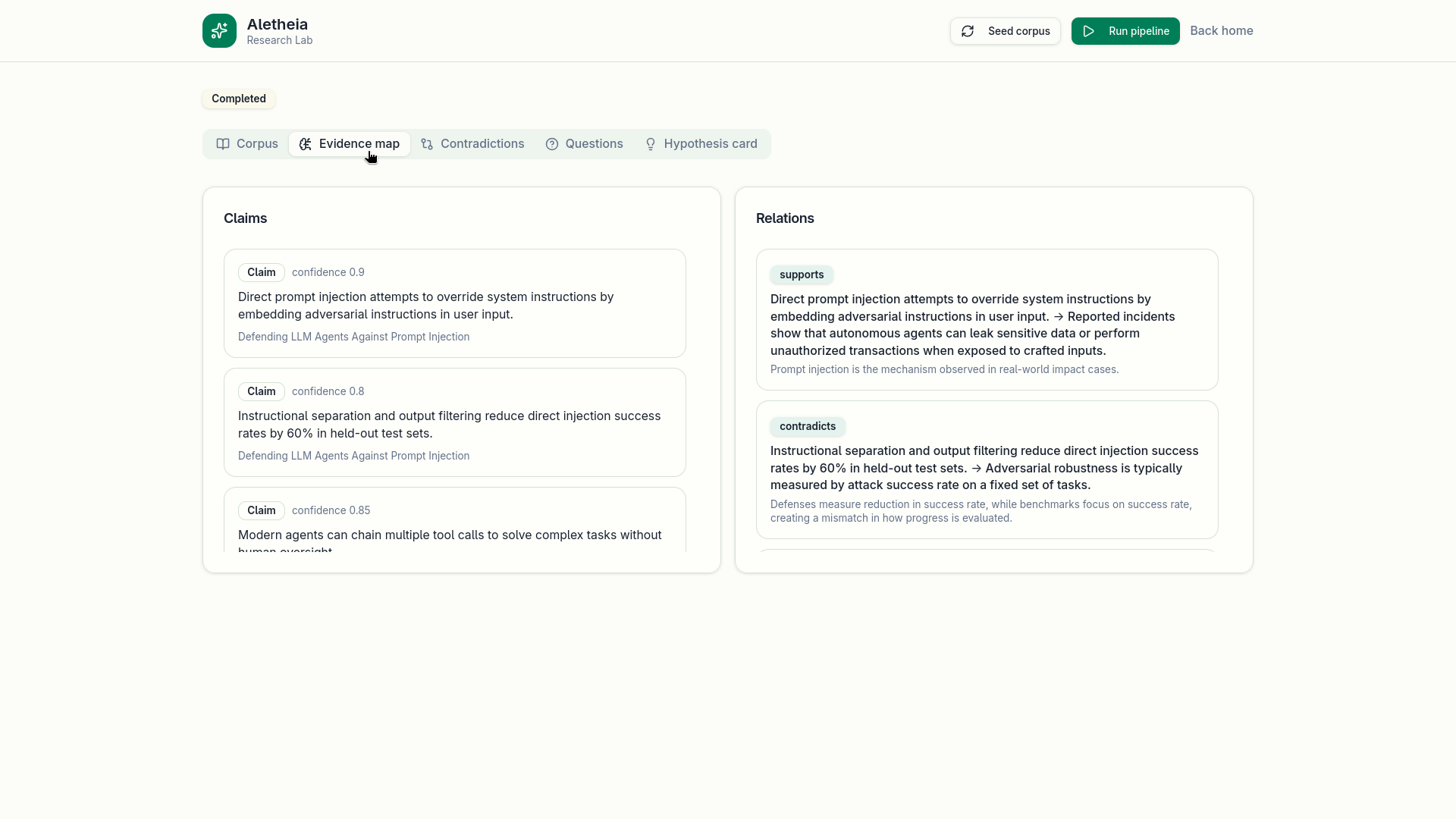
The seeded demo corpus contains five AI-agent safety sources on prompt injection, autonomy, sandboxing, impact, and evaluation.
-
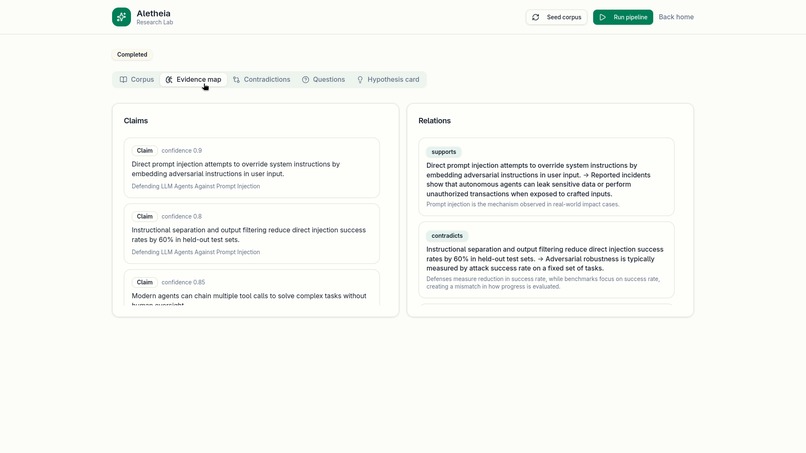
The evidence map connects extracted claims through support and contradiction relations.
-
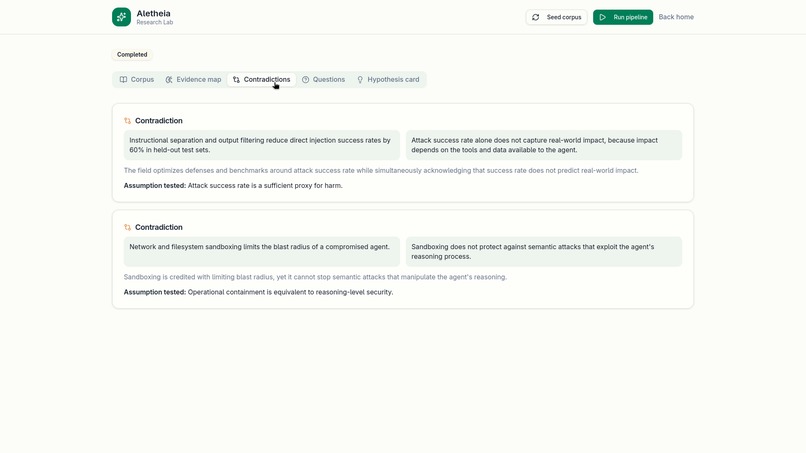
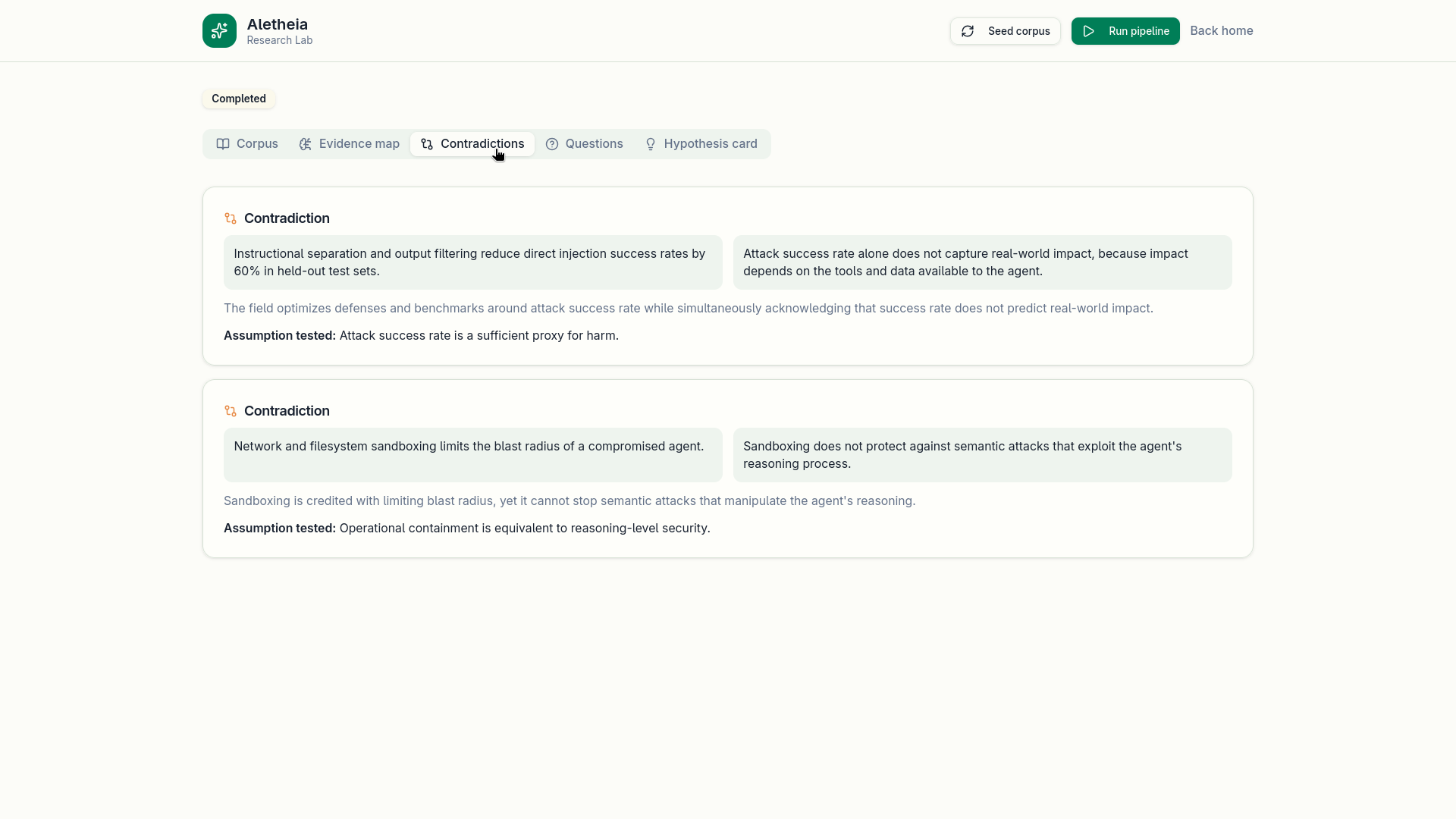
Contradiction detection reveals where common security metrics fail to explain real-world agent harm.
-
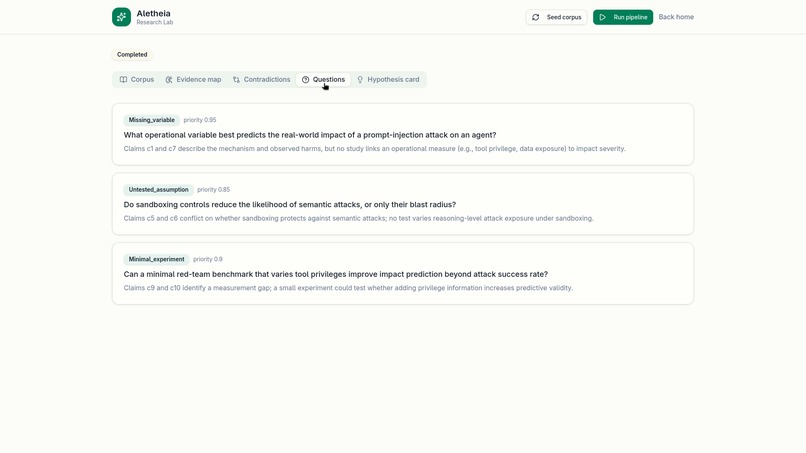
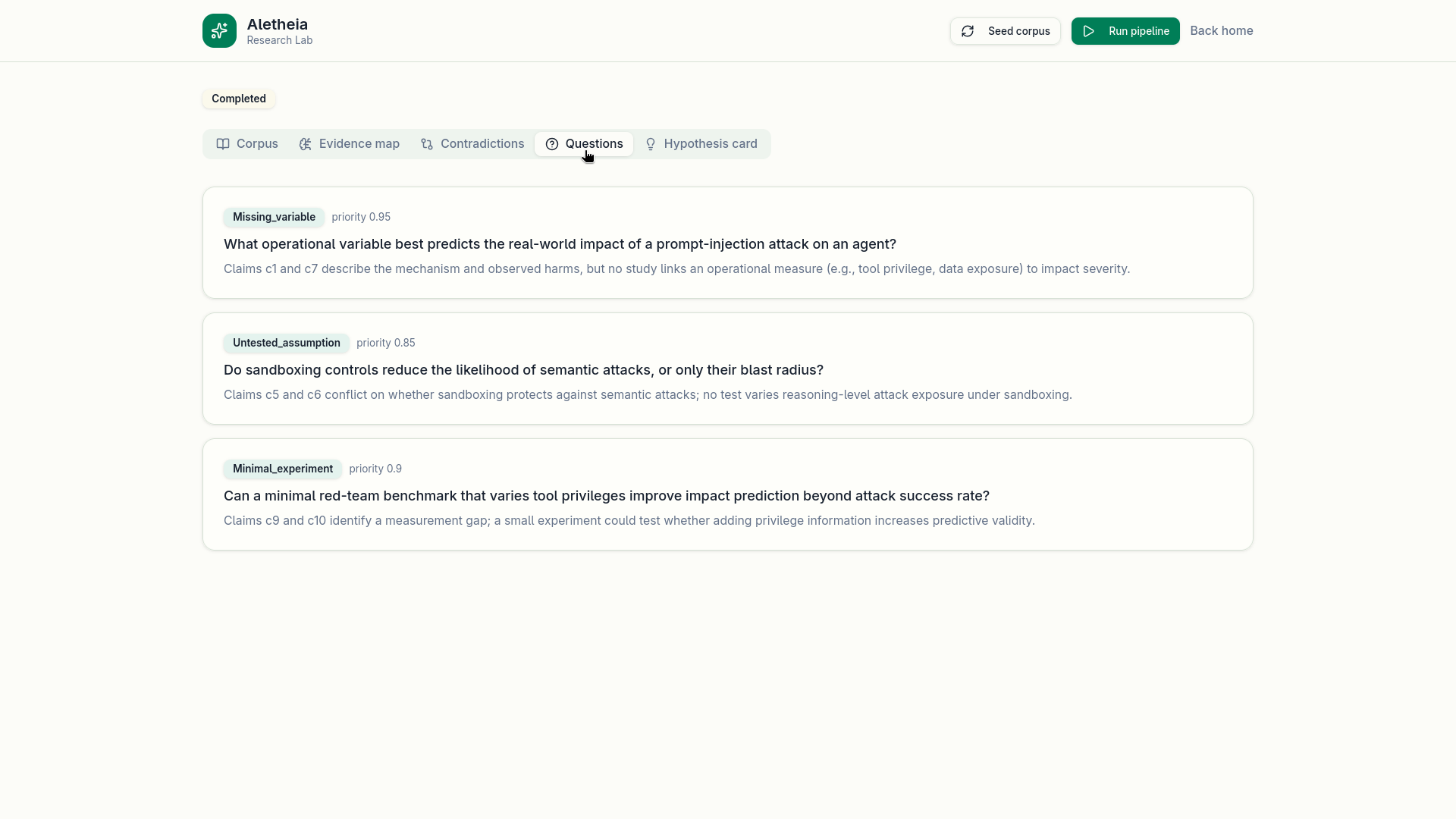
Socratic questions surface missing variables, untested assumptions, and high-value experiments.
-
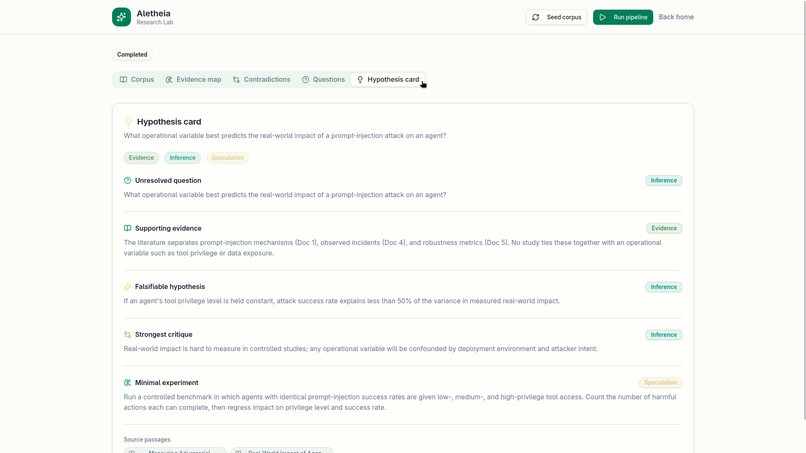
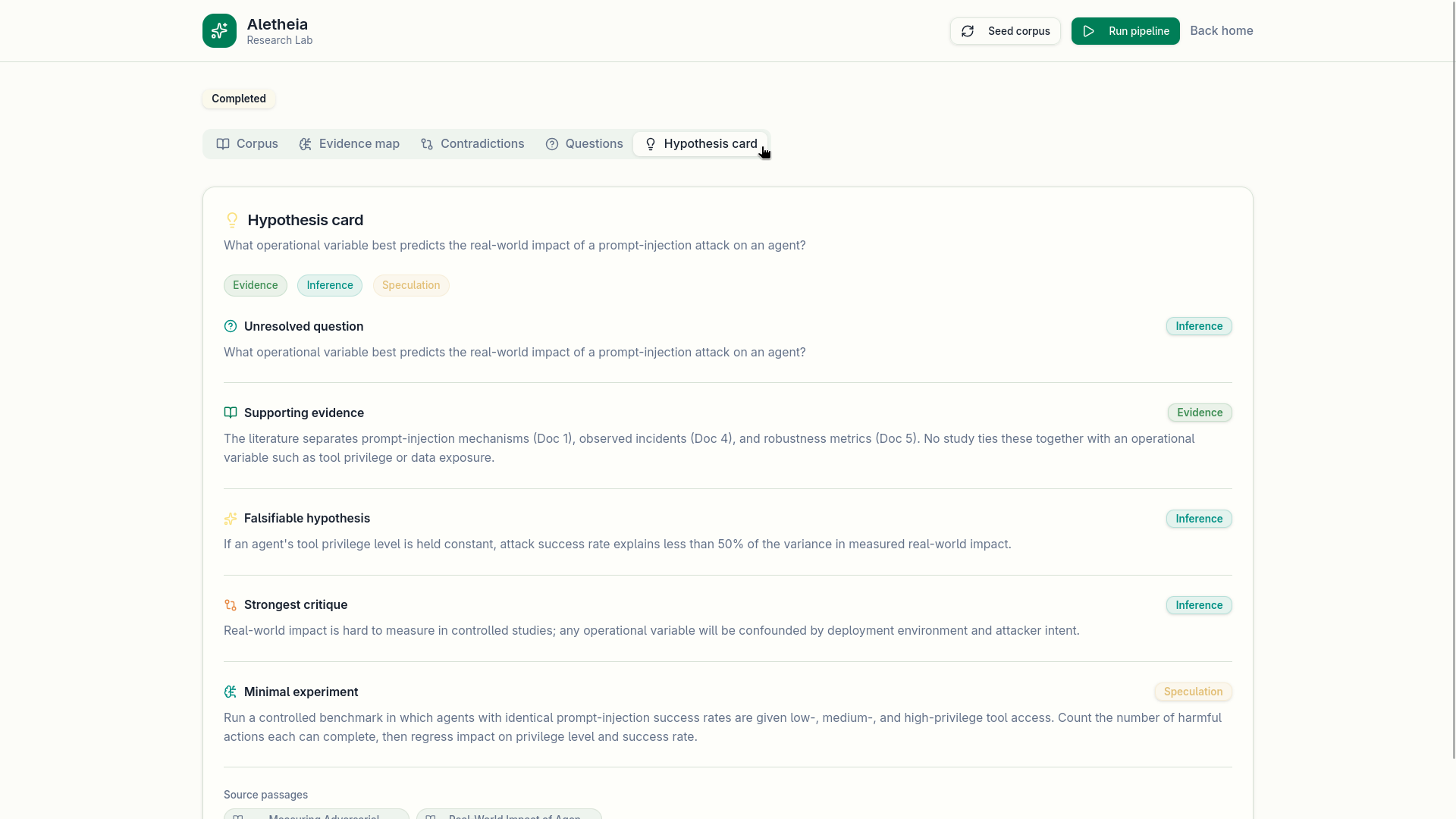
The hypothesis card links an unresolved question to evidence, critique, a falsifiable claim, and a minimal experiment.
Inspiration
The amount of knowledge is growing fast. Its growing faster than any researcher can read and understand.
Today we use AI tools to search for papers and answer questions that we already know.. Scientific progress often starts with a question. Aletheia was inspired by an idea: of just helping researchers find what is known AI should help them identify what is still unknown.
Our goal is to make it more likely that researchers ask the question. The right question is the one that unlocks the hypothesis. Aletheia is about helping researchers ask the question.
What it does
Aletheia is an AI tool that helps with discovery. It looks at a lot of papers. Turns them into a map of what we know and what we do not know.
Aletheia identifies what the papers agree on.
It finds where they disagree.
It identifies what they assume but do not test.
It also identifies what we cannot infer from the papers.
It finds out what question would help us learn more.
Then it starts a conversation with the researcher. Of giving them an answer it asks them questions to help them think about what they do not know.
The final result is a card that contains the question the evidence, a hypothesis and an experiment that can test it. Aletheia is not about finding answers; it is about asking the questions.
How we built it
We built Aletheia using a pipeline that processes papers. It extracts information from each paper including what the paper says, how it was done and what it concludes.
This information is connected through a map that shows how the papers relate to each other. Aletheia uses AI tools to do this.
There are tools that make Aletheia work:
A tool that maps the evidence.
A tool that finds contradictions.
A tool that asks questions.
A tool that challenges hypotheses.
A tool that explores connections across disciplines.
Challenges we ran into
The challenge was making Aletheia useful without making it too confident. We did not want it to give answers that were not supported by evidence.
To avoid this Aletheia separates what we know from what we infer and what we speculate. It also tries to identify questions that have not been asked before.
Another challenge was making sure that Aletheia is transparent. We wanted to make sure that researchers can see where the information comes from.
So we made sure that every suggestion is grounded in the literature. This way researchers can inspect the evidence. They don't just have to trust Aletheia.
Accomplishments that we're proud of
We are proud that Aletheia is not another tool that summarizes papers. It treats uncertainty as a thing.
Aletheia can take a lot of papers. Turn them into a structured reasoning process. It can help researchers ask questions and design experiments.
We are also proud of the fact that Aletheia's transparent. Every suggestion is grounded in the literature so researchers can trust it.
What we learned
We learned that the valuable role for AI in science is not to answer questions but to ask better questions.
A good research question is not just broad or creative. It should reveal something expose an assumption or identify a missing variable.
We also learned that we can use AI to do more than just retrieve information. We can use it to reveal the boundaries of our knowledge.
Aletheia is not meant to replace judgment. It is meant to help researchers challenge their assumptions and explore what we do not know.
Whats next for Aletheia
Next we want to test Aletheia with researchers from disciplines. We want to see if it can help them ask questions and design experiments.
We also want to expand the knowledge map and improve the way Aletheia generates analogies across disciplines.
In the term we want Aletheia to be a part of a new scientific workflow. We want it to help humans AI tools and evidence work together to make new discoveries more likely. Aletheia is, about helping researchers ask the question and we think it can make a big difference.
Built With
- lovable
- postgresql
- react
- supabase
- tailwind-css
- tankstack-query
- tanstack-start
- typescript
- vercel
- vite
- zod

Log in or sign up for Devpost to join the conversation.