-
-
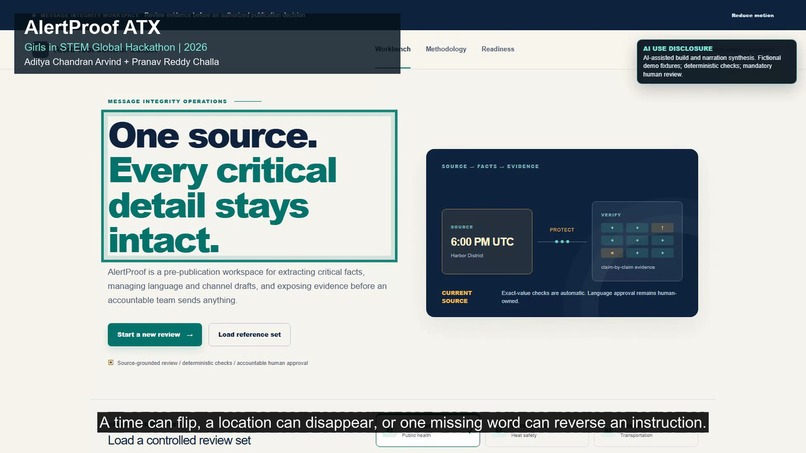
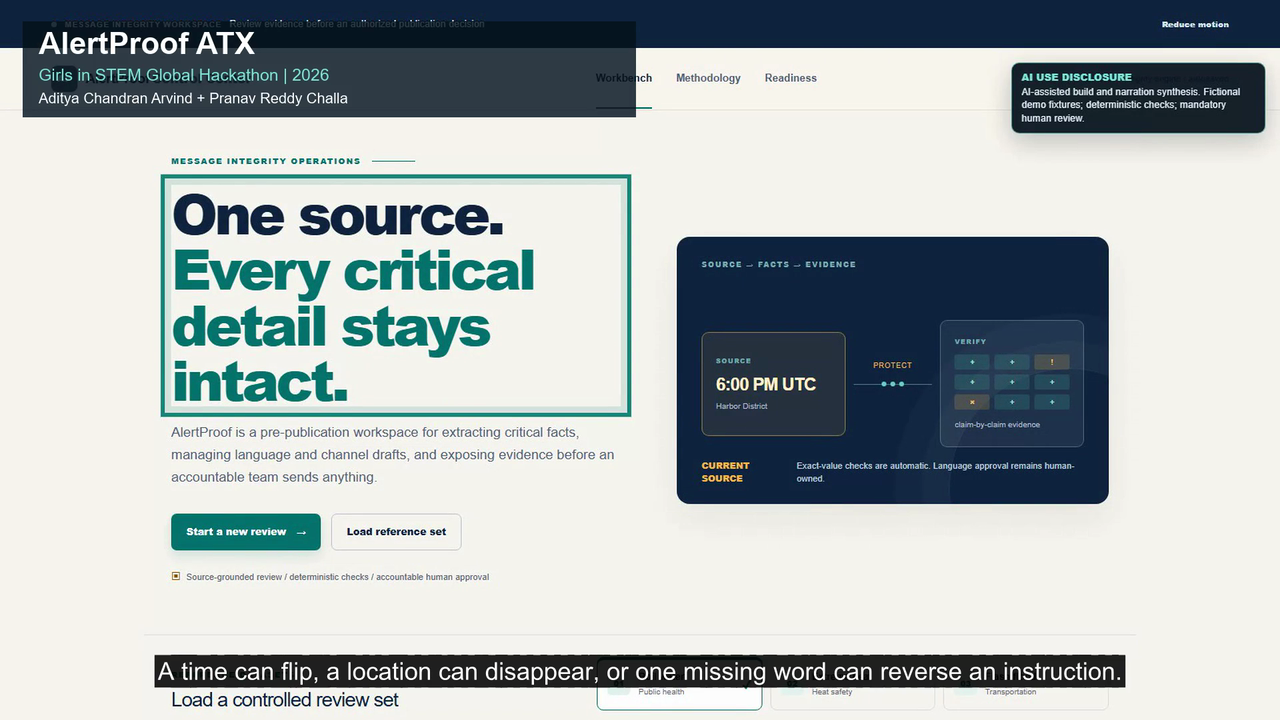
AlertProof ATX: the emergency-message integrity problem and student team.
-
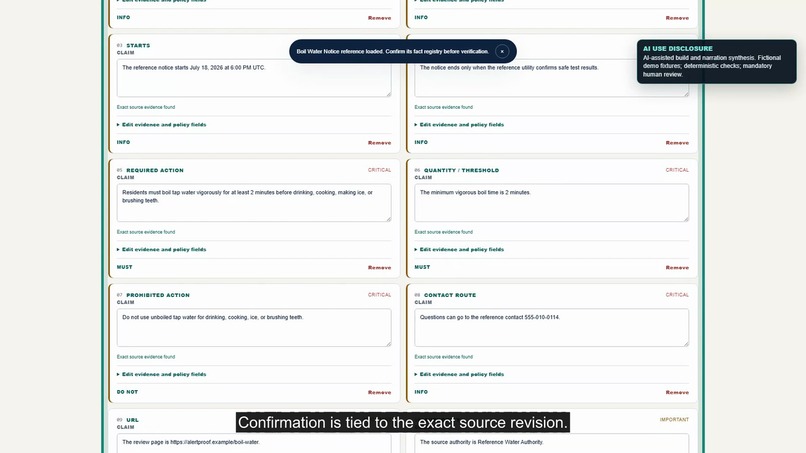
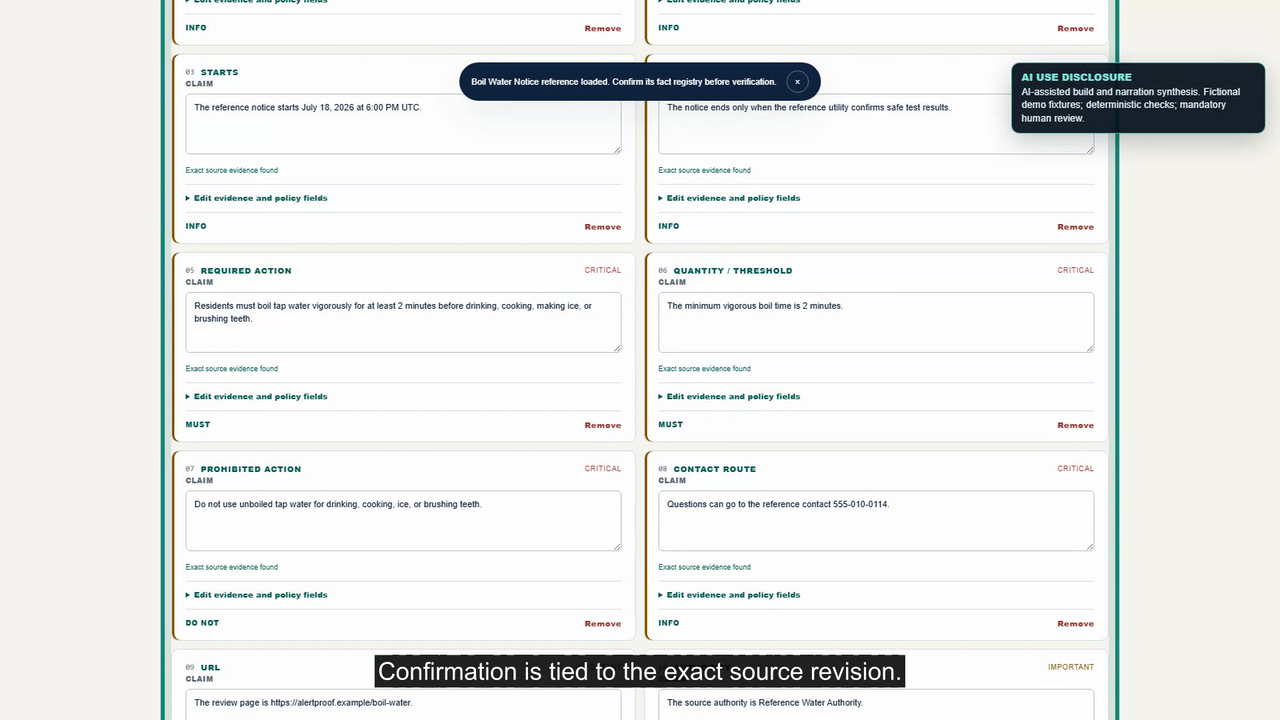
Fact registry: reviewer-owned protected values for time, place, action, contact, and prohibitions.
-
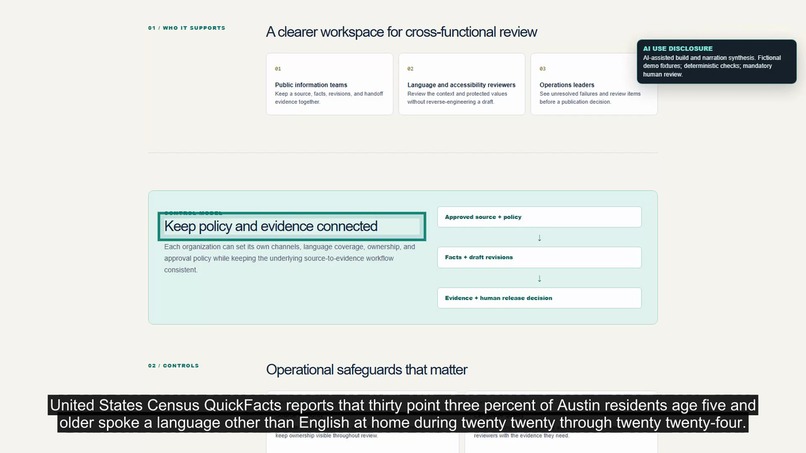
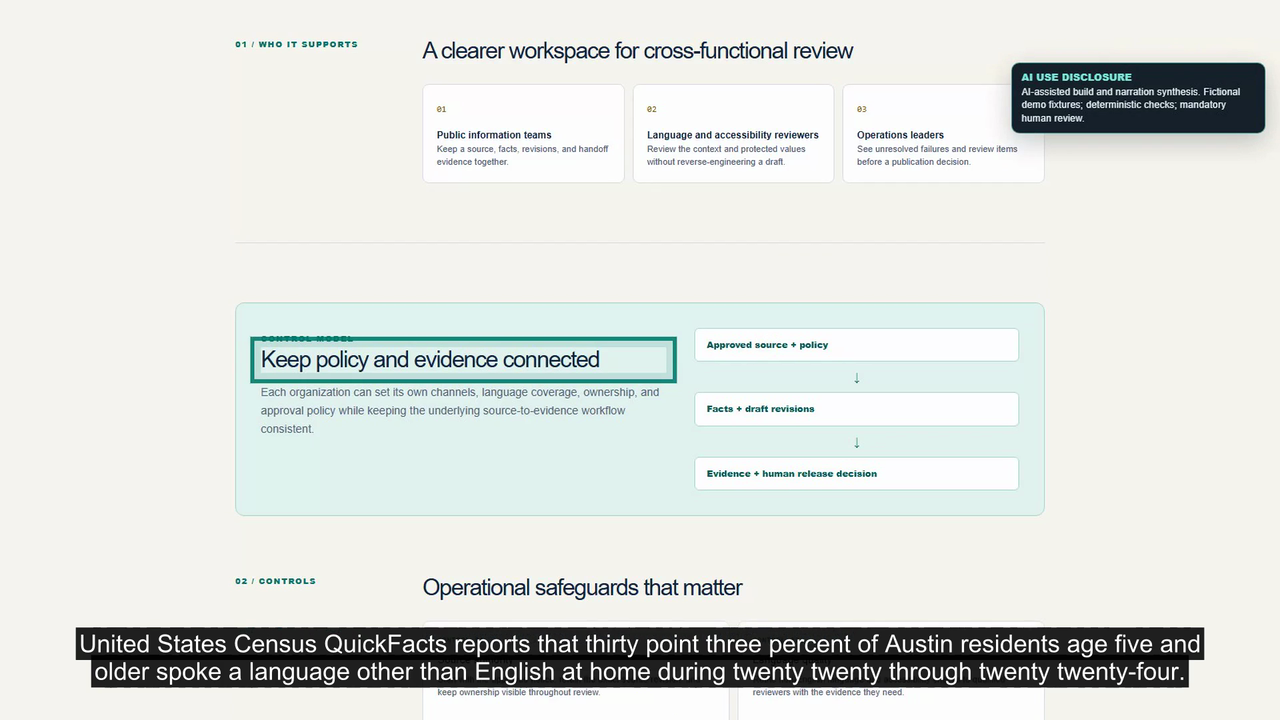
Austin context: multilingual communication needs with explicit non-affiliation and safety boundaries.
-
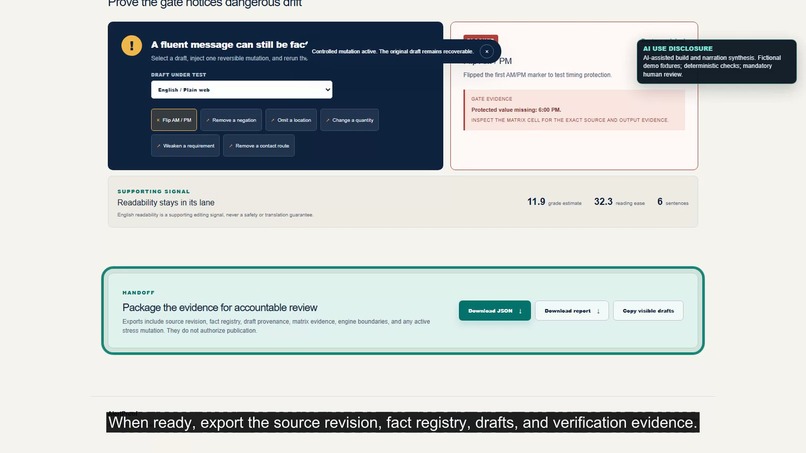
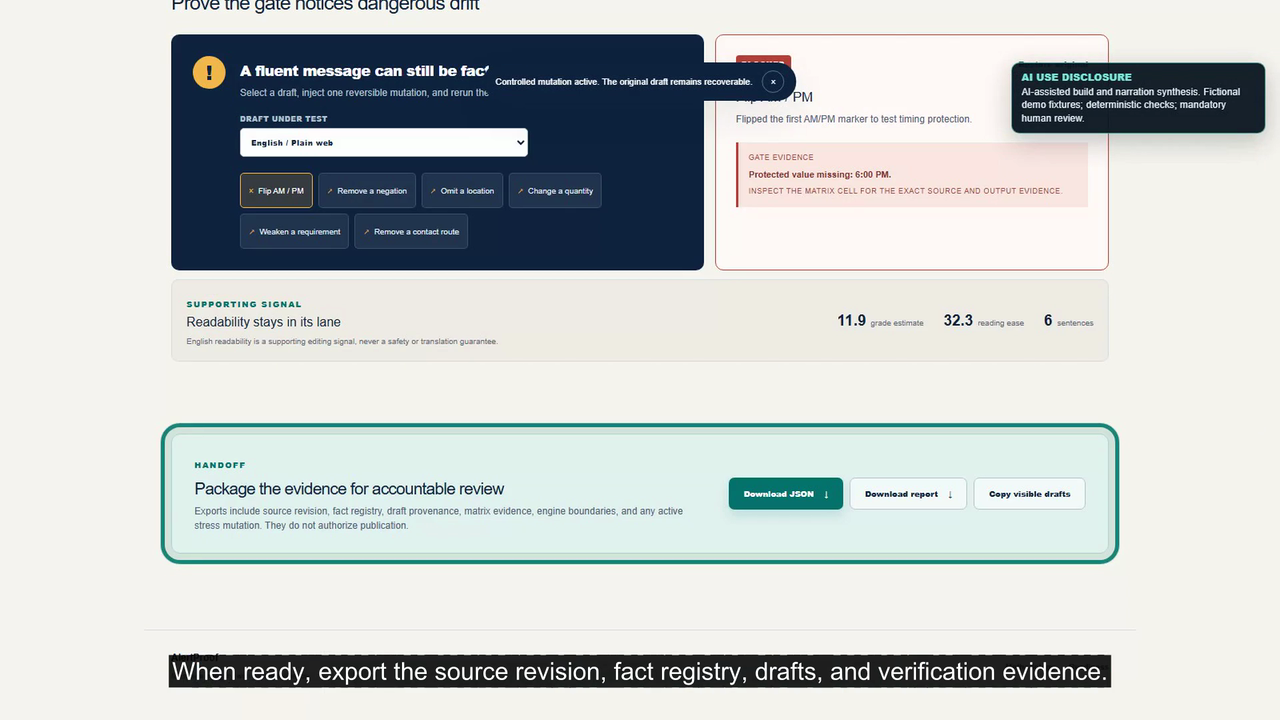
Auditable handoff: export source revision, facts, drafts, checks, and reviewer evidence.
-
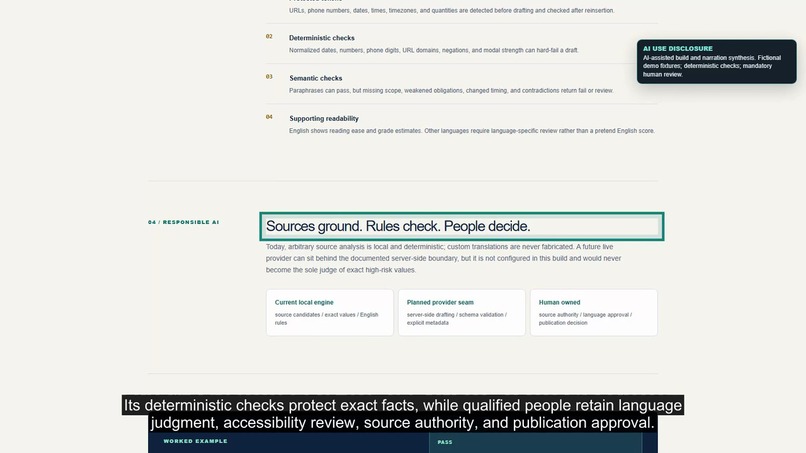
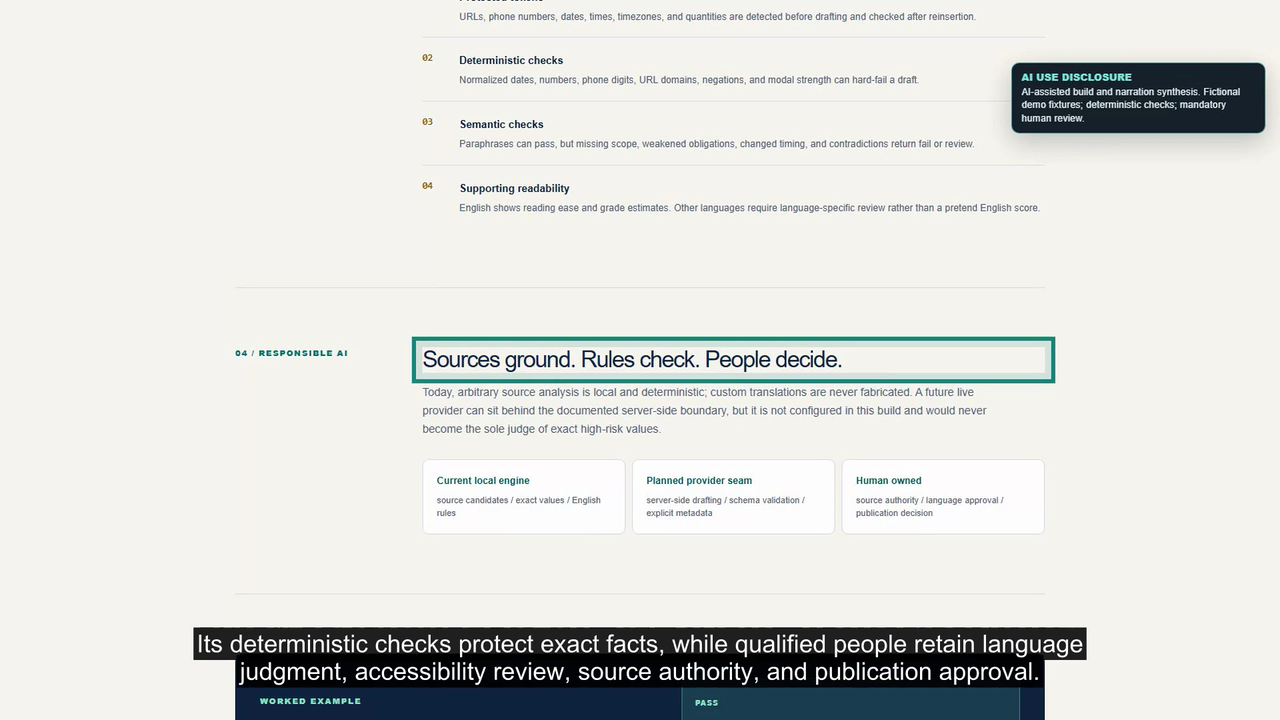
Methodology and responsible AI: deterministic checks support—not replace—qualified human judgment.
-
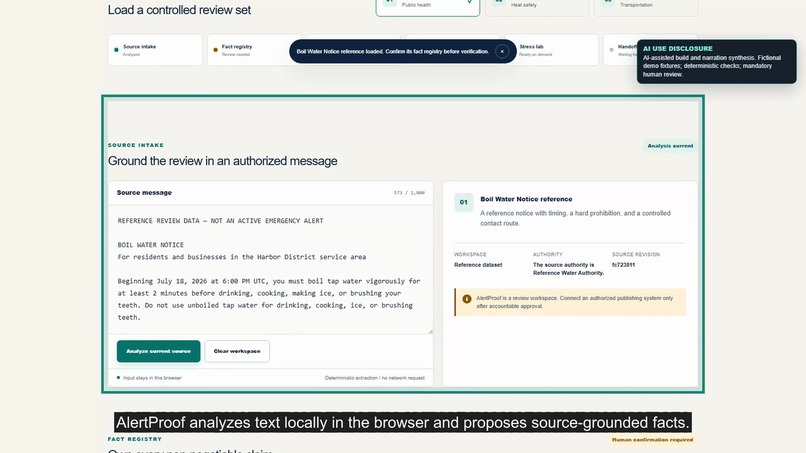
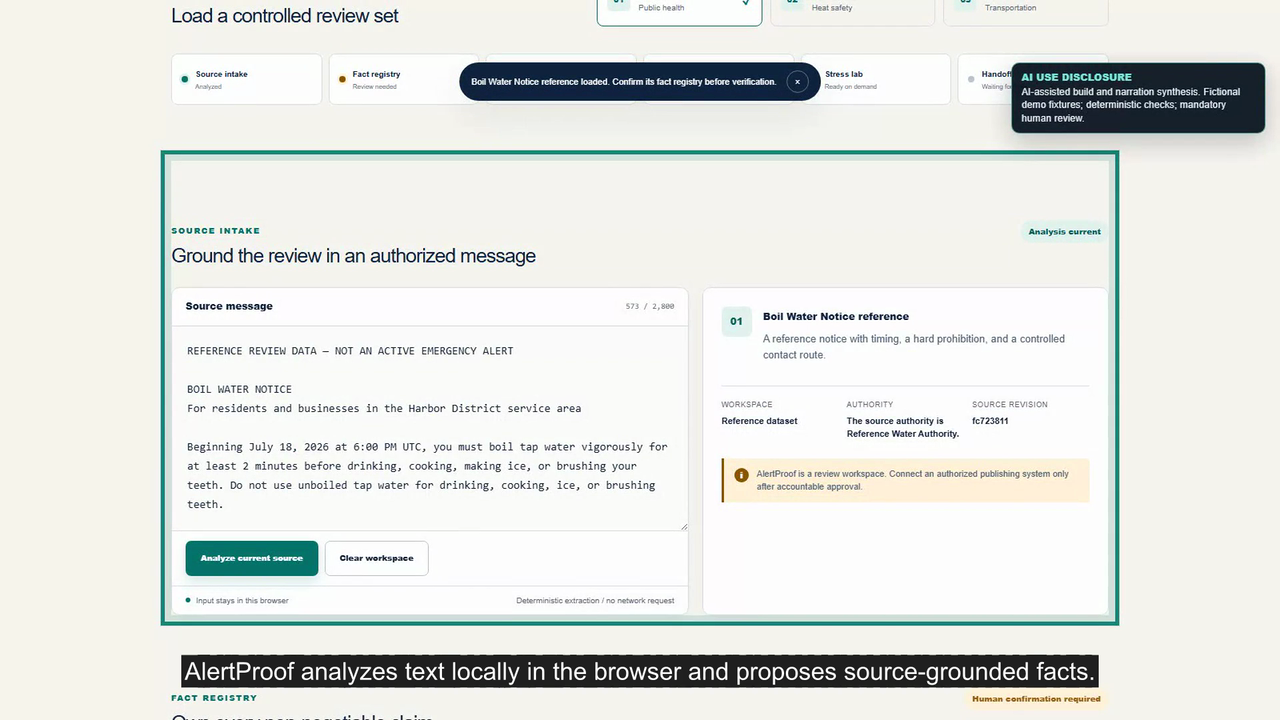
Source intake: load a fictional reference alert and track its authorized revision.
-
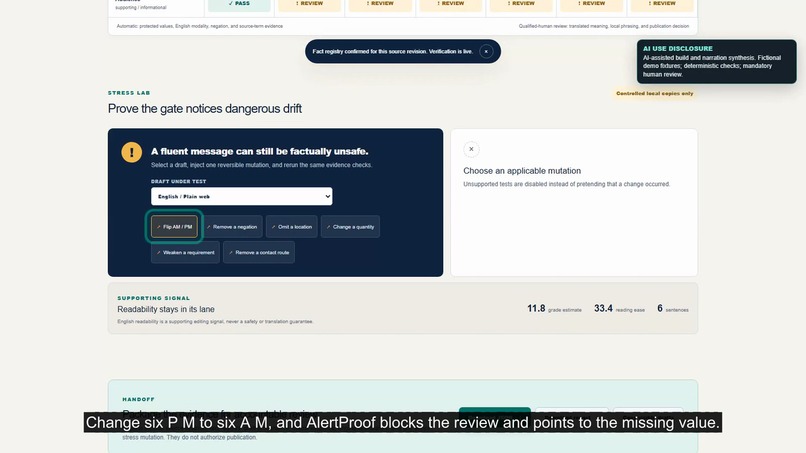
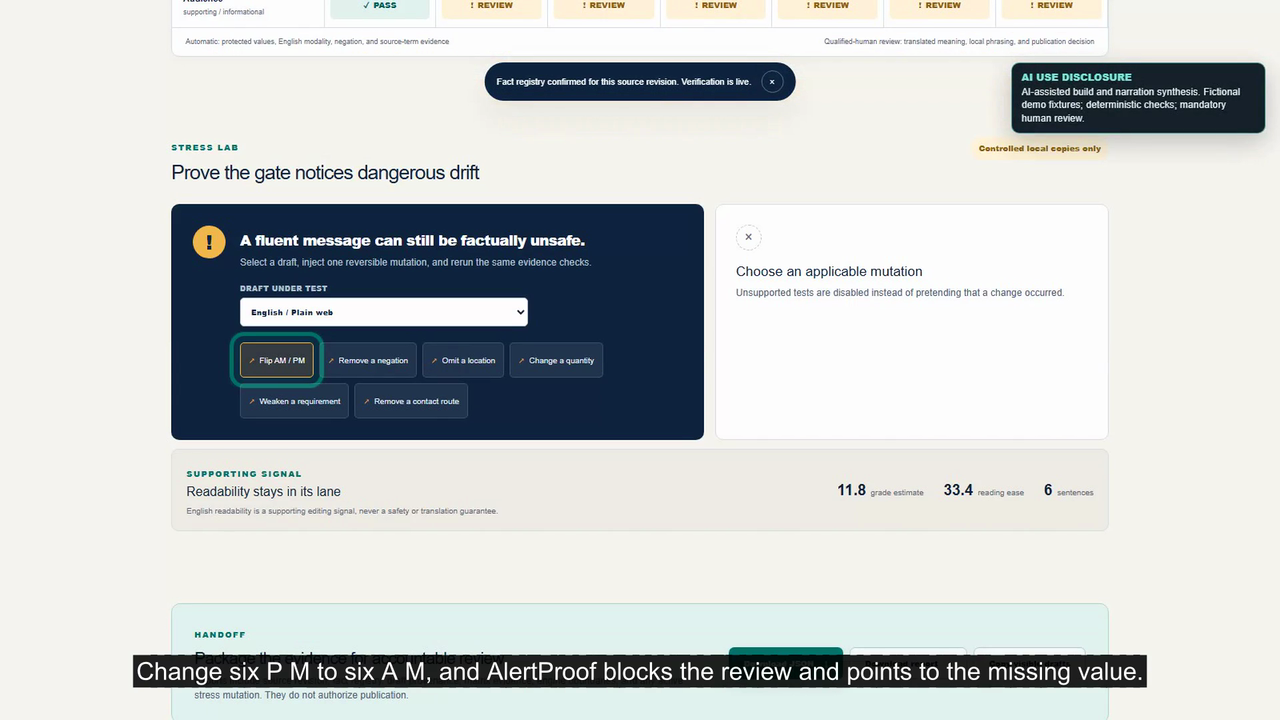
Blocked drift: a PM-to-AM mutation fails the exact-value check and stops the review gate.
-
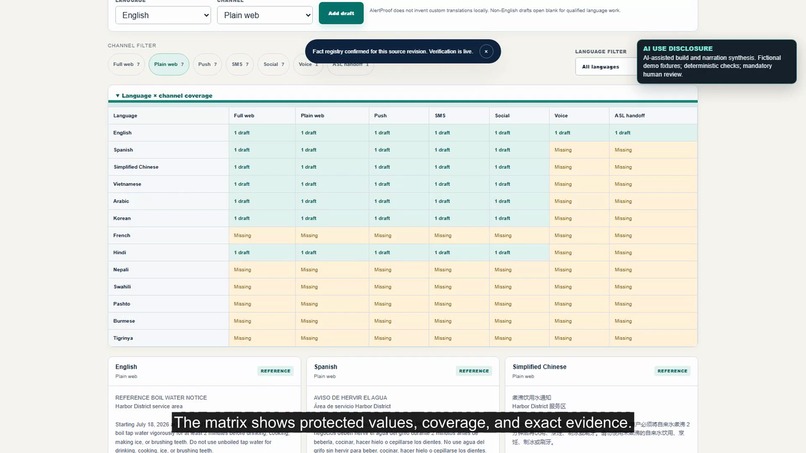
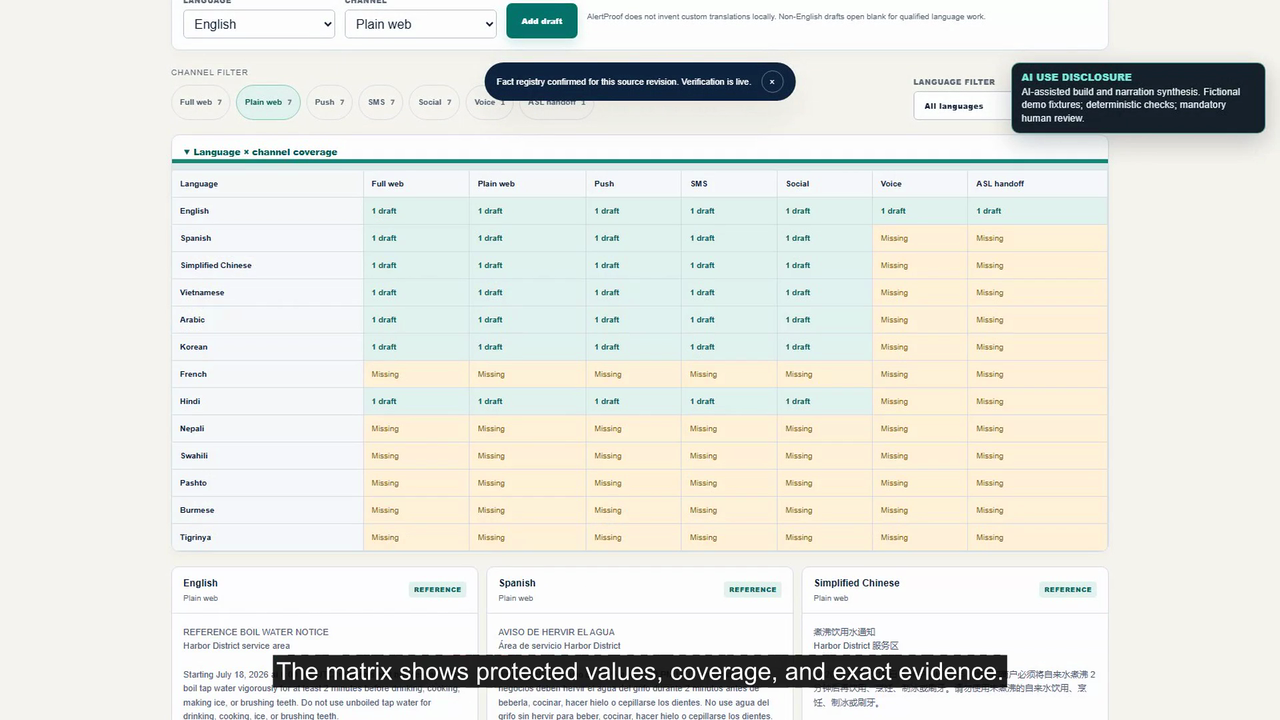
Multilingual review: compare language and channel drafts in one evidence matrix.
Inspiration
Emergency communication is often treated as a translation problem. In practice, the harder problem is preserving the facts that change what a person should do: the time, the location, the action, the contact number, and what must not be disclosed. A fluent sentence can still be unsafe if one of those facts drifts.
AlertProof ATX is our response to that review gap. We wanted a small, inspectable workbench that makes important claims visible, tests them across language and channel variants, and tells a human reviewer exactly what still needs attention before anything is published.
What it does
AlertProof ATX is a pre-publication verification assistant for emergency messages. A reviewer enters a canonical message and protected facts, selects supported languages and channels, then receives:
- Draft variants for English, Spanish, Vietnamese, Arabic, and Pashto, with right-to-left metadata where relevant.
- A claim-by-claim verification matrix for times, locations, actions, contacts, and protected details.
- A sabotage test that intentionally mutates a high-risk fact to prove the verifier can block it.
- Evidence drawers, uncertainty labels, reviewer aggregation, and JSON, HTML, and copy-ready exports.
- Offline fictional fixtures so the full workflow can be evaluated without API keys or a live provider.
The app is an assistant, not an autonomous publisher. Human review remains mandatory.
How we built it
We built the workbench with TypeScript, React, a Next-compatible App Router surface, vinext, Tailwind, Zod, and the Node test runner. The core verification path is deterministic and schema-validated. Exact high-risk facts are checked with explicit rules; semantic checks are shown as supporting evidence rather than presented as a certificate of translation quality.
The app is local-first and can run without a provider key. A provider seam is available for future experimentation, but the demo path uses local fixtures so judges can reproduce every result. The same scenario can be viewed as a calm PASS state or a deliberately broken BLOCKED state.
Challenges we ran into
The biggest design challenge was deciding what must never silently change. We separated exact protected facts from explanatory or semantic evidence, then made uncertainty visible instead of hiding it behind a green score. We also had to make failure useful: a blocked result should identify the failing claim and the source and target values a reviewer needs to compare.
Another challenge was keeping the UI readable while showing evidence, mutations, channel constraints, and multilingual metadata. We used a five-step workbench, clear status badges, and an evidence drawer so the reviewer can move from summary to source-level detail without losing context.
Accomplishments that we are proud of
- A complete offline-first five-step emergency-message review workbench.
- Three representative scenarios, including a clean pass, a review-required case, and a blocked high-risk mutation.
- Austin-aligned language and channel fixtures, including RTL metadata for Arabic and Pashto.
- A verification matrix that exposes claim status, evidence, uncertainty, and human-review aggregation.
- Six mutation tests that exercise time, location, action, contact, protected-location, and channel failures.
- Export paths for JSON, HTML, and copy-ready text.
- A production build surface with a polished judge-facing demo and reproducible local checks.
Impact and feasibility
The same review pattern could help emergency communication teams, school districts, utilities, healthcare nonprofits, and community organizations. Teams could configure their approved languages, channels, templates, contacts, and protected-location rules without changing the core evidence model.
We are intentionally not claiming lives saved, certified translation accuracy, institutional partnerships, or operational deployment. Those claims require field validation and accountable partners. Our contribution is a concrete, testable review layer that helps teams see what must be verified before a message moves forward.
What we learned
Trust is not a single accuracy number. A responsible tool needs to show the exact facts it protected, the evidence supporting each result, what it cannot determine, and when a human must intervene. Deterministic checks are especially valuable for numbers, times, locations, actions, and contacts because those details can be tested directly.
We also learned that failure states deserve as much design care as success states. The blocked scenario is not a corner case; it is proof that the system can refuse to silently approve a dangerous change.
What's next for AlertProof ATX
Next, we would validate language and channel rules with professional translators, interpreters, and community reviewers. We would add an independent semantic verifier, red-team historical-style messages, and measure whether the evidence view improves reviewer outcomes. Only after that evidence would we consider a tightly governed operational pilot.
AI use and responsible boundaries
AI assistance contributed to implementation, product copy, tests, fixture preparation, documentation, and demo-video production and editing. The narration is a user-provided human recording with owner-directed, same-source factual corrections; no speech synthesis was used. The current public build does not call a live generative model. Its multilingual drafts are prepared evaluation data, not certified translations, and it cannot publish autonomously. People retain source authority, language judgment, accessibility review, and publication approval.
Built With
- node.js
- react
- tailwind
- typescript
- zod

Log in or sign up for Devpost to join the conversation.