AlertAI: Empowering 911 Responders with Real-Time AI Assistance
Inspiration
911 professionals are increasingly overstressed and understaffed, with many lacking the necessary training, managerial support, and technology to perform their jobs effectively, particularly during mental health emergencies and natural disasters. A high turnover rate has further intensified the shortage of call-takers across the country. AlertAI was developed to tackle these issues by providing real-time AI assistance, streamlining call analysis, and reducing the cognitive load on responders. By improving response times and enhancing decision-making, AlertAI helps 911 professionals focus on their critical work, ensuring they can serve their communities more effectively.
The idea for AlertAI was driven by the need to improve emergency response times in life-critical situations. By leveraging AI, we saw an opportunity to assist dispatchers in quickly identifying essential information from emergency calls, enabling faster, more informed decision-making and response.
What it does
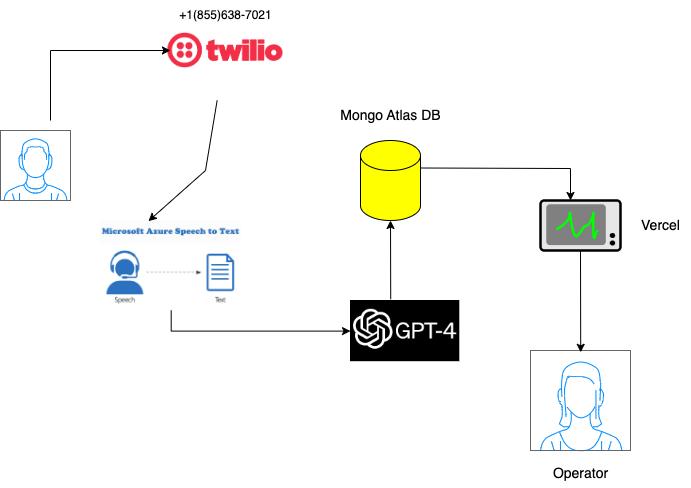
AlertAI is an AI-powered tool designed to assist 911 responders by transcribing emergency calls in real-time and extracting critical information such as location, caller details, and urgency. Using Twilio for live call handling, Azure Speech-to-Text for transcription, and GPT-4 for intelligent data extraction, AlertAI provides dispatchers with a clear, interactive dashboard. The extracted data is then stored in a MongoDB Atlas database, giving responders quick access to vital information and helping them prioritize and make faster decisions during emergencies.
How we built it
AlertAI was built using a combination of powerful tools and technologies: -Twilio for real-time call transcription. -Azure Speech-to-Text to convert call audio into text. -OpenAI’s GPT-4 for extracting key entities and important details from the transcriptions. -MongoDB Atlas to store the extracted data in a structured and retrievable format. -Gradio to create a live, interactive dashboard where 911 responders can monitor and manage incoming calls and critical data in real-time.
Challenges we ran into
We encountered several challenges during development:
- Real-time performance: Ensuring that transcription and data extraction happened fast enough to keep up with live calls was a major hurdle. This required optimizing the integration of Twilio, Azure Speech, and GPT-4 to ensure seamless processing.
- Data accuracy: Extracting key information such as location and urgency from noisy or ambiguous calls posed challenges, requiring extensive fine-tuning of GPT-4 for accuracy.
- Multi-service integration: Integrating Twilio, Azure, GPT-4, MongoDB, and Gradio into a single pipeline was complex, especially ensuring they communicated effectively in real-time without lag or data loss.
Accomplishments that we're proud of
We are proud of building a fully functional system that integrates multiple services to provide real-time support to 911 responders. We successfully developed a user-friendly dashboard that streamlines the call analysis process and reduces the cognitive load on dispatchers. The ability to provide accurate, real-time transcriptions and intelligent data extraction is an accomplishment that could make a meaningful impact on emergency response times and effectiveness.
What we learned
This project taught us the value of combining AI with real-world applications. We gained experience in integrating multiple APIs and services, optimizing real-time performance, and building responsive front-end solutions for critical tasks. Additionally, we learned how AI can assist in emergency scenarios by easing the burden on human operators, improving their ability to respond quickly and effectively.
What's next for AlertAI
- Improving accuracy: We will continue refining GPT-4 to better handle edge cases like noisy calls or ambiguous situations.
- Adding predictive analytics: We aim to integrate predictive models to anticipate resource needs based on previous emergency data, helping responders allocate resources more efficiently.
- Expanding features: Integrating location-based data from Google Maps and additional metrics to provide more context and improve dispatchers' decision-making.
- Scaling the solution: We plan to scale the platform for wider deployment and explore partnerships with emergency response organizations.
- Identifying emotions and hidden signs: We plan to develop functionality that can detect emotions and hidden signs of distress from at-risk callers, providing additional support to responders during critical situations.

Log in or sign up for Devpost to join the conversation.