-
-
Simulation of Coal Conversion to Graphite

Inspiration
Our technological advancement and the future of our planet depend on batteries. Beyond their need for energy generation, they are implicit in energy storage which curbs energy waste. Therefore, to build a sustainable energy source, we need good batteries, and currently, the best kind of batteries is Lithium-ion batteries.
A critical component of batteries is graphite. Graphite is made up of carbon atoms connected in hexagonal rings like a honeycomb.
Graphite occurs naturally and is considered indispensable to the global shift towards electric vehicles. It is also the most significant component in lithium-ion batteries by weight, with each battery containing 20-30% graphite. But due to losses in the manufacturing process, it takes 30 times more graphite than lithium to make the batteries.
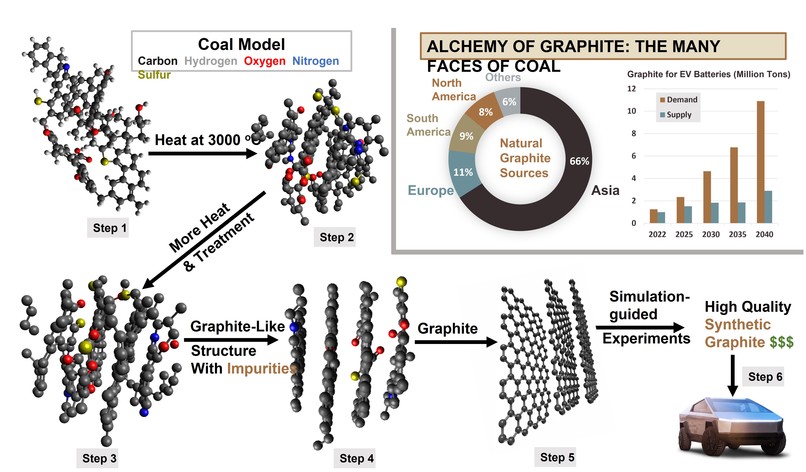
However, there is a serious problem regarding the availability of graphite for battery production. Natural graphite is becoming very scarce. The histogram on the left shows that the increase in demand is running headlong into a supply shortage. By 2040, natural graphite is projected to have among the largest supply shortfalls of battery materials, with demand outstripping expected supplies by about 8 million metric tons.
It becomes a matter of great importance to find an alternative to natural graphite, in the form of synthetic graphite that can serve as a replacement for natural graphite. Coal is one of the materials that can be used to get graphite.
Appalachia is one of three major coal-mining regions in the United States; Eight states lie in the Appalachian region. About 27% of the coal produced in the United States came from the Appalachian coal region. West Virginia is the largest coal-producing state in the region and the second-largest coal-producing state in the United States.
The chemical components of coal consist of a lot of Carbon atoms but include other impurity elements like hydrogen, oxygen, nitrogen, and sulfur. In the industry, burning off those impurity elements should give new material that contains only carbon atoms. Then further heat has been proven to produce layered carbon materials with a structure that looks like graphite. This process of obtaining synthetic graphite from coal is called graphitization
However, the problem is that those materials produced in this method of heating (called graphitization) do not work as well as natural graphite in batteries. The reason behind this has not been fully known or verified. It is also difficult to probe the material produced because the temperature needed to produce this synthetic graphite is so high (around 3000 Kelvin) that no in-situ method exists to probe the material during production.
In this project, I attempt to find answers to why coal-based synthetic graphite fails for batteries by implementing a computational protocol that is based on the physical phenomena of coal heating.
What it does
My code builds a realistic model of coal based on its chemical components (Carbon, hydrogen, oxygen, nitrogen, and sulfur). and then I simulate the heating process done in the industry for coal conversion to graphite (graphitization) and I study what happens to the atoms to understand why the materials fail for batteries
How we built it
Model: I built the model using python and implemented some periodic boundary conditions on the containing box. I have used the chemical information for each element and about the elements randomly in a box (at the right densities). Since coal contains a lot of carbon atoms relative to other elements, the model had 80% carbon atoms and the rest was divided between hydrogen, nitrogen, oxygen, and sulfur.
Simulating Heating For the heating process, I implemented a protocol based on algorithms that take into account the mechanics of the interaction between atoms. This means I considered the combined interaction of each atom and its neighbor. So based on the chemistry of these elements and the boundary conditions that I imposed.
Challenges we ran into
I had a hard time getting the codes to give me results in good time, so I had to optimize my recursions and for-loops. I also had a hard time visualizing my results.
Accomplishments that we're proud of
I finally got my model to form layers which is my greatest joy. So starting with a coal-like model, my codes could figure out how to form graphite-like is done in real-life. Essentially my simulation mimics the industrial processor graphitization.
What we learned
I found that while I achieved a layered carbon structure, the layers were not made only of Carbon atoms alone. In fact, there were also oxygen, sulfur, and nitrogen atoms in those layers, pretending to be carbon.
I believe this is why coal-based synthetic graphite fails for batteries. With this information, manufacturers can tune up their process of graphitization now knowing that even if they get layered structures, those layers may also have non-carbon atoms.
What's next for Alchemy of Graphite: The many faces of coal
There is still a lot to be done. This is only a preliminary result. I have to find out what processes could help remove those non-carbon elements. if I achieve that, I can share my protocol with the industry towards obtaining good graphite from coal that would be useful in making batteries


Log in or sign up for Devpost to join the conversation.