Inspiration
The transition from Web 3.0 to Web 4.0 is being driven by autonomous AI agents, but these agents are currently economically stranded. They lack a secure, native way to transact without human intervention. While the Algorand X402 protocol introduced a brilliant mechanism for machine-to-machine (M2M) micro-payments, we realized two massive gaps remained: sustainable fiat monetization for the developers building these agents, and existential security against the impending threat of quantum computing. We wanted to build a bridge that connects the seamless user experience of traditional mobile subscriptions with a zero-trust, post-quantum decentralized backend.
What it does
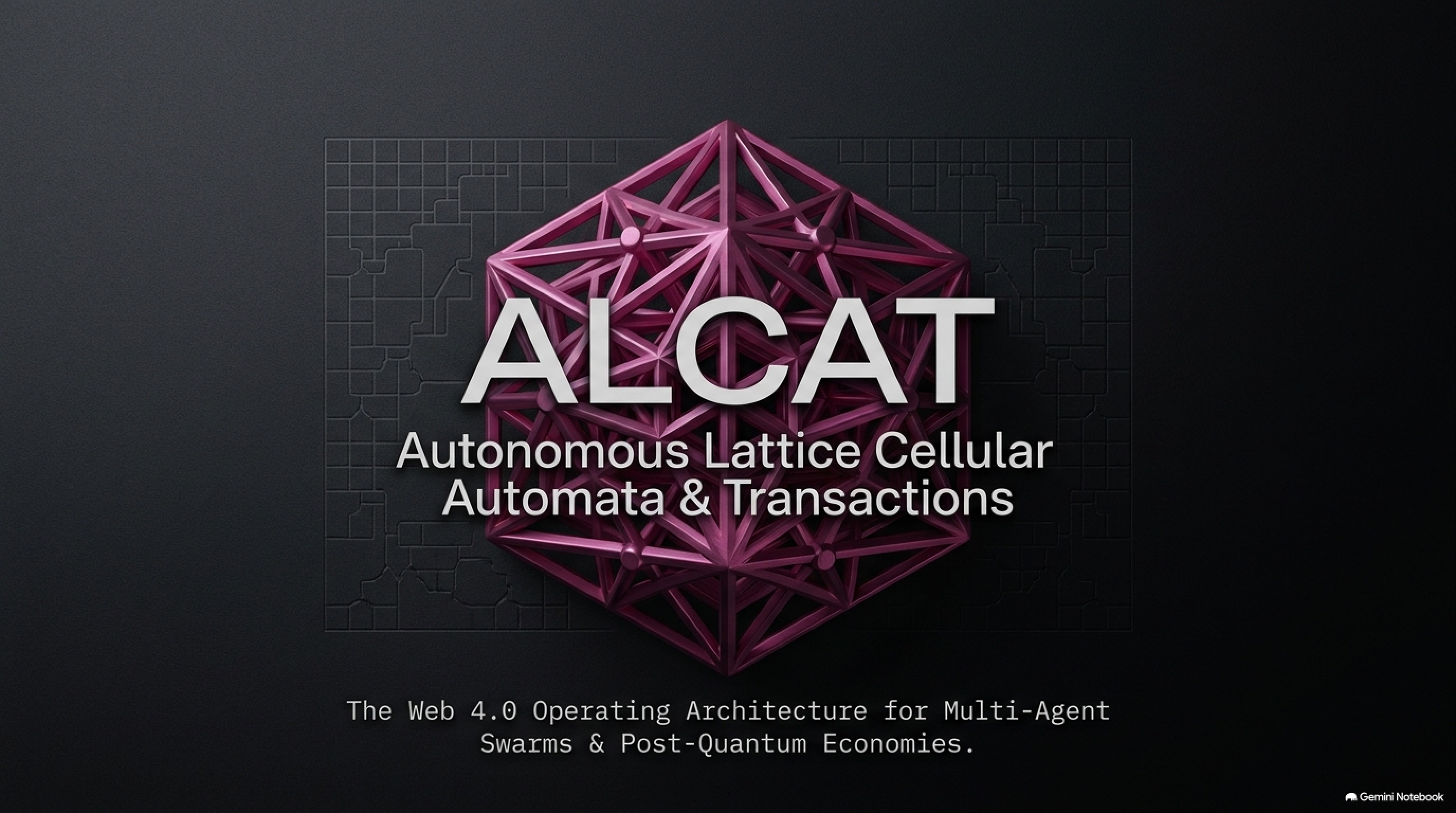
ALCAT (Autonomous Post-Quantum Web 4.0 Automaton) is a mobile-first AI agent ecosystem. From the user's perspective, it operates as a standard mobile app where they can purchase AI usage credits or premium subscriptions using traditional fiat via RevenueCat.
Under the hood, ALCAT acts as a fully autonomous economic engine. Once a user subscribes, their dedicated AI agents are spun up and granted economic agency. These agents traverse the internet, discovering resources in the "Bazaar" layer, negotiating prices, and executing instant M2M micro-payments using the Algorand X402 protocol. Every autonomous decision and transaction signature is secured using NIST-standardized Post-Quantum Cryptography, ensuring that the agents' wallets and communications remain impenetrable.
How we built it
We constructed ALCAT across three distinct layers to ensure scalability and security:The Human Interface & Monetization (TypeScript/React Native): We built a polished mobile frontend where users configure their agents. We integrated the RevenueCat SDK to handle fiat subscriptions and ad-based tiers seamlessly, bypassing the friction usually associated with Web3 onboarding.The Autonomous Automaton (Python/Rust): The core AI orchestration relies on state-machine logic and cellular automata principles (inspired by Conway's models) to route tasks.The Decentralized & Post-Quantum Backend: We utilized Algorand's Testnet for executing the X402 protocol, leveraging atomic transaction groups for fee delegation so the agents never have to worry about gas. For cross-chain autonomous logic, we deployed smart contracts on Arbitrum Sepolia using Arbitrum Stylus (Rust). To secure the agentic wallets, we implemented ML-DSA-65 (Dilithium) for digital signatures and ML-KEM (Kyber) for secure key exchange, rooted in Learning With Errors (LWE) lattice mathematics. The underlying security relies on the hardness of the LWE problem, defined as finding the secret vector $\vec{s}$ given the public matrix $A$ and the noisy vector $\vec{b}$, such that:$$A\vec{s} + \vec{e} \equiv \vec{b} \pmod q$$
Challenges we ran into
Integrating post-quantum cryptography with highly constrained blockchain environments was our biggest hurdle. PQC signatures and public keys (like those generated by ML-DSA-65) are significantly larger in byte size compared to traditional ECDSA or Ed25519 signatures. Fitting these massive cryptographic payloads into standard transaction limits without breaking the atomic transaction group structure on Algorand required highly optimized Rust implementations and clever data serialization. Additionally, synchronizing the traditional Webhook lifecycles of RevenueCat with the asynchronous, decentralized state of our AI agents took several architectural iterations to get exactly right.
Accomplishments that we're proud of
We successfully closed the loop between Web2 monetization and Web3 agentic commerce. Watching a user purchase a subscription via a standard Apple/Google Pay flow (powered by RevenueCat), which immediately triggered a backend smart contract to authorize an AI agent, which then autonomously paid another machine using Algorand X402—all while secured by post-quantum lattice cryptography—was an incredible technical milestone.
What we learned
We vastly deepened our understanding of hybrid key exchange protocols and the practical implementations of X402 fee delegation. We also learned how to effectively bridge traditional SaaS architecture with decentralized infrastructure, proving that developers don't have to choose between Web3 innovation and reliable Web2 revenue streams.
What's next for ALCAT
Our immediate next step is expanding the "Bazaar" discovery layer to allow third-party developers to list their APIs directly within the ALCAT ecosystem. We also plan to open-source the core PQC routing module—adding it to the Magical Garbage repository—so other developers can easily integrate quantum-resistant M2M payments into their own agentic frameworks. Ultimately, we aim to prepare ALCAT for mainnet deployment and pitch the infrastructure to upcoming startup accelerator programs.
Built With
- aiagentics
- algorand
- arbitrum
- automatonai
- blockchain
- gemini
- github
- netlify
- quantum
- revenuecat
- x
- youtube

Log in or sign up for Devpost to join the conversation.