Inspiration## Inspiration
Arabic researchers, editors, translators, and teachers often encounter sentences that are grammatically correct but still sound influenced by translation from another language. Distinguishing between an actual error, a translation-influenced pattern, and an expression that has become accepted in modern Arabic requires time, linguistic expertise, and historical evidence.
I created ALC Lab to turn this difficult judgment into a transparent, sentence-by-sentence research workflow.
What it does
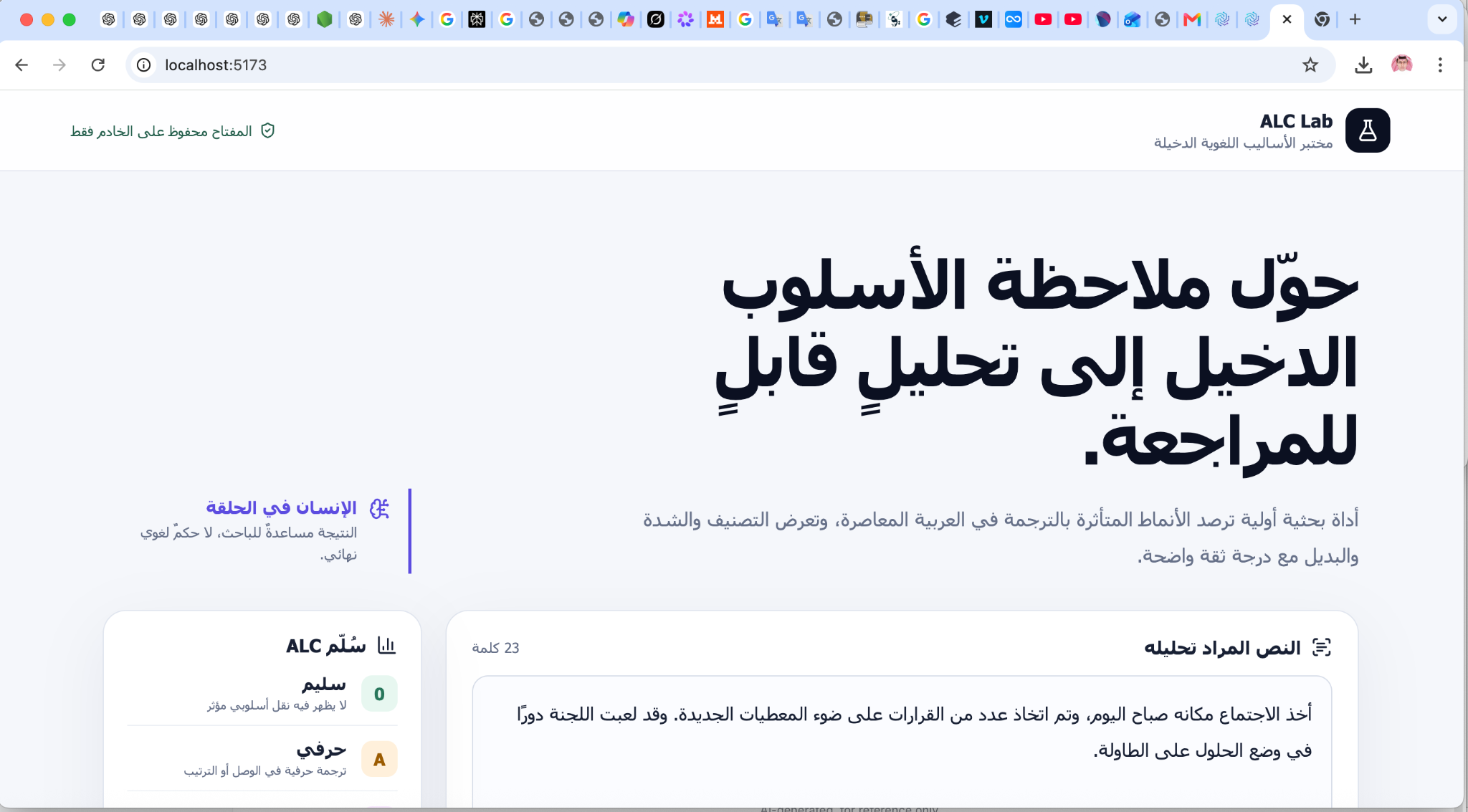
ALC Lab analyzes contemporary Arabic text at the sentence level and classifies each sentence using five categories:
- 0 — Standard: no influential transferred pattern detected
- A — Literal: literal transfer in word order or connection
- B — Lexical: translation-influenced collocation or word choice
- C — Structural: transferred syntactic construction
- D — Formulaic: translated institutional or fixed template
For every suspected pattern, the tool presents:
- the sentence and suspected expression
- category and severity
- confidence level
- linguistic explanation
- possible source-language pattern
- a clearer Arabic alternative
- methodological limitations
The results can also be exported as JSON or CSV for research and review.
How I built it
The prototype uses a React and Vite Arabic RTL interface with a Node.js and TypeScript backend.
The live-analysis path is designed around the OpenAI Responses API and GPT-5.6, with structured output validated through a JSON Schema. GPT-5.6 Terra is the default balanced option, while Luna and Sol are available for different speed and reasoning needs.
The API key remains on the server and is never exposed to the browser. The application also includes a transparent rule-based demo mode so the interface can be tested without requiring users to provide a paid API key.
Challenges
The main challenge was not simply detecting unusual expressions. It was separating:
- historical linguistic origin
- modern frequency of use
- grammatical correctness
- stylistic acceptability
- evidence of translation influence
A frequent expression is not automatically standard Arabic, and an unfamiliar expression is not automatically a calque. For that reason, ALC Lab avoids presenting its output as a final linguistic judgment.
Accomplishments
- Built a complete Arabic-first RTL research interface
- Created a sentence-level classification framework
- Added severity, confidence, explanation, and alternatives
- Designed the output around human expert review
- Added JSON and CSV export
- Included a free and transparent demonstration mode
What I learned
Language-analysis tools should not hide uncertainty. The most useful system is not one that gives a simple correct-or-incorrect answer, but one that exposes the evidence, confidence, limitations, and possible alternatives so that a researcher can make the final decision.
What's next
The next stage is to connect ALC Lab to:
- a documented corpus of historical and contemporary examples
- an expert annotation and review workflow
- a benchmark dataset for evaluating model accuracy
- reusable corrections that improve future analyses
- collaborative tools for linguists, editors, and Arabic teachers
What it does
How we built it
Challenges we ran into
Accomplishments that we're proud of
What we learned
What's next for ALC Lab
Built With
- api
- gpt-5.6
- json
- node.js
- openai
- react
- schema
- typescript
- vite

Log in or sign up for Devpost to join the conversation.