
Inspiration
In Bangladesh, almost nobody checks out on a website. Retail happens inside Facebook Messenger and WhatsApp, where a buyer opens three or four pages at once, asks price koto?, and buys from whoever replies first. The whole business lives or dies in the DMs, yet the people doing the actual selling, the page moderators, are usually hired on a vibe and left to learn live, in front of real ad spend.
Shop owners bleed margin in the same three ways. High-intent leads get ghosted when replies take longer than about 45 seconds, burning paid Facebook ad spend one slow response at a time. Outside-Dhaka orders collapse when an untrained rep folds on the ৳130 advance bKash courier fee, and 25–30% of those parcels end up as delivery cancellations that bleed return shipping costs. And skeptical buyers ("real pic den", "onno page e kom") get defensive answers or unauthorized discounts from people who were never coached on what to say.
The skill that matters here, handling a pushy Banglish buyer under a timer, is testable. And once it's testable, it can be practiced, and it can be interviewed for. That became AlapLab, one engine with two jobs: train moderators who close, and hire the ones who already do.
What it does
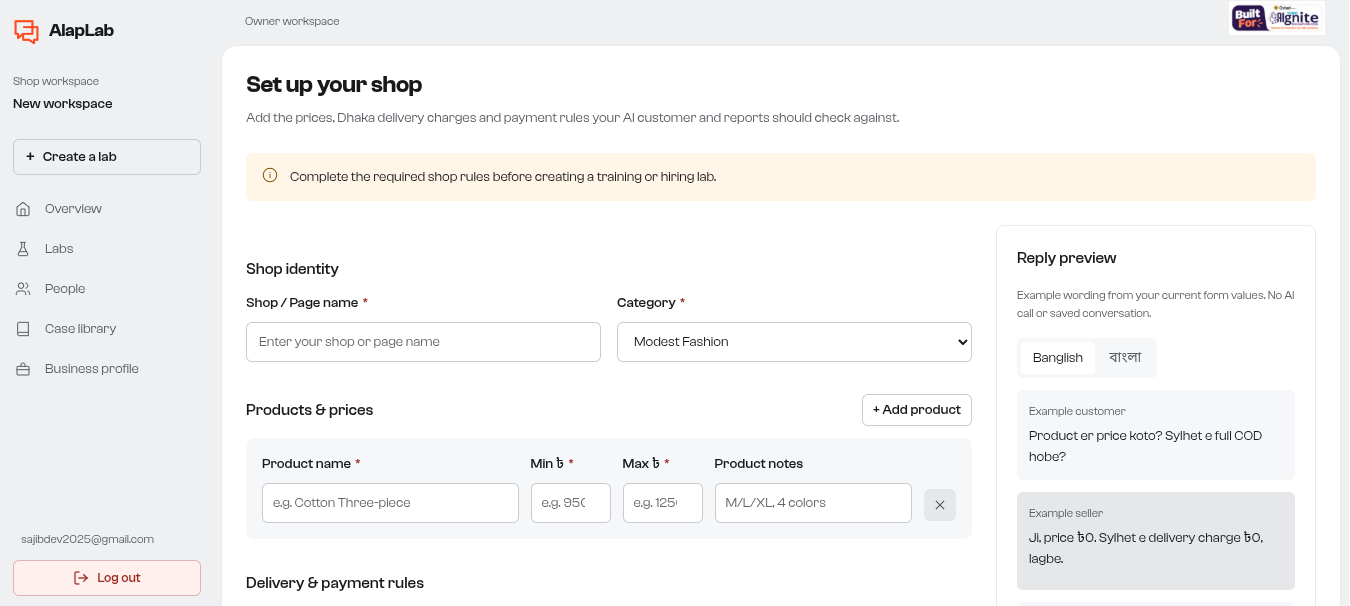
AlapLab is a conversational practice and evaluation lab built for Bangladesh's F-commerce and D2C sellers. An owner fills in a Business Profile: catalog with prices in BDT, Dhaka vs. outside-Dhaka courier fees, bKash advance rules, discount ceiling, banned promises. That profile is the ground truth for everything that follows.
Two modes run on top of it:
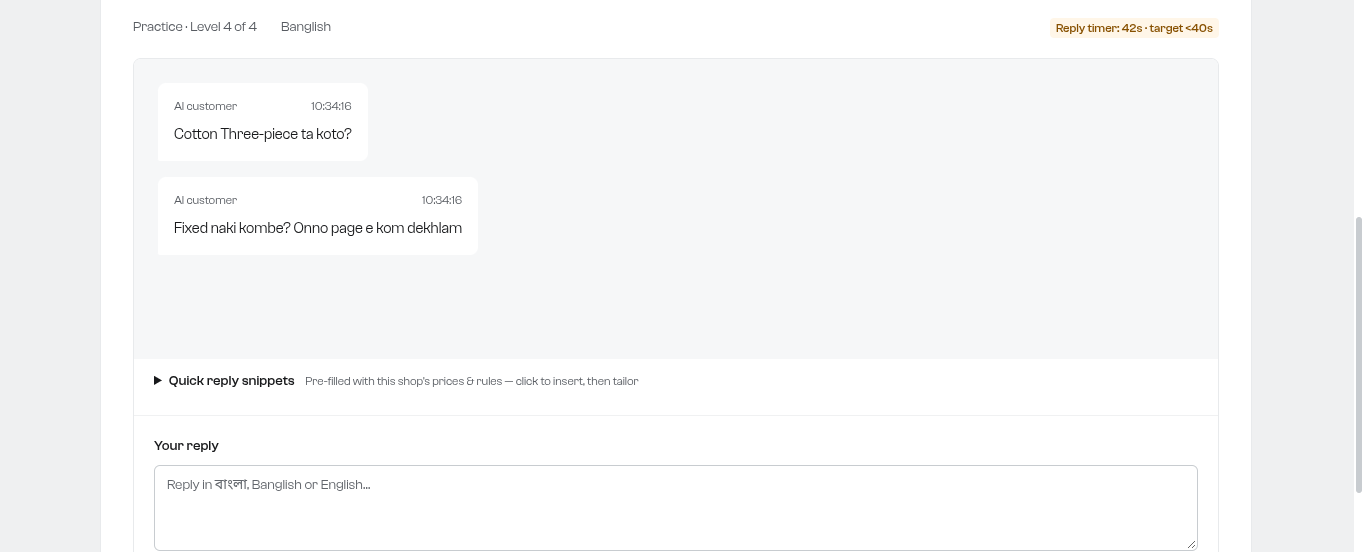
- Training mode (for existing moderators). A link, no password. The participant chats with an AI customer that behaves like a real shopper, not a cooperative assistant: it switches between Bangla, Banglish, and English mid-chat, hides facts until it gets asked, turns impatient when replies are slow, and walks away if handled badly. Difficulty adapts across 4 levels, and every session ends with feedback: score, average reply time against the 45s target, and the exact messages that helped or hurt, each with a better local phrasing to try on the retry.
- Hiring mode (for applicants). Single-use links that expire, one timed session, the same frozen cases for every candidate. The owner gets a ranked report with per-criterion scores, average reply speed, order conversion, evidence quotes, and a Strong/Possible/Weak fit recommendation plus a suggested interview question based on the candidate's weakest area.
Using AI to draft replies is allowed in both modes. Participants are judged on what lands: fast, accurate, and written like a person from Dhaka, not a 200-word "Dear Valued Customer" paste.
How we built it
A single full-stack app, built solo for the AIgnite Buildathon 2026.
- Next.js (App Router) + React + TypeScript, with server actions and server-side data loading; Tailwind CSS for the UI, with Clash Grotesk plus Noto Sans Bengali so Bangla script renders properly instead of falling back to system fonts.
- Supabase for Postgres, auth, and row-level access. An owner only ever sees their own business's labs, assignments, sessions, and scores.
- OpenAI models (configurable via
OPENAI_MODEL, defaulting to gpt-6-luna) power both AI sides: the customer engine (persona with hidden state, a 0–100 willingness score, impatience triggers on slow replies, gradual reveal, and anti-hint protection if a participant tries to interrogate the test itself) and the judge. - Hybrid scoring. Deterministic rule checks for anything countable: per-message SLA seconds, price and delivery fee math against the profile, whether the discount ceiling was respected, whether closing collected name, full address with thana, and an 11-digit phone. A rubric-based LLM judge handles tone, language fit, and objection handling, and is required to cite the exact messages behind every score, which get regex-verified back against the transcript.
- Profile snapshots per session, so changing the courier fee mid-training never rewrites finished conversations. Owner-uploaded real chats pass through an anonymizer that strips phone numbers, addresses, and bKash details before they're stored.
Challenges we ran into
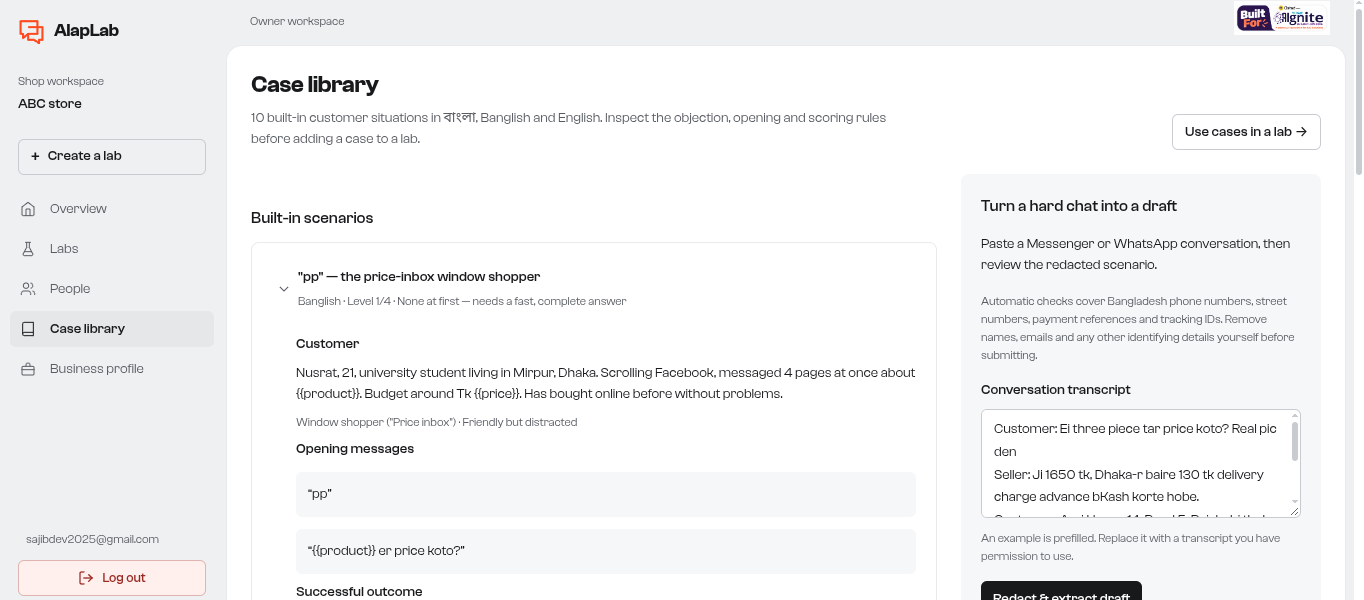
- Banglish has no orthography. Kto, koto, kom, km. There is no normalizer, and trying to build one was a trap. The working approach was to not normalize at all: mirror the style the case was written in, and score meaning, speed, and tone rather than spelling.
- Keeping the judge honest. An LLM left alone produces smooth numbers you can't trust. Requiring evidence quotes and regex-verifying that each quote actually exists in the transcript catches most fabrication. A calibration test, the same good answer written in Bangla script, Banglish, and English, keeps one language from being graded more harshly than another.
- Hallucinated pricing is a business-killer. If the bot quotes a delivery fee the shop doesn't use, nothing else about the demo matters. Everything quotes from the business profile snapshot; the AI never invents numbers, and rule checks confirm them.
- Making pushy feel fair. The customer needs to refuse the bKash advance and haggle without feeling rigged. The willingness score, moved by reply speed and reply quality, keeps outcomes earned rather than random.
- Time as a first-class mechanic. Per-message timers reshaped the interface more than anything else: visible clock pressure, expired-link states, resumed sessions where the clock doesn't pause. Interviewing under real DM pressure is the whole point, so timing had to live in the core, not in a report afterwards.
Accomplishments that we're proud of
- A complete end-to-end loop inside the hackathon window: owner onboarding, business profile, lab builder, link dispatch through WhatsApp or Messenger, participant chat, and an evidence scorecard, all in any browser, with no installs and no passwords for participants.
- An AI customer that feels uncomfortably real. Test sessions that open with
pp,real pic den?, oronno page e kom dekhlam... full COD deya jabe na?get treated like real DMs. - Zero pricing hallucinations: every taka figure in a demo session traces back to the business profile.
- A judge that shows its work. Every score ships with quoted lines, so an owner can dispute a rating in ten seconds.
- A scoring philosophy designed for how people actually work in 2026: AI-assisted replies are judged on speed and accuracy and never penalized for using AI, while blind, unedited pastes lose points on tone and accuracy.
What we learned
- Talk to the people before building anything. The three failure modes in the product (ghosted leads, RTO bleeding, unauthorized discounts) all came from merchant conversations, and staying narrow made the product sharper.
- The domain is the hard part. Courier fee structures, willingness curves, Apni/Tumi etiquette, Banglish code-switching. The LLM is one component inside that logic, not the logic itself.
- Anything countable should be counted with code, not generated. Deterministic checks for taka and seconds; the model only judges what genuinely needs judgment.
- Banglish is a first-class language, not a typo problem. It's the dominant language of Bangladeshi DMs and it belongs in the rubric.
- Judging a skill is a different problem from testing one. Prompted judges drift; rubrics, mandatory evidence, and multi-script calibration are the difference between an opinion and a score.
What's next for AlapLab
- Run a pilot with 10–20 real merchants in Dhaka and validate that lab scores actually predict live page conversion.
- Calibrate with a panel of experienced F-commerce page managers scoring sample transcripts, and only ship criteria where AI and human scores agree.
- Finish full training mode: adaptive difficulty, weak-spot targeting, speed drills, progress badges, and the team dashboard.
- Add local payments (bKash/Nagad) for training subscriptions and hiring credit packs.
- Let owners upload their own hard Messenger chats as custom cases, with automatic anonymization; add voice-note support, since voice notes are everywhere in Bangladeshi DMs.
- Support regional dialects (Chittagonian, Sylheti) so shops can train candidates for the buyers they actually have.
Built With
- nextjs
- openai
- react
- supabase
- typescript
- vercel
