-
-
MindOS
MindOS - Project Description
Project Description
MindOS is a web-based "Neural Command Center" that treats your brain like a biological computer that can be optimized. Instead of just managing tasks, it manages neural states. I built the backend using Python (Flask) to orchestrate a symphony of AI models: Google Gemini for cognitive reasoning (Prefrontal Cortex logic), Replicate for visual priming (Occipital Lobe), and ElevenLabs for auditory regulation. The frontend is a custom-built, reactive interface using HTML5, Vanilla JavaScript, and TailwindCSS, designed to induce a "Flow State" through calm, blue-toned glassmorphism aesthetics.
Purpose
I chose this problem because, honestly, I often feel overwhelmed by "hustle culture." We have a million apps to manage our time, but zero apps to manage the organ doing the work, our brain. I wanted to build something that bridges the gap between hard neuroscience (like the Reticular Activating System) and daily habits. This project matters because it democratizes access to high-level cognitive behavioral therapy (CBT) and executive function training. It’s not just a tool; it’s a digital anchor for anyone struggling with anxiety, ADHD, or imposter syndrome.
How it Works
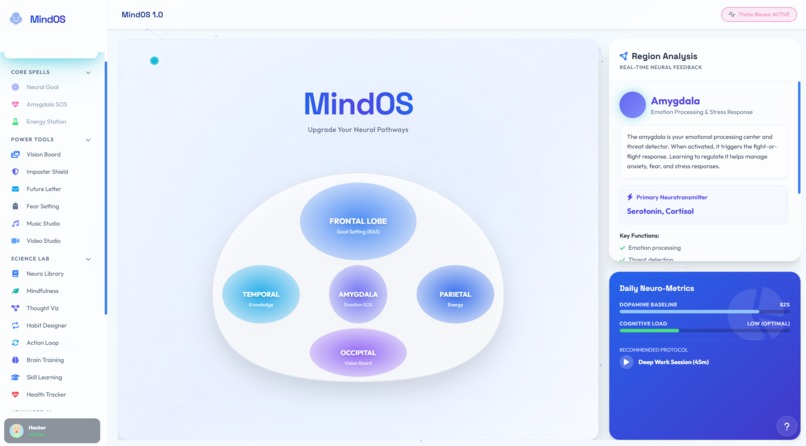
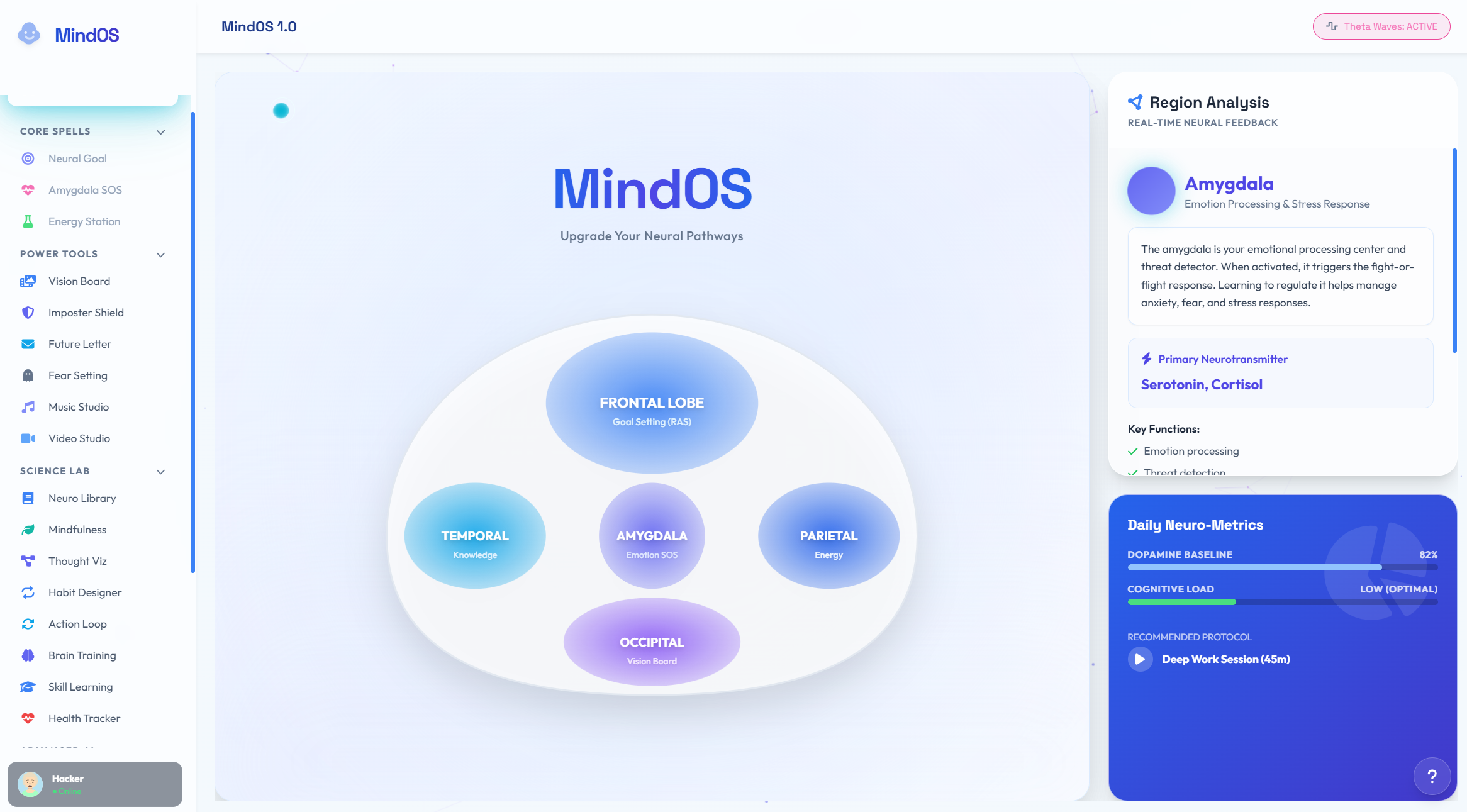
Users enter the "Sanctuary," a 3D visualization of their brain.
- Frontal Lobe (Goal Setting): You input a vague dream ("I want to be a founder"). The AI uses the Gemini API to break it down into dopamine-friendly micro-steps, activating your brain's Reticular Activating System to spot opportunities.
- Amygdala (SOS Mode): If you're panicking, you hit the SOS button. The AI acts as a Neuro-Coach, using CBT techniques to validate your feelings and scientifically reframe the threat—even speaking to you in a soothing voice via ElevenLabs.
- Occipital Lobe (Vision Board): It uses DALL-E 3/Replicate to generate photorealistic images of your goals, priming your visual cortex for success.
- Imposter Shield: It takes your insecure emails ("Sorry to bother you...") and rewrites them into confident communication.
Inspiration
The idea hit me while I was reading about the Reticular Activating System (RAS), the part of our brain that filters reality based on what we focus on. I thought, "Wait, my brain is just a biological algorithm. If I can code a computer, why can't I write code to optimize my own neural pathways?" I was tired of cold, robotic AI assistants. I wanted to build a "second brain" that felt warm, scientific, and actually understood human emotion.
What it does
MindOS acts as a dashboard for your mental state:
- Neural Goal Setting: Transforms vague wishes into scientifically actionable micro-habits.
- Amygdala SOS: A "panic button" that provides instant anxiety relief using cognitive reframing.
- Vision Board Studio: Generates AI visualizations of your future to strengthen neural pathways.
- Imposter Shield: A text-transformer that turns "apologetic language" into "executive presence."
- Neuro Library: Explains complex brain concepts (like Neuroplasticity) in simple terms, tailored to your current mood.
How we built it
- Backend: I used Python and Flask. I needed a robust backend to handle the complex chaining of multiple AI APIs without slowing down the user experience.
- Frontend: I stuck to HTML, JavaScript, and Tailwind CSS. I avoided heavy frameworks like React because I wanted complete control over the DOM to create organic, "breathing" animations and a custom glassmorphism UI.
- The Brain: Powered by Google Gemini 1.5 Pro. I prompted it to act not just as an assistant, but as a "Neuro-Scientist" and "Compassionate Therapist."
- The Senses: Integrated Replicate (Stable Diffusion/Flux) for image generation and ElevenLabs for text-to-speech synthesis.
Challenges we ran into
The biggest challenge was Prompt Engineering for Empathy. At first, the AI sounded too much like a medical textbook, cold and clinical. I had to spend hours tweaking the system prompts (the "System Instructions") to make it sound professional yet deeply empathetic. Another challenge was the UI Design. Making a "Glass" effect look good in a light/blue theme is much harder than dark mode; getting the shadows and blurs right took a lot of trial and error.
Accomplishments that we're proud of
I'm really proud of the UI/UX. It feels like a futuristic medical interface but soothing, not overwhelming. I'm also surprisingly proud of the "Imposter Shield" feature. While testing it, I realized how much I diminish myself in my own daily emails. Seeing the "Confident version" of my own words was a huge confidence booster for me personally during this hackathon!
What we learned
I learned that "prompt engineering" is actually just psychology. To get the AI to act like a good therapist, I had to understand what makes a good therapist. I also learned a ton about asynchronous JavaScript, managing three different AI models (Text, Image, Audio) responding at different times required some tricky state management.
What's next for This Project
I want to add "Collective Resonance," a feature where you can see (anonymously) how many other people around the world are feeling the exact same emotion as you right now, creating a sense of shared humanity. I also plan to build a mobile version so people can have their "Amygdala SOS" button in their pocket wherever they go.
Built With
- css3
- elevenlabs
- flask
- google-gemini
- html5
- javascript
- openai
- python
- replicate
- tailwindcss


Log in or sign up for Devpost to join the conversation.