-
-
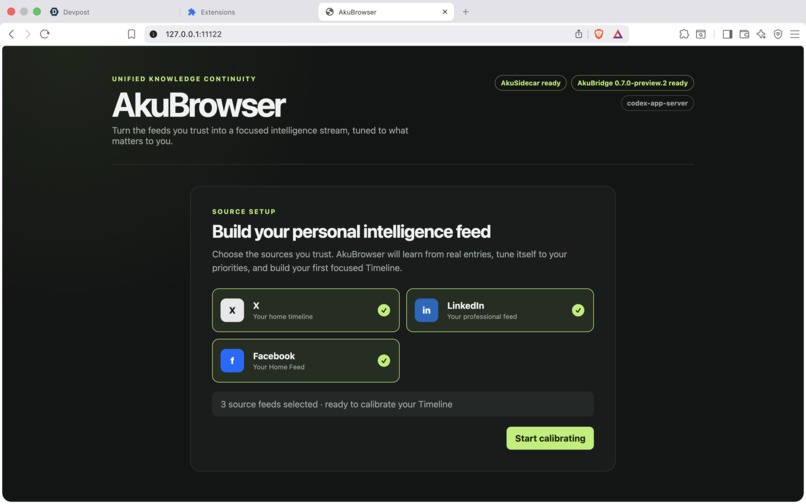
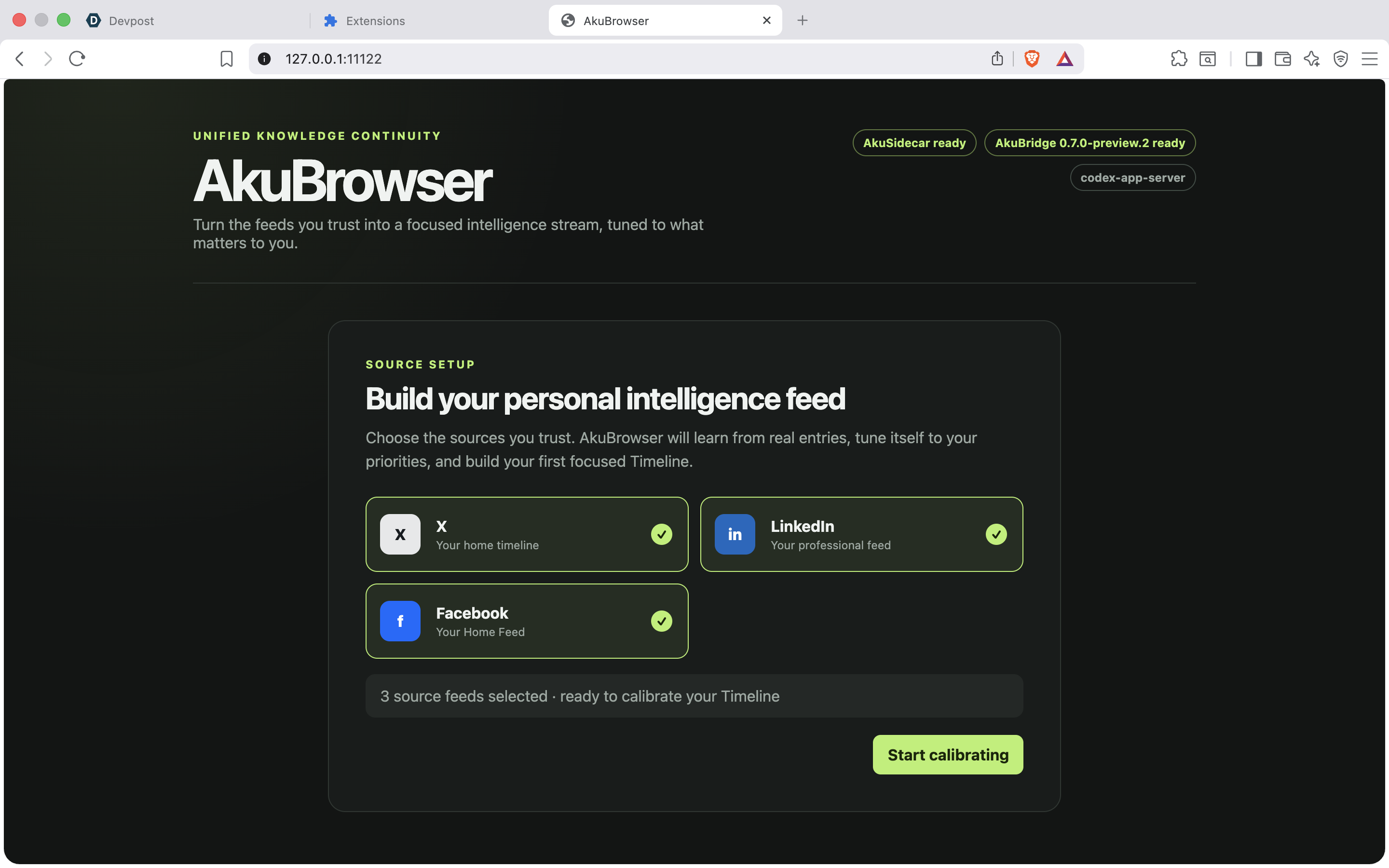
Choosing source social media
-
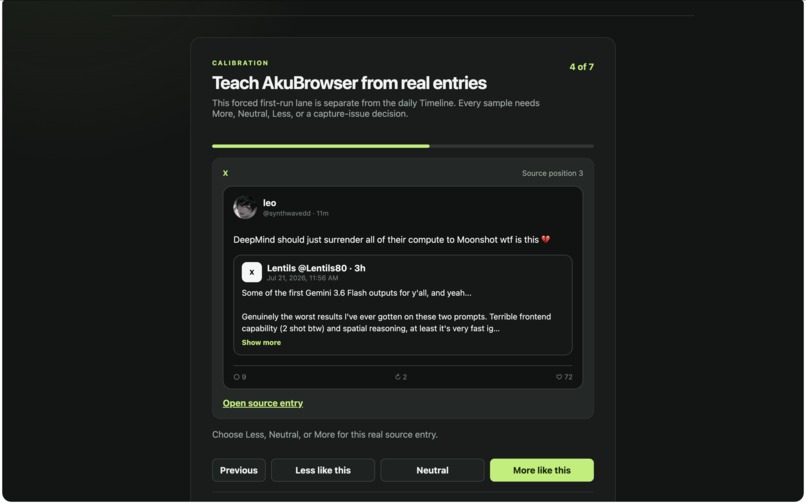
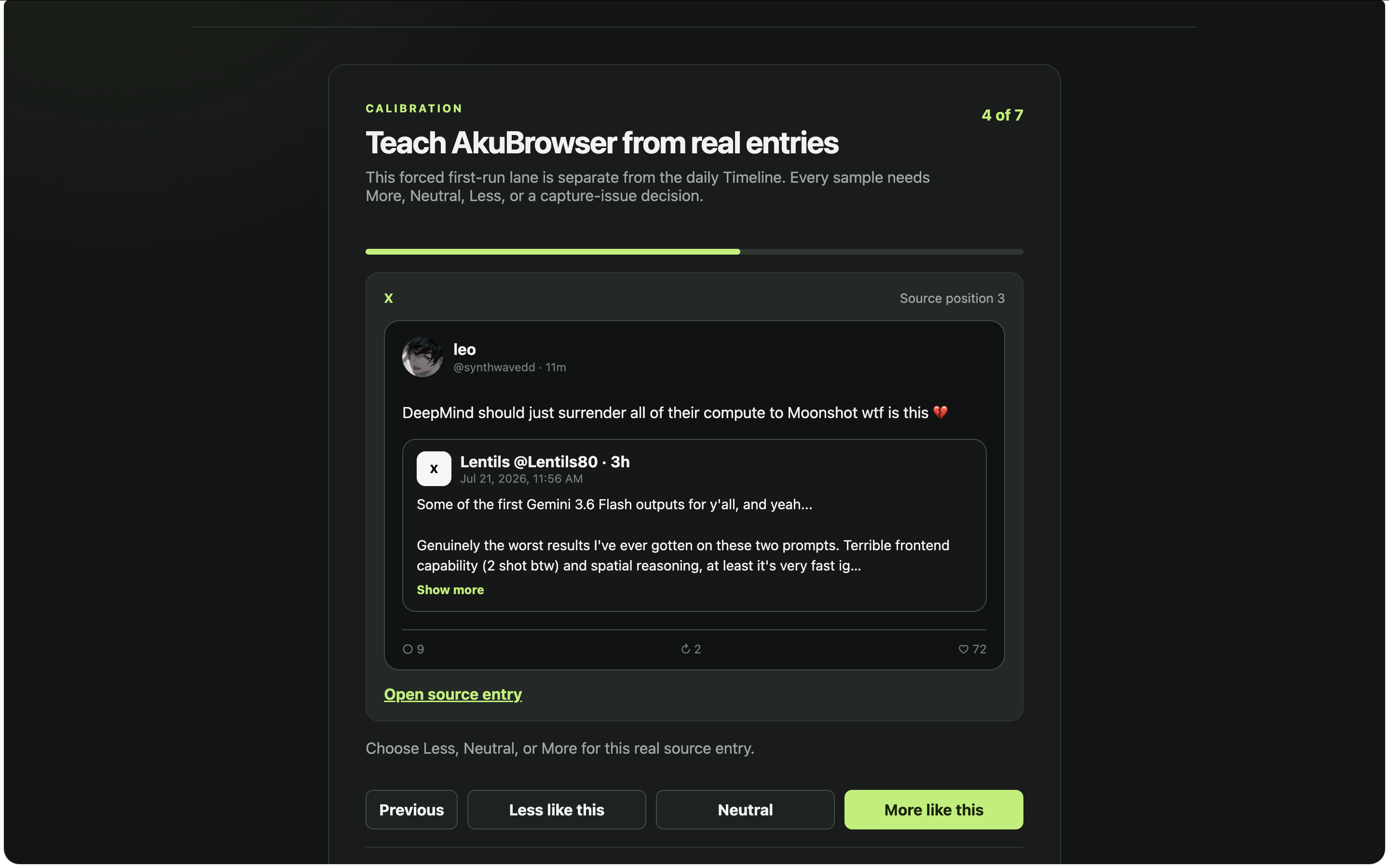
Initial calibration of what you want to see more and less
-
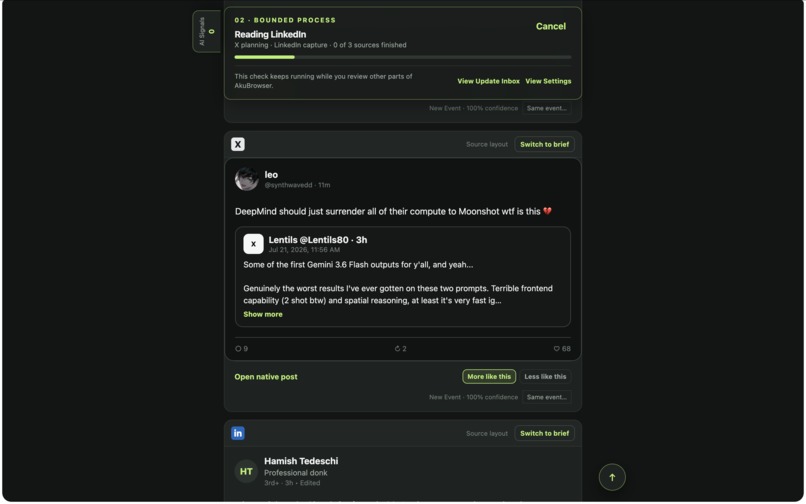
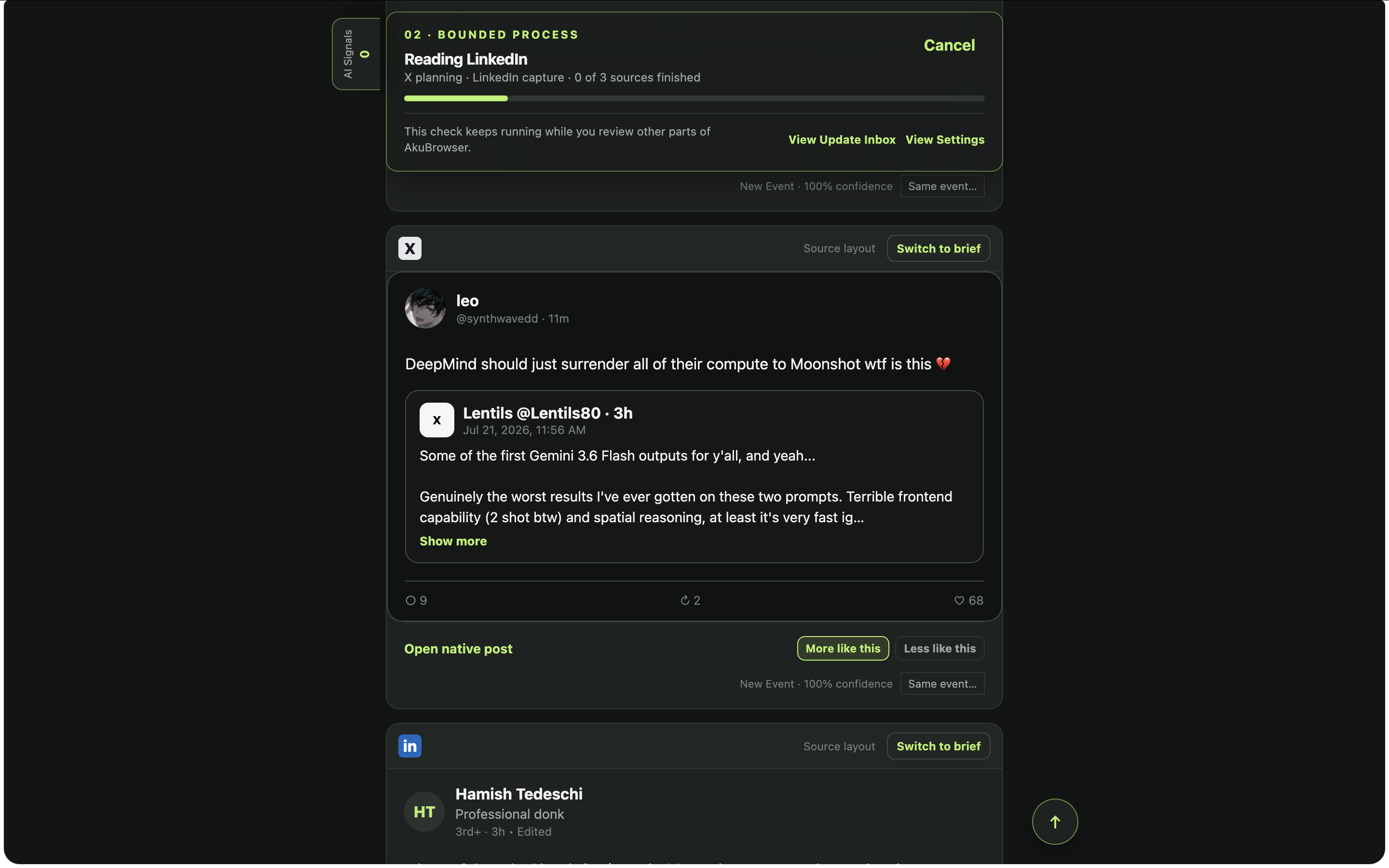
Pulling post from your sources and processing it for your timeline
-
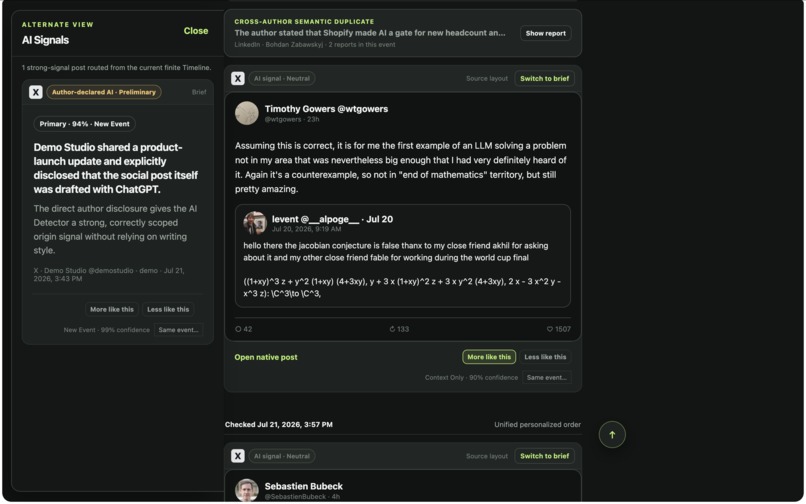
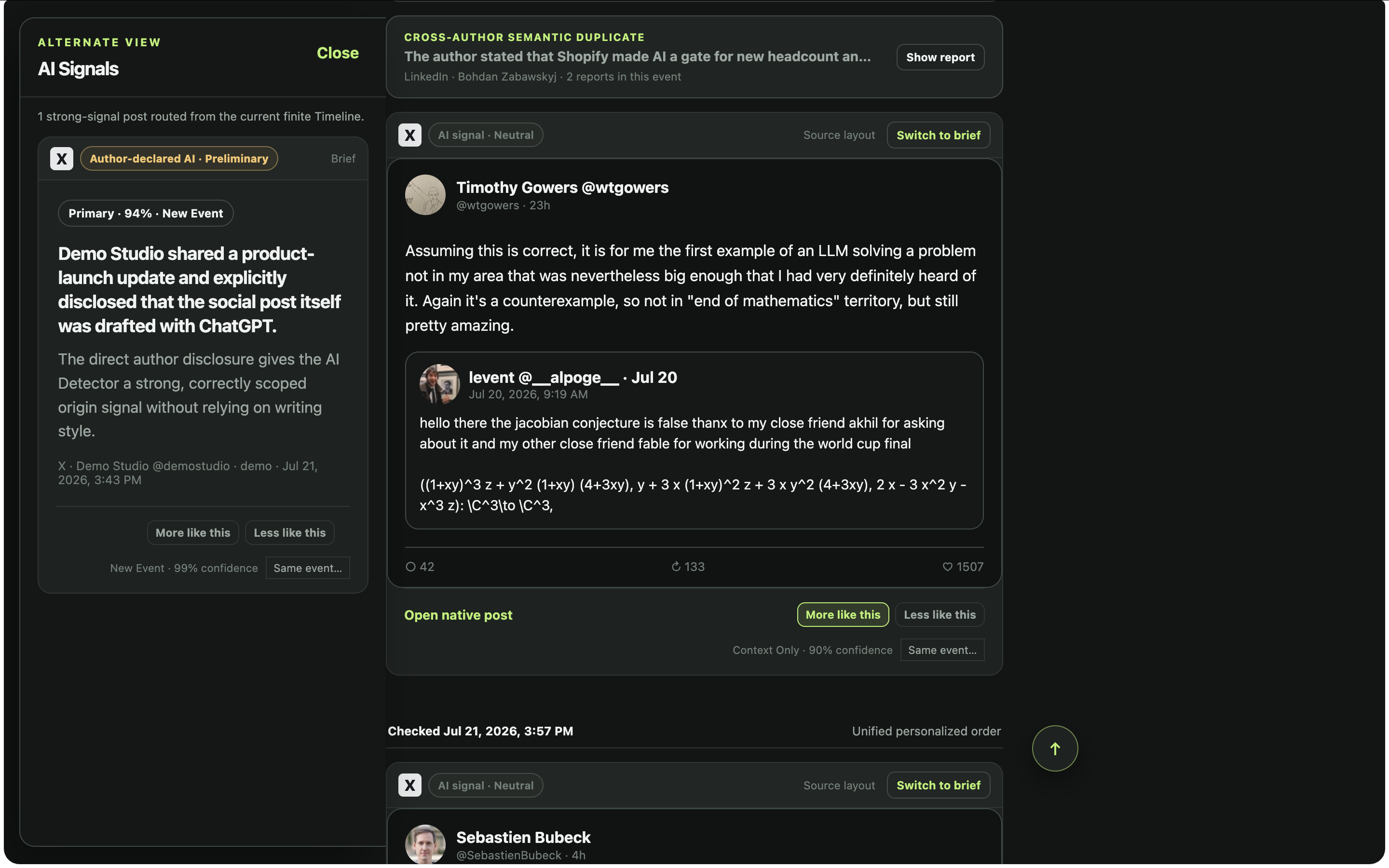
Post that has strong signal of AI and Has repeated semantic content is handled differently to lessen your cognitive burden.
-
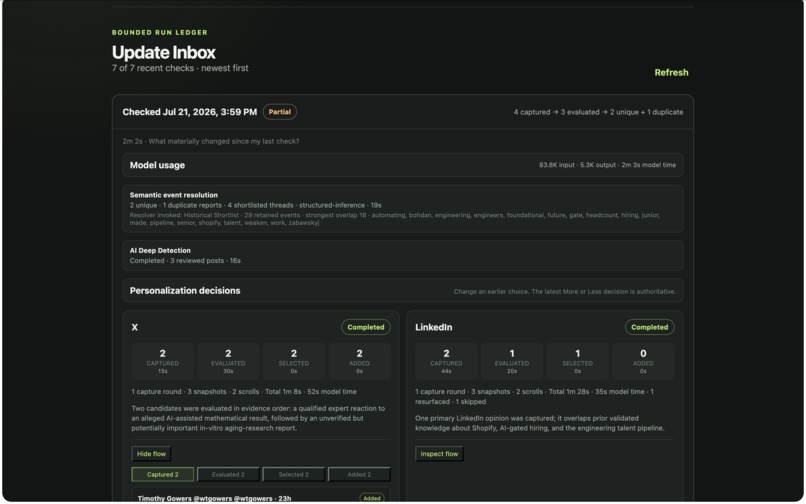
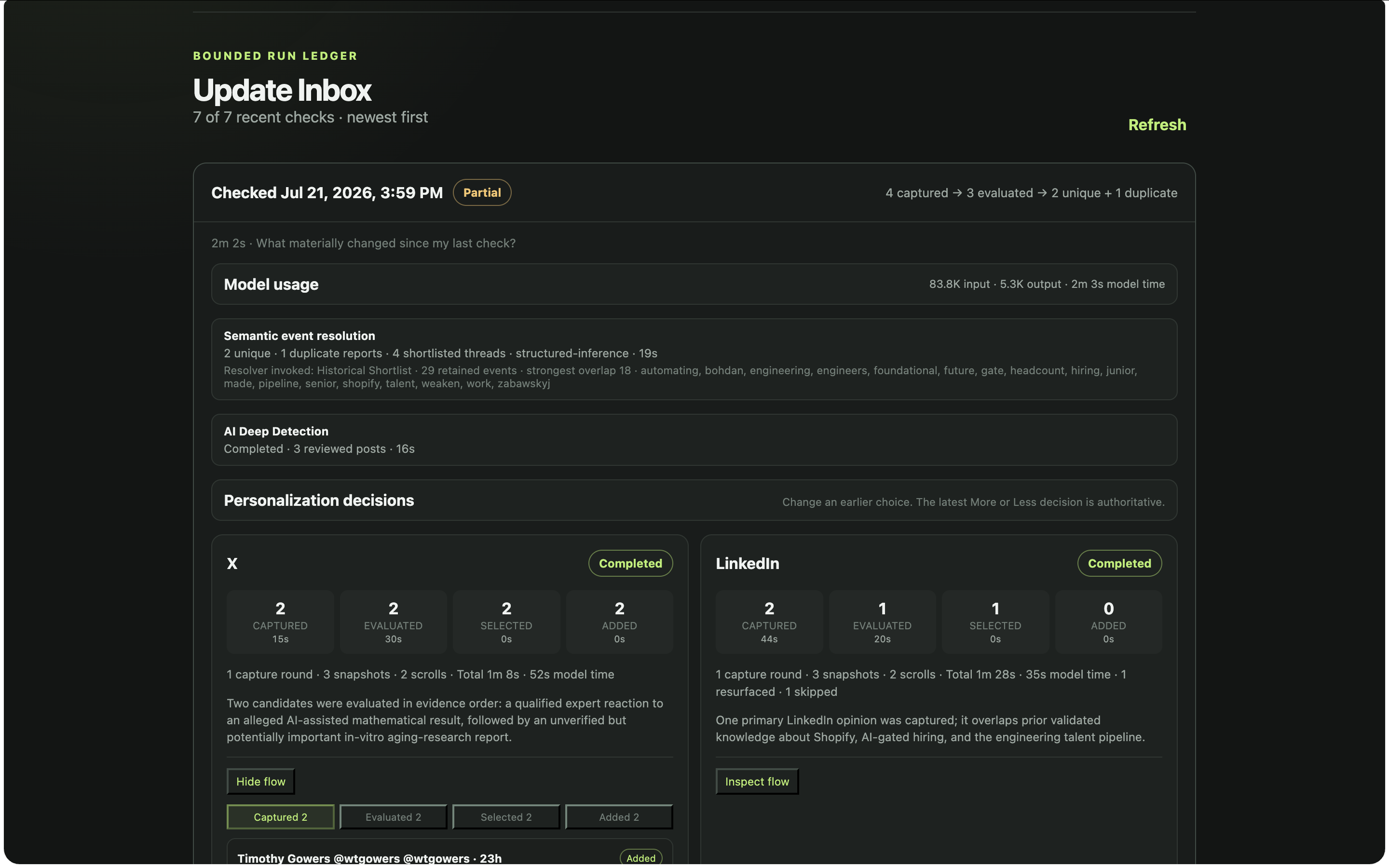
Inbox for people like to check the inner working
-
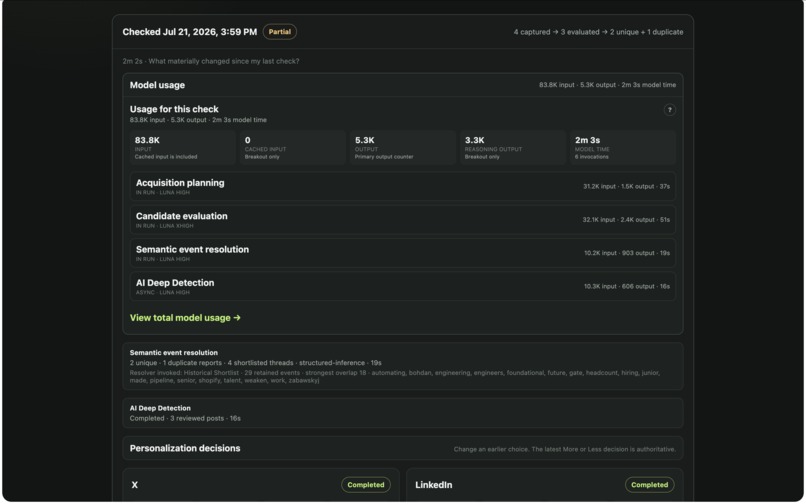
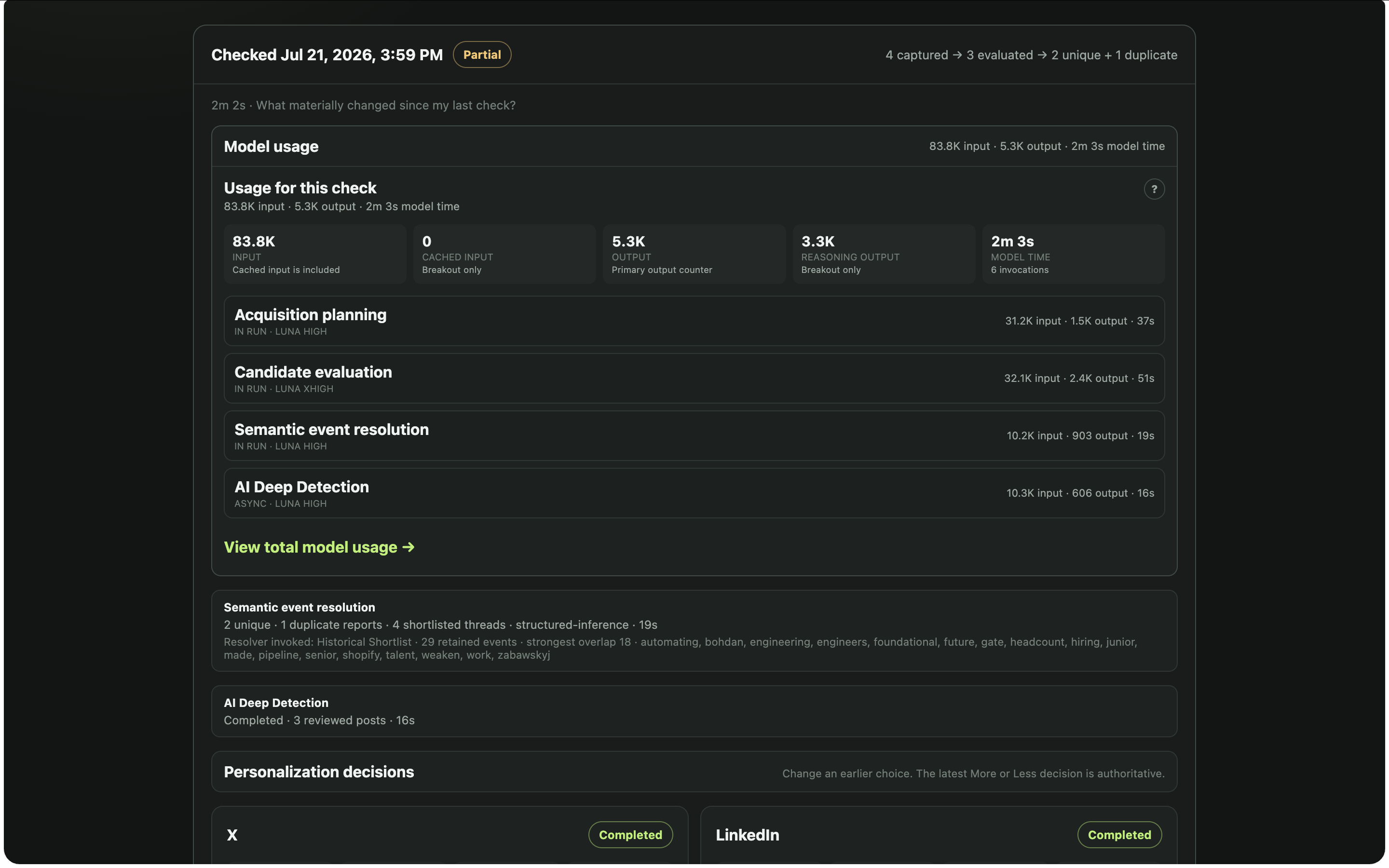
How much token you consume each run can be viewed
-
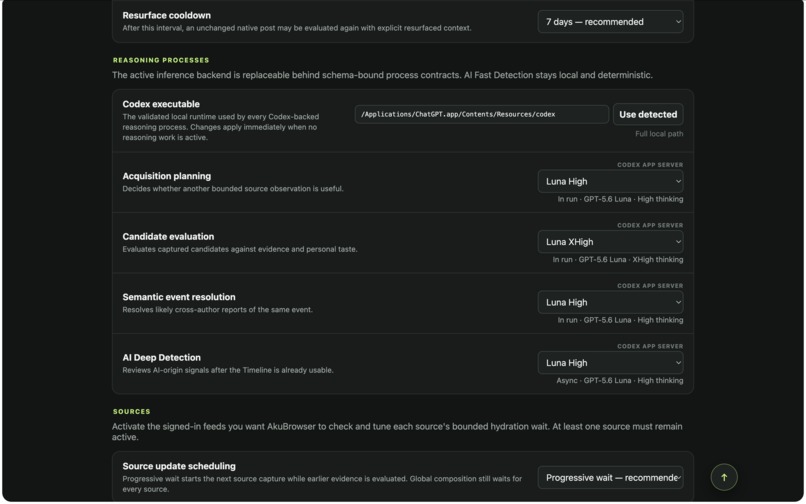
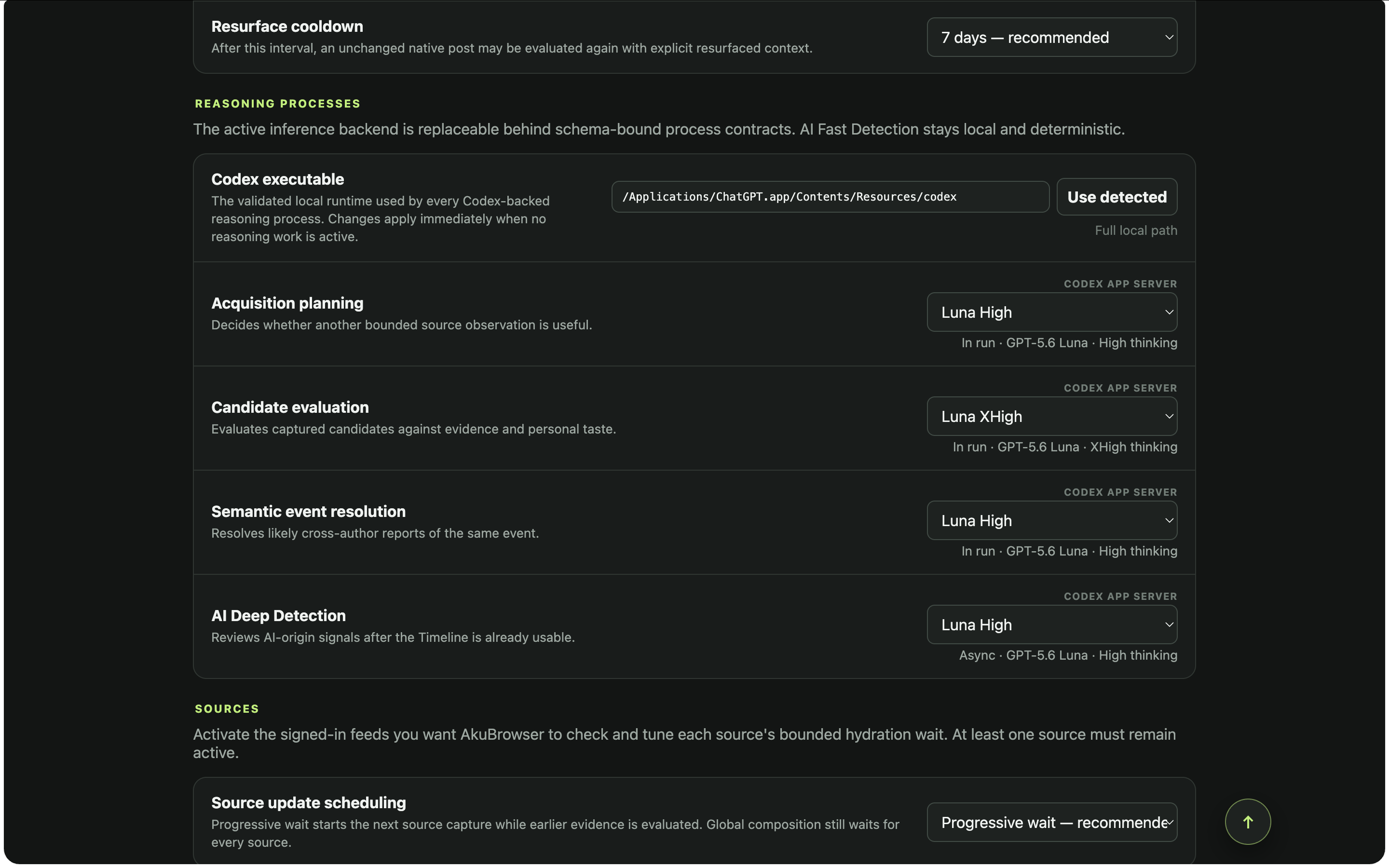
You can change the model and thinking effort and others in settings
Inspiration
Attention is what everyone is fighting for right now.
With the rise of For You Pages, every social platform is designed around an infinite feed. There is always another post, another notification, and another reason to keep scrolling. Access to information has improved, but consuming that information has become exhausting.
I want to give control back to the user: the ability to decide which topics deserve their attention, which information they want to see more of, and when they have consumed enough. This is implemented by using cross-source semantic, to collapse similar content from difference author or source. And also a simple implementation if the content is AI generated or not. Lessen the burden of people who want to see AI generated content less.
And as the Internet is changing constantly, browser it still the gateway to all the knowledge that available for human kind online. As we interact more and more with agent with MCP in the future a new kind of browser will be needed. Where the control is in the hand of the user not the server.
What it does
Instead of passively accepting everything pushed into a timeline, AkuBrowser helps users filter and prioritize what is relevant to them. Its goal is not to replace the platforms or discard everything their recommendation systems have learned. AkuBrowser works with the user’s existing authenticated Chrome session. It treats the existing feed order as a borrowed behavioral prior, then builds a user-owned preference and reasoning layer on top of it.
The desired experience is simple:
Show me what matters to me, explain why it matters, preserve the sources, and let me feel finished.
It currently supports X, Facebook and LinkedIn.
A typical session:
- Captures a bounded set of posts from the user’s authenticated X, Facebook, and LinkedIn feeds.
- Validates each observation while preserving its metadata and original context.
- Skips unchanged posts or that has already been delivered.
- Uses Codex for Acquisition Planning. To determines whether the available evidence is sufficient or whether one additional bounded observation would be useful,
- Uses Codex for Candidate Evaluation. To describes each candidate’s topics, materiality, novelty, urgency, actionability, and evidence strength.
- Combines those assessments with the user’s explicit interests and locally learned preferences.
- Filters candidates according to the user’s attention policy.
- Uses Codex for cross-source semantic reasoning to recognize posts about the same event, collapse repeated reports, and preserve meaningful updates or different perspectives.
- Composes the selected events into one finite, personalized timeline.
- Applies fast AI detection and Deep AI detection (using Codex) to filter AI post to a dedicated drawer (configurable)
- Ends with a clear “End of catch-up” marker.
AkuBrowser currently learns through explicit interaction rather than passive surveillance. Preference-based filtering and ranking are applied through deterministic application policy. The user remains the authority.
How we built it
AkuBrowser is divided into these independent components:
- AkuBridge is a read-only Chrome extension. It performs bounded, read-only capture, source-specific quality checks and sends structured evidence to AkuSidecar.
AkuSidecar is a local Golang application. It owns the UI, storage persistence (SQLite), session orchestration, deterministic selection, preference policy and managed Codex App Server process (Acquisition Planning, Candidate Evaluation, Semantic Event Resolution, Deep AI Detection).
AkuBrowser is the main product and integration repository. It owns the architecture, canonical contracts, compatibility checks, Windows and macOS packaging, and aggregate development workflows across the components.
AkuSupervisor is an optional tool based Rust-based local lifecycle supervisor. It perfect to work with agentic workflow. It has MCP protocol that can determine the right time to start, stop and restart the plugins or the sidecar. The usage of token and computer usage can be reduced greatly with using AkuSupervisor in repeated development cycle.
AkuSupervisor may eventually be bundled with AkuBrowser as the local lifecycle engine responsible for launching and maintaining AkuSidecar.
What we built during OpenAI Build Week
AkuBrowser started with the release of GPT 5.6. Only with the release of Sol that I started to believe it possible to implement this Idea without taking a huge amount of time. At least until the MVP stage. OpenAI Build Week gives the opportunity to push the development further. During the Build Week submission period, we materially extended it with the help of Codex across all repositories.
The Build Week work includes:
- Implementing AkuSidecar and rewrite it from Node.js (because codex sdk only available to Node.js) to Go (transition to Codex App Server) while preserving SQLite state, recovery, and product behavior
- Integrating Codex App Server for Acquisition Planning, Candidate Evaluation, cross-source semantic resolution, and AI Deep Detection, profiles and usage telemetry
- Implementing preference-aware selection with calibration, More/Less feedback, local learning, candidate filtering, and correction controls
- Building a cross-source Semantic Event Engine that collapses repeated reports while preserving meaningful updates, contradictions, and perspectives
- Expanding bounded, source-faithful capture to X, LinkedIn, and Facebook with shared quality, freshness, media, and lifecycle controls
- Adding AI Fast and Deep Detection with user-controlled Inline, Drawer, and confirmed Hide modes;
- Strengthening onboarding, session recovery, exact-evidence suppression, resurfacing, reset, and Sidecar-restart behavior
- Packaging verifiable Windows x64 and macOS universal portable previews with native AkuSidecar executables, platform launchers, provenance, checksums, and the bundled AkuBridge extension
- Extending AkuSupervisor with lifecycle ownership, cooperative Bridge reload, health and log monitoring, read-only MCP support, and synchronized cross-repository tests.
- And many others. It's fully build using Codex and GPT 5.6
The dated Git history and BUILD_WEEK.md document which capabilities existed before the event and which were added or materially extended during the competition.
Challenges we ran into
One of the hardest challenges was preserving source fidelity.
Modern social sites are dynamic, and Chrome extension service workers can stop and restart. We built source-specific adapters, bounded retries, durable checkpoints, idempotent commands, and recovery paths so a partial capture or Sidecar restart does not corrupt the session. Preserving source fidelity was especially important to preserve the same consuming content feeling for the user.
Preference filtering introduced another important challenge: information can be objectively material without being personally relevant. We needed to separate content understanding from user preference. Codex describes the content, while the user’s explicit interests and feedback determine how that content competes for their limited attention. And then implementation the cross-source semantic reasoning and AI filter to reduce the user burden to not ingest the same content or unwanted content.
Security was equally important. Web content is untrusted evidence and may contain instructions intended to manipulate an AI agent. We isolates captured content from system instructions, limits the authority of the Reasoning Provider, validates every structured response, and keeps browser movement and filtering authority under deterministic policy.
We also had to manage Codex token usage carefully. Development and runtime reasoning compete for the same limited resources.
Finally, packaging a local system that spans Chrome, Go, SQLite, Codex, and a Rust supervisor is a product challenge of its own. We now provide clear portable entry points for Windows and macOS, while AkuSupervisor remains separate development tooling. A guided, signed installation and update experience remains future work.
Accomplishments that we’re proud of
We are most proud that our original idea—giving control of attention back to the user—became an enforceable product rather than only a design promise. AkuBrowser combines bounded capture from authenticated X, Facebook, and LinkedIn feeds with structured Codex reasoning, user-owned preference filtering, cross-source semantic event resolution, knowledge continuity, AI Signals, and one finite Timeline.
We also proud for being able to deliver a working prototype of a very ambitious and vague idea in couple of weeks. Tackling the technical issue, even re-writing AkuSidecar to a different Languange and protocol it become a doable task for better architecture. Things that previously could become a huge blocker now just a matter how many tokens can be spend. And thus a good token management become an important part in the development of this project.
What we learned
We learned that AI works best when probabilistic reasoning is surrounded by deterministic boundaries. Codex can understand meaning, context, and evidence, but permissions, state and others must remain under application control.
And development using AI doesn't mean you should let AI take the lead. It can lead you astray and spend token in places that is unnecessary and put you on difficult position when things need to be changed. A good token management is the key to deliver your project.
We also learned that there's almost no boundary between the Idea you have and the possibility to implement it. Things that are difficult or take a very long time to implement could be done today. As long as you slice the specification correctly. It's worth to create a PoC to see is your idea actually make sense & feasible or not.
What’s next for AkuBrowser
AkuBrowser currently supports Windows x64 and macOS through a universal portable bundle for both Intel and Apple silicon, covering X, Facebook, and LinkedIn. Each package includes AkuBridge and a native AkuSidecar, while AkuSupervisor remains separate development tooling. Our next direction is to simplify installation and updates, expand to more social media and web sources, and eventually support Linux.
The long-term goal is to rethink how people consume information in the age of Intelligence. Where information is abundant and attention is fought over. Website is not the only way to access information. With the rise of Agent and MCP protocol, how agent can be discovered and access, will be the new frontier. And browser seems to still be in the forefront as our access gate.
Managing all the information provided by servers or agents on the internet will be the next challenge for Aku Browser. We might not be dependent on static representation from the server. But could dynamically build dependent on the user needs and like.
There's also the economics side of monetary transaction and serving ads. It will be all handled by agent in the browser. But some human will also feel the needs to have a channel that preserve only for human interaction without an agent involvement. This is the challenge for future browser. And AkuBrowser could be the first generation of that future browser.

Log in or sign up for Devpost to join the conversation.