Inspiration
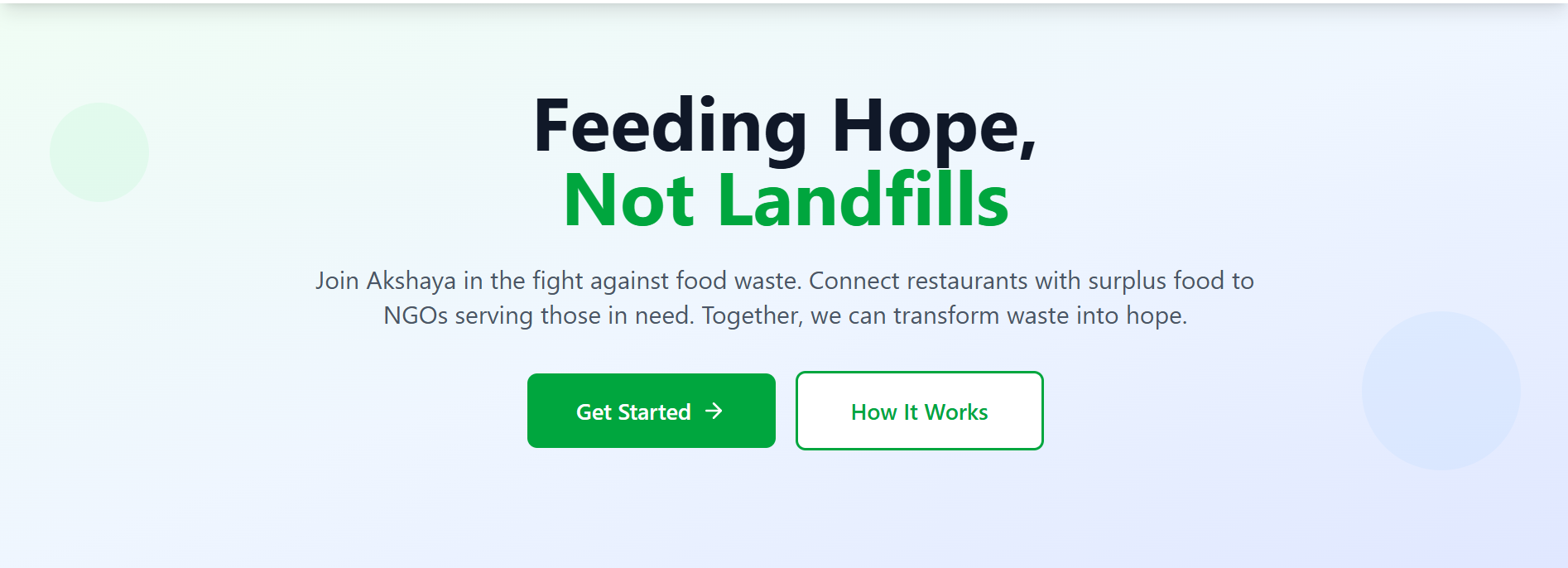
Akshaya started from a simple, painful observation: perfectly good food being thrown away while people in need waited outside restaurants. That cognitive dissonance — food wasted at scale while communities go hungry — inspired a practical question: how can technology, coordination, and compassion be combined to rescue surplus food and redirect it to organizations that need it?
What it does
Akshaya connects restaurants and other food providers with NGOs and community organizations. It lets partners:
- Register/login (email + Google sign-in)
- Create and manage food-availability logs (what food is available, pickup windows, quantity)
- Match available food with nearby NGOs and volunteers
- Store user profiles and role-specific data in Firestore
The initial product is focused on streamlining communication and record-keeping so surplus food reaches people quickly and safely.
How we built it
- Framework: Next.js (app router) with React for UI.
- Authentication & backend: Firebase v12 — Authentication (email/password + Google), Firestore (users, food logs), Storage (images/files).
- Auth wiring: Firebase initialization and a centralized auth provider (including Google sign-in helper).
- Pages & features: signup, login, food-log, dashboard, founder.
- UI and icons: Tailwind-style utility classes + lucide-react icons.
- Helpful hooks: react-firebase-hooks simplifies email/password flows.
Challenges we ran into
- Role verification & authentication complexity.
- Scalability of matching and data at increased volume.
- Go-to-market trust and onboarding barriers.
Accomplishments that we're proud of
- Full client-side Google sign-in + email/password auth with automatic Firestore profile creation.
- Clean auth context pattern that keeps UI components simple.
- Intuitive, mobile-first UI components for signing up, logging food, and viewing partner information.
- A small but complete end-to-end flow from sign-up → profile creation → logging food → viewing food logs.
What we learned
- Firebase is a great fit for rapid prototyping of auth and realtime-backed features, but it requires clear decisions about security rules and data modeling early on.
- Building for real users (restaurant staff, NGO coordinators) prioritizes simplicity, short flows, and forgiving forms over many advanced features.
- Handling third-party OAuth requires testing across environments (local, staging, production) and remembering to add authorized domains and correct redirect configuration.
What's next for Akshaya
Short-term:
- Improve onboarding flows (guided setup for restaurants/NGOs).
- Add richer food-log fields (food type, temperature handling, images) and simple validation for safety.
- Implement a notification or matching system to alert nearby NGOs when new food is logged.
Medium-term:
- Role-based dashboards with metrics (rescued meals, partner impact).
- Mobile-first PWA flow for field use (offline-first read-only views, background sync when possible).
- Integrate volunteer scheduling and pickup assignment.
Built With
- firebase
- nextjs
- tailwind


Log in or sign up for Devpost to join the conversation.