-
-
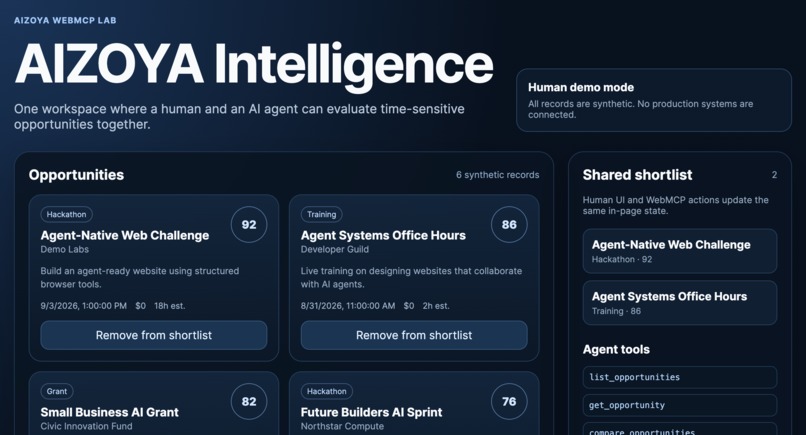
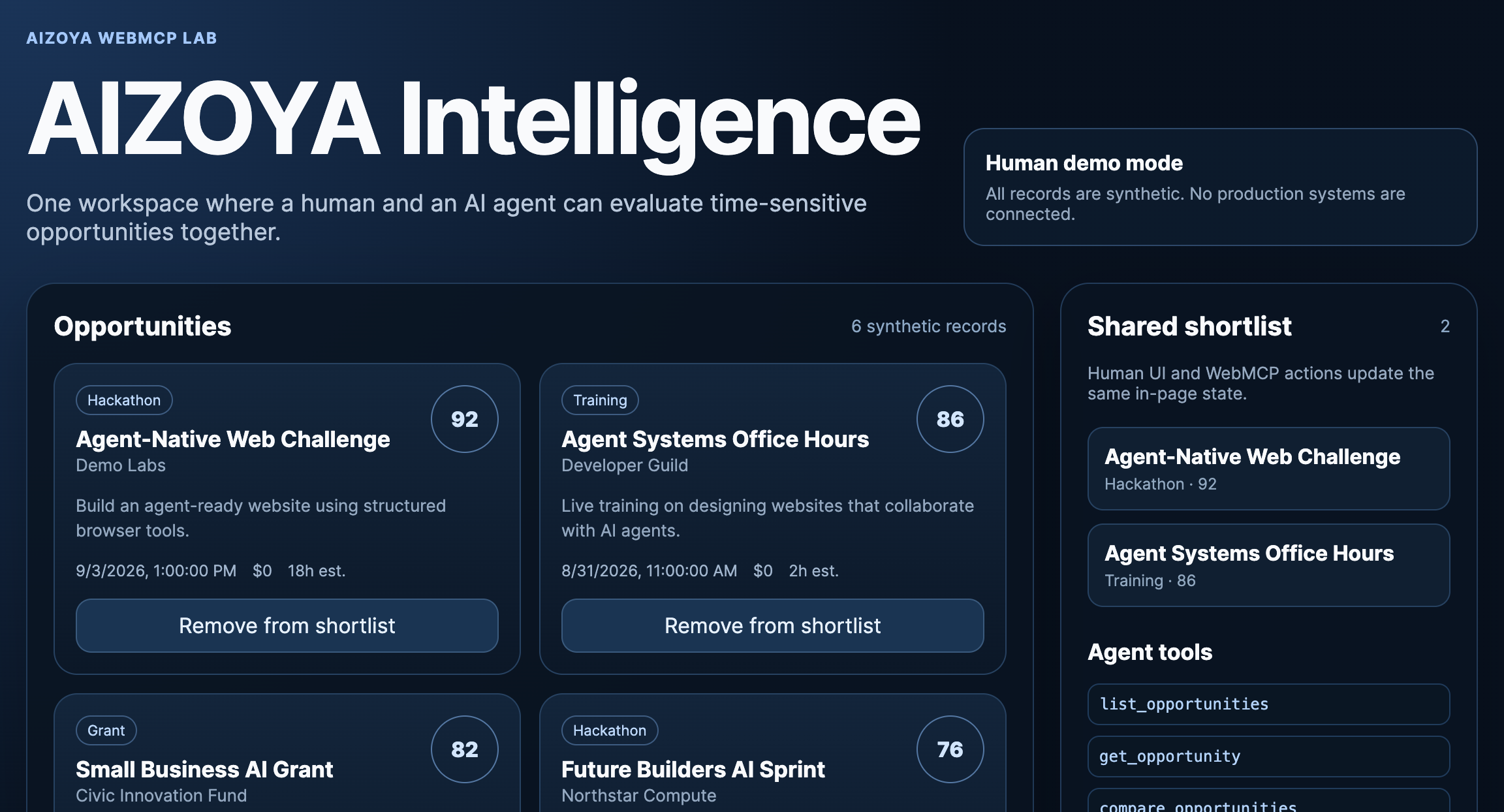
Live opportunity dashboard showing structured records, decision scores, deadlines, and the shared shortlist.
-
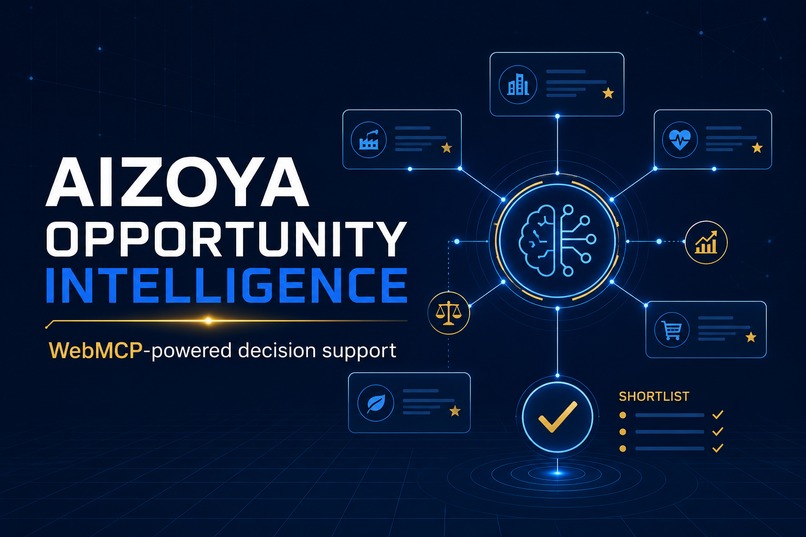
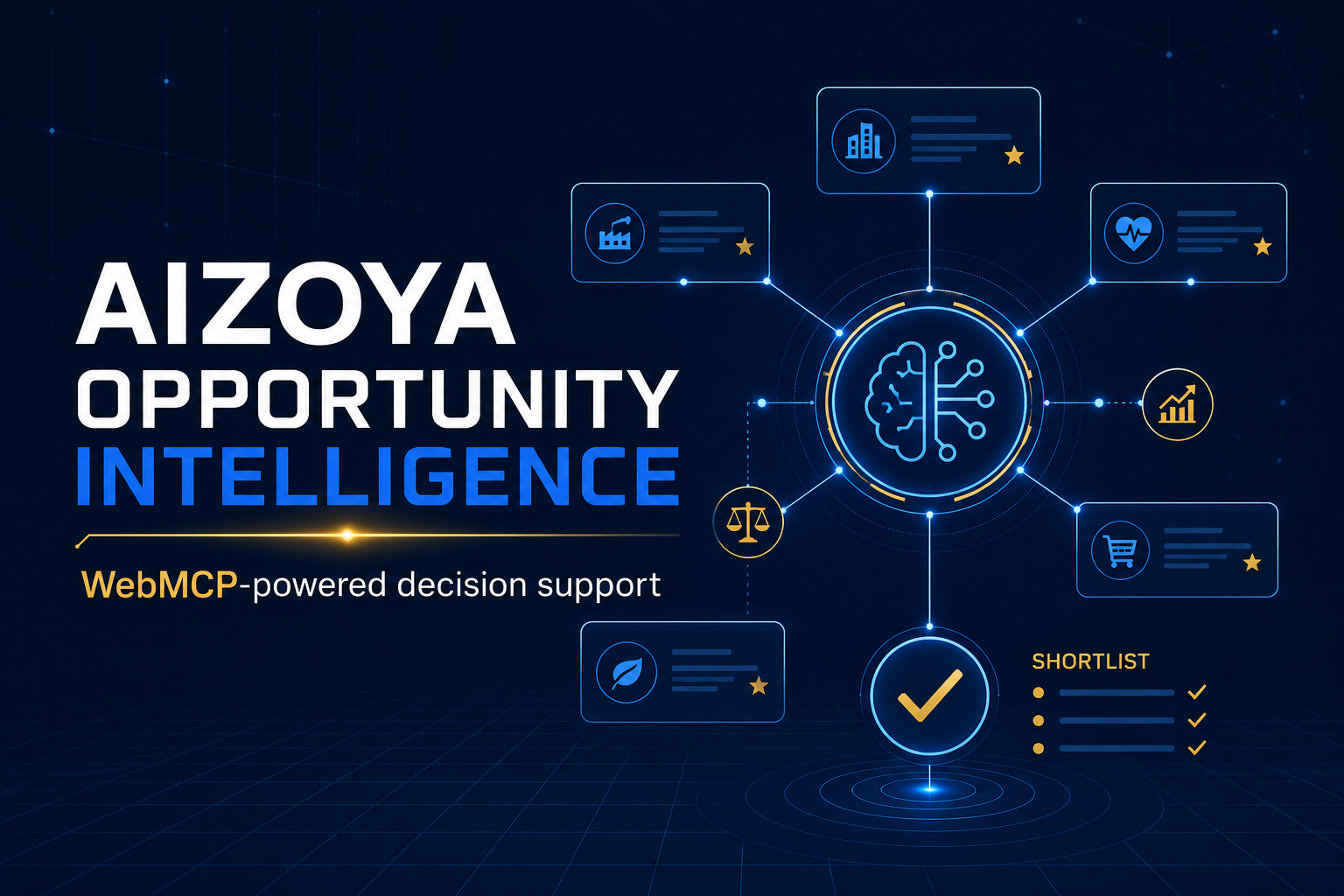
AIZOYA Opportunity Intelligence: WebMCP-powered decision support for people and AI agents.
Inspiration
Business owners and innovation teams face more opportunities than they can manually assess. Key information is often scattered across dashboards, websites, documents, and portals. Traditional browser agents must interpret visual interfaces and guess which controls to use, resulting in slow and unreliable performance.
AIZOYA Opportunity Intelligence introduces a new approach: a website designed for both people and AI agents. WebMCP enables the site to present clear, structured capabilities while maintaining the visual experience and user control.
What it does
AIZOYA Opportunity Intelligence serves as a WebMCP-enabled opportunity command center. Users can instruct an AI agent to:
- List the opportunities available on the page
- Compare two opportunities using their scores, strategic fit, deadlines, and other decision factors
- Add a selected opportunity to the shortlist
The agent uses registered website tools rather than guessing through the interface. Because the page and agent share the same context, results appear directly in the user interface.
The prototype shows how WebMCP can support business research, innovation portfolios, grant discovery, accelerator applications, procurement opportunities, and other decision-intensive workflows.
How we built it
We developed a responsive web application with Next.js, React, and TypeScript, and deployed it on Vercel. The application registers structured WebMCP tools with defined names, descriptions, inputs, and outputs.
The core tools support three stages of the decision workflow:
- Opportunity discovery
- Side-by-side comparison
- User-directed shortlisting
The interface displays structured opportunity records, and the WebMCP layer provides agents with reliable access to these capabilities. We tested the deployed application using ChatGPT’s in-app browser by issuing natural-language requests and confirming the correct tools were identified and executed.
Challenges we ran into
Our main challenge was designing tools that were useful to agents without being too broad or ambiguous. Tool descriptions, parameter schemas, opportunity identifiers, and results needed to be predictable.
We also needed to make agent interactions visible and understandable to users. Because shortlisting changes application state, the workflow required clear intent and observable feedback instead of hidden automation.
Testing an emerging browser standard required validating both the traditional user interface and the agent-driven experience.
Accomplishments that we’re proud of
- Built and deployed a working WebMCP-enabled application
- Registered multiple focused tools instead of one unrestricted tool
- Demonstrated an end-to-end agent workflow
- Enabled structured comparison between opportunities
- Connected an agent action to visible shortlist state
- Preserved a useful interface for people who interact with the site manually
What we learned
WebMCP changes how websites communicate their capabilities. Visual design remains important for users, while structured tools give agents clearer instructions and more reliable actions.
We also learned that the most effective agent tools are focused, well-described, and based on visible application state. Human control and transparency become increasingly important as agent capabilities grow.
What’s next
Next, we plan to expand the prototype into a comprehensive AIZOYA portfolio command center with authenticated workspaces, live opportunity sources, evidence-backed scoring, deadlines, reminders, bilingual support, audit history, and approval controls for key actions.
Our long-term vision is a human-centered intelligence system that enables organizations and their AI agents to discover opportunities, evaluate them consistently, and act more quickly and with greater accountability.
Built With
- ai
- and-javascript-and-deployed-it-on-vercel.-the-application-uses-the-imperative-webmcp-api-through-document.modelcontext.registertool(.)-to-register-six-structured-tools-with-defined-descriptions
- annotations
- chatgpt
- codex
- css
- css3
- github
- html5
- input-schemas
- javascript
- validation
- vercel
- webmcp


Log in or sign up for Devpost to join the conversation.