Inspiration
Customers increasingly ask AI for businesses, services, products, and media instead of browsing websites alone. Most business sites were built for people to click through—not for agents and owners to collaborate on the same public document.
An agent might find a business or summarize a page, but finishing the customer’s intention still means navigating forms, copying details, calling manually, or handing off to a human. Building the page itself is even harder: agents can draft text, but they rarely have a safe, structured way to edit a live site with the owner in control.
We built AIWEB OS around a simple idea:
A business page should not only tell AI what the business does. It should give people and agents a shared, reviewable way to build it and act on it.
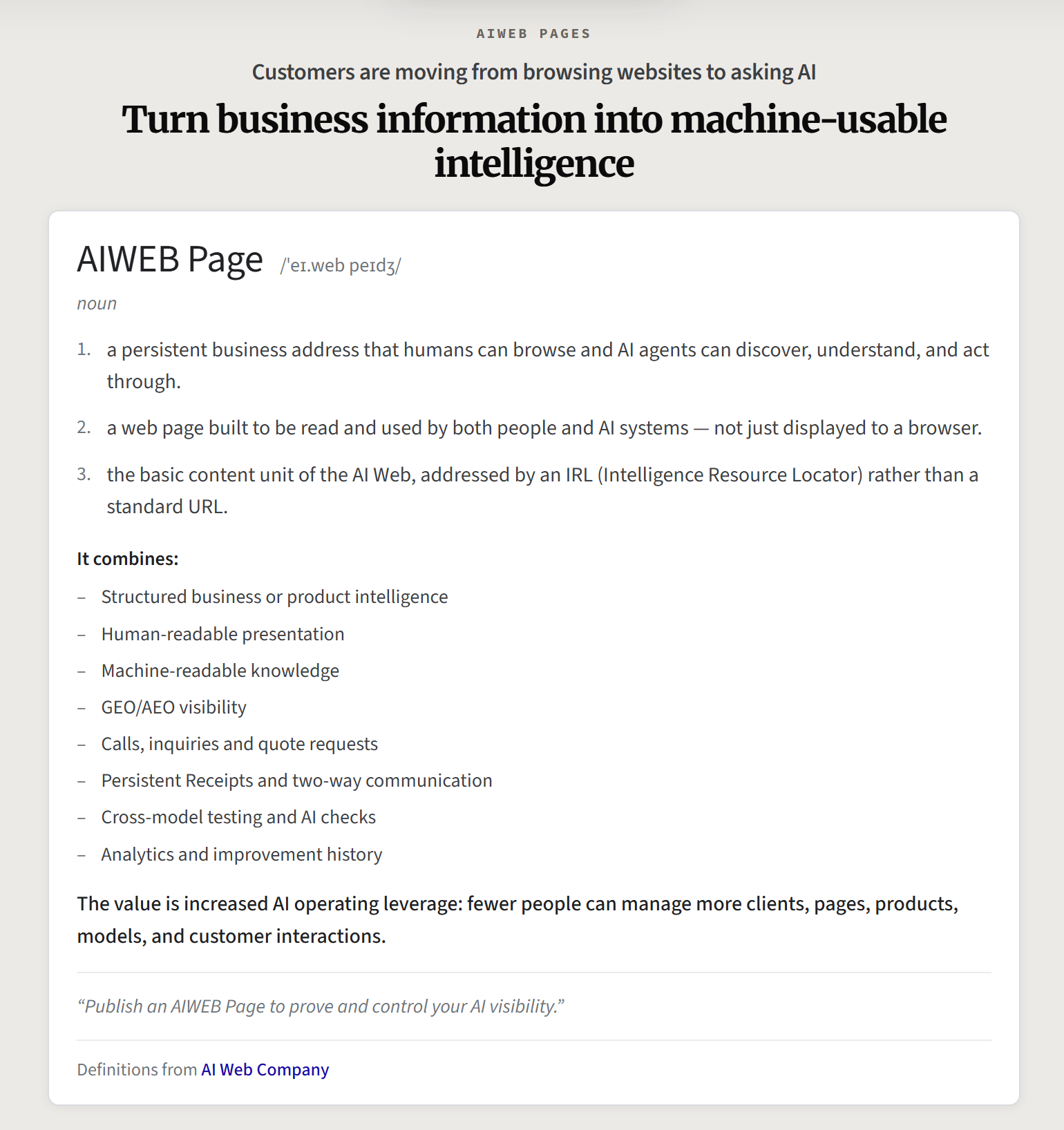
AIWEB Pages are public, portable business documents that connect live identity, information, and actions (Call / inquiry, media, Receipts, continuation). WebMCP gave us a browser-native way to expose those capabilities directly from the page—both in Publisher (create) and on the live IRL page (operate).
What it does
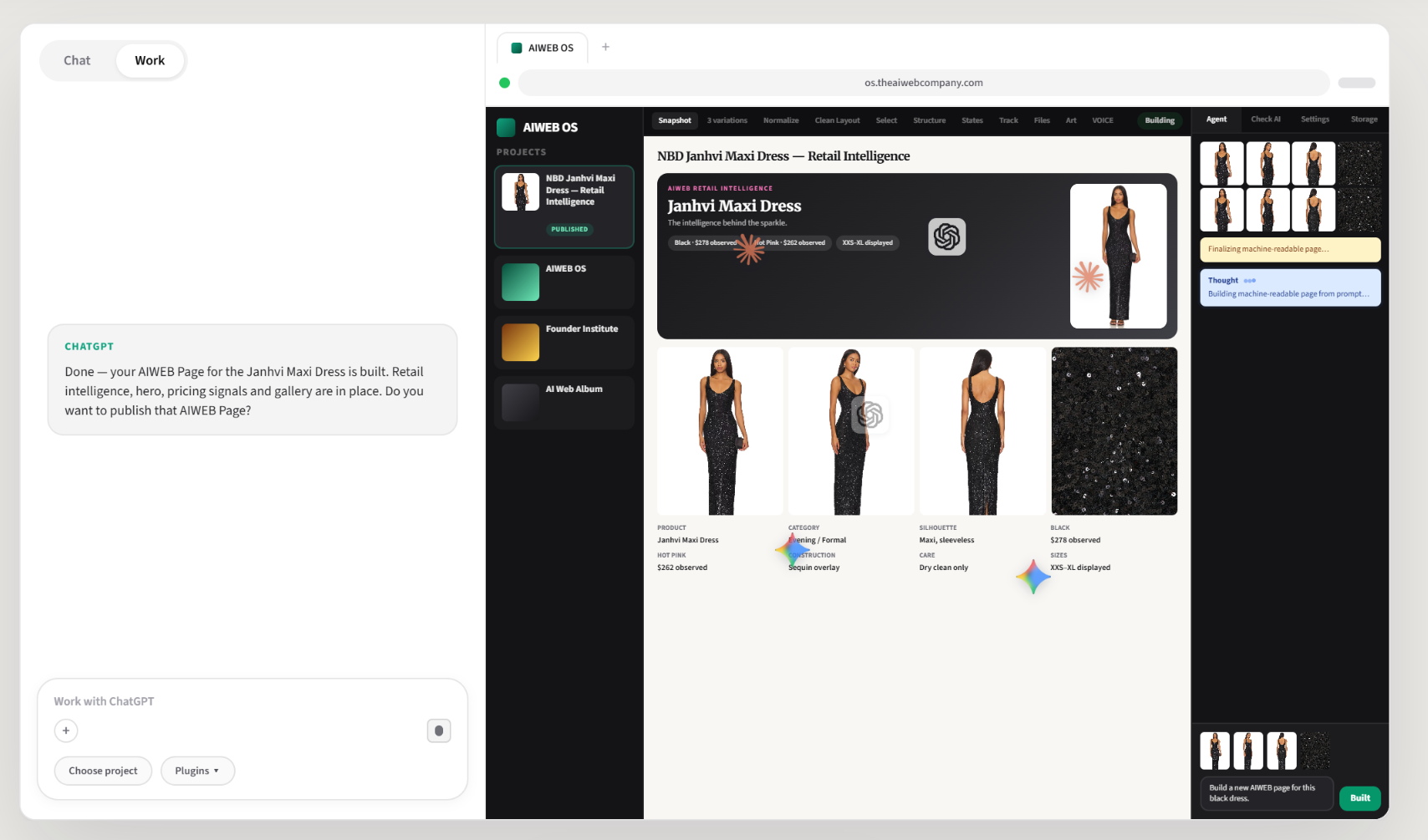
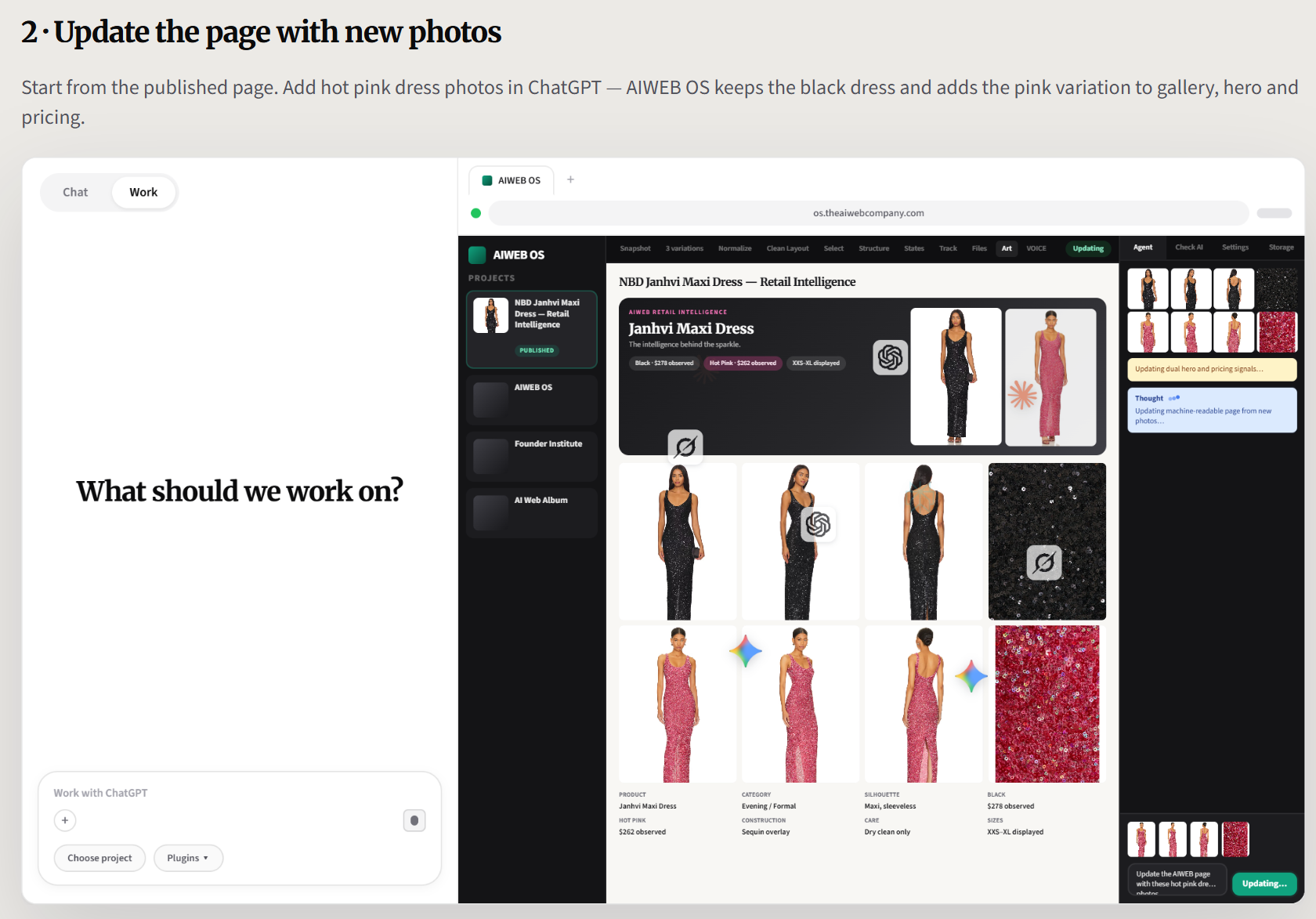
AIWEB OS uses WebMCP so humans and ChatGPT can work the same surfaces:
Create — Publisher + WebMCP
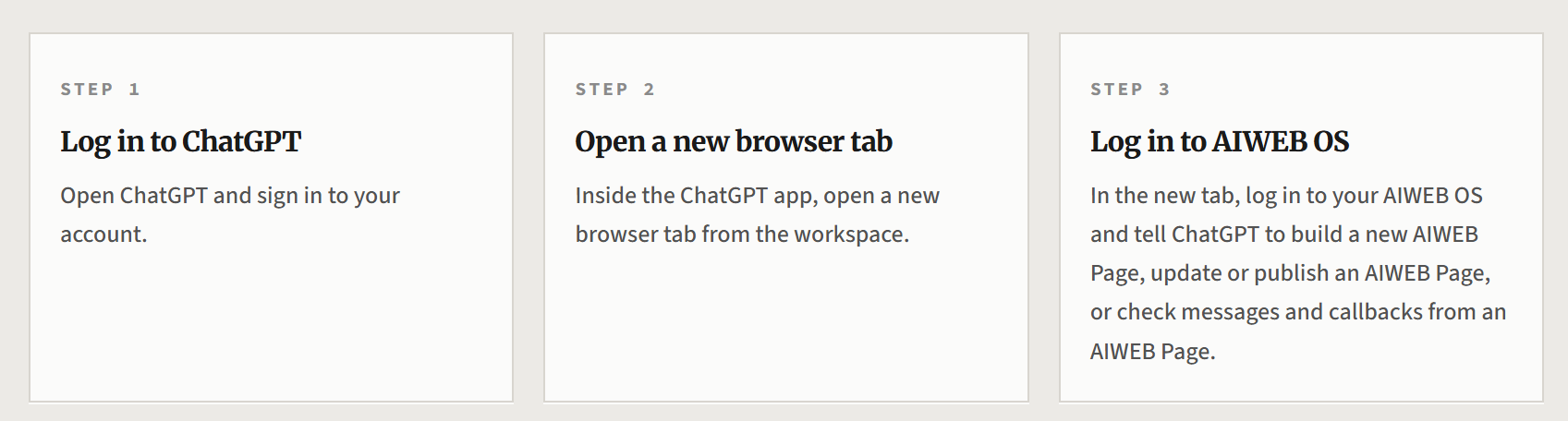
- Owner opens a blank page in AIWEB OS.
- Attaches images and describes the business (or pastes a judge scenario brief).
- ChatGPT uses editor WebMCP tools on the open page: snapshot the draft, edit identity and sections, FAQs, forms, validate, run AI Check, and request publish.
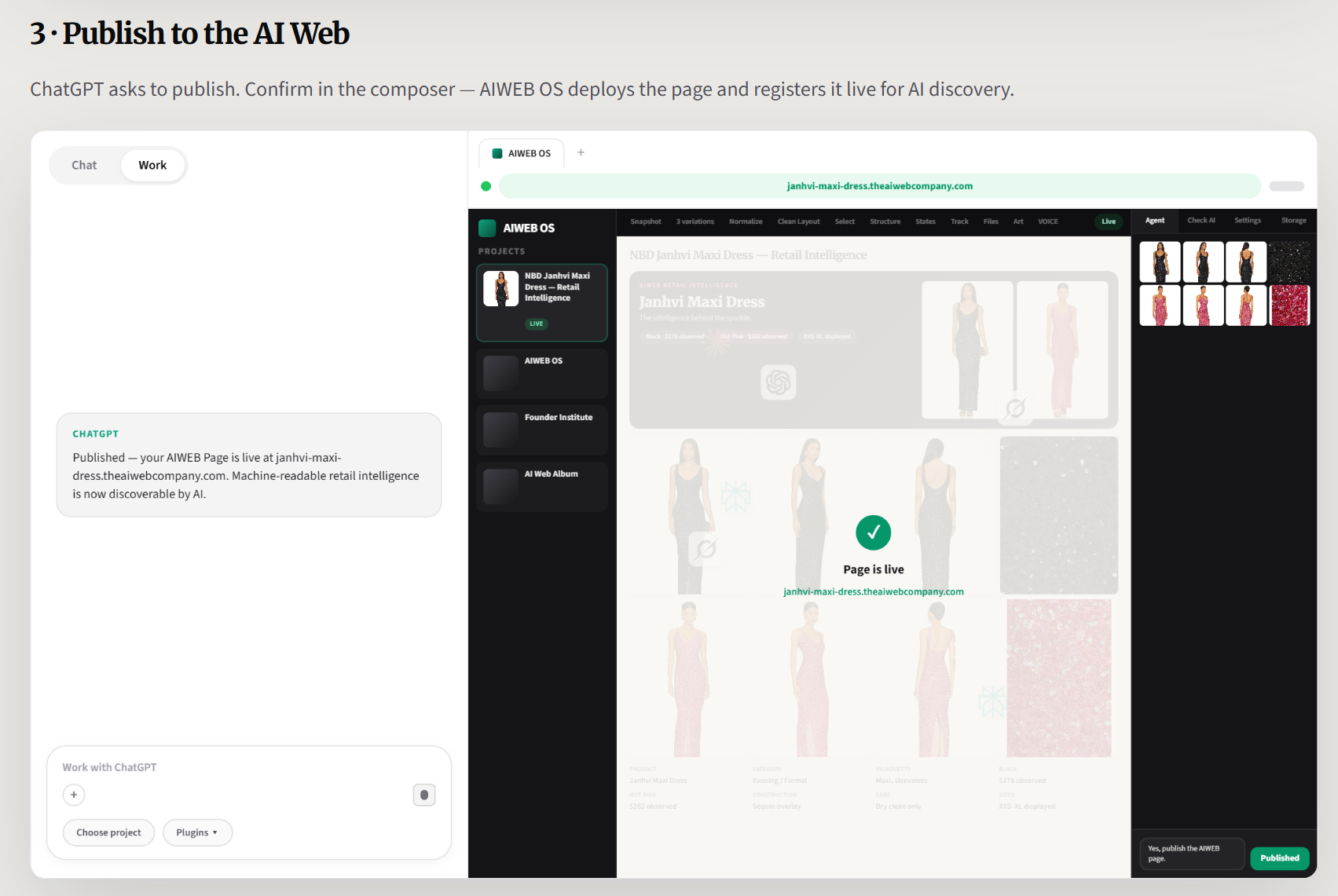
- Publication waits for an explicit human yes (
publish_draftwith confirm).
Operate — published AIWEB Page + WebMCP
- A customer asks something like: “Request a quote for a wedding with 100 guests.”
- The agent recognizes capabilities exposed by the published page, fills the visible form, and lets the customer review before submit.
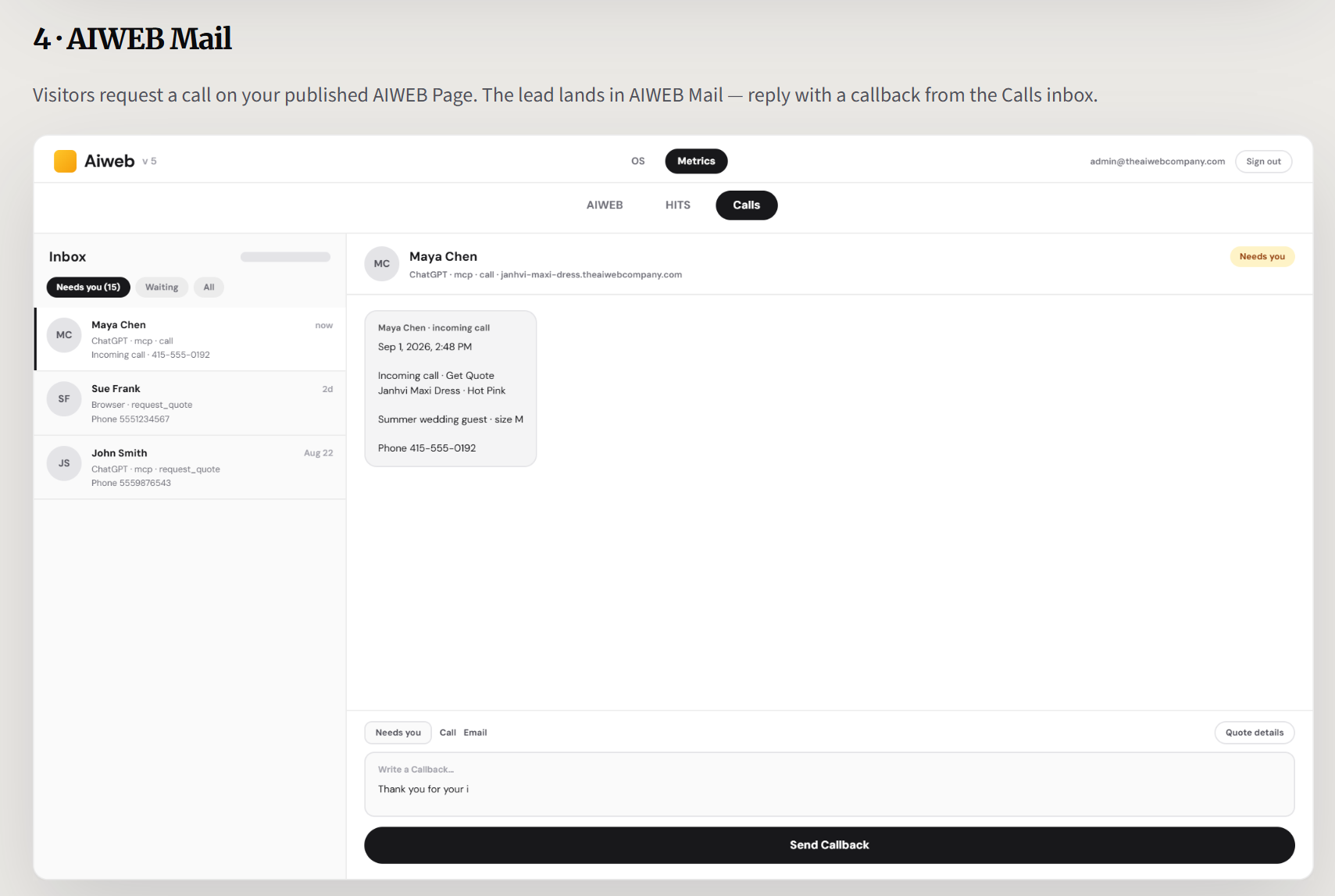
- The business gets the lead; the customer gets an AIWEB Receipt.
- The business replies in Publisher; the customer continues on the same Receipt.
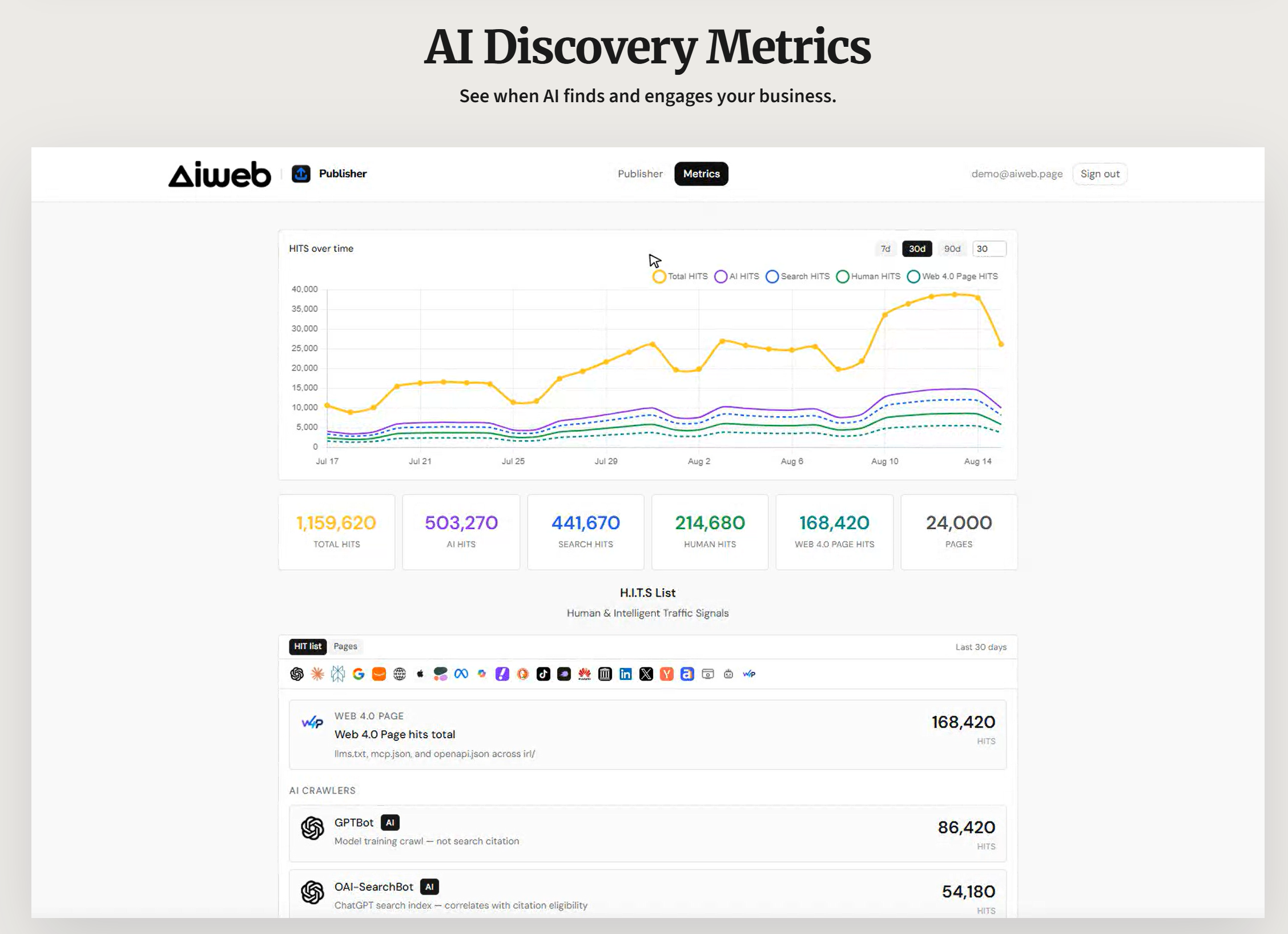
- Discovery and action are recorded as HITS (Human & Intelligent Traffic Signals), including WebMCP as a channel when applicable.
End-to-end journey:
Intent → Build (WebMCP) → Publish → Call → Receipt → Business response
Judges can reproduce the create path with the Pet Voyage image bundle and Act 1 prompt (see testing notes / JUDGE_TEST_ACTS.md). Example outcome (optional): Pet Voyage.
How we built it
AIWEB already existed as a production Publisher and a network of AIWEB Pages, plus server-side MCP for chat applications.
For the WebMCP Challenge we added a browser-native WebMCP layer on top of that stack:
- Editor WebMCP on the open Publisher workspace — tools such as draft snapshot, structure edits, FAQs, validate, AI Check, publish hints, and gated publish.
- Page WebMCP on the public IRL document — page facts, FAQs, form requirements, Call / inquiry with human confirmation, Receipt tools.
Implementation principles:
- Register tools with
document.modelContext.registerTool({ name, description, inputSchema, execute })so ChatGPT’s in-app browser (or WebMCP-enabled Chrome) can operate the page. - Keep the same human UI; agents assist through structured tools rather than a hidden agent-only twin.
- Agent may prepare; human authorizes publish and customer submission.
- Route actions through existing AIWEB lead / Receipt / HITS pipelines.
- Record protocol and agent source for measurement.
Server MCP connects chat apps to the wider AIWEB network. WebMCP works at the webpage itself—an open, page-local control surface for the same identity and actions.
Challenges we ran into
Separating assistance from authorization
An agent should understand and prepare a business action without silently committing the customer—or publishing without the owner. We kept forms and publish flows visible and required explicit human approval.
Serving humans and agents through one page
We did not want a hidden agent-only endpoint that duplicated the site. The goal is one interface that stays readable for people while becoming structured and actionable for agents.
Co-authoring a live draft safely
WebMCP Build mutates a real draft (identity, sections, FAQs, forms, media). Agents must use tools instead of dumping the prompt into the page. Preserving structured content while placing media is an ongoing reliability problem we treat as first-class product work.
Maintaining a canonical business identity
Business facts get copied into directories and model answers where they go stale. AIWEB resolves actions through the registered AIWEB Page so the business keeps a canonical, updateable identity.
Measuring activity across platforms
Each AI provider sees activity inside its own product. Businesses need an independent view across models, browsers, crawlers, and protocols. AIWEB records interaction at the shared page and registry layer (HITS). AIWEB records GEO and AEO metrics as discovery and actions called HITS—Human and Intelligent Traffic Signals. A HIT is created when a human or machine discovers, reads, validates, or acts through a registered AIWEB Page. The event can be attributed to its channel, including WebMCP when applicable.
Extending an existing production platform
Because AIWEB shipped before the challenge, we had to isolate and document the WebMCP surface while preserving production Publisher, federation, and server MCP workflows.
Accomplishments that we're proud of
Before this challenge, AIWEB had already published 14,928 public AI Web Pages and independently recorded 233,567 federated HITS across human and machine activity.
For the WebMCP Challenge, we connected an open public business page to an end-to-end outcome:
- An agent can co-build a page through WebMCP tools in Publisher.
- An agent can recognize a real business capability on the live page.
- The agent can help prepare the action while the human stays in control.
- The business receives a structured lead; the customer receives a persistent Receipt.
- AIWEB independently measures the interaction.
That moves the experience beyond AI-generated answers into real create-and-operate activity on the open web.
What we learned
WebMCP is more than automating clicks on a website. It lets the public web itself become an interface for agents while preserving familiar, visible experiences for humans.
Exposing one page as a tool is only the first layer. Businesses also need:
- A portable identity they control
- A way to publish current information
- Discovery across models and search systems
- Reusable business actions
- Receipts and continuing communication
- Independent cross-agent measurement
WebMCP provides the open connection between agent and webpage. AIWEB OS networks those pages into shared identity, discovery, action, and measurement—with ChatGPT able to act as a team lead operating the page through WebMCP.
Like Cloudflare can observe traffic across networks, AIWEB can observe human and machine traffic as it reaches the same registered pages. Public pages stay open and portable; the registry, index, and federated HITS create an intent-and-action graph no single AI platform sees alone.
What's next for AIWEB OS
We plan to deepen WebMCP across create and operate:
- Stronger Build orchestration (block-level patches, protected structures, durable media works)
- Richer live-page capabilities (Call, media play, discovery, status checks, structured updates)
- Share of Intent — measurement that uses qualified HITS to show which pages, intentions, actions, and agent sources capture observed demand
Our larger goal: make the AIWEB Page a universal agentic business document—open enough for compatible models, search, and browsers to read and use—supported by a registry, identity, action, and intelligence network.
AIWEB gives every business a public page that humans can browse, AI agents can act through, and the business can independently measure.
Built With
- agentic
- ai
- dev
- mcp
- web
- webpage

Log in or sign up for Devpost to join the conversation.