Inspiration
At an international summer school, I struggled to follow English lectures in real time. I knew I needed more listening practice, but I was already busy with research and software projects, so finding a separate study block every day was difficult.
At the same time, I noticed that I was repeatedly waiting for AI assistants to finish generating answers. Each pause was short, but together they represented a meaningful amount of unused time.
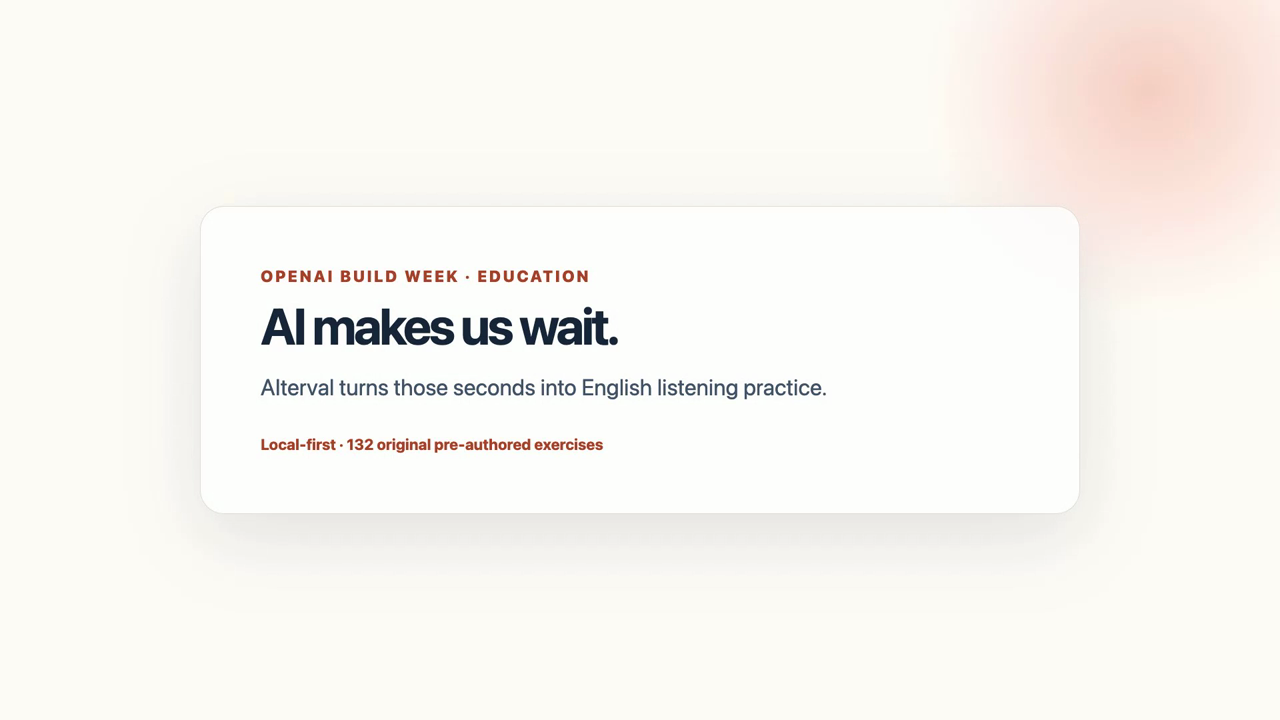
That led to the central idea behind AIterval:
Instead of asking busy people to find more time for learning, turn the time they already lose into a learning habit.
What AIterval does
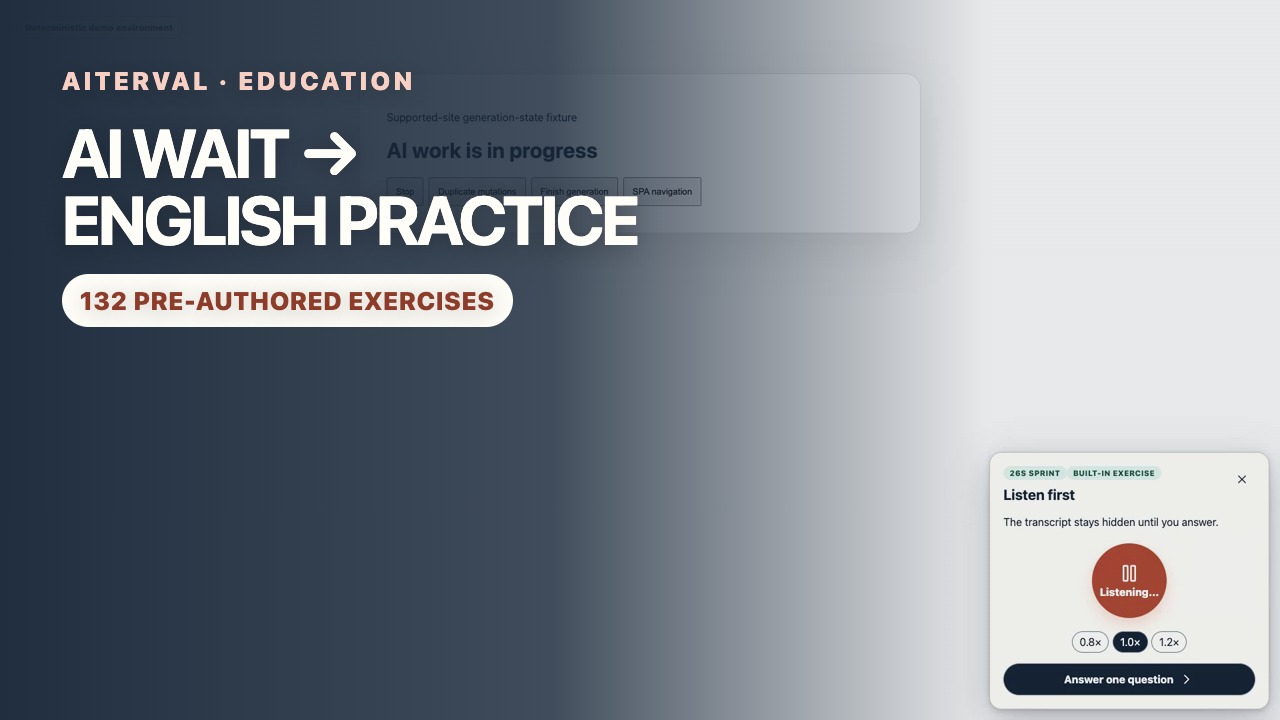
AIterval is a local-first browser extension that turns AI waiting time into short English listening exercises.
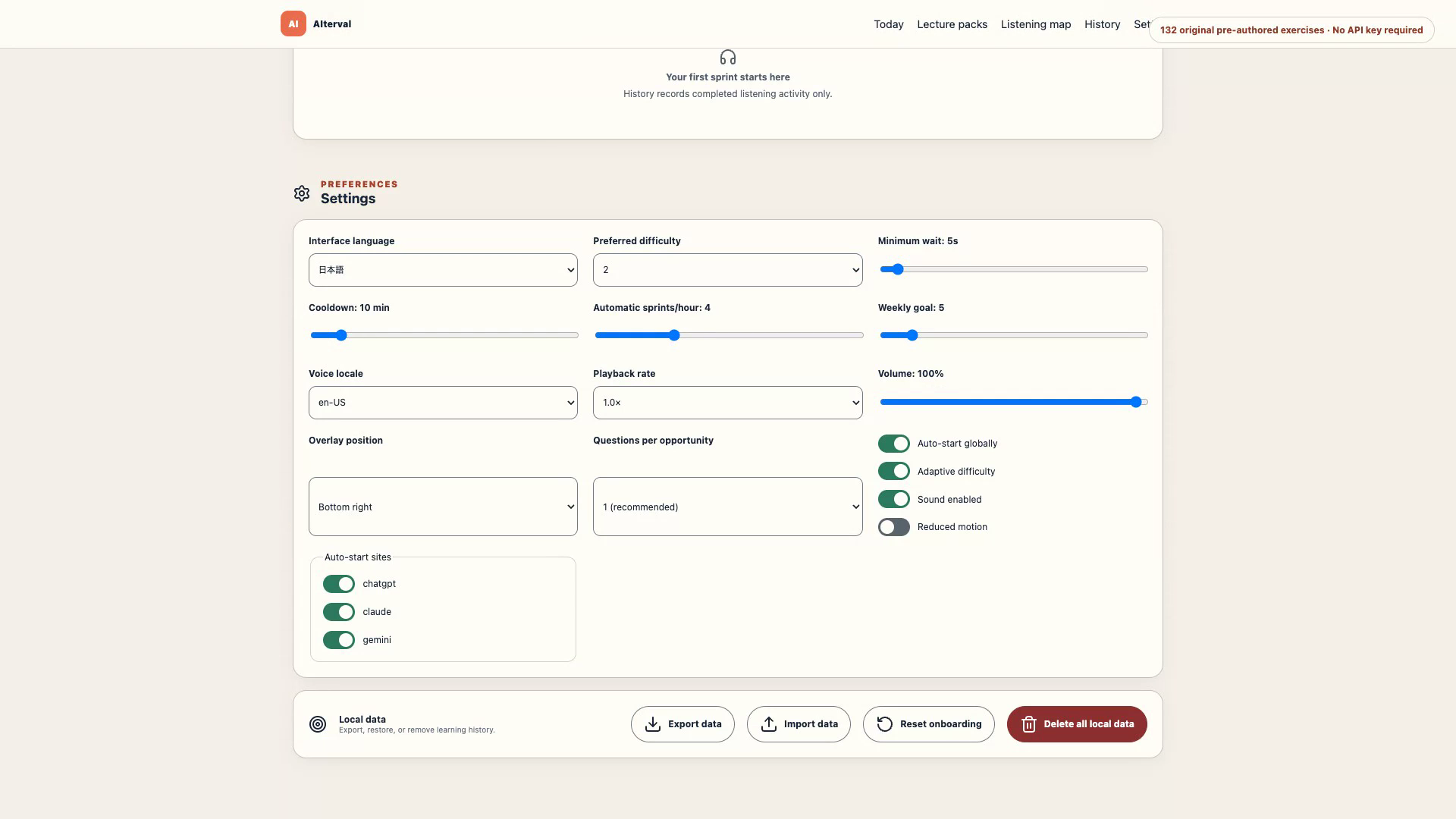
When a supported AI service begins generating, AIterval detects the generation state and waits for the user’s configured threshold. It then presents a 15–90 second listening exercise with audio, answer choices, feedback, and lightweight progress tracking.
AIterval currently supports:
- ChatGPT
- Claude
- Gemini
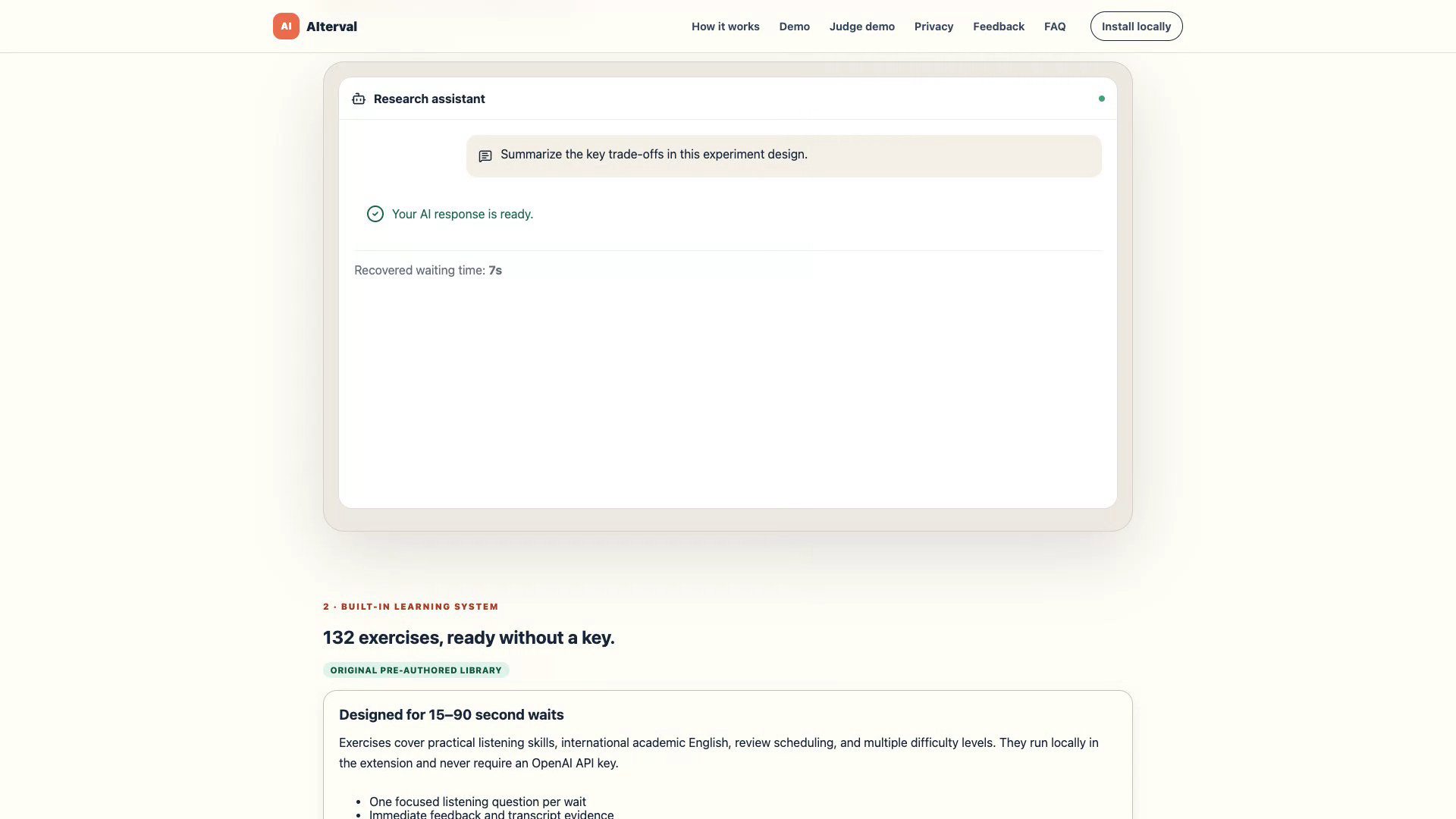
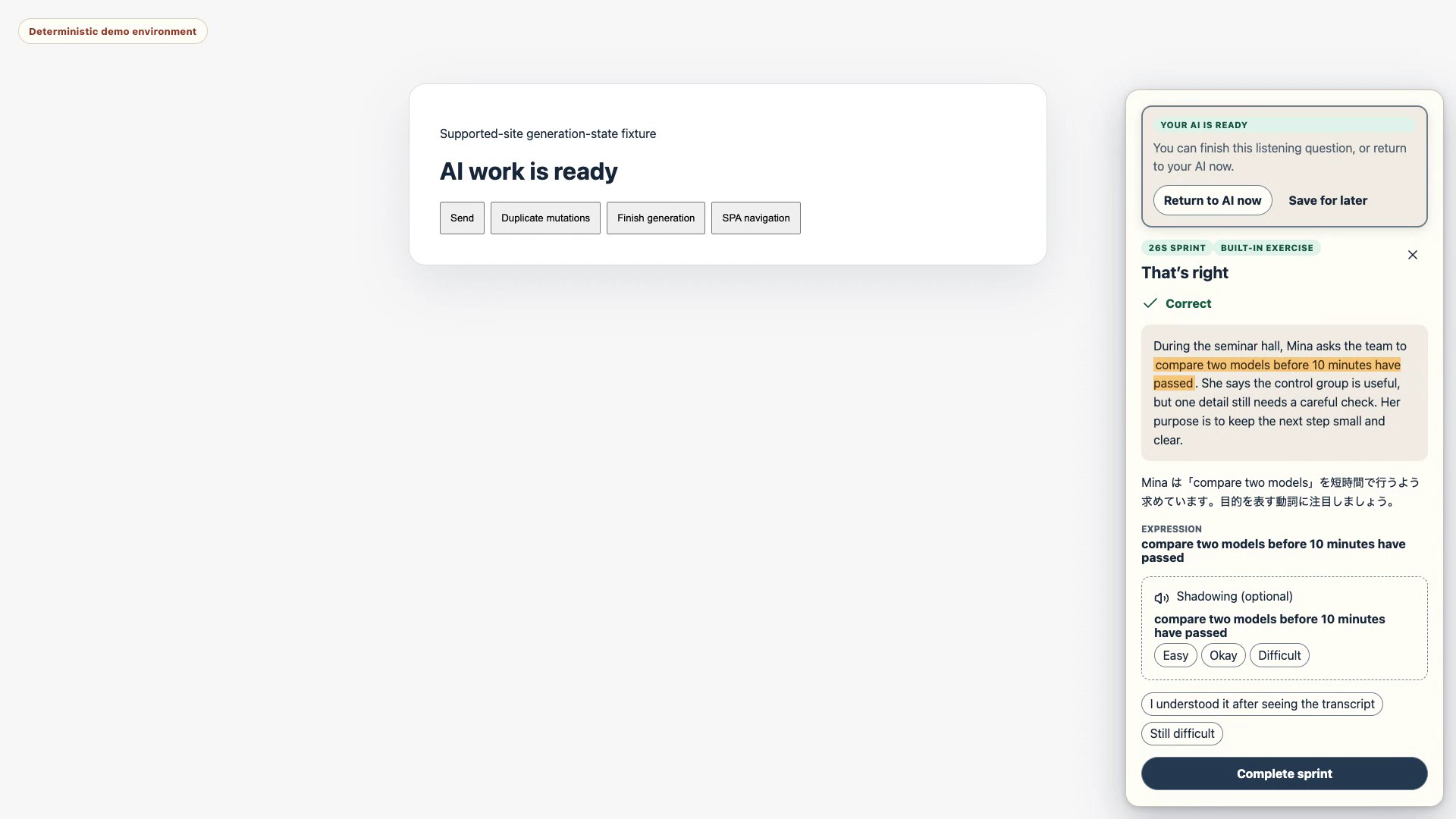
When the AI response becomes ready, AIterval displays a clear notification without cutting off the listening audio. The user can finish the current question or return to the AI immediately.
The extension includes 132 original pre-authored exercises, so it works without an OpenAI API key or runtime AI-generation service.
Learning progress, review history, weak-skill signals, preferences, and recovered waiting time are stored locally.
Privacy by design
AIterval does not read or store the user’s prompts or AI responses.
The extension observes only narrow interface signals needed to determine whether the supported AI service is currently generating. It does not use analytics, advertising, tracking SDKs, remote extension code, or cloud-based learning storage.
This privacy boundary was treated as a core product requirement rather than an optional feature.
How I built it
I developed AIterval with Codex and GPT-5.6 as engineering collaborators.
I provided the original problem, product concept, privacy constraints, interaction design, and final product decisions. Codex with GPT-5.6 helped implement and refine:
- The deterministic exercise state machine
- Browser-specific adapters for ChatGPT, Claude, and Gemini
- The Manifest V3 extension architecture
- Shadow DOM isolation for the in-page interface
- Local-first storage and review scheduling
- Speech synthesis and playback controls
- Keyboard and accessibility support
- Light and dark theme handling
- Automated unit and end-to-end tests
- Vercel deployment and the public judge demo
- Reproducible extension packaging and release checks
The submitted product does not use GPT-5.6 to generate exercises at runtime. GPT-5.6 was used throughout the development process to help reason about architecture, implementation, debugging, testing, security, accessibility, and release engineering.
Challenges
Detecting AI generation without reading conversations
The extension needed to recognize when an AI service was working while preserving a strict privacy boundary.
Instead of inspecting conversation text, AIterval uses narrow, service-specific UI signals associated with generation controls. This required separate adapters because each supported service has a different interface and may change over time.
Separating AI readiness from the exercise lifecycle
An early implementation treated “the AI is ready” as a replacement state for the listening exercise. This caused the overlay to unmount and interrupted the current audio.
I redesigned the state model so that host readiness and exercise progress are independent. Listening, answering, and feedback can now continue while the interface also indicates that the AI response is ready.
Building a readable interface inside third-party websites
The AIterval overlay runs inside a Shadow DOM so that host-page styles do not break the extension. However, an early theme-scoping issue caused transparent surfaces and unreadable white-on-white text.
The styling system was revised around theme-aware tokens, and accessibility regression tests were added for light mode, dark mode, disabled states, focus indicators, narrow screens, and 200% zoom.
Making browser speech behavior reliable
Browser speech synthesis differs across systems and installed voices. AIterval therefore includes voice selection, graceful fallback behavior, explicit playback controls, and deterministic test providers that simulate playback without depending on a particular operating-system voice.
Creating a judge-friendly installation path
Because Chrome Web Store publication is not yet complete, the project needed a clear public installation guide and a reproducible ZIP release.
The final release includes a signed-out download path, checksum verification, installation instructions, and a public browser demo that can be evaluated without rebuilding the repository.
What I learned
The most important lesson was that a small interaction can require careful systems design when it runs inside another product.
AIterval is not simply a timer that opens a quiz. It must coordinate:
- A third-party website’s generation state
- An independent learning-session state
- Audio playback
- User dismissal and navigation
- Local progress updates
- Accessibility
- Privacy boundaries
I also learned that automation is most useful when paired with explicit human judgment. Codex and GPT-5.6 accelerated implementation and testing, but the most important product decisions came from observing real behavior and deciding what felt respectful and useful to the learner.
For example, automatically stopping the audio when the AI became ready was technically simple, but it created a frustrating experience. Testing the product revealed that the better design was to notify the user while allowing the current sentence to finish.
Accomplishments
I am proud that AIterval now includes:
- 132 original listening exercises
- Support for three major AI assistants
- Local-first progress and review scheduling
- A strict prompt-and-response privacy boundary
- Accessible light and dark themes
- Keyboard navigation and 200% zoom support
- Automated unit and browser-extension tests
- A reproducible public release with checksum verification
- A public demo and installation guide
The final release is AIterval v0.2.1.
What is next
The next step is to conduct a small user study with busy students, researchers, and developers to evaluate whether AIterval can create a sustainable learning habit.
Future work may include:
- Chrome Web Store publication
- More exercise categories and proficiency levels
- Improved browser-voice onboarding
- Additional supported AI tools
- Better adaptation based on locally stored weak-skill signals
- Optional user-created exercise packs that preserve the same local-first privacy model
AIterval does not ask people to create more time.
It turns time they already lose into an opportunity to learn.
Built With
- actions
- api
- chrome
- codex
- css
- dom
- extension
- github
- gpt-5.6
- html
- javascript
- manifest
- next.js
- node.js
- openai
- playwright
- pnpm
- react
- shadow
- speech
- typescript
- v3
- vercel
- web

Log in or sign up for Devpost to join the conversation.