-
-
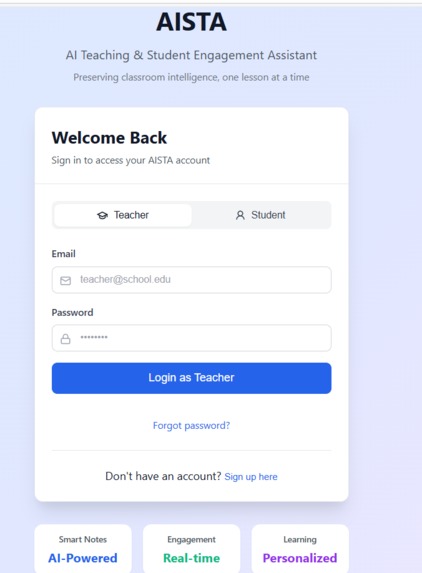
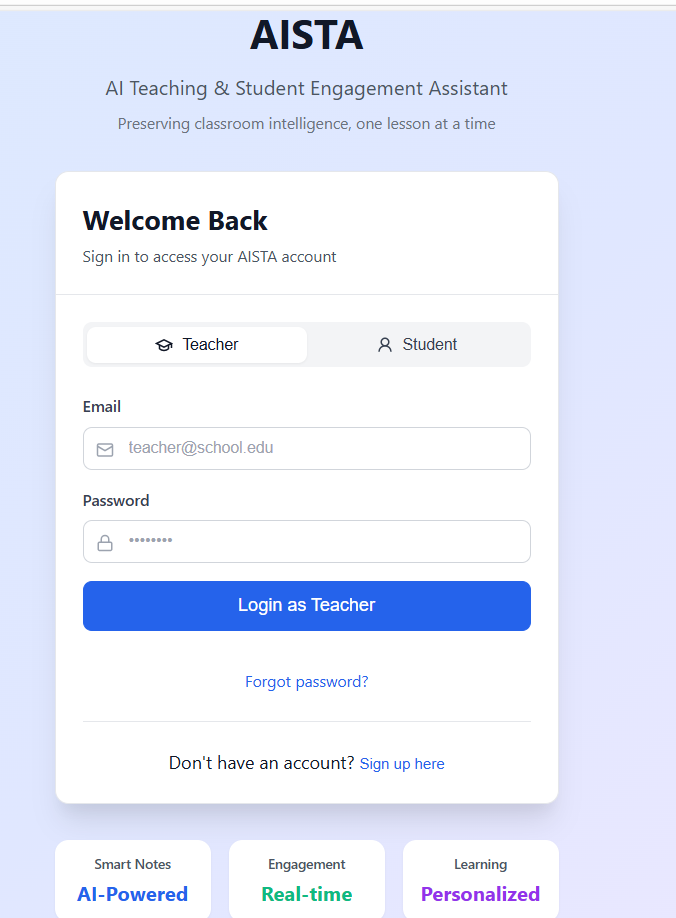
AISTA login
Inspiration
The inspiration for AISTA emerged from studying the growing challenges in modern education systems, particularly highlighted in recent reports on the U.S. education sector. Several nationwide observations revealed: Declining academic performance Reading and math proficiency levels are steadily decreasing Over 400,000 classrooms are handled by non-licensed or substitute educators Student disengagement is increasing, reflected in absenteeism, fatigue, and lack of participation Teacher stress and staff shortages are at historic highs Rising mental health and attention-related challenges in classrooms Deep inequities in educational quality, driven by property-tax-based school funding models These issues raised a key question:
How can we ensure consistent, high-quality learning even when teachers are overburdened, unavailable, or replaced by substitutes?
This question led to AISTA — a system designed to keep every learner on track, regardless of classroom constraints.
What It Does
AISTA is an AI-powered Classroom Assistant that supports teachers, substitute instructors, and students through four core capabilities:
🔹 AI Micro-Lectures
Step-by-step explanations of concepts
Real-life analogies and simplified breakdowns
Topic-aligned examples generated on demand
🔹 ClassroomPulse (Engagement Awareness – Prototype Level)
Estimates engagement using visual and interaction-based signals
Designed to observe indicators such as facial orientation, posture, and activity patterns
Implemented as a prototype engagement workflow to demonstrate feasibility
🔹 Adaptive Teaching Support
When engagement drops, AISTA:
Simplifies explanations
Reinforces key points
Introduces short reflective or quiz-style questions
🔹 After-Class Learning Kit
Automatically generated at the end of a session:
Session summary
Structured and simplified notes
Quiz and revision questions
These outputs are generated using LLMs, aligned with how the topic was actually taught.
How We Built It
Building AISTA provided several important technical and design learnings:
** Real-time AI systems are powerful—but complex**
We explored how to connect:
Computer vision pipelines (prototype level)
Large Language Models
Session-based data streams
User interface feedback loops
Measuring engagement is non-trivial
We learned that engagement cannot rely on a single signal. Instead, it benefits from combining multiple indicators, such as:
Face orientation
Expression patterns
Eye focus and head movement
Inactivity bursts and pauses
These insights informed our hybrid engagement design, even where full automation is planned for future work.
Prompt engineering is a critical skill
We refined prompts to:
Avoid repetitive explanations
Adapt examples to lesson context
Generate diverse quiz questions
Produce concise summaries aligned with slide content
User experience matters more than perfect prediction
Even a prototype becomes impactful with:
An intuitive dashboard
Clear, color-coded engagement cues
Simple lesson selection and session flow
How We Built It (Technology Overview)
AISTA integrates LLMs, prototype-level vision logic, and full-stack development.
Tech Stack
Python + FastAPI — Backend logic and API services
Gemini API (LLM) — Micro-lectures, summaries, quizzes
OpenCV / MediaPipe (Prototype / Design-Level) — Engagement signal extraction
Streamlit / Web UI — Live interaction and visualization
NumPy & Pandas — Interaction tracking and pattern analysis
Webcam Input (Optional) — Visual engagement signals
Advanced real-time and vision components are implemented at prototype or design level to demonstrate system feasibility.
Challenges We Ran Into
Engagement values appeared repetitive Early versions produced nearly identical engagement scores. We addressed this using: Time-based smoothing Multi-signal aggregation Repeated-frame filtering LLM responses became repetitive We improved content originality through: Dynamic prompt engineering Context-aware prompt variation Circular generation avoidance Real-time processing latency We optimized performance by: Reducing frame processing frequency Using lightweight vision logic Prioritizing session-level inference Basic dashboard experience We enhanced usability by adding: Low-engagement alerts Concept markers Session timelines Handling multiple lesson topics We introduced: Predefined lesson categories Topic-specific LLM prompt seeds Accomplishments We’re Proud Of We successfully built a working prototype that: Demonstrates AI-assisted teaching support Detects engagement trends at a conceptual level Adapts explanations dynamically Generates learning kits after each session AISTA presents a scalable and ethical AI-assisted education framework that addresses: Teacher shortages Learning gaps Student disengagement
What’s Next for AISTA – AI Teaching & Student Engagement Assistant
🔹 Multi-student engagement detection
🔹 Student-specific adaptive learning profiles (privacy-safe)
🔹 School- and district-level analytics
🔹 VR/AR-enhanced interactive learning
🔹 Teacher–AI hybrid teaching workflows

Log in or sign up for Devpost to join the conversation.