-
-
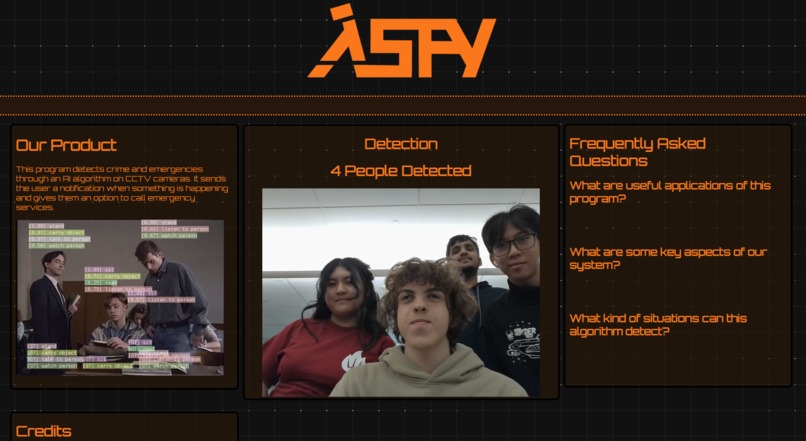
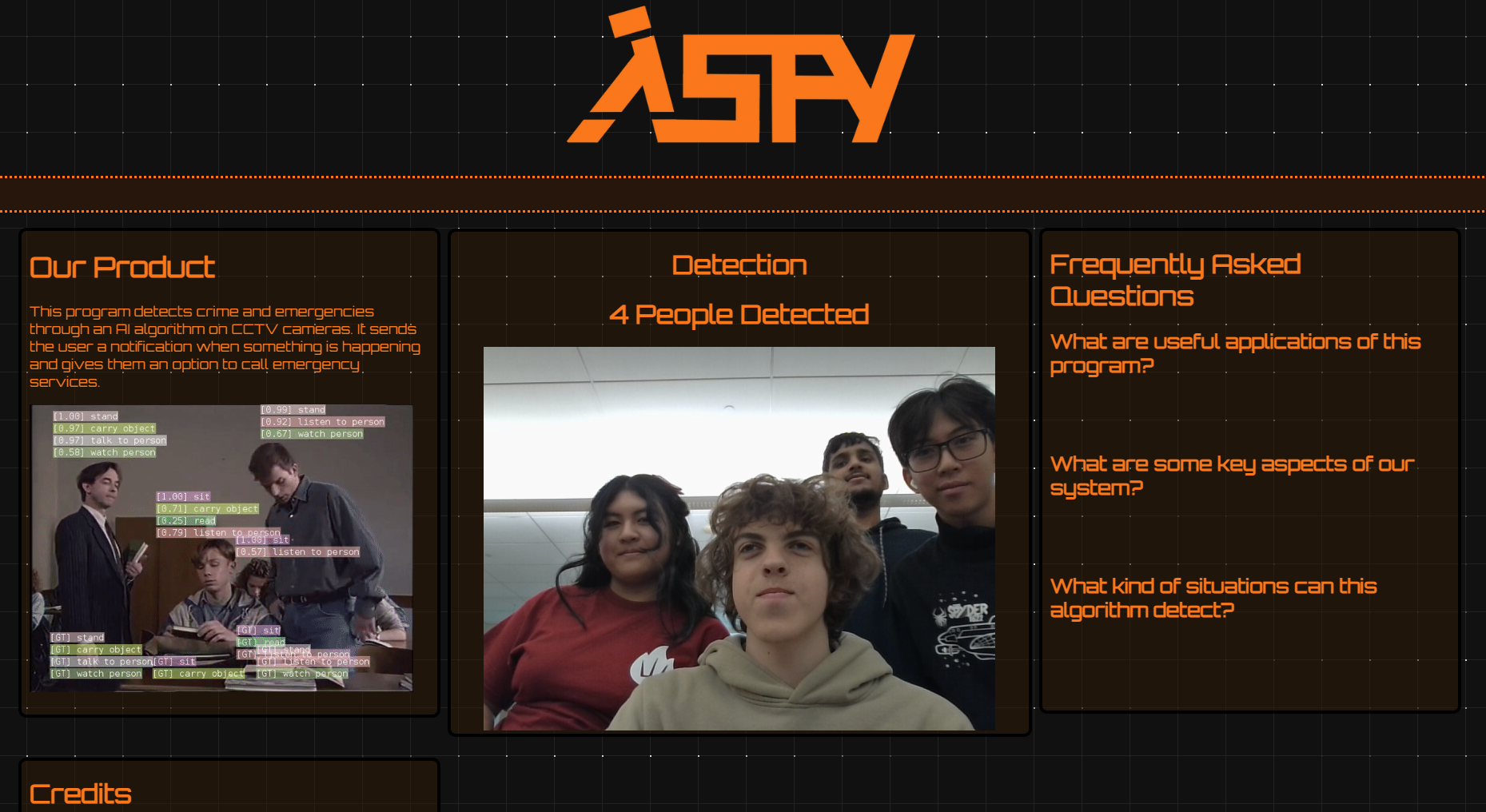
Above the camera, as you can see, our AI detected that there are 4 people on camera.
-
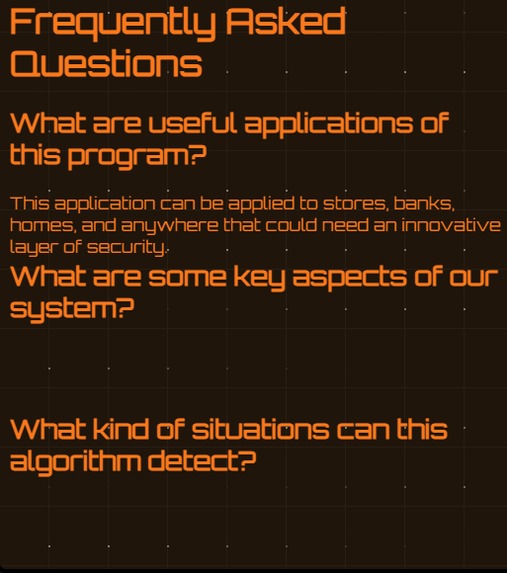
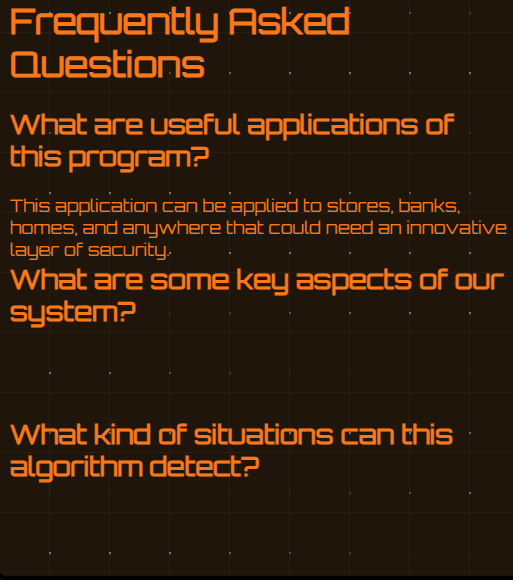
The FAQ's do not show up unless you hover on them with your mouse. This is the first FAQ.
-
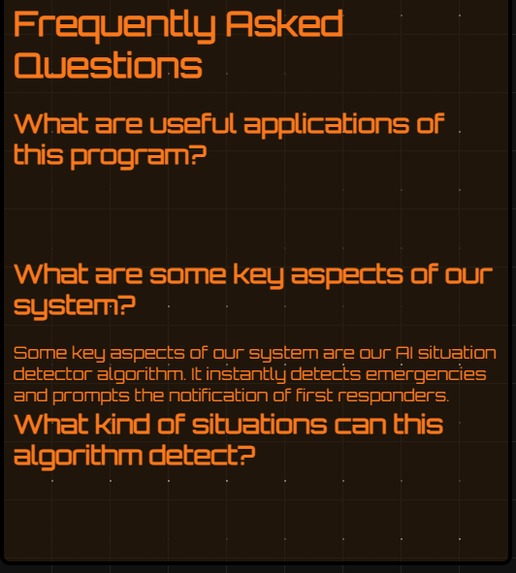
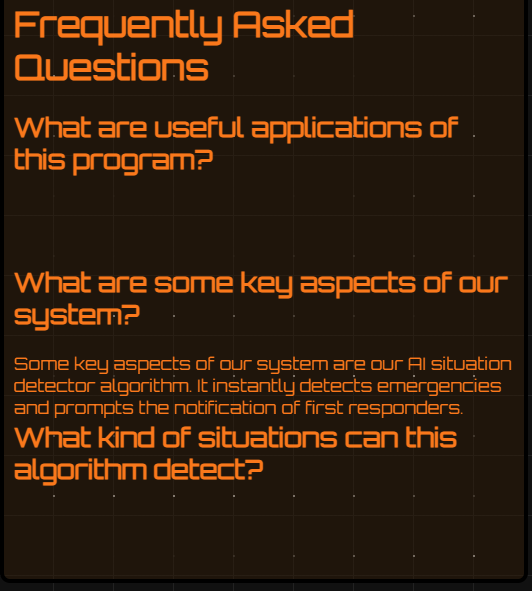
The FAQ's do not show up unless you hover on them with your mouse. This is the second FAQ.
-
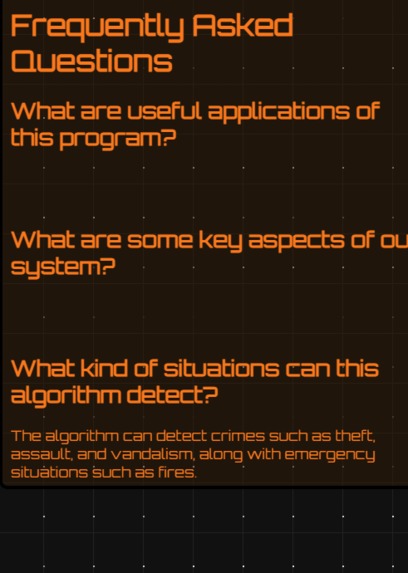
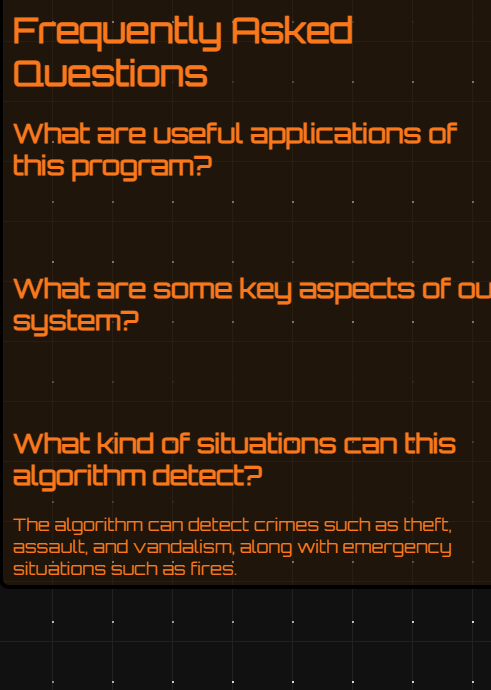
The FAQ's do not show up unless you hover on them with your mouse. This is the third FAQ.
Inspiration
One of our team members' grandmothers suffered from a stroke, lying helpless on the ground for upwards of 6 minutes before emergency services arrived to administer aid. The brain suffers severe damage after 3 minutes, so every second counts during an emergency like a stroke. Thus, we as a team realized the importance of emergency services and the critical nature of their response times. Put simply, the quicker emergency services can respond results in more lives saved.
What it does
Our software was originally intended to integrate into any security camera system, such as that of a convenience store or gas station, to detect live emergencies as they happen and prompt the security camera operator to alert emergency services, thus decreasing emergency response times and increasing lives saved.
We ended up not having time to detect all emergencies due to resource/monetary constraints. However, we were able to create a functional website that can perform its job of utilizing a camera, such as that on a laptop, to detect people present in the camera's footage. Since, as of now, it is only able to detect whether there are people present in the camera, it could be implemented in areas where people are not permitted, such as a bank vault.
How we built it
We had 4 people on the team in total. We split our jobs into front-end and back-end: Front-end being more visual/aesthetic, and back-end being more research full, figuring out how to host a local ai server through python, and unfortunately needing to use a pre-trained model, as all the custom training software we looked at either took way too long or would cost upwards of $200.
Challenges we ran into
The AI processing was for sure a big issue, as our back-end programmer has never worked with Python or AI integration. As mentioned earlier, we were also looking for different models, even considering training our own; however could only settle on a pre-trained model, "Ultralytics" imported from YOLOv8.
Accomplishments that we're proud of
In the end, we were able to deliver a solution that has no errors, is simple to use, and is accurate and fast in detecting individuals. Doing all this while also learning a lot and having a visually appealing front-end.
What we learned
This hackathon was a big learning experience for everybody on our team. As previously mentioned, our two programmers were preparing for this hackathon, learning Python, JavaScript, web development, AI integration, and more!
What's next for AISpy
If we had more time and resources, we would like to expand and scale our solution so it can detect all emergencies. We were limited in our model training software since it was behind a paywall. If we were to bypass this paywall without our software, we would be able to detect all emergencies to further decrease emergency response times.
If you want to learn more about our process and development, check out this slideshow!: https://www.canva.com/design/DAGnuXYWXfY/b7kiHESAylMaXMlvmQVFng/edit?utm_content=DAGnuXYWXfY&utm_campaign=designshare&utm_medium=link2&utm_source=sharebutton
Built With
- css
- fastapi
- github
- html
- javascript
- pip
- python
- ultralytics
- uvicorn


Log in or sign up for Devpost to join the conversation.