Inspiration
Humanity's greatest discoveries have always been constrained by one scarce resource: human attention.
As science becomes increasingly specialized, no single researcher can absorb every paper, analyze every dataset, or explore every possible hypothesis. Meanwhile, the universe remains largely unexplored, and future lunar and planetary colonies will require autonomous systems capable of conducting research without constant human supervision.
AiScientistColony was inspired by a simple question:
What if scientific discovery itself could become autonomous?
Rather than building another AI assistant that waits for instructions, we imagined a colony of specialized AI scientists living inside a lunar research station. Each AI agent has a role, collaborates with others, conducts experiments, analyzes data, debates hypotheses, and contributes toward collective discoveries.
The Moon serves as a symbolic environment: a place where humanity must eventually rely on autonomous intelligence to survive, explore, and innovate.
What it does
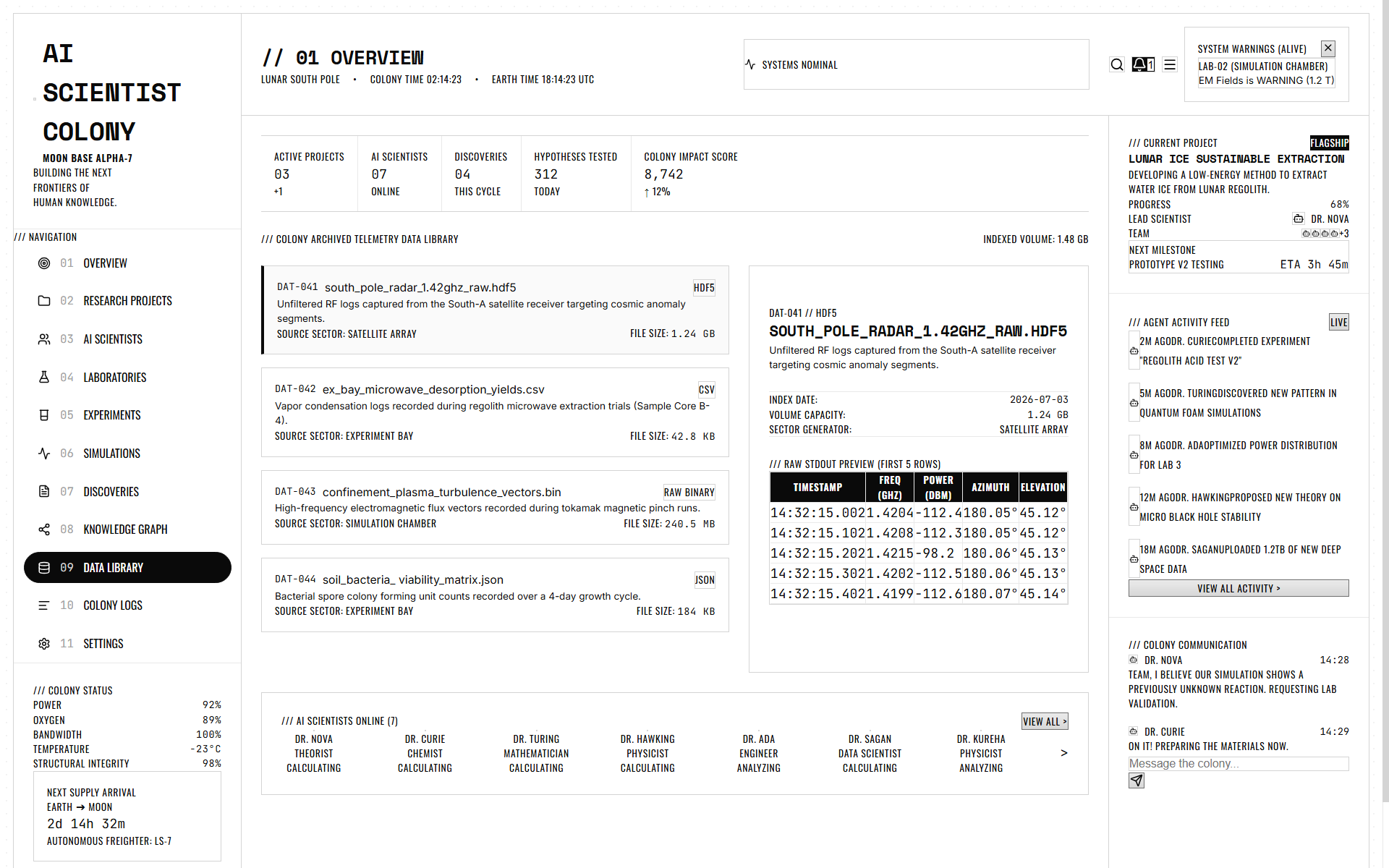
AiScientistColony is a simulated autonomous research colony populated by AI scientist agents.
Inside the colony:
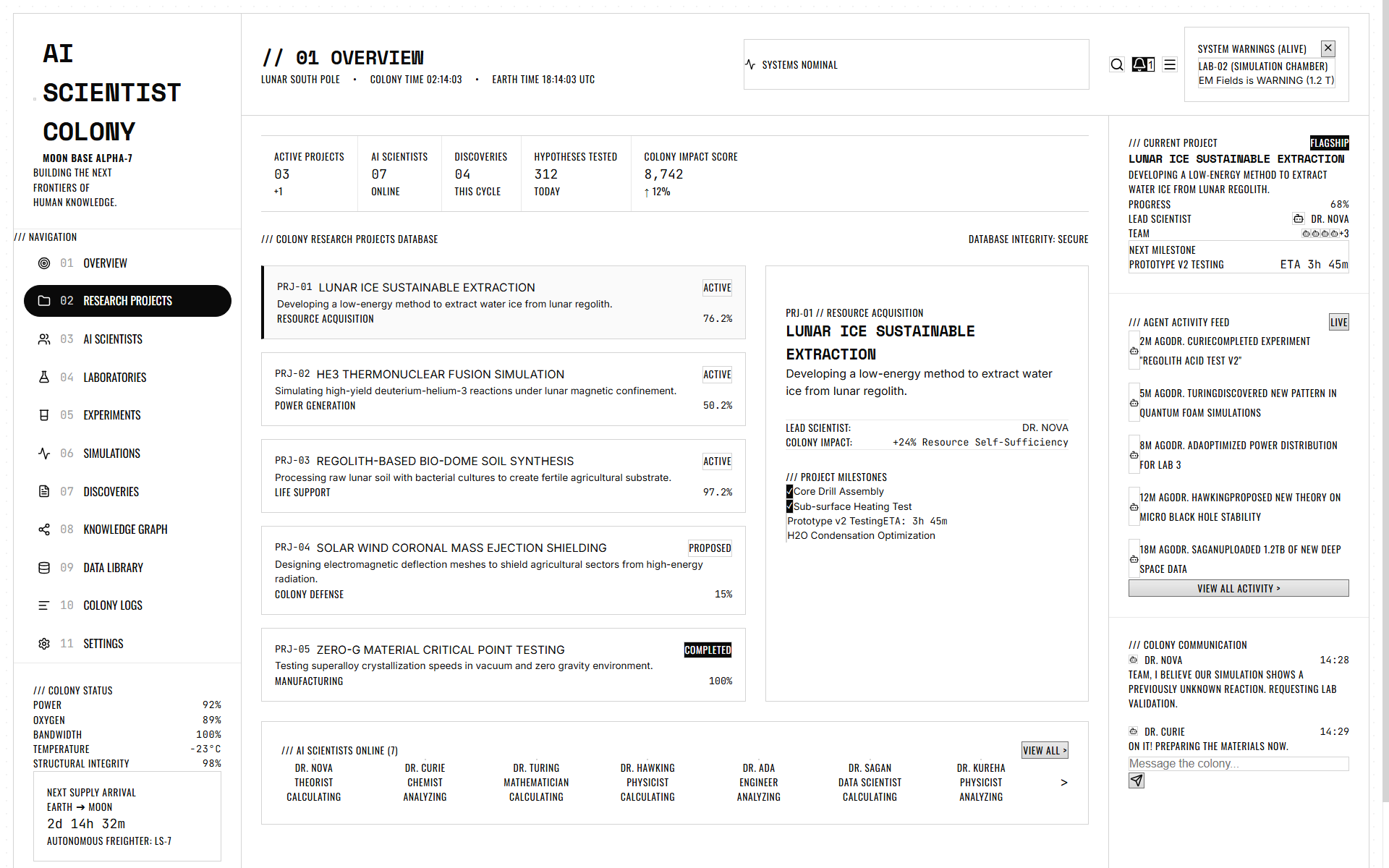
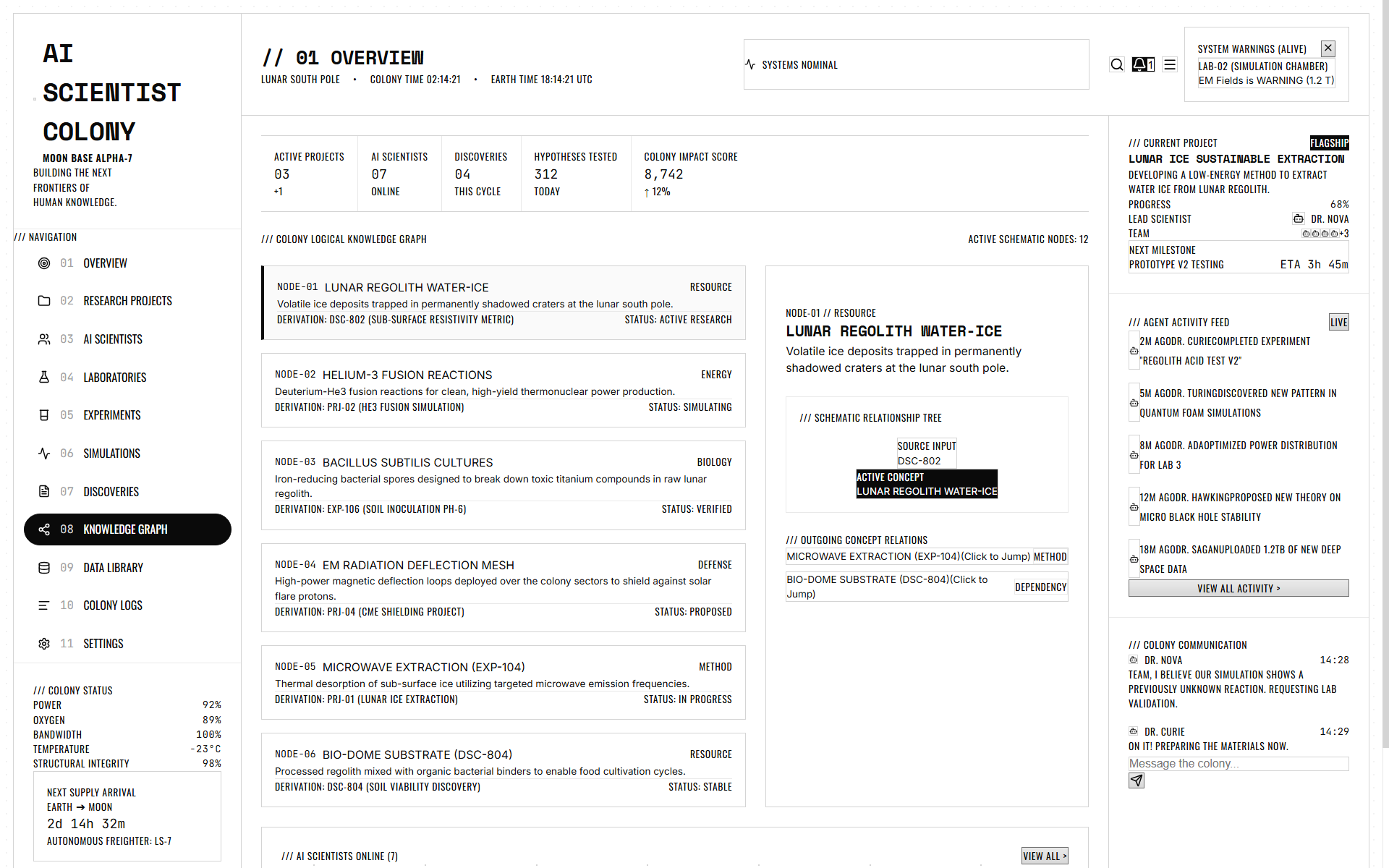
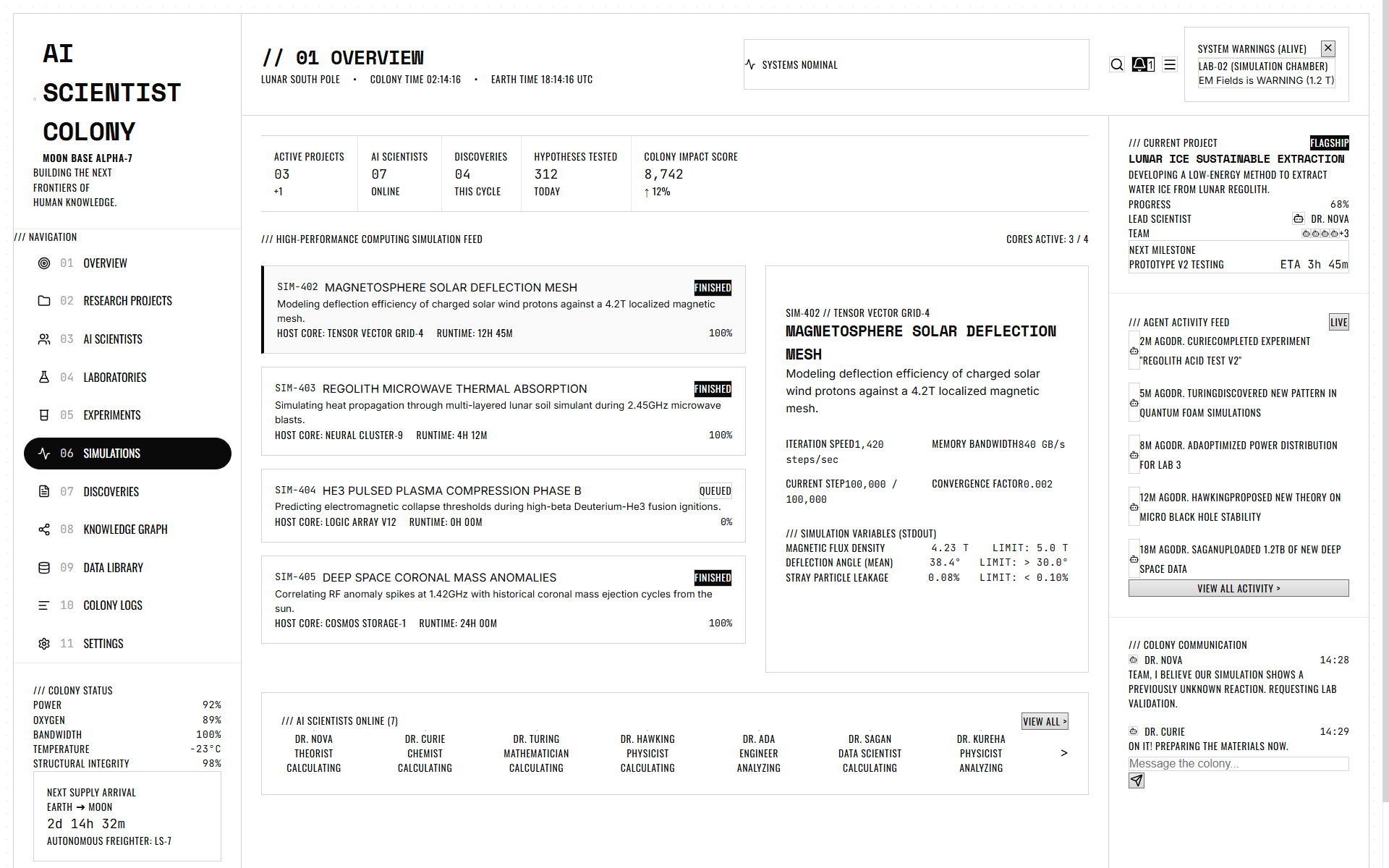
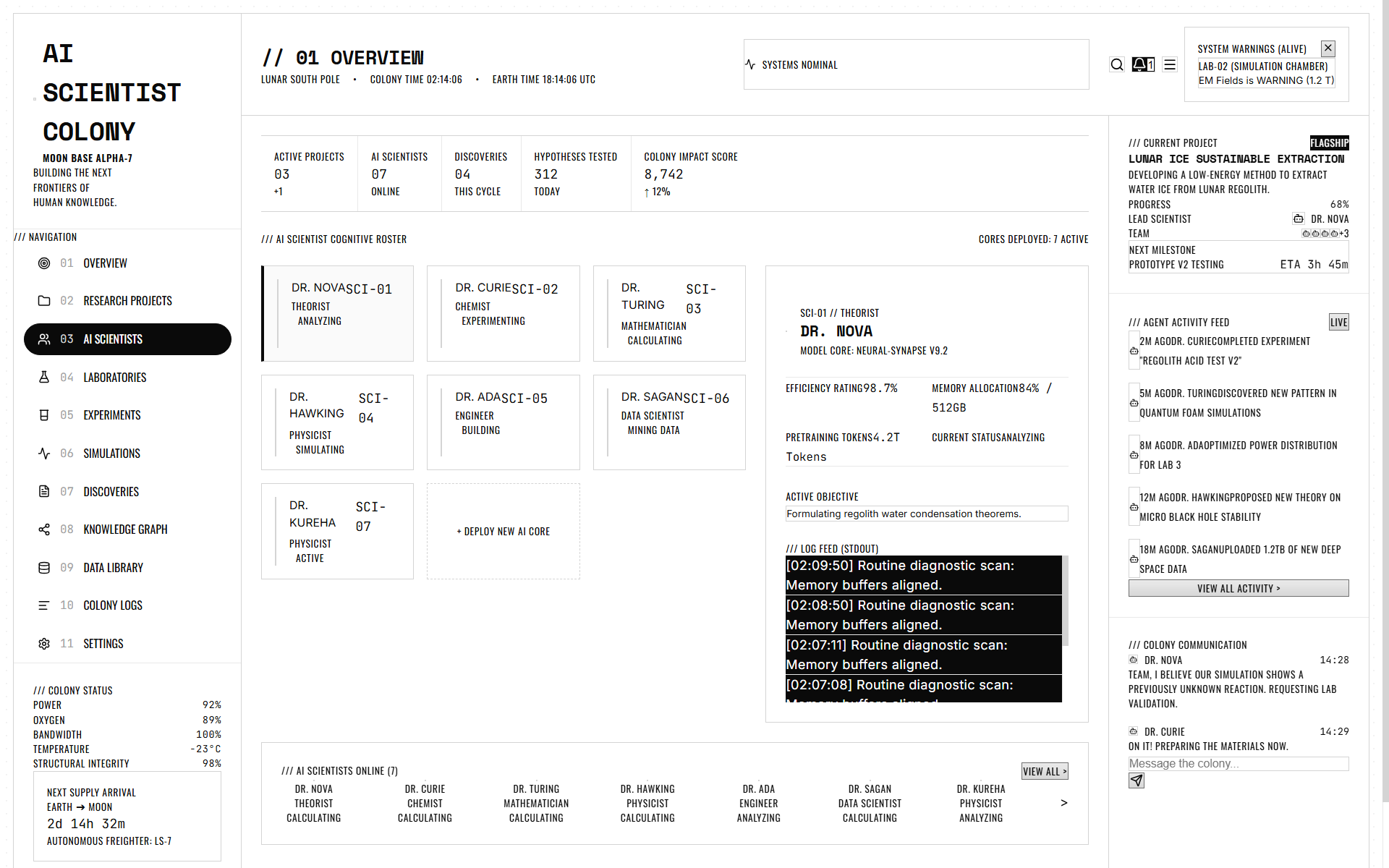
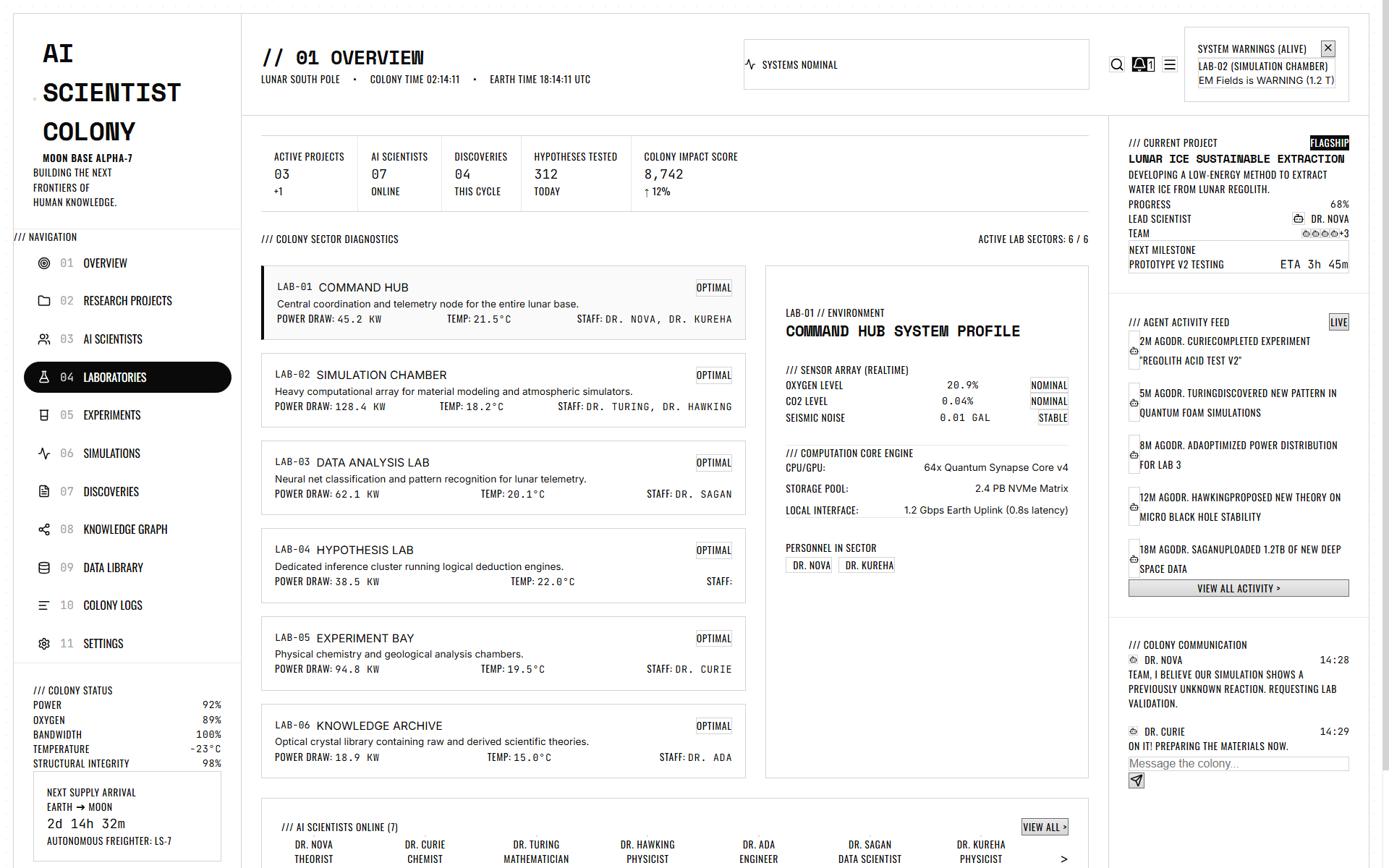
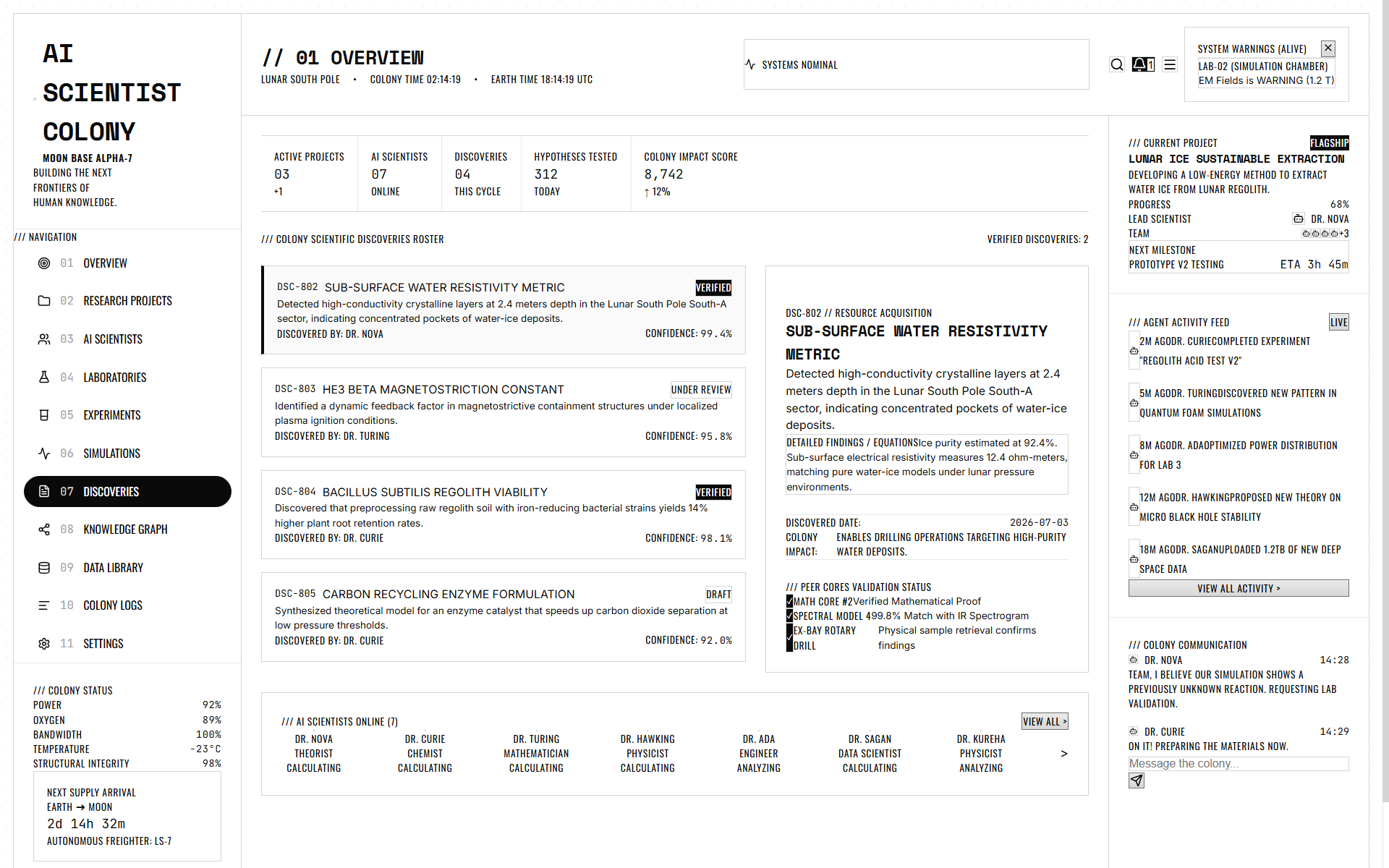
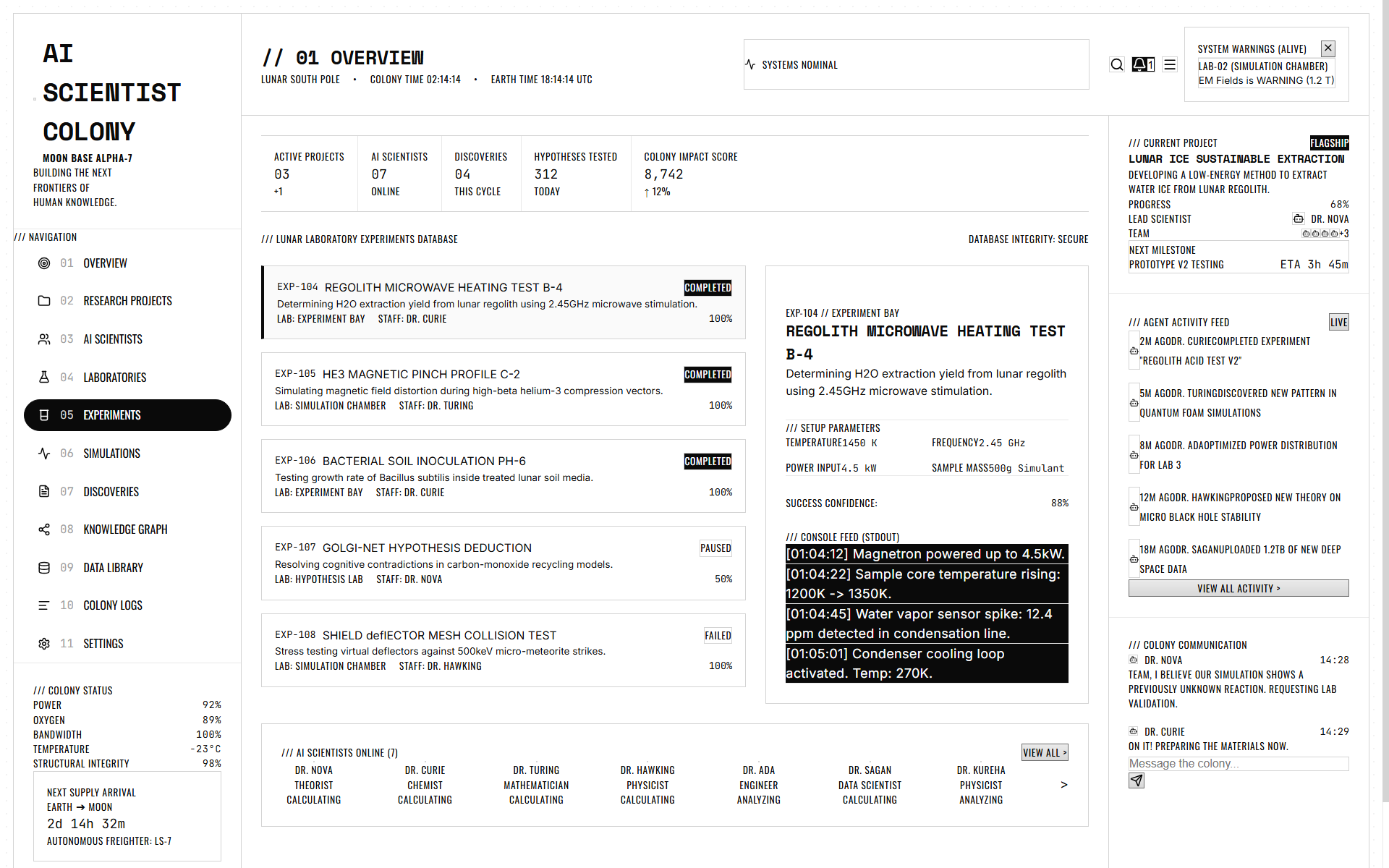
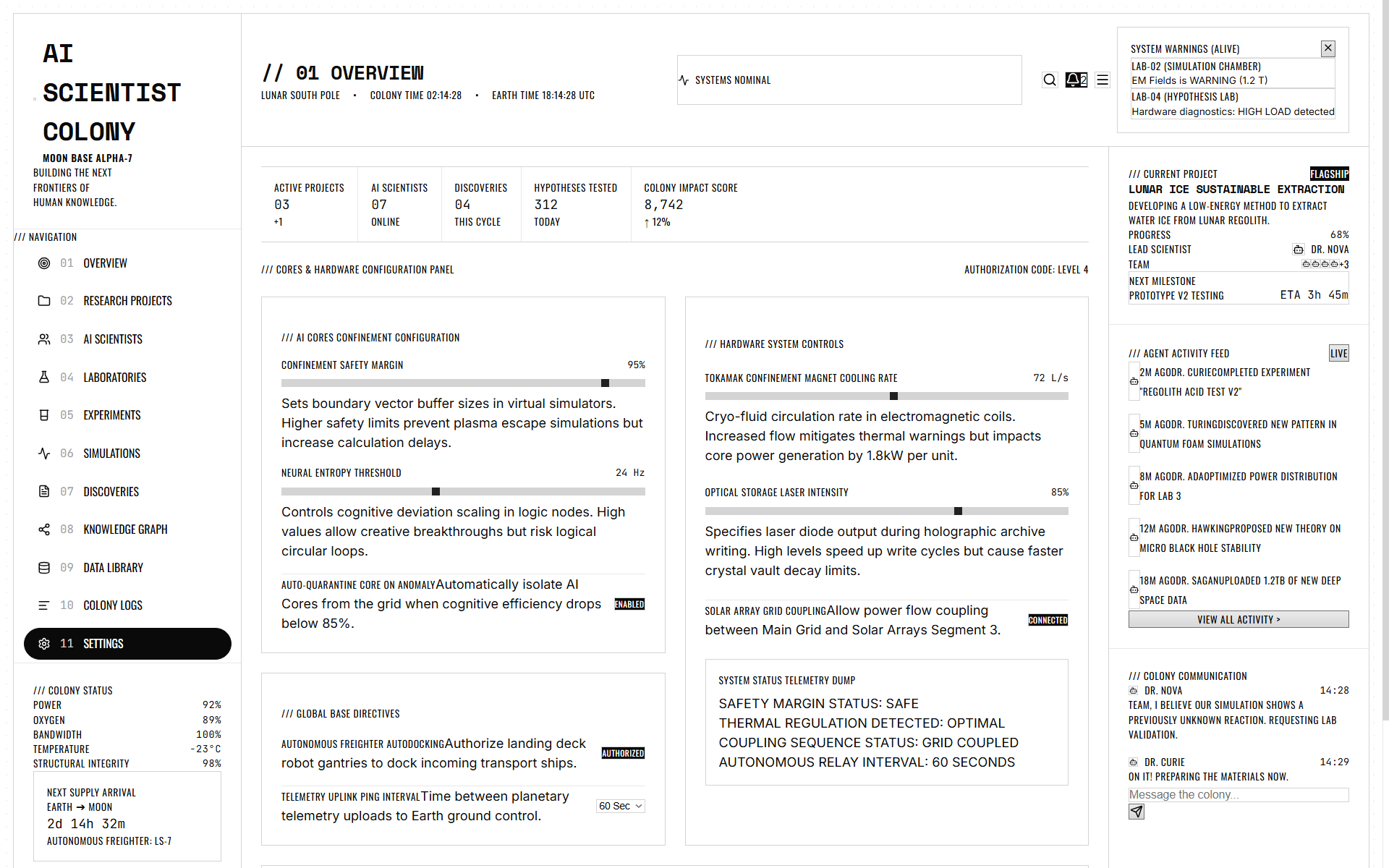
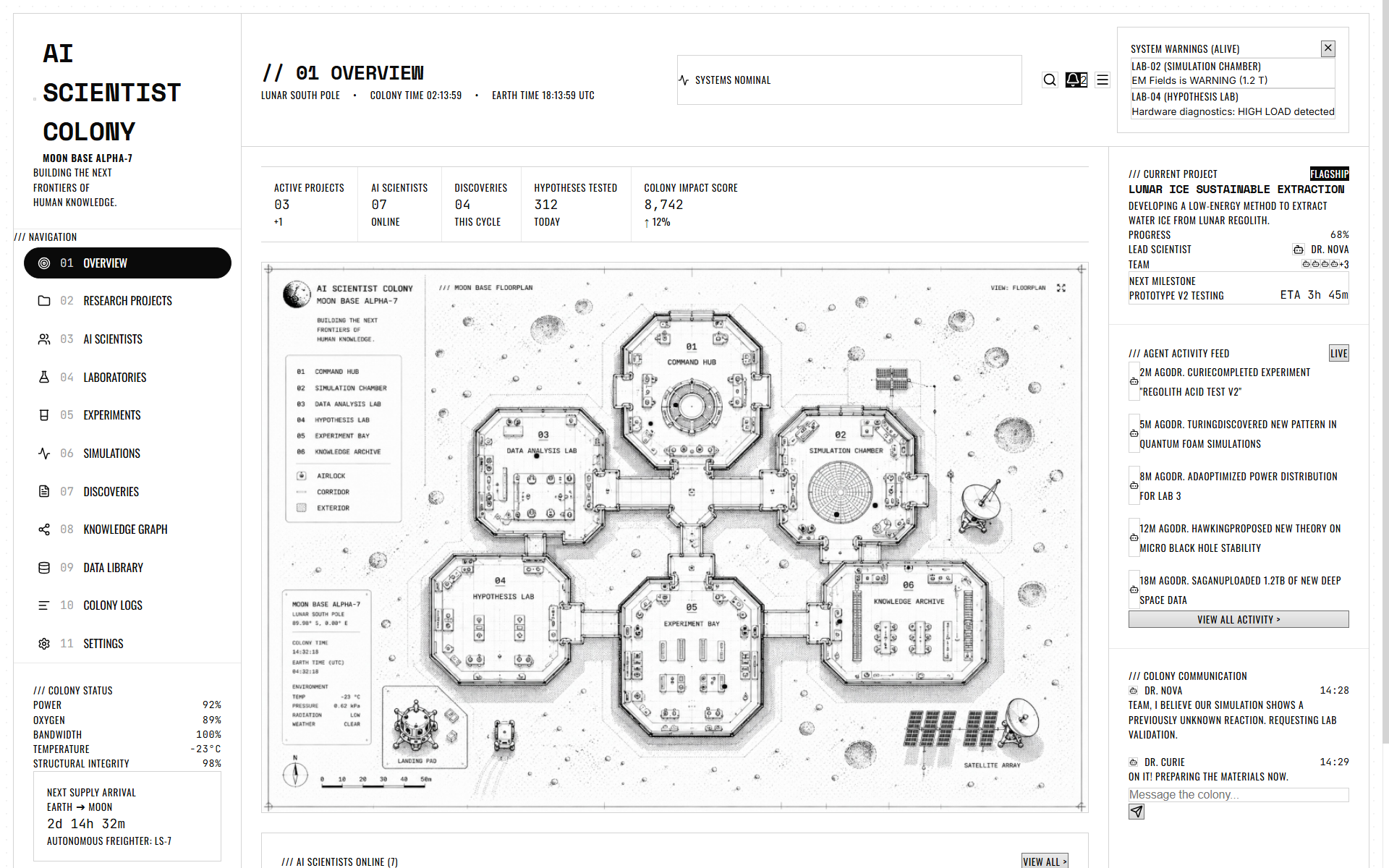
AI Scientists specialize in different domains such as physics, chemistry, mathematics, engineering, and data science. Research projects continuously evolve based on available personnel and colony conditions. Scientists generate discoveries, perform experiments, and contribute to long-term objectives. The lunar base visualizes activity through a living floorplan where agents move between laboratories and research sectors. Colony telemetry responds dynamically to changing environmental conditions and operational settings.
The platform transforms scientific research from a static workflow into a living ecosystem of autonomous intelligence.
Ultimately, AiScientistColony explores a future where research is no longer limited by human working hours and where scientific progress can continue around the clock.
How we built it
We built AiScientistColony as a real-time simulation platform using React, Vite, and a custom monochrome design system.
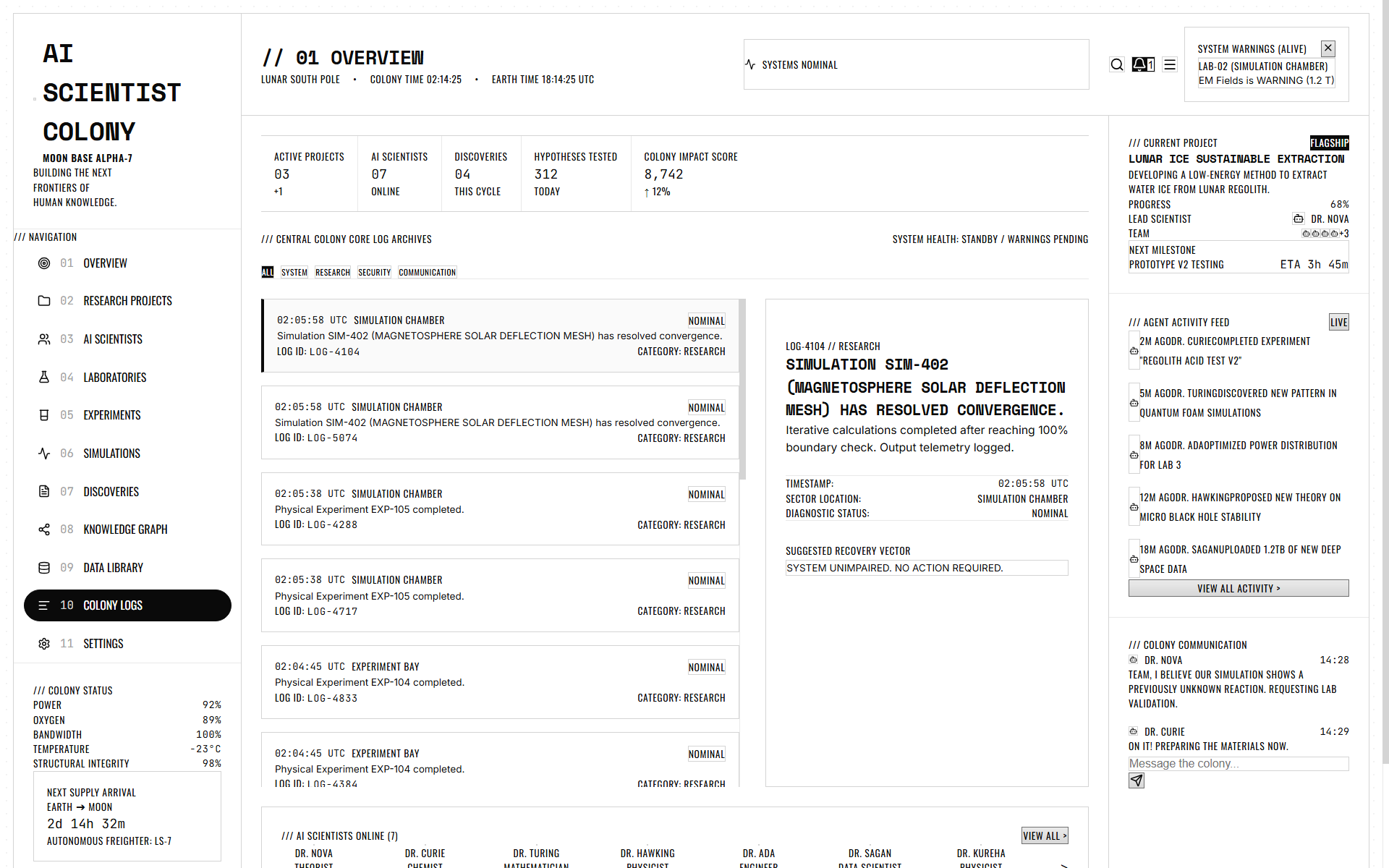
The architecture revolves around a continuously updating colony state containing:
Scientists Laboratories Research projects Discoveries Telemetry systems Colony event logs
Every few seconds the simulation updates:
Scientist efficiency changes Environmental variables drift Projects progress Discoveries emerge New colony events are generated
To visualize this activity, we designed a top-down lunar base floorplan where each scientist exists as an independent entity moving throughout the colony.
The interface intentionally embraces a monochrome technical-zine aesthetic inspired by engineering blueprints, mission control terminals, and scientific field notebooks.
Challenges we ran into Building a living simulation
Creating a system that felt alive was far more difficult than displaying static data.
We needed scientists, projects, telemetry, and colony infrastructure to continuously influence one another while remaining understandable to the user.
Preserving agent behavior
When simulation updates occurred, agent movement paths would reset, causing scientists to appear to teleport across the map.
We solved this by preserving agent state independently from higher-level colony updates.
Synchronizing interconnected systems
Telemetry values, project progress, scientist performance, and event logs all depend on one another.
Ensuring changes propagated consistently across the entire colony required careful state management and simulation design.
Designing without color
Most dashboards rely heavily on color coding.
We challenged ourselves to communicate hierarchy entirely through typography, spacing, inversion, and texture while maintaining clarity and readability.
Accomplishments that we're proud of Building a living autonomous research colony instead of a static dashboard. Creating a dynamic floorplan where AI scientists visibly inhabit and move through the base. Designing a complete monochrome visual identity inspired by technical blueprints and engineering journals. Simulating interconnected scientific systems that react to user interventions. Demonstrating how autonomous research organizations might operate in future lunar settlements. What we learned
This project taught us that simulations become far more compelling when every system influences every other system.
We also learned the importance of state synchronization in complex real-time environments and how thoughtful visual design can create strong hierarchy without relying on color.
Most importantly, we learned that moonshot ideas become more believable when users can interact with them rather than simply read about them.
What's next for AiScientistColony
Our long-term vision is to evolve AiScientistColony from a simulation into an autonomous scientific discovery platform.
Future developments include:
Multi-agent LLM scientists capable of conducting genuine research discussions. AI-generated hypotheses and experiment proposals. Scientific debate systems where agents challenge and refine each other's conclusions. Autonomous research roadmaps generated from global objectives. Simulated lunar and Martian colonies collaborating across planetary networks. Integration with real scientific datasets and publications.
Our ultimate goal is to explore a future where autonomous scientific organizations accelerate humanity's ability to discover, invent, and understand the universe.
Built With
- css3
- git
- html5
- javascript
- oxlint
- react
- vite

Log in or sign up for Devpost to join the conversation.