-
-
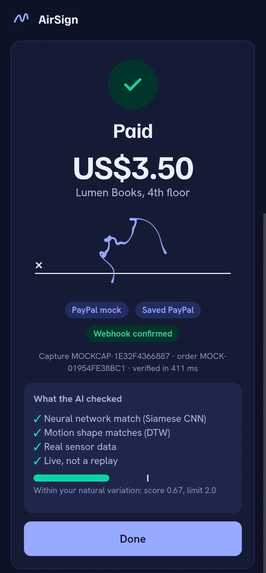
AirSign Customer POV 3
-
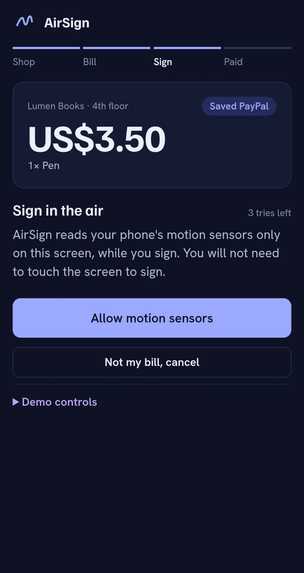
AirSign Customer POV 2
-
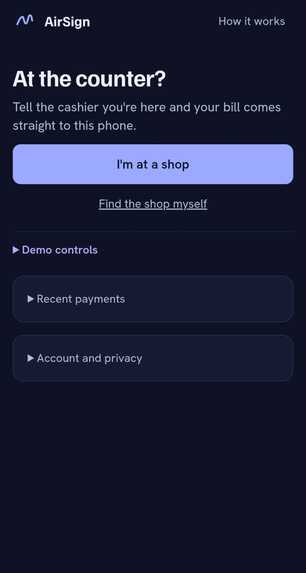
AirSign Customer POV 1
-
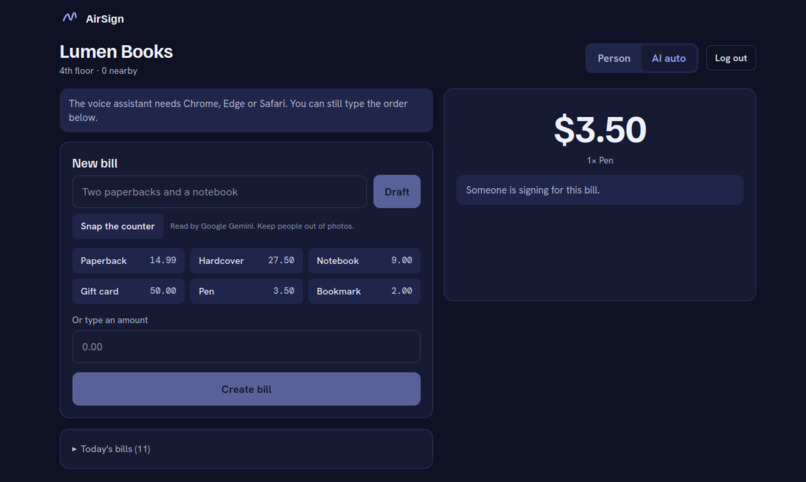
AirSign Cashier POV 1
-
AirSign Cashier POV 2
Paying in a shop still means a card, a PIN or a special terminal. PINs can be watched, a quick tap is easy to do without thinking, and new payment hardware is one more cost for every small shop. So we asked: can you confirm a payment with something you do, using only the phone already in your pocket? People have trusted signatures for a long time, because they're personal and deliberate. We wanted to bring that into the air.
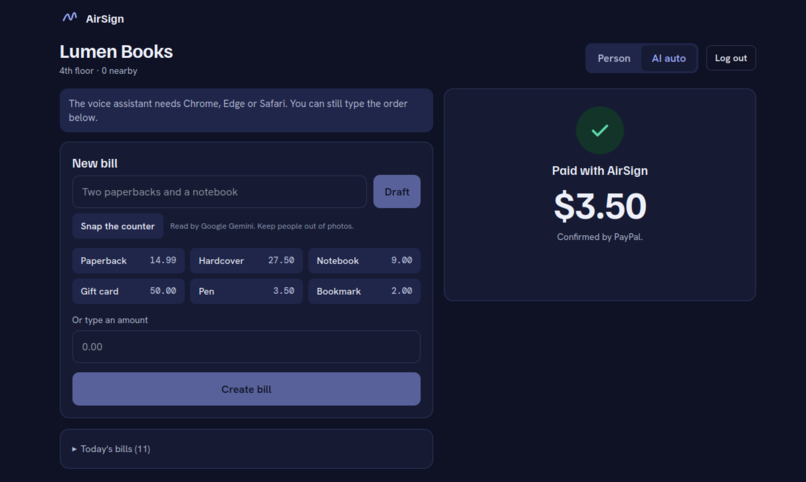
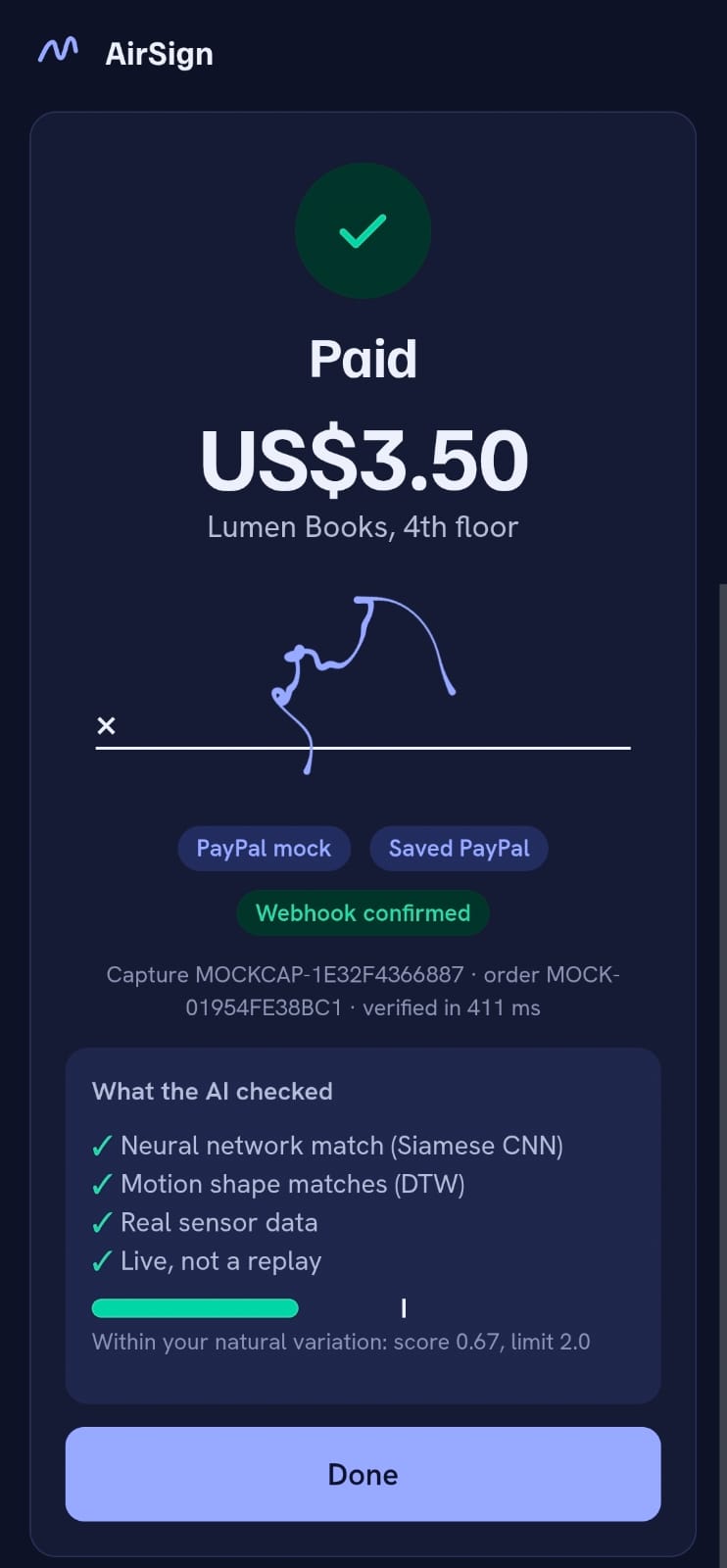
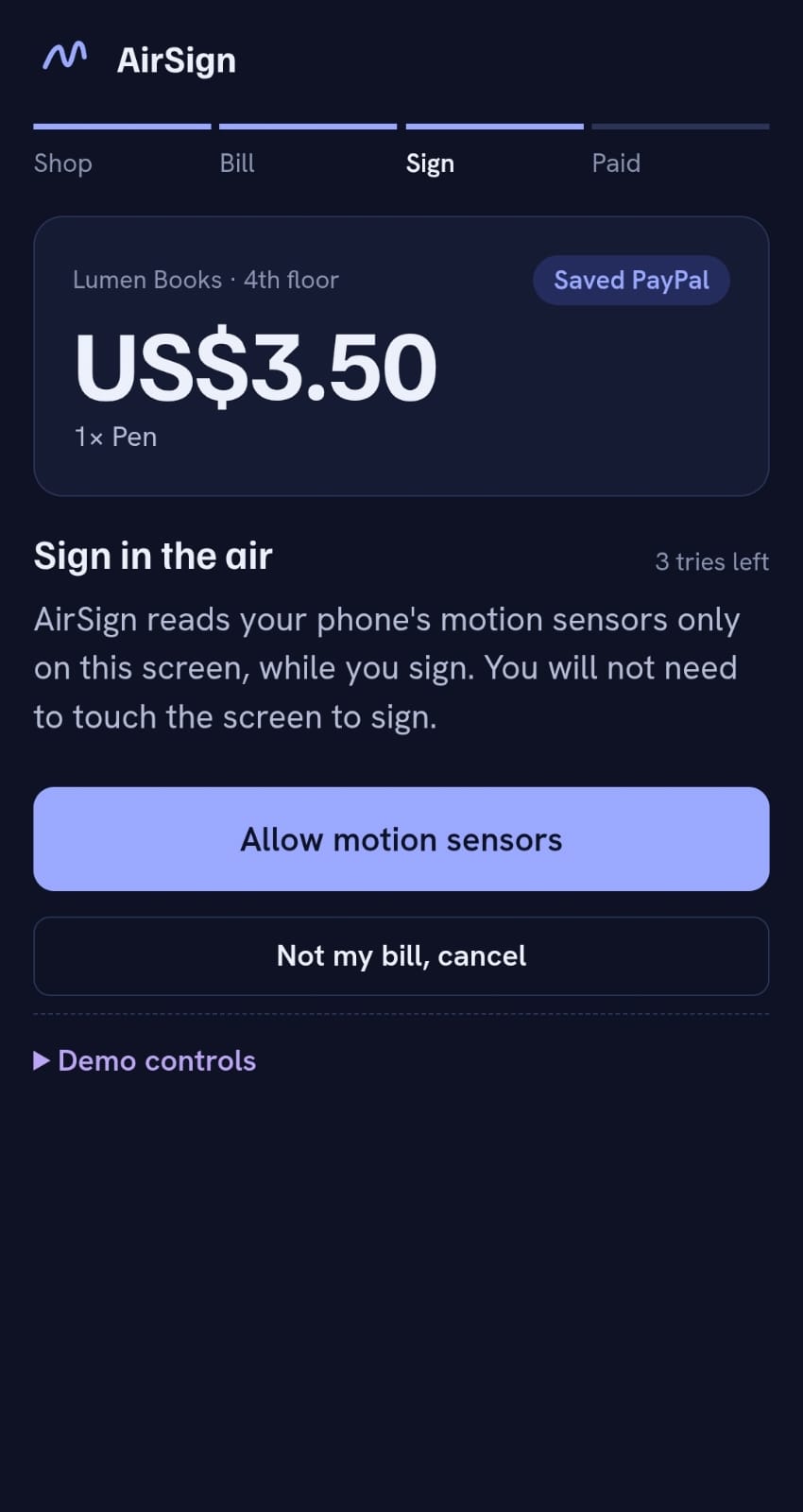
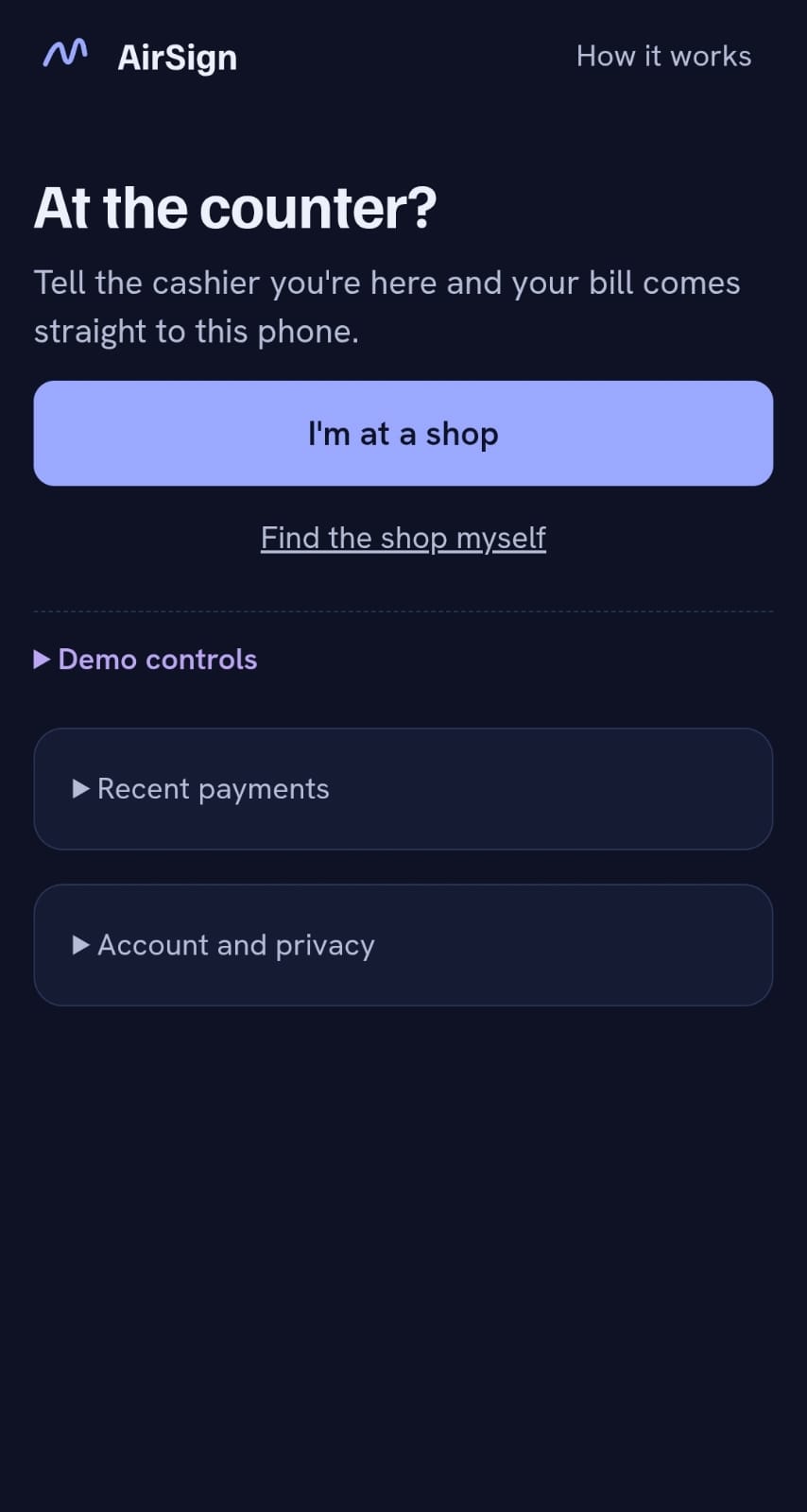
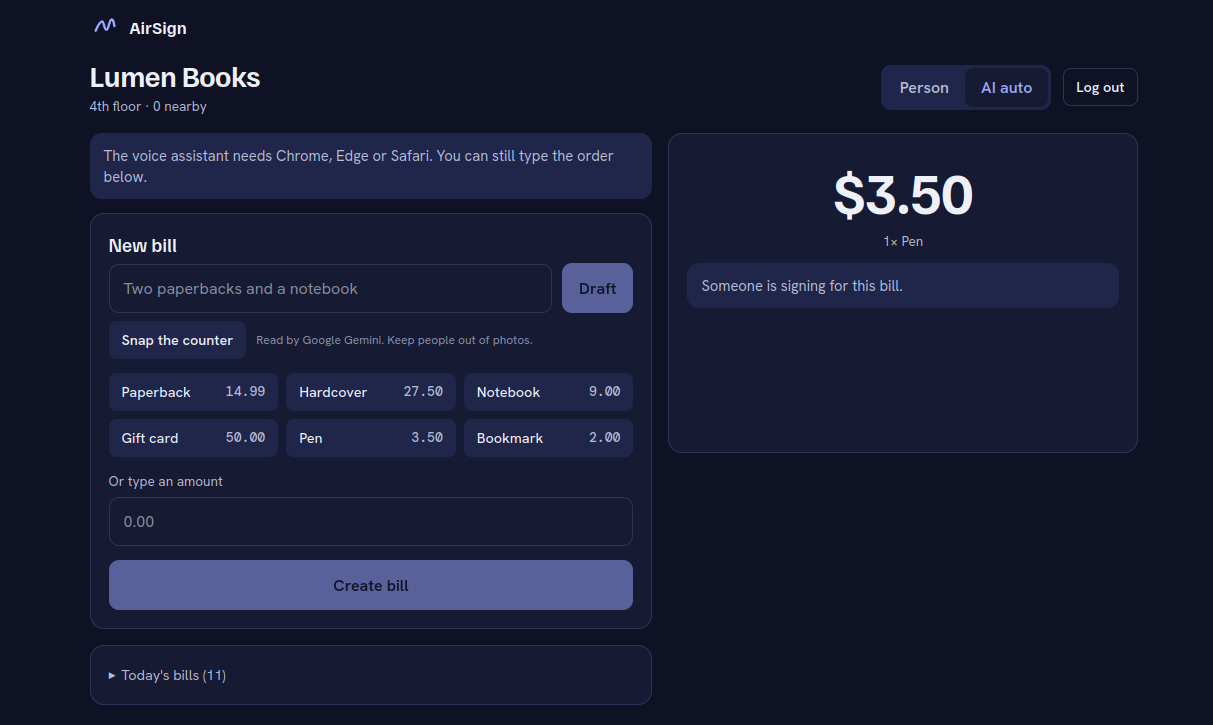
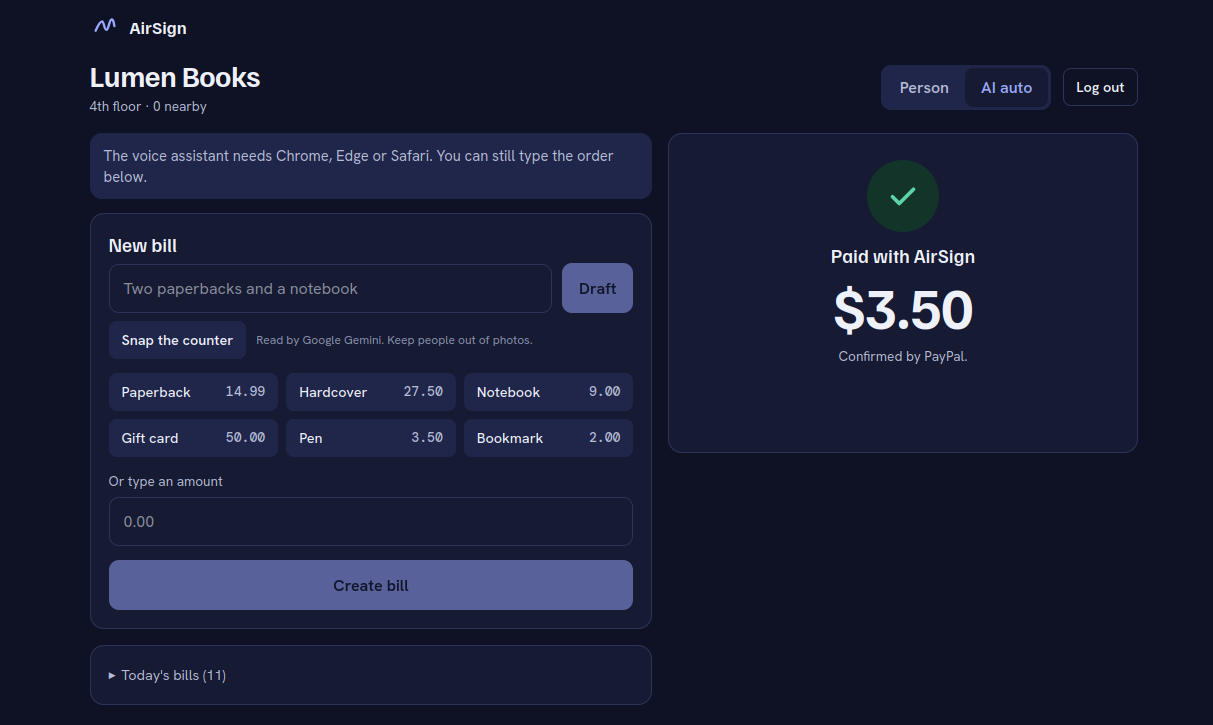
AirSign lets you pay in a shop by signing in the air with your phone. There's no card, no PIN and no terminal, just a mobile browser. You set up your air signature once by repeating a personal movement 7 times, like writing your initials in the air. You can also save your PayPal account once. In the shop, you tap "I'm at a shop", and your first name appears on the cashier's screen. The cashier takes a photo of the items or says the order. AI drafts the bill, and the cashier checks it and sends it to your phone. There's also a voice mode that takes the order, reads it back, asks your name and sends the bill. Your phone buzzes. You hold it still, sign in the air, and hold still again, without touching the screen. Your movement appears on screen as pen ink. AI checks that the movement matches yours. Only then does the server take the payment through PayPal, and you get a receipt. Normal purchases need one signature. Something unusual, like a large bill at a shop you've never used, gets a stricter check or two signatures, with a plain explanation of why. Copied movements, replayed recordings and fake sensor data are rejected. Everything runs on the PayPal sandbox, so no real money moves. Judges without a phone can try it all in a clearly labeled simulation mode.
What we built: PayPal: Orders API v2 to create and capture payments, Vault to save a PayPal account once, the JavaScript SDK v6 button for approval, and webhooks to confirm payments. We also audited our integration against PayPal's AI Toolkit guidance and fixed what it found. Signature check: the phone's gyroscope and accelerometer record the movement. We compare it to your saved signature with dynamic time warping and a small neural network we trained ourselves. Other AI: Google Gemini reads photos and orders to draft bills, and rewrites risk reasons in plain words. A risk engine combines clear rules with an anomaly model trained on payment history to decide how strict the check should be. App: a Python and FastAPI backend, a React and TypeScript mobile web app, hosted on Render with a Neon Postgres database. One rule shaped the design: amounts come from the bill stored on the server, never from the phone, and the only code that can take money is a passing signature check. AI drafts bills and explains decisions, but it can't move money.
Challenges we faced: 1) Telling floors apart: phone location can find a building but not a floor, so shops stacked on top of each other look identical. We moved to customers checking in and appearing on the cashier's list, with a short code as a backup. 2) People vary: your signature changes a little every time, and everyone varies differently. A single strict threshold rejected some real users, so we had to rethink how thresholds are set. 3) Making signing comfortable: our first version made you press and hold the screen while moving the phone, which felt awkward. We rebuilt it to be hands-free, with buzzes, tones and spoken prompts, because you can't read a screen that's moving. 4) Telling a signature from a shake: small accidental movements could slip into a recording, so we added filtering to keep them out. 5) Bugs in the details: A high-risk payment could get stuck after two failed tries and one good one. Our webhook check sent PayPal a reformatted message instead of the original. An early fake-sensor check let some generated data through. Tests and reviews caught each of these before they reached users, and all three are fixed.
Accomplishments that we're proud of: 1) A complete in-store payment flow that needs no card, PIN or terminal, from the cashier's bill to the PayPal receipt. 2) Signing with no touch at all, with your movement drawn back as real-looking ink. 3) A design where AI helps at every step, but only a passing signature can release money. 4) Being honest about limits: we measure where the system fails, and we say that a motion signature is one security factor, not a replacement for Face ID. 5) Respecting privacy: raw sensor recordings aren't kept for payments, signature templates are encrypted, and you can delete your signature at any time.
The learning: Good security is useless if it's annoying. Removing one press-and-hold changed how the whole product felt. Test numbers can flatter you. Testing thresholds on people the system hadn't seen gave much worse results than our first numbers, and that changed how we built it. Simulated data shows the system works, but only real people on real phones show how well. AI is most useful when its job is clearly limited. Letting it read orders but not set prices or approve payments made the whole system easier to trust.
Future prospects of AirSign: 1) Test with more people and more phone models, and publish the real accuracy numbers, including the misses. 2) Move signature matching onto the phone, using keys tied to the device, so biometric data never needs to leave it. 3) Build a native app for better sensors, floor detection and background alerts. 4) Set up proper payouts so many independent shops can each receive their own money through PayPal. 5) Get a legal review of biometric and payment rules before any real-money use.
Built With
- devicemotion-api
- docker
- fastapi
- geolocation-api
- google-gemini
- neon
- numpy
- paypal-ai-toolkit
- paypal-javascript-sdk
- paypal-orders-api
- paypal-server-sdk
- paypal-vault
- paypal-webhooks
- postgresql
- python
- pytorch
- react
- render
- scikit-learn
- scipy
- sqlalchemy
- sqlite
- typescript
- vite
- web-speech-api

Log in or sign up for Devpost to join the conversation.