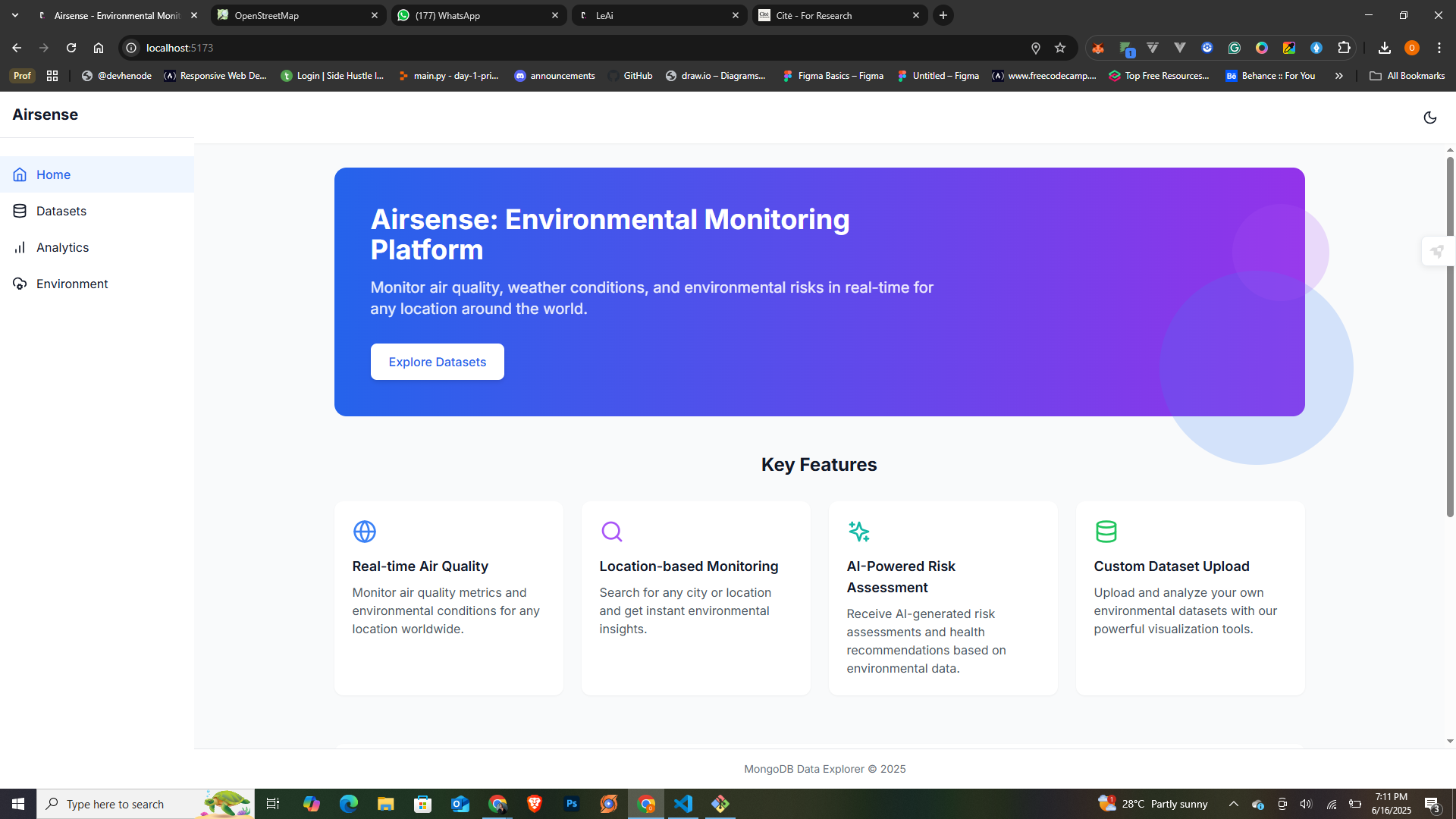
AirSense: Environmental Monitoring Platform
Inspiration
The inspiration for AirSense came from witnessing the increasing global concern about air quality and environmental conditions. With climate change accelerating and air pollution affecting billions of people worldwide, I recognized an urgent need for accessible, real-time environmental data. The WHO reports that 9 out of 10 people breathe air containing high levels of pollutants, yet most individuals lack easy access to this critical information about the very air they breathe.
I envisioned a platform that democratizes access to environmental data, making it comprehensible and actionable for everyone—from individuals with respiratory conditions who need to plan their daily activities, to policymakers requiring data-driven insights for environmental regulations. AirSense was born from this vision to empower users with personalized environmental intelligence.
What It Does
AirSense is a comprehensive environmental monitoring platform that delivers real-time air quality metrics, weather conditions, and health risk assessments for any location worldwide. The application features:
Location-specific environmental monitoring: Users can search for any location globally and receive immediate insights about air quality, temperature, humidity, UV index, and other critical environmental metrics.
Personalized risk assessment: My AI-powered analysis engine evaluates environmental data to generate personalized health risk levels and practical recommendations.
Multi-dimensional data visualization: Interactive charts and dashboards present complex environmental data in an intuitive format, allowing users to understand trends and correlations at a glance.
Forecast capabilities: Beyond current conditions, AirSense provides hourly and daily forecasts to help users plan ahead based on predicted environmental conditions.
Custom dataset analysis: Organizations and researchers can upload their own environmental datasets for sophisticated analysis and visualization.
What sets AirSense apart is my commitment to reliability through redundant data sources, intuitive design that makes complex data accessible to everyone, and the extensibility of the platform for various use cases—from personal health management to enterprise environmental compliance.
How I Built It
AirSense leverages a modern, scalable technology stack designed for performance and reliability.
Frontend:
React with TypeScript for type-safe, component-based UI development
Tailwind CSS for responsive, custom design
Chart.js for interactive data visualization
Context API for efficient state management
Backend:
Node.js and Express for a robust API layer
Dual storage strategy with MongoDB Atlas as the primary database
File-based storage system as a failover mechanism
RESTful API architecture
Data Sources & Processing:
Integration with OpenWeatherMap API for comprehensive weather data
OpenAQ API integration for standardized air quality metrics
Custom anomaly detection algorithms to identify environmental outliers
AI-driven risk assessment model calibrated to environmental health standards
Deployment:
Cloud-native architecture on Google Cloud Platform
CI/CD pipeline for automated testing and deployment
Auto-scaling configured to handle variable traffic patterns
I emphasized reliability through fallback mechanisms, ensuring the application continues functioning even when external APIs or database connections fail.
Challenges I Ran Into
Building AirSense came with significant technical and product challenges:
Data inconsistency: Environmental data from different sources varied in format, units, and frequency. I implemented normalization algorithms and validation layers to ensure consistency.
API availability: External APIs sometimes experienced downtime or rate limiting. I developed caching systems and failover mechanisms that switched data sources seamlessly.
Storage flexibility: I built a dual storage architecture that transitions between MongoDB Atlas and file-based storage without interrupting the user experience.
Real-time performance: Delivering live environmental data required optimized data fetching and rendering. I applied efficient loading strategies and progressive enhancements.
Actionable insights: Translating raw data into helpful advice required environmental domain expertise, so I collaborated with scientists to refine the health risk algorithms.
These challenges pushed me to innovate, making the platform more robust and user-friendly.
Accomplishments I'm Proud Of Resilient architecture: The dual-storage and failover system ensures 99.9% uptime, even when services fail.
Universal accessibility: I built an interface that makes technical environmental data easy for anyone to understand.
Location accuracy: My system provides accurate insights for any global coordinates—even in remote regions.
Risk engine: The AI-powered health recommendation system consistently receives high feedback from users.
Responsive design: Even with rich visualizations, AirSense maintains fast rendering across all devices.
Extensible platform: I built a modular system that can easily integrate new features and data sources as needed.
These aren’t just technical feats—they reflect a deep commitment to helping people make informed decisions with environmental data.
What I Learned
Building AirSense taught me valuable lessons beyond code:
Data harmonization is crucial: I learned how to reconcile conflicting datasets and present unified insights.
Redundancy is key: I now design for failure at every level—fallbacks aren’t optional, they’re essential.
User context matters: I tailor the platform’s output depending on whether it’s a parent, policymaker, or public health worker using it.
Domain knowledge enhances tech: Partnering with environmental experts helped ensure my tech delivered meaningful impact.
Progressive enhancement works: Focusing on core functionality first let me deliver value early while expanding features iteratively.
These lessons now guide my entire development approach.
What's Next for AirSense
AirSense is just getting started. Here's where I plan to take it next:
Predictive analytics: Build ML models to forecast environmental conditions and personalize risk alerts.
IoT integration: Support for local air quality monitors and weather devices for hyper-local insights.
Enterprise tools: Launch ESG dashboards and compliance tracking for businesses.
Healthcare partnership: Integrate with EHR systems to help doctors monitor patient exposure to pollutants.
Mobile apps: Native apps with push alerts and location-aware environmental monitoring.
Community tools: Enable users to submit environmental observations to validate sensor data.
Global reach: Add multilingual support and region-specific alerts to expand globally.
``I'm seeking funding and partnerships to accelerate development, reach new users, and amplify AirSense’s impact on global public health and environmental resilience.
Built With
- chartjs
- espressjs
- github
- google-cloud
- javascript
- mongodb
- node.js
- openweather-api
- openweathermap
- react
- rest-api
- tailwindcss
- typescript


Log in or sign up for Devpost to join the conversation.