-
-
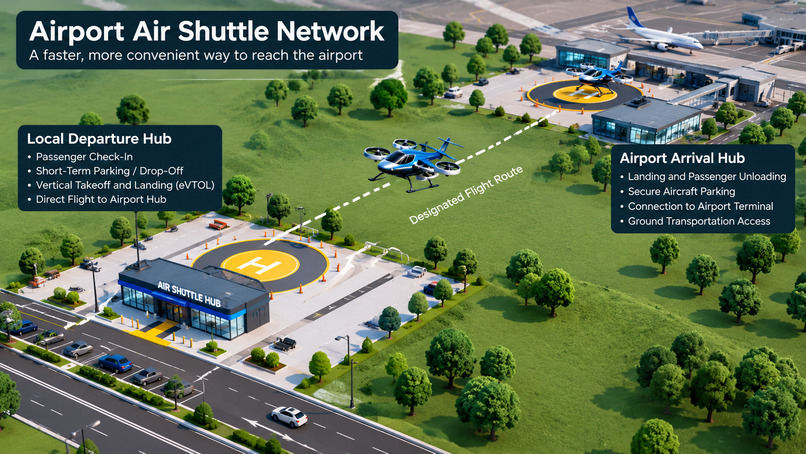
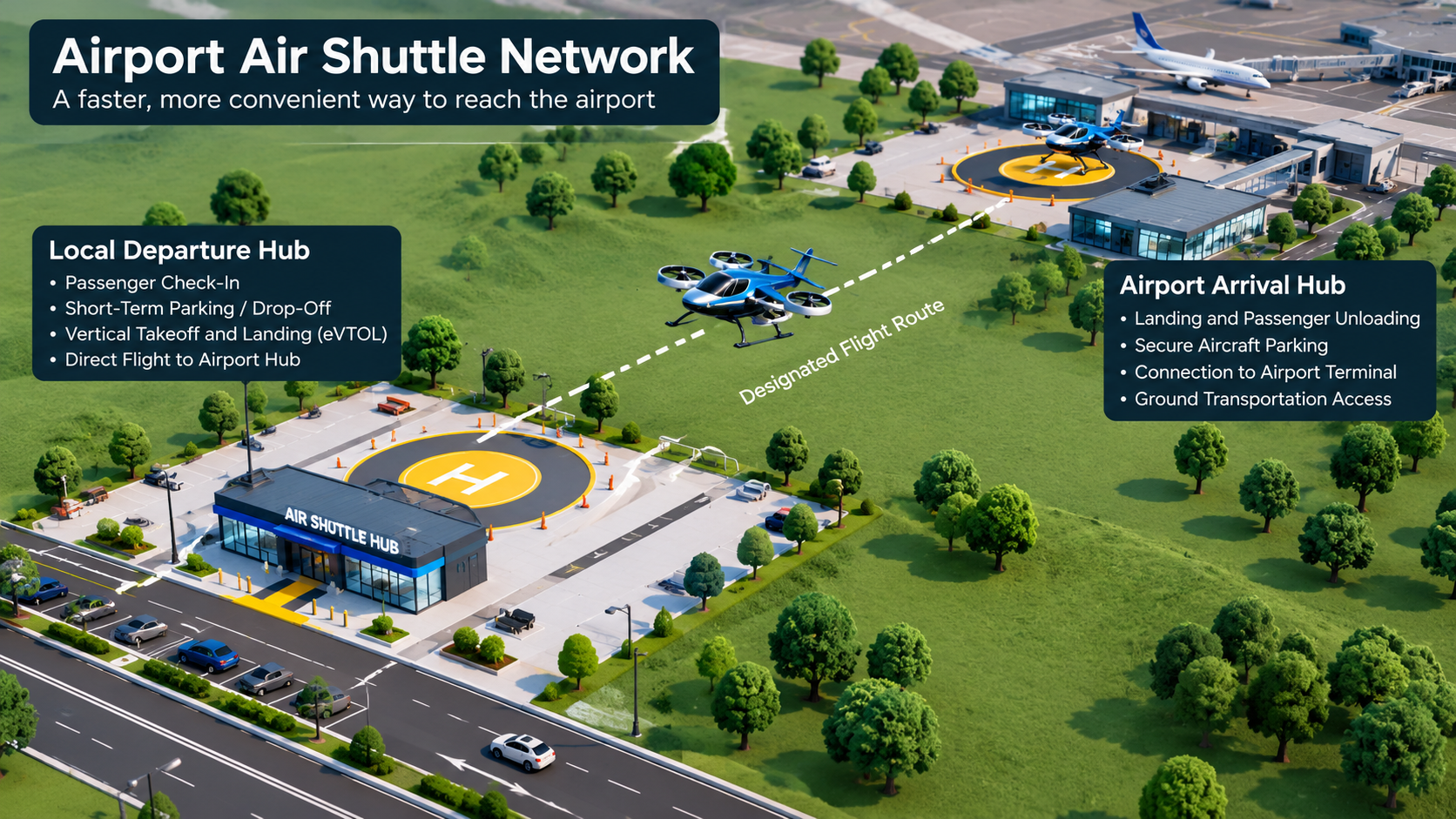
Conceptual visualization of the Airport Air Shuttle Network, connecting local departure hubs to airports using eVTOL aircraft.
-
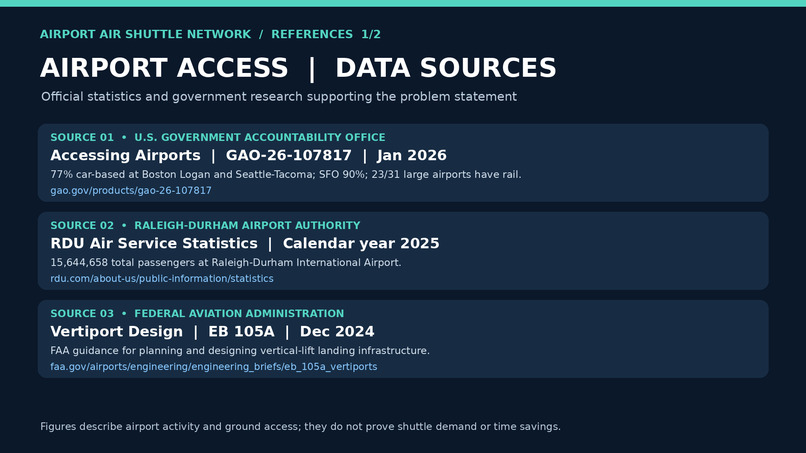
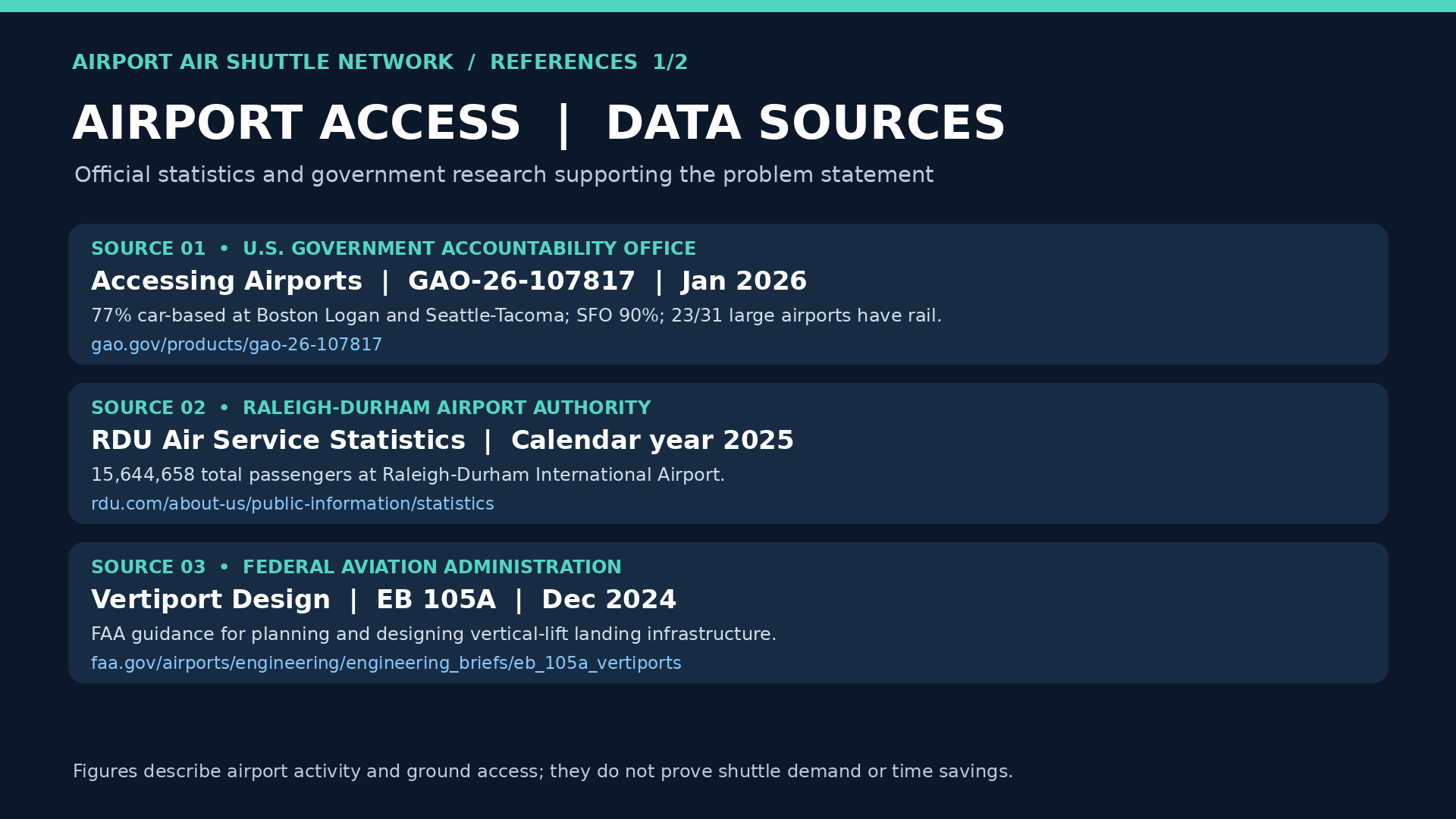
Airport Access Data Sources
Airport Air Shuttle Network
A Scalable Aerial Transportation Infrastructure for Passengers and Freight
Inspiration
The Airport Air Shuttle Network originated from my exploration of future space transportation and a separate concept involving how vehicles might interact with their surrounding environment.
As I explored smaller-scale applications, my attention shifted toward personal hovercraft and emerging electric vertical takeoff and landing (eVTOL) aircraft.
I began considering how these technologies could solve real transportation problems.
One opportunity stood out: airport access.
Instead of requiring every traveler to drive directly to a busy airport, what if passengers could travel to a nearby departure hub and complete the remaining journey by air?
That question became the foundation of the Airport Air Shuttle Network.
What It Does
Airport Air Shuttle Network proposes a modular transportation system connecting local departure hubs to airport-side arrival facilities using suitable vertical takeoff and landing aircraft.
The initial operating concept follows six steps:
- A passenger arrives at a local hub by personal vehicle or drop-off transportation.
- The passenger completes check-in and boarding procedures.
- A qualified pilot operates the aircraft along an approved flight route.
- The aircraft lands at a designated airport-side hub.
- After the aircraft is secured and its rotors have stopped, the passenger exits.
- A ground shuttle or pedestrian connection completes the journey to the airport terminal.
The initial demonstration focuses on one passenger, one aircraft, and two hubs.
The objective is to evaluate whether this system could reduce airport access times, provide convenient transportation alternatives, and reduce dependence on congested roads.
How I Built It
I developed the concept by examining passenger movement, infrastructure requirements, aircraft capabilities, scheduling, and operational safety.
Rather than attempting to manufacture a new aircraft, I focused on developing transportation infrastructure that could potentially support compatible existing and emerging aircraft.
Using Blender, Python, and AI-assisted development, I created a conceptual 3D demonstration illustrating the local departure hub, airport arrival hub, aircraft, landing areas, vehicle access, and passenger movement.
Johnston Regional Airport in North Carolina was selected as a potential demonstration location for future feasibility evaluation. No airport partnership or operational approval has been established.
Challenges
Developing a practical aerial transportation network requires addressing multiple engineering and operational challenges.
These include aircraft payload and endurance, propulsion, charging infrastructure, weather limitations, airspace management, landing-site requirements, passenger safety, and regulatory approval.
The system must also demonstrate sufficient passenger demand, measurable transportation benefits, and sustainable operating economics.
These challenges form the basis of the proposed feasibility and validation process.
Accomplishments
The project has progressed from an initial transportation concept into a defined operating model supported by a 3D visualization.
The current demonstration illustrates the relationship between the local departure hub, aircraft, airport-side arrival hub, and passenger transfer.
The project remains at the conceptual design stage. No physical aircraft testing or commercial operations have been conducted.
Future Expansion and Commercial Scalability
The Airport Air Shuttle Network is designed as a modular transportation infrastructure concept capable of expanding across multiple geographic regions, aircraft categories, and commercial industries.
The initial demonstration focuses on one passenger, one aircraft, and two transportation hubs. However, the long-term vision extends far beyond airport access.
Phase 1 — Airport Passenger Transportation
The first objective is to evaluate a practical airport transportation service using small vertical takeoff and landing aircraft.
Local departure hubs would provide passenger check-in, vehicle drop-off, aircraft boarding, and direct transportation to an airport-side arrival facility.
This initial phase would establish operating procedures, safety requirements, infrastructure specifications, and a foundation for future expansion.
Phase 2 — Metropolitan Airport Networks
Following successful validation, additional departure hubs could be developed around participating airports.
Instead of relying on one departure location, passengers could access the service from multiple communities surrounding a metropolitan area.
Potential advantages include reduced dependence on congested road corridors, more transportation choices, and improved airport accessibility.
Expansion could prioritize areas with demonstrated travel demand, suitable operating locations, and sufficient economic potential.
Phase 3 — Nationwide and Regional Transportation
The next opportunity involves connecting transportation networks across multiple metropolitan regions.
Compatible infrastructure and standardized operating procedures could allow participating operators to establish services in additional cities.
Regional routes could also be evaluated where aircraft range, operating costs, infrastructure, and regulations support practical service.
The long-term objective is a transportation system capable of expanding geographically without depending on a single aircraft model or manufacturer.
Phase 4 — Corporate, Hospitality, and Tourism Markets
The same infrastructure concept could potentially support specialized passenger transportation services.
Commercial applications include corporate travel, executive transportation, hotel and resort transfers, tourism destinations, private aviation connections, and major events.
These markets could create opportunities for contracted transportation services, premium passenger fares, and partnerships with participating businesses.
Phase 5 — Commercial Freight and Logistics
A significant future opportunity involves adapting the network for commercial cargo transportation.
Dedicated freight hubs could serve distribution centers, manufacturing facilities, industrial parks, and other commercial destinations.
Potential applications include:
- Time-sensitive commercial shipments
- Manufacturing components and replacement equipment
- Distribution and logistics operations
- Specialized industrial transportation
- Regional freight connections
Freight services could provide an additional revenue opportunity through commercial transportation contracts and logistics partnerships.
Cargo operations would require aircraft and infrastructure specifically designed for their payloads, operating environments, and safety requirements.
Phase 6 — Heavy-Lift Aircraft Research
Long-term expansion could include research into specialized vertical-lift aircraft capable of transporting substantially larger cargo loads.
One potential research objective is evaluating aircraft configurations capable of carrying payloads approaching 40,000 pounds.
Research would investigate lightweight structural designs, propulsion requirements, alternative or assisted lifting technologies, aircraft stability, energy efficiency, and emergency operating capabilities.
This represents an exploratory engineering objective, not an existing aircraft capability.
Heavy-lift operations would require separate infrastructure, extensive engineering validation, regulatory approval, and demonstrated commercial feasibility.
Phase 7 — Infrastructure and Network Services
As transportation services expand, the network itself could become a commercial platform.
Potential business models include:
- Passenger transportation fares
- Corporate transportation contracts
- Commercial freight agreements
- Hub infrastructure access and leasing
- Partnerships with airports and property owners
- Network scheduling and coordination services
- Agreements with qualified third-party aircraft operators
A modular infrastructure approach could allow different aircraft operators and transportation providers to participate without requiring the network developer to manufacture or own every aircraft.
Long-Term Vision
The ultimate objective is to develop an adaptable aerial transportation network capable of supporting passenger travel, commercial transportation, and specialized freight services across multiple geographic regions.
The system would begin with a focused airport passenger demonstration, expand through validated commercial applications, and evolve as aviation technology and infrastructure capabilities improve.
Each expansion stage would depend on demonstrated technical feasibility, regulatory approval, passenger or freight demand, and sustainable operating economics.
The long-term opportunity is not limited to transporting passengers between two locations. It is the development of a coordinated transportation infrastructure capable of serving multiple industries through compatible aerial transportation systems.
Potential Business Models
Commercial opportunities may include passenger fares, corporate transportation agreements, airport and hospitality partnerships, cargo transportation contracts, infrastructure access, and network-management services.
The project is intended to support multiple possible operating models without depending exclusively on aircraft ownership or manufacturing.
These revenue opportunities remain hypotheses requiring market research and financial validation.
What I Learned
Developing the project demonstrated that an aerial transportation service involves much more than the aircraft itself.
Infrastructure, passenger handling, scheduling, safety, aircraft compatibility, and coordination with existing transportation systems are equally important.
It also demonstrated how 3D modeling and AI-assisted development can help an independent innovator explore and communicate a transportation concept before physical testing.
What's Next
The next development stage will focus on technical feasibility and commercial validation.
Priorities include identifying suitable aircraft, evaluating regulatory requirements, developing preliminary hub specifications, estimating operating costs, researching passenger demand, and seeking feedback from aviation professionals and potential partners.
Future research will examine network scalability, commercial freight applications, and alternative heavy-lift aircraft concepts.
The immediate objective is to validate a practical airport passenger transportation model while establishing a foundation for broader commercial applications.
Airport Air Shuttle Network begins with one passenger, one aircraft, and two hubs—but its long-term vision extends across multiple transportation markets.
