-
-

the Airlock logo
-
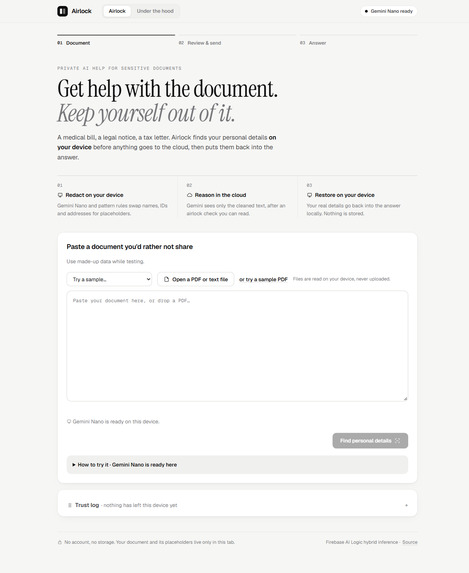
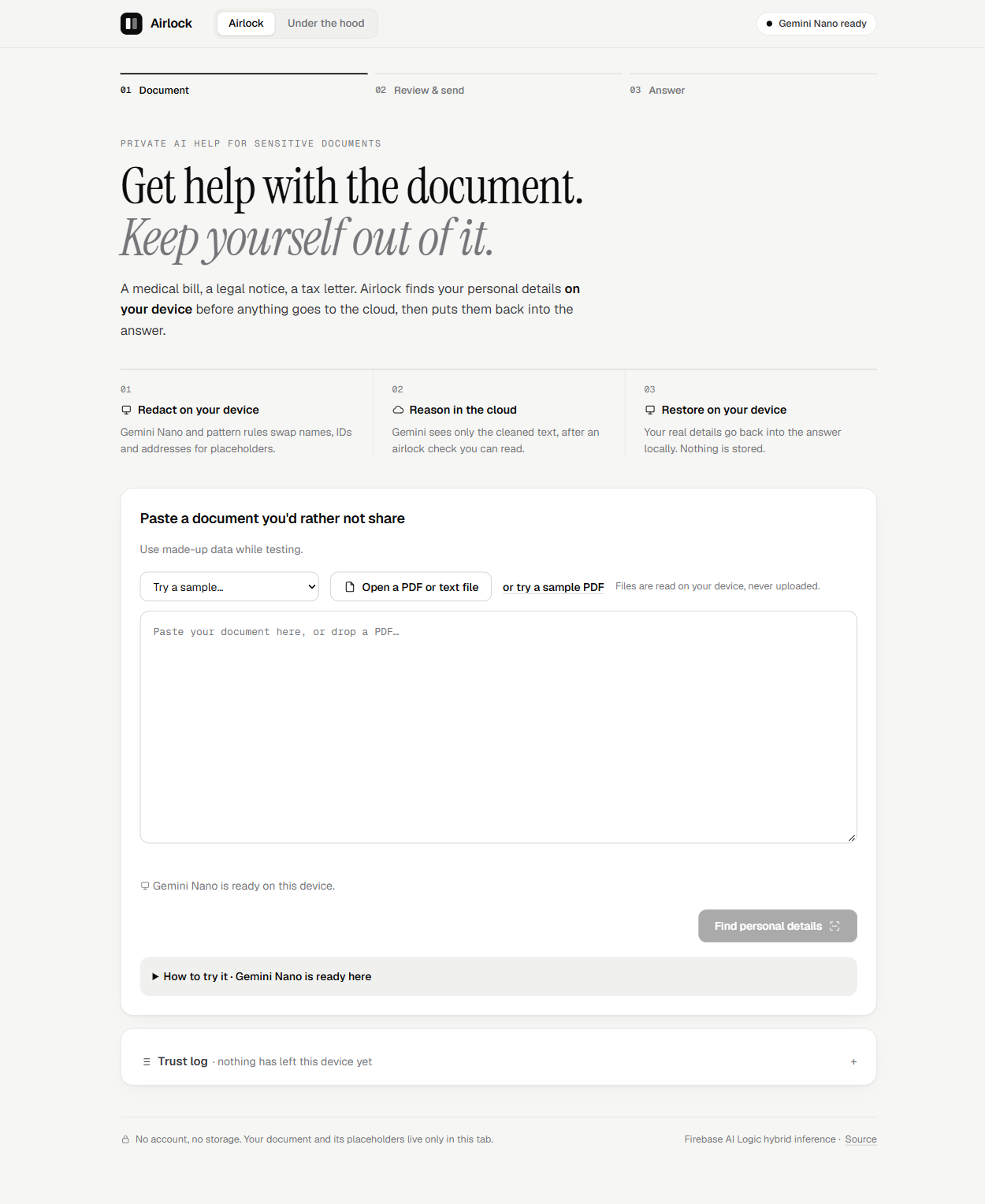
the home screen with the headline
-
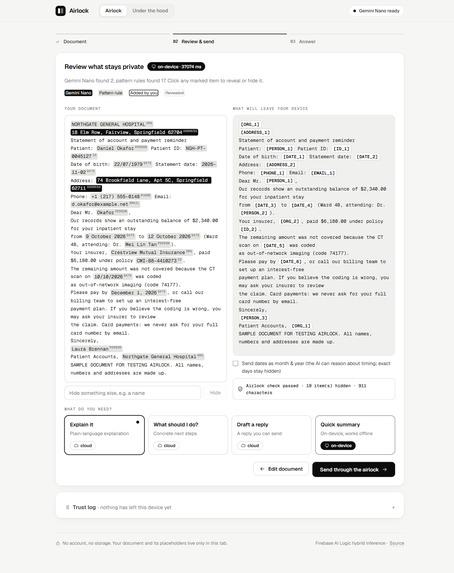
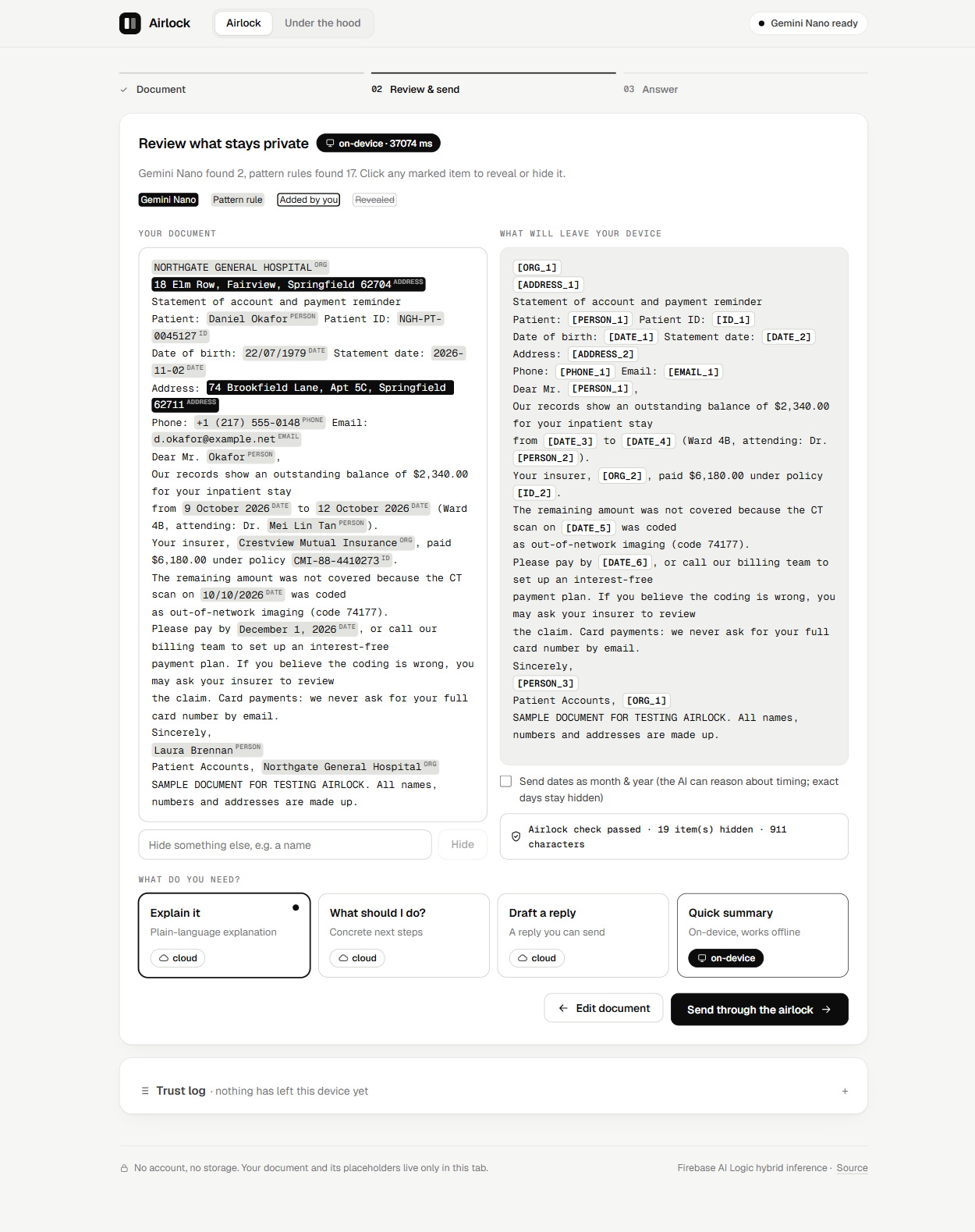
the document next to what leaves the device
-
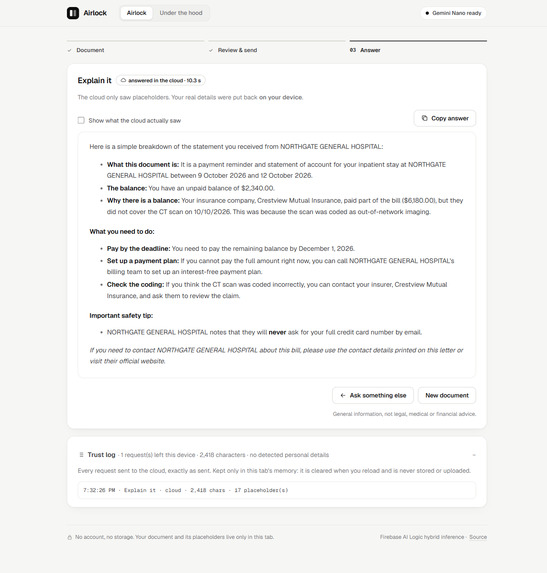
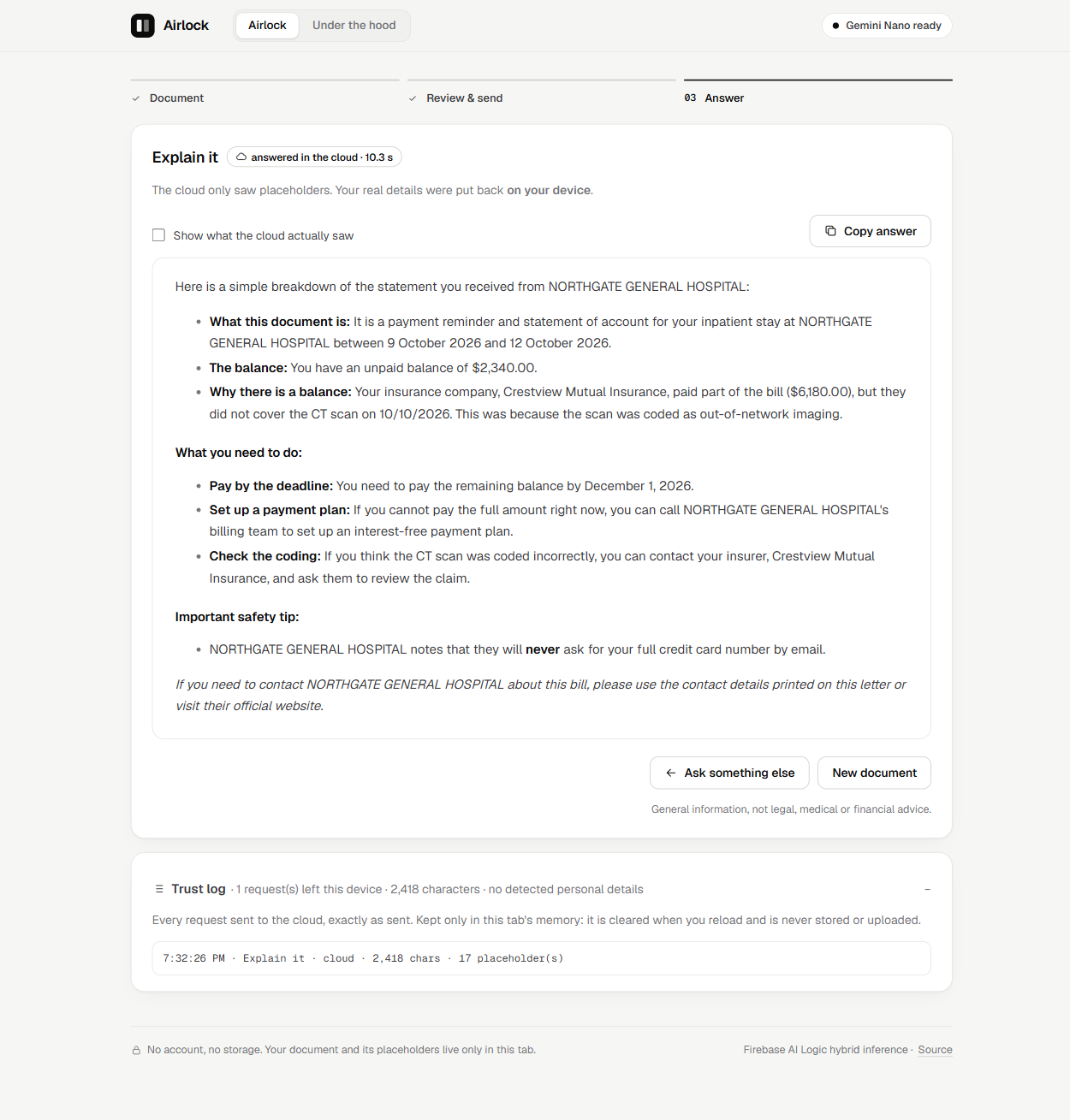
a real cloud answer with your details restored
-
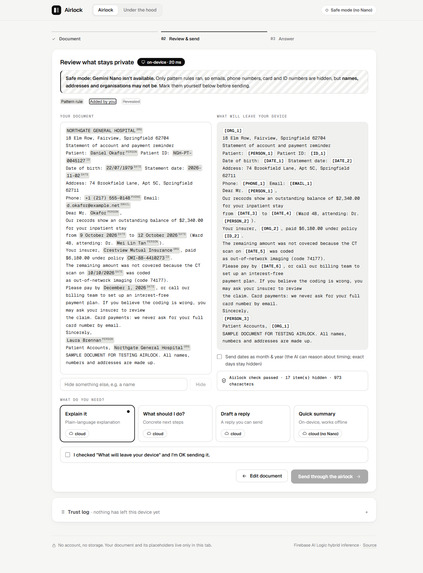
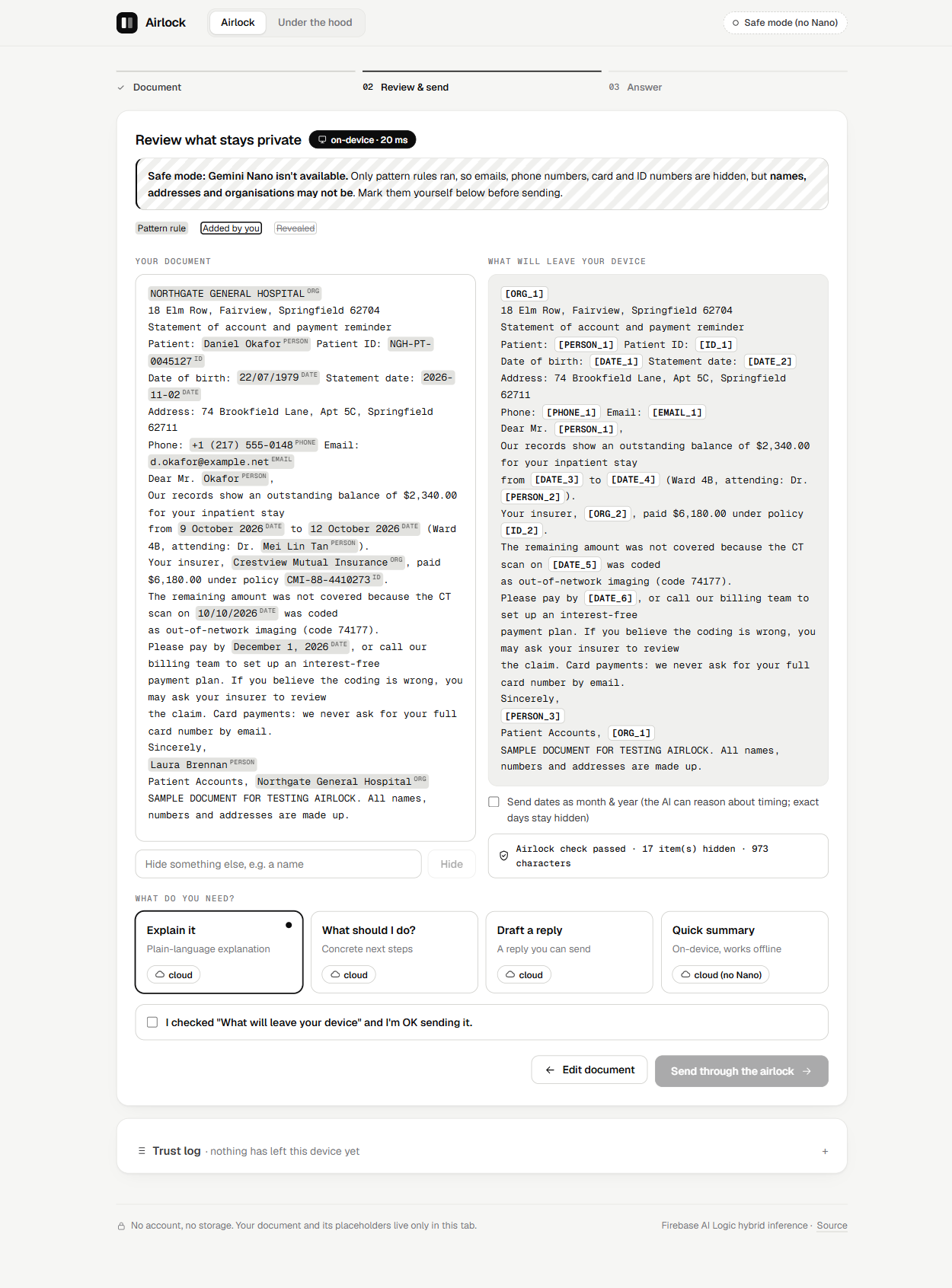
safe mode without Gemini Nano
-

the phone layout


Inspiration
The documents people most need help understanding are the ones they should least share: a hospital bill, a notice to vacate, a tax letter, an HR complaint. People paste them into chatbots anyway, because the stakes are high and the language is hard. That hands a cloud service their name, date of birth, address, patient ID and policy numbers.
We noticed that the reasoning a large model does over these documents almost never needs the identity. "Why didn't my insurer pay?" can be answered just as well for [PERSON_1] as for a real name. Hybrid AI made it possible to act on that: a small model on the device that sees everything, and a large model in the cloud that sees only what it needs.
What it does
Airlock is a web app with three steps:
- Redact on your device. Paste text, pick a synthetic sample, or open a PDF. The PDF is parsed in the browser and never uploaded.
- Gemini Nano, running in Chrome through Firebase AI Logic in
ONLY_ON_DEVICEmode, extracts names, addresses, organisations and IDs as constrained JSON. - Deterministic rules catch emails, phone numbers and dates, plus checksum-validated card numbers, IBANs and national IDs.
- Every item becomes a stable placeholder such as
[PERSON_1].
- Gemini Nano, running in Chrome through Firebase AI Logic in
- Review, then send through the airlock.
- Your document and exactly what will leave your device sit side by side.
- You can click any item to reveal or hide it, hide any phrase yourself, or blur dates to month and year.
- An on-device airlock check re-scans the full prompt, and the send button stays locked if anything hidden would leak.
- Reason in the cloud, restore on your device. Gemini (
ONLY_IN_CLOUD) explains the document, lists next steps with deadlines, or drafts a reply, using only placeholders. Airlock then puts your real details back into the answer locally.- A switch shows what the cloud actually saw.
- A trust log lists every request that left the device, with its exact text.
It stays useful when conditions change:
- Quick summary runs on Gemini Nano (
PREFER_ON_DEVICE) and works fully offline. - In a browser without Nano, Airlock switches to an honest safe mode: pattern rules only, a clear warning about what may slip through, and explicit consent before sending.
How we built it
- Firebase AI Logic hybrid inference (
firebase/ai,getGenerativeModelwithmode). Every call picks its route on purpose:- Detection:
ONLY_ON_DEVICE, so raw text can never fall back to the cloud. - Reasoning:
ONLY_IN_CLOUD. - Quick summary:
PREFER_ON_DEVICE. - The UI badges come from the SDK's real
inferenceSource.
- Detection:
- Constrained output on the device.
responseConstraintmakes Gemini Nano return JSON, and every entity is located verbatim in the text. Anything Nano invents is discarded. - Defence in depth. Pattern rules with Luhn, mod-97 and Verhoeff checks; name rules after titles, field labels and sign-offs; overlapping spans merged; anything found once is hidden everywhere it occurs, and a surname alone shares the full name's placeholder.
- The airlock check runs on the entire outgoing prompt, combining pattern detection with whole-word matches of every hidden value.
- Prompt-injection guard. The document is fenced as data, and the model is told to keep placeholders and never guess what's behind them. Invented placeholders are flagged to the user. Restoring is plain token replacement from a local vault, never a model.
- The Firebase platform:
- App Check with reCAPTCHA Enterprise protects every AI Logic call.
- Remote Config chooses the cloud model without a redeploy.
- Hosting serves the app with security headers.
- Frontend: React 19, TypeScript and Vite. pdf.js is lazy-loaded for local PDF text extraction. Markdown answers render as React elements, with no
innerHTML. The interface is deliberately monochrome: detected items look like redaction marks, and placeholders render as chips. - Measured, not guessed. We wrote 20 synthetic documents across 6 domains with hand-labelled personal data, scored in unit tests and live in the browser with real Gemini Nano:
$$\text{recall} = \frac{\text{personal items hidden before sending}}{\text{all labelled personal items}}$$
Patterns alone reach 83% recall at 100% precision; with Gemini Nano, 99–100%. A 53-check end-to-end test drives the whole flow in real Chrome and intercepts the cloud call to assert that nothing labelled ever leaves the device.
Challenges we ran into
- Gemini Nano is good at extraction but inconsistent between runs: it would miss a different name each time. So every item type that can have a deterministic backstop got one, and Nano became the layer that catches what rules can't, such as addresses and unusual names.
- Small details broke privacy in surprising ways. A regex
iflag silently disabled capital-letter checks inside Unicode classes. A PDF's column layout made "Daniel Okafor Patient" look like one name. A hidden "Al" first matched inside "Total". Each one became a regression test. - The cloud model attributed details to the wrong party. It sometimes told patients to contact the hospital at the patient's own phone and email. We fixed it with prompt rules about whose details are whose, verified across repeated runs.
- Model availability. Our first cloud model timed out on the server side, so we made the model a Remote Config value and switched without redeploying.
- Nano needs a user gesture to load, and its first call is slow. We warm it up on the first click into the document box and show progress.
Accomplishments that we're proud of
- 99–100% recall at 97–98% precision with patterns + Gemini Nano, and 100% precision in safe mode.
- An airlock you can see: the exact outgoing text, a blocking re-scan, and a trust log that matches what the network request carried.
- A hybrid design where each mode has a reason to exist, not a demo of switching modes.
- It works offline, without Nano, and on a phone-width screen.
What we learned
- Hybrid AI is most compelling when the split itself delivers value. Here the device is the trust boundary, and the cloud is the brain.
- Small on-device models shine at narrow, constrained tasks like JSON extraction. Open reasoning is what the cloud is for.
- Privacy features need evaluation sets and tests just like accuracy features do. "It looked fine in the demo" hides run-to-run variance.
What's next
- OCR for scanned PDFs, on the device.
- A Chrome extension that puts the airlock in front of any chatbot's text box.
- More languages and region-specific ID formats.
- Optional generalisation of indirect identifiers: rare conditions, small towns, exact ages.
Try it: https://airlock-b789e.web.app · Code: https://github.com/Sayandeep-Pal/Airlock
Built With
- chrome-prompt-api
- css
- firebase
- firebase-ai-logic
- firebase-app-check
- firebase-hosting
- firebase-remote-config
- gemini
- gemini-nano
- javascript
- pdf.js
- playwright
- react
- recaptcha-enterprise
- typescript
- vite
- vitest

