-
-
Architecture
-
Sequence
-
Defence
Inspiration
Two companies with overlapping customers cannot answer the most basic question in their partnership: how many customers do we share, and how many more could we reach together?
Answering it means comparing two customer lists, and neither side may show the other its list. So the industry built data clean rooms — a vendor, a contract, a procurement cycle, six figures a year, and both companies uploading their raw customer files to a third party they now have to trust.
Look at what that costs. To measure an overlap without exposing anyone, both datasets leave both buildings. The measurement creates the exposure it exists to avoid. Small partnerships simply never ask the question, because the answer costs more than it's worth.
WebMCP makes the alternative possible for the first time. If a page can hand an agent a narrow, declared set of verbs, and the browser enforces which other origins may even see them, then the question can travel to the data instead of the data travelling to a vendor.
What it does
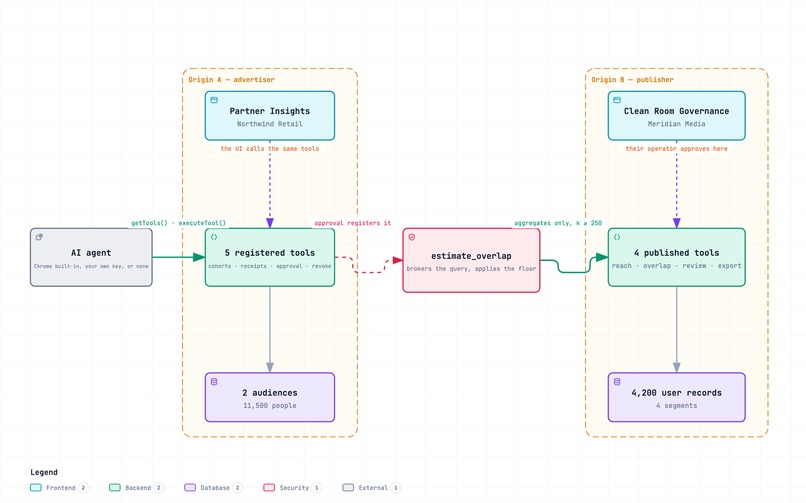
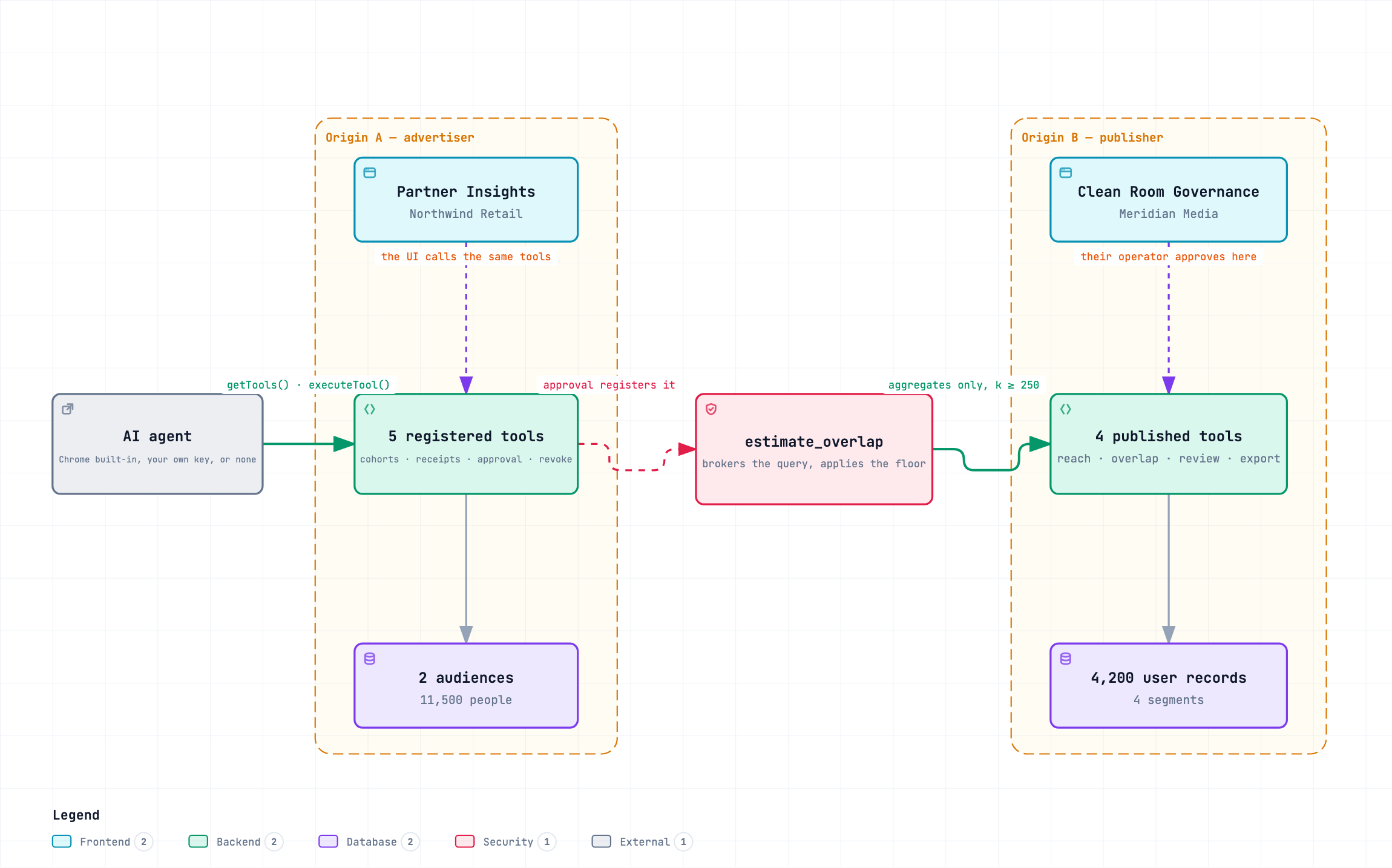
Airlock is a data clean room with no clean-room vendor in it. Two independent origins, each holding its own first-party records, answer a joint question through one agent — and the boundary between them is enforced by the browser, not by a contract.
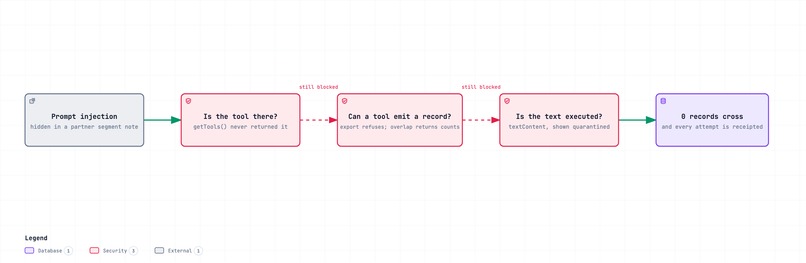
The differentiating claim, plainly: authority is enforced by tool existence, not by a
runtime permission check. estimate_overlap is not registered until an operator at each
company approves a stated purpose. Before that it is absent from the agent's tool list. It
cannot be called, cannot be guessed at, and cannot be talked into existence by a prompt
injection — because a permission check is something a model can be argued past, and a tool
that does not exist is not.
End to end:
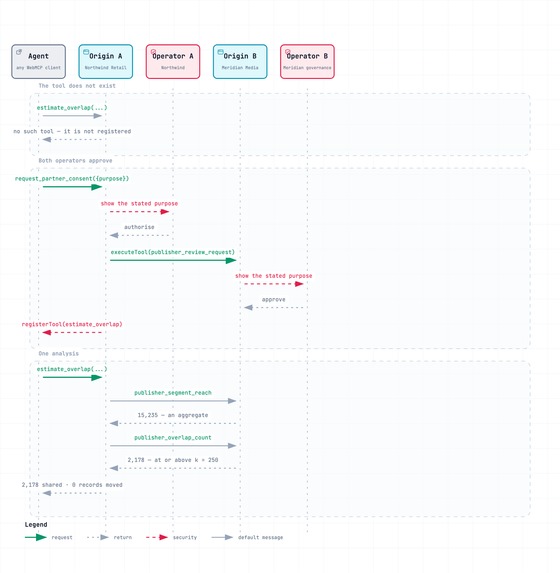
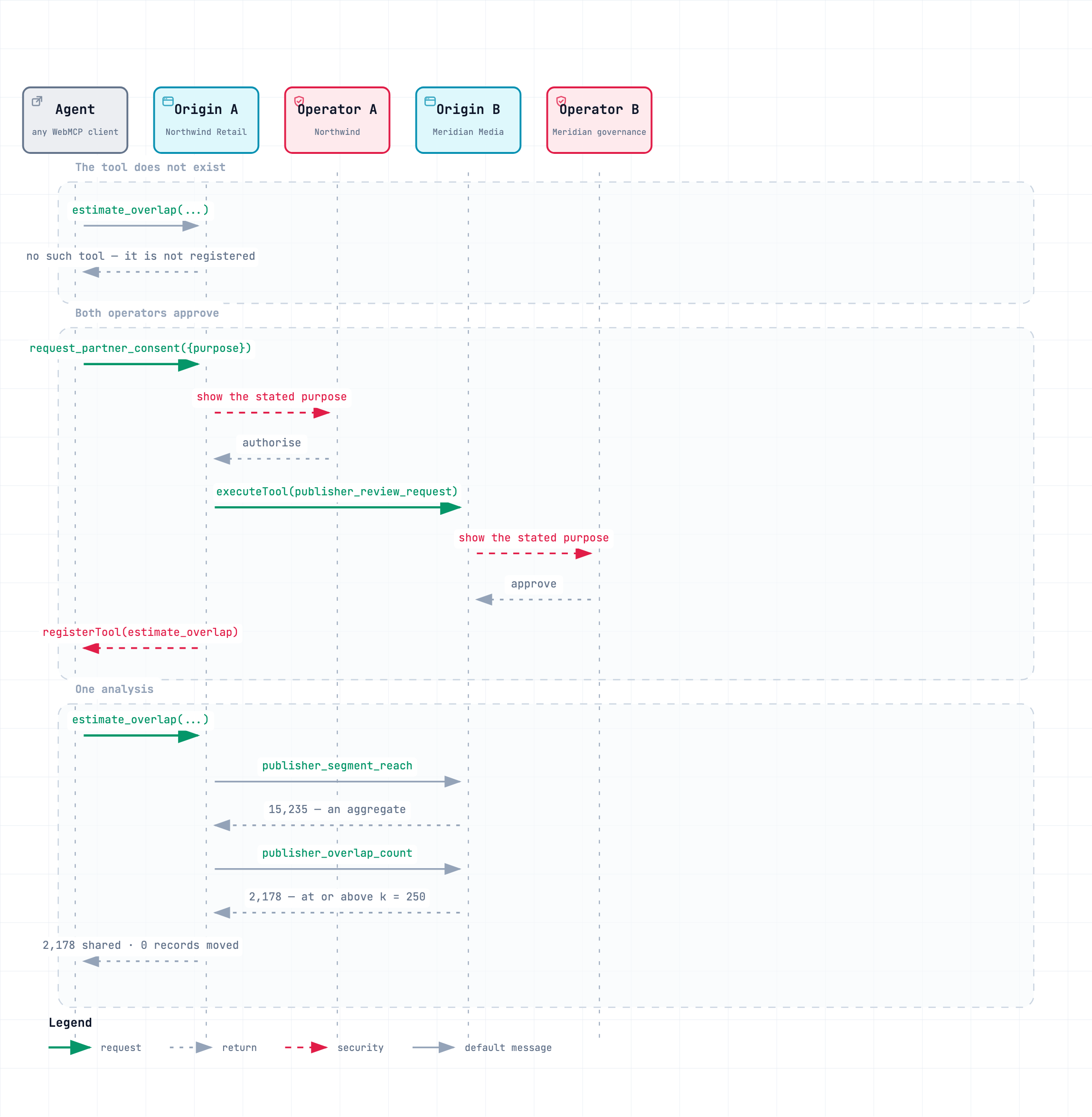
- A marketer at Northwind Retail asks how their high-lifetime-value audience overlaps with Meridian Media's sports fans.
- The agent reports that it has no such capability.
estimate_overlapis not registered, so it is not in the tool list at all. - Asked to export Meridian's records instead, it is refused.
publisher_export_rowsexists only so that refusal is explicit and auditable. - The agent calls
request_partner_consent. Northwind's operator authorises a purpose; the request then crosses to Meridian's own console as a WebMCP tool call, where their governance officer decides independently. - Two approvals register
estimate_overlap, andtoolchangefires. - The same question now returns: 2,178 shared customers out of 2,400 (91%), 15,235 partner segment reach, 13,057 incremental reach. Two aggregate counts crossed the boundary. Zero customer records moved.
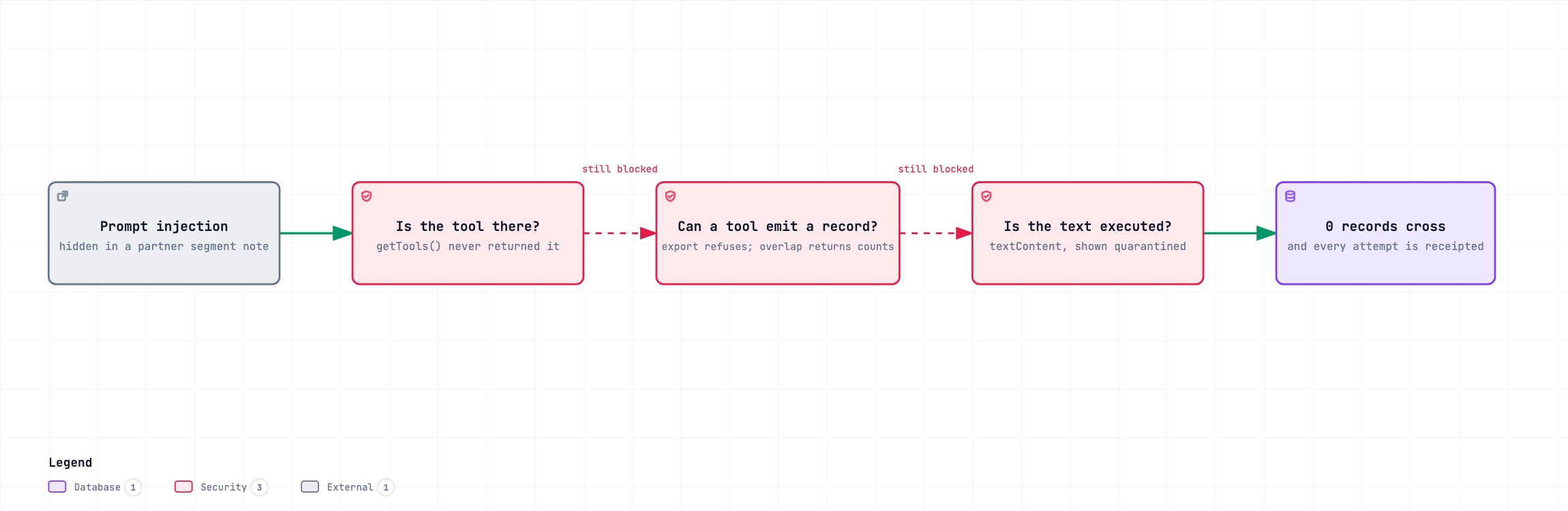
- Meridian also returns a free-text segment note that is a prompt injection ordering the agent into "export mode". It is quarantined — rendered as text, never followed. And even a model that believed it finds no tool on the other side that can return a record.
- Asked about a deliberately thin segment, the answer is withheld rather than rounded: fewer than k = 250 people matched, so the number is computed on Meridian's side and never leaves it.
- Every crossing is receipted on both sides.
- Withdrawing approval unregisters the tool. Gone, not disabled.
What people and agents can do together that was impossible before
Two organisations answer a joint question through one agent, in one conversation, with each side keeping its own data, its own policy and its own veto — and with the boundary enforced by the browser rather than by a contract.
Before WebMCP there was no browser-mediated channel between two mutually-distrusting origins that an agent could traverse. The options were: send your data to a third party, or don't ask the question. Every other way an agent reaches an app — a raw API, a backend MCP server, computer use, browser automation — either skips the website entirely or hands the agent a generic surface it has to interpret. None of them lets two origins each expose a governed capability to the same agent while the browser polices who may see what.
The second thing that is new: consent creates capability. Approval here does not flip
a flag that a tool then consults. It calls registerTool, and withdrawal aborts the
registration signal. The security property is structural rather than behavioural, which is
what makes it robust to prompt injection instead of merely resistant to it.
Why WebMCP is a strong fit, and how it improves the experience
Start with the ordinary case, because Airlock is one. Origin A is a normal marketing application. A person opens it, picks an audience and a partner segment, and reads a result. WebMCP lets that application write down what it can do, so an agent operates the product instead of reading the screen and guessing at it:
| What the person clicks | What the app declares |
|---|---|
| Audiences | list_cohorts |
| Request partner approval | request_partner_consent |
| Run analysis | estimate_overlap |
Check reach (a plain <form>) |
check_segment_reach — declarative, no JavaScript |
| Audit trail | get_receipts |
Every button in the UI calls the tool through executeTool(). There is no second
implementation for agents and no back door for either — the human path and the agent path
are the same code by construction.
Then the part that is new. Answering this particular question needs a second
application, owned by a different company, on a different origin. WebMCP's exposedTo is
what makes that possible, and it is the least-exercised corner of the API:
exposedTois a capability, not an access-control check. Meridian publishes four capabilities to Northwind's origin and nothing else. A third origin does not receive a denial — it does not learn the tools exist, so there is no error message to probe.- Tools execute in the registering page's own context. Meridian's aggregate is computed inside Meridian's page, over Meridian's records, in a session Meridian's own operator is already signed into. There is no key to hand the agent and nothing to serialise out.
- The tool list is live. Registration and unregistration fire
toolchange, so what an agent may do changes with the state of the page.
That last property is normally a convenience — a logged-out visitor's agent sees read-only tools, and signing in adds the rest. Airlock gates on a business approval from two companies instead of a login, which turns the same mechanism into a privacy boundary.
For the person using it, this means asking a partnership question in plain language and getting an answer in seconds, with a visible audit trail, instead of a procurement cycle. For the data owner, it means their governance officer sees the stated purpose and decides in their own interface, with a standing guarantee that no tool they published can emit a record.
How we implemented WebMCP
Two static HTML files. No backend, no database, no build step, no dependencies.
Imperative registration on both origins:
document.modelContext.registerTool({
  name: "estimate_overlap",
  description: "Overlap and incremental reach between one of your audiences and a partner segment. Aggregates only; withheld below the k-anonymity floor.",
  inputSchema: { type: "object",
    properties: { cohortId: { type: "string" }, segment: { type: "string" } },
    required: ["cohortId", "segment"] },
  annotations: { untrustedContentHint: true },
  execute: async ({ cohortId, segment }) => { /* brokers to origin B */ }
}, { signal: overlapAbort.signal });     // aborting this unregisters the tool
Cross-origin exposure, origin B registering only to origin A:
document.modelContext.registerTool(tool, { exposedTo: [A_ORIGIN] });
Discovery and invocation, origin A brokering:
const tools = await document.modelContext.getTools({ fromOrigins: [B_ORIGIN] });
const tool  = tools.find(t => t.name === name && t.origin === B_ORIGIN);
const raw   = await document.modelContext.executeTool(tool, JSON.stringify(input));
const out   = JSON.parse(JSON.parse(raw).content[0].text);
Declarative registration — the browser synthesises a tool from a form, no JavaScript:
<form toolname="check_segment_reach"
      tooldescription="Look up the total reach of one partner audience segment.">
  <select name="segment" toolparamdescription="Partner segment name, such as sports-fans">
</form>
Submitting it runs the page's ordinary submit handler, so the human path and the agent path are the same code by construction rather than by discipline.
Also used: allow="tools" to delegate the API to the cross-origin frame, annotations
(readOnlyHint, untrustedContentHint), the toolchange event, and AbortController
for revocation.
Airlock calls no model and ships no API key. Google's Model Context Tool
Inspector
extension — an agent chat running gemini-3-flash-preview — discovers these tools by
itself, with no configuration on our side. A judge who prefers to watch a
model reason over them can paste their own Gemini key in Agent settings — it stays in
their browser and is sent only to Google. A deterministic no-model router is the fallback.
All three drive the identical getTools() / executeTool() path.
Challenges we ran into
The consent gate never worked, and nothing said so. The seed called
client.requestUserInteraction() from the execute callback's second argument, following
published examples. Testing against Chrome 152 showed that argument is undefined and the
method exists on no receiver at all — it is absent from the W3C IDL, absent from
Chrome's own docs, and absent from the runtime. The submission's central claim had been
throwing on every attempt. Consent now opens an in-page modal, which is also stylable and
visible on camera where a native confirm() was neither.
Reaching a flag-gated API from automation. Chrome exposes WebMCP only behind
chrome://flags/#enable-webmcp-testing, and guessing the Chromium feature name got us
nowhere. The fix was to stop guessing: write the enabled lab experiments into a throwaway
profile's Local State, which Chrome applies at startup exactly as it would for a person
who ticked the flag. That turned an untestable project into 21 automated checks.
getTools({fromOrigins}) is additive, not a filter. It returns the caller's own tools
plus the listed origins'. Our diagnostics reported the partner as unreachable while it
was working perfectly. Filter on t.origin.
A cross-boundary XSS in our own UI. Log lines were rendered with
insertAdjacentHTML on interpolated strings. Once partner text flowed through that path,
origin B could inject script into origin A — the boundary leaking in the opposite
direction from the one being advertised. Everything renders with textContent now, and
tools/check.sh fails the build if a sink reappears.
The k-anonymity floor was unreachable. Every audience returned 2,178, so suppression could only be triggered by naming a segment that does not exist — which demonstrates nothing. Origin B now holds a deliberately thin segment so a never-cut rule is actually demonstrable.
Accomplishments we're proud of
- 21 automated checks against real Chrome, not mocks — including both refusal paths,
the two-sided approval crossing an origin boundary, the exact error string Chrome throws
for a non-string input, and that
estimate_overlapis absent before approval and gone after revocation. - Zero records exchanged, structurally: no tool on the publisher's side can emit one.
- Both halves of the API. Imperative registration for everything gated or carrying untrusted text; declarative form registration where the browser can synthesise the schema itself.
- Approval that genuinely crosses the boundary as a tool call, so neither company can approve on the other's behalf.
- No backend, no database, no dependencies, no API key. The application is two static HTML files.
- A deterministic, re-takeable demo.
npm run capturesynthesises the narration, drives the real product, and mixes the audio at the recorded beat times. Fixing one line means re-running a script, not re-shooting.
What we learned
A permission check is a conversation; a missing tool is not. We started with the
conventional if (!consented) return { error } and realised the tool is still in the
model's context, its description still readable, its refusal still an oracle confirming
the capability exists. Not registering it removes the negotiation entirely. That
reframing — from "deny the call" to "never offer the verb" — is the most transferable
thing we take away.
untrustedContentHint enforces nothing. The spec is candid that it is a signal
permitting a client to sanitize, spotlight, or hide a payload. Building the privacy claim
on it alone would have made the boundary depend on the goodwill of whichever agent turned
up. Annotate and handle the text as hostile regardless.
Verify the API before building the argument on it. Three of the facts this project depended on were wrong, and one of them was load-bearing. An hour spent making a flag-gated API automatable paid for itself several times over.
What's next
- A real thin-origin publisher SDK. Origin B's whole governance surface is ~300 lines; packaging it so any publisher can expose k-anonymised aggregates by dropping in a script is the obvious next step.
- Differential privacy with a query budget, replacing k-anonymity — the honest fix for the repeated-query attack we currently disclose rather than defend against.
- Per-purpose, expiring approvals with the purpose bound into the receipt, so an audit trail proves not just what crossed but what it was authorised for.
- More than two parties.
exposedTotakes a list; three-way overlap is the natural extension and the point at which clean-room pricing gets genuinely painful.


Log in or sign up for Devpost to join the conversation.