Inspiration
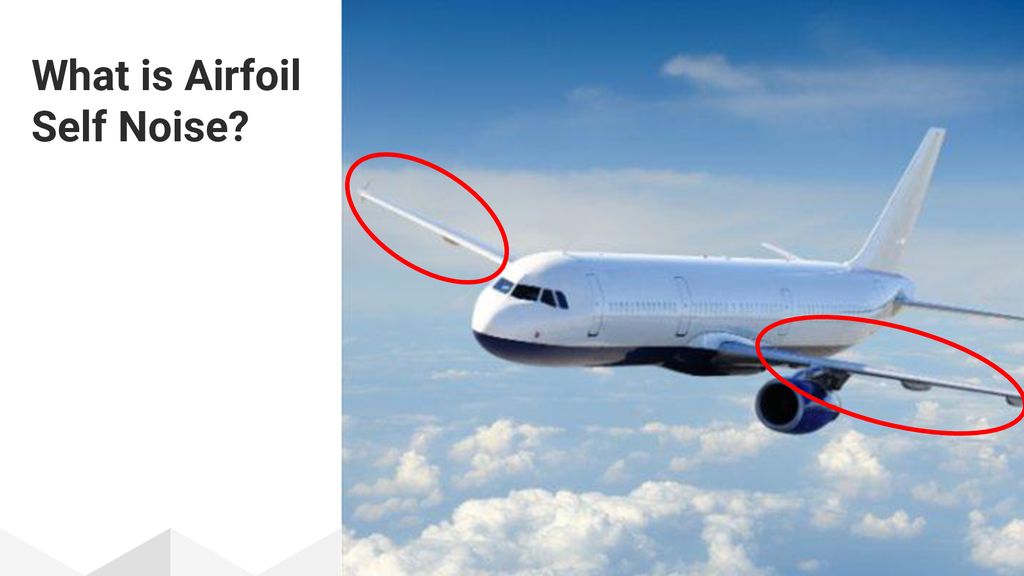
Airfoil noise is a significant concern as it impacts aircraft performance, passenger comfort, and environmental factors. By developing a model to predict airfoil self-noise, engineers and researchers can gain insights into the noise generation mechanisms and explore strategies to reduce noise emissions.
What it does
The project aims to build a model that predicts the self-noise level of an airfoil based on various aerodynamic and geometric parameters. The model takes input variables such as airfoil shape, angle of attack, chord length, free-stream velocity, and other factors that influence airfoil noise. By utilizing these inputs, the model provides an estimate of the noise level generated by the airfoil, allowing for noise prediction and analysis.
How we built it
To build the predictive model for airfoil self-noise, we followed a systematic approach:
Data Collection: We obtained a dataset containing information about airfoil parameters and corresponding noise levels. Data Preprocessing: We cleaned the dataset, handled missing values, and normalized the features to ensure consistent scaling. Feature Selection: We identified the most relevant features that influence airfoil noise and removed any redundant or insignificant variables. Model Selection: We experimented with various machine learning algorithms suitable for regression tasks, such as linear regression, decision trees, random forests, or neural networks. Model Training: We split the dataset into training and testing sets and trained the selected model on the training data. Model Evaluation: We evaluated the model's performance using appropriate metrics such as mean squared error (MSE), root mean squared error (RMSE), or R-squared. Model Optimization: We fine-tuned the model by adjusting hyperparameters or employing techniques like cross-validation or ensemble methods to improve its accuracy and generalization.
Challenges we ran into
Accomplishments that we're proud of
Building a predictive model that accurately estimates the self-noise level of airfoils based on given parameters.

Log in or sign up for Devpost to join the conversation.