-
-
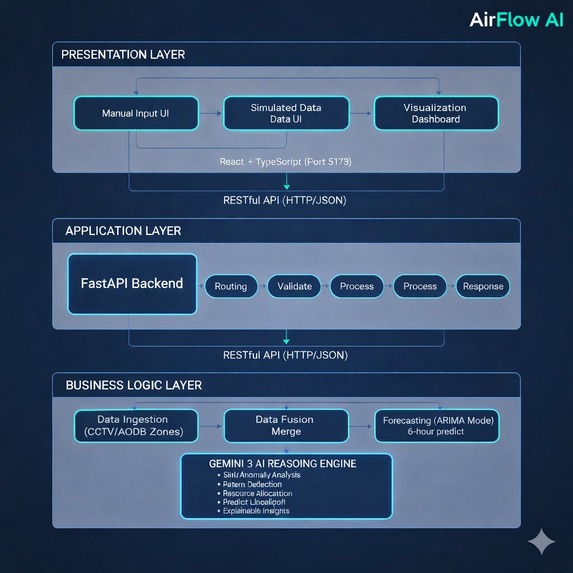
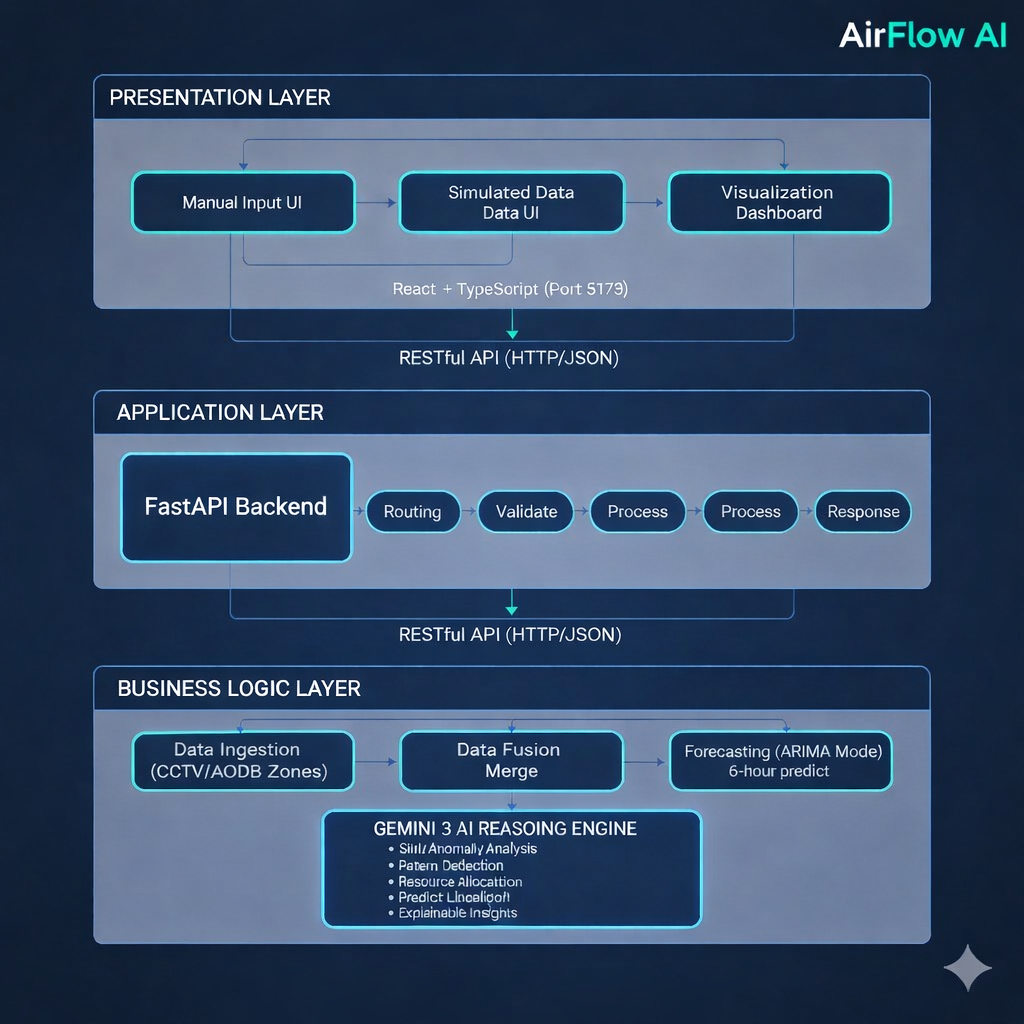
A three-tier architecture designed for real-time processing, predictive accuracy, and mission-critical reliability.
-
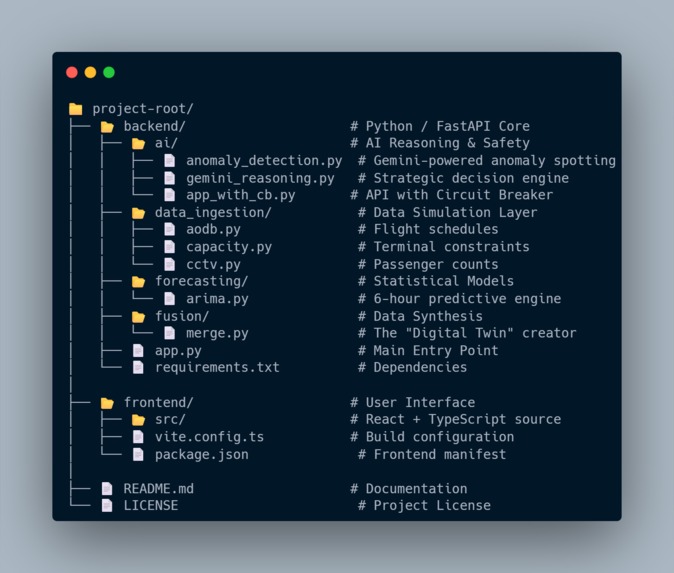
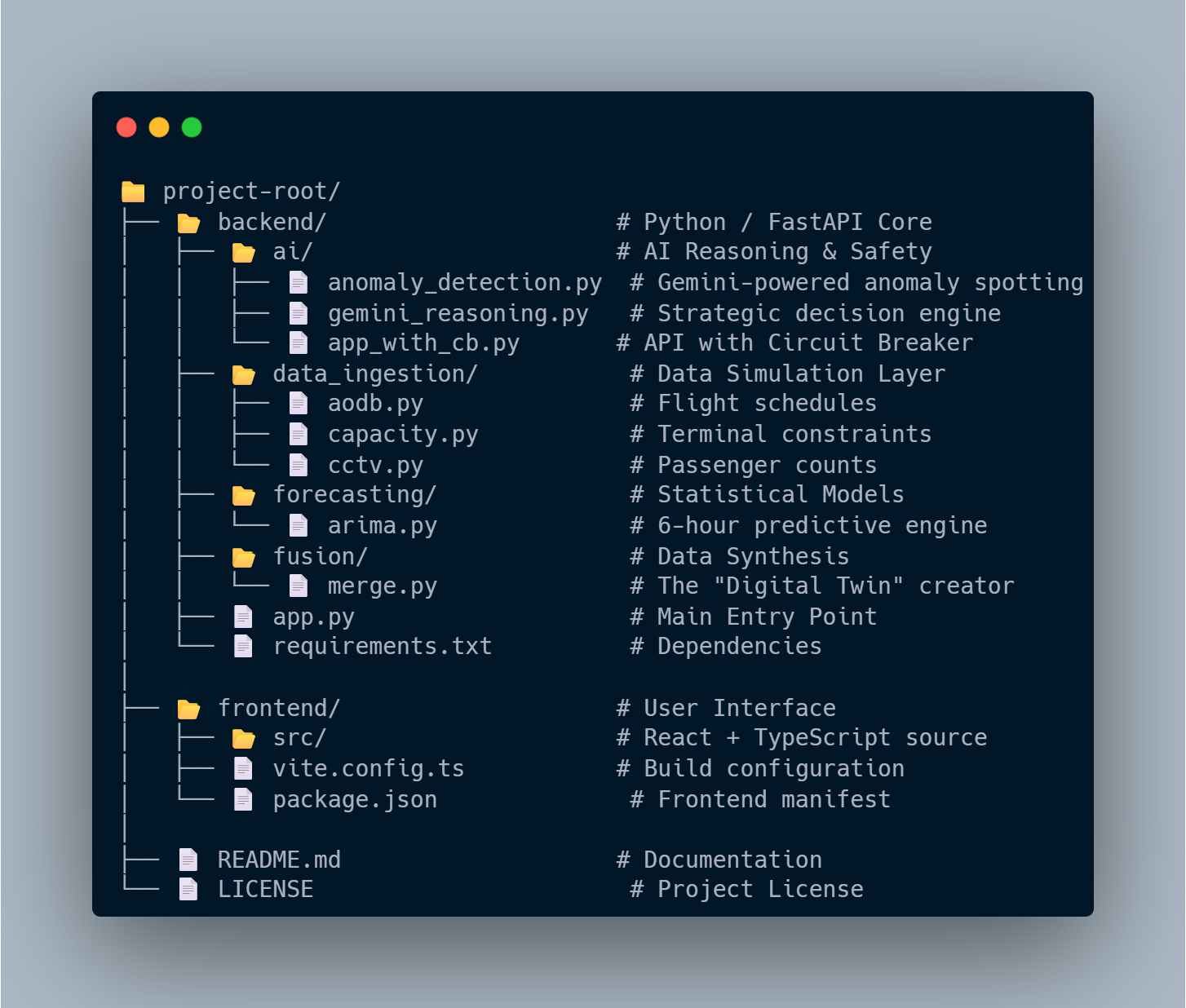
Project Structure
-
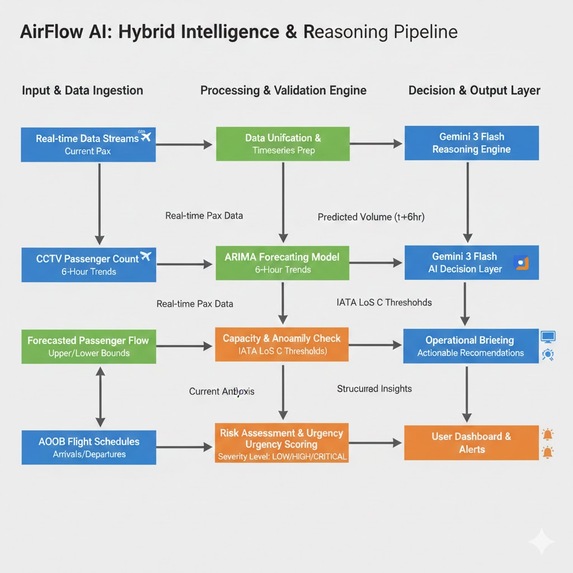
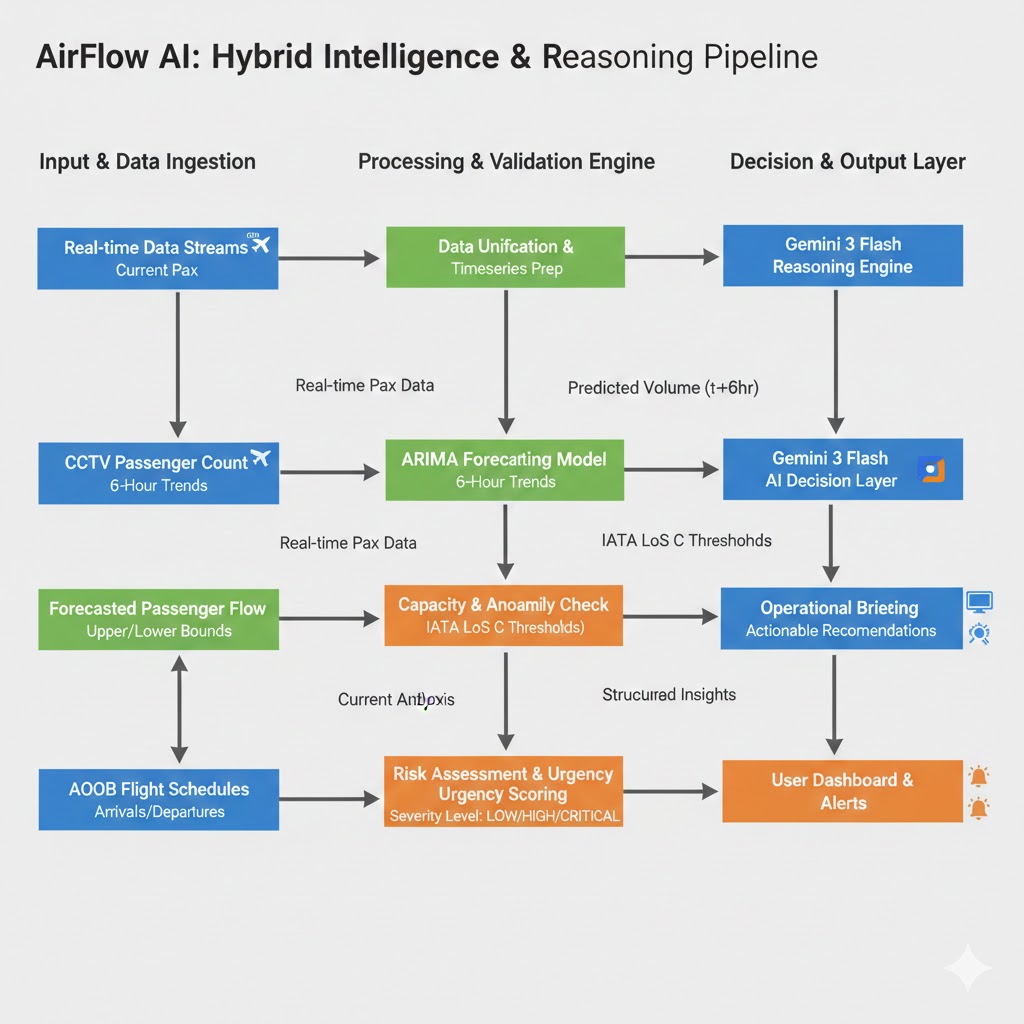
running a multi-stage engineering process.
-
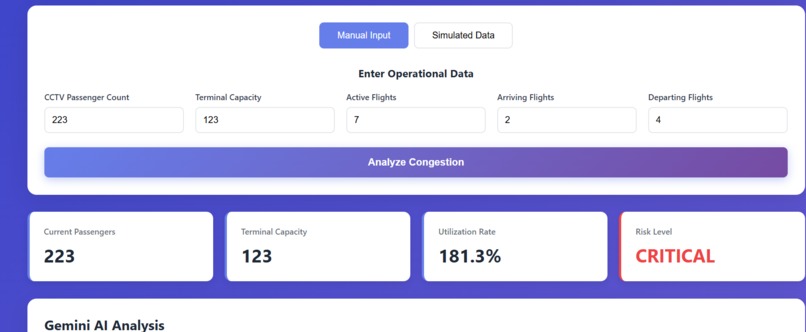
PoC 1
-
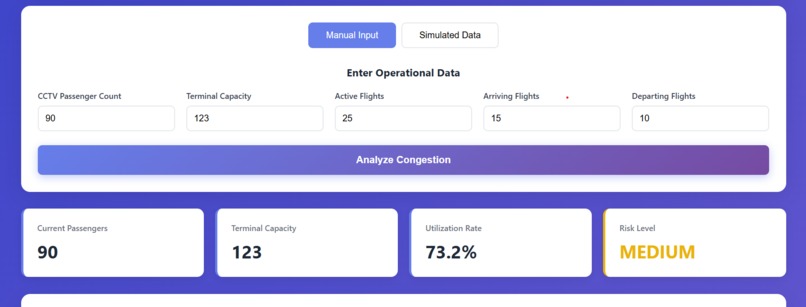
PoC 2
Inspiration
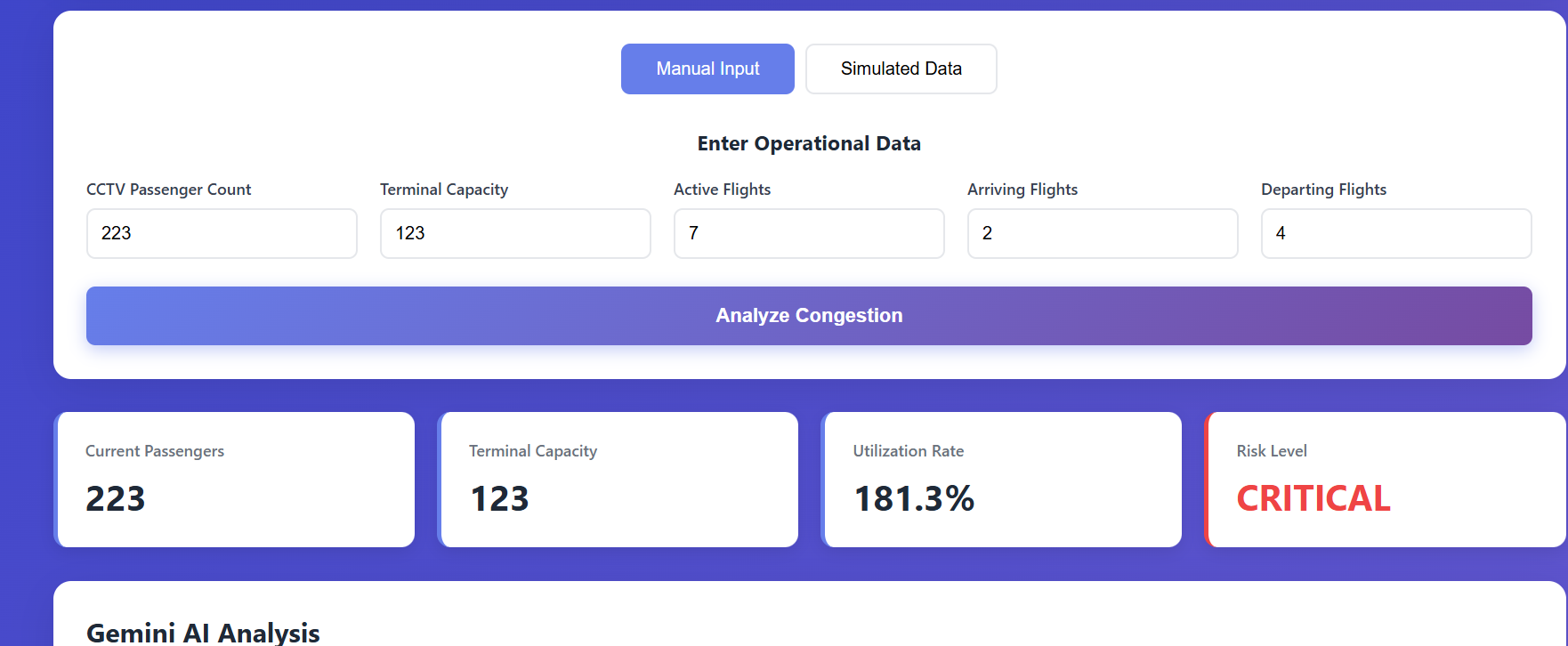
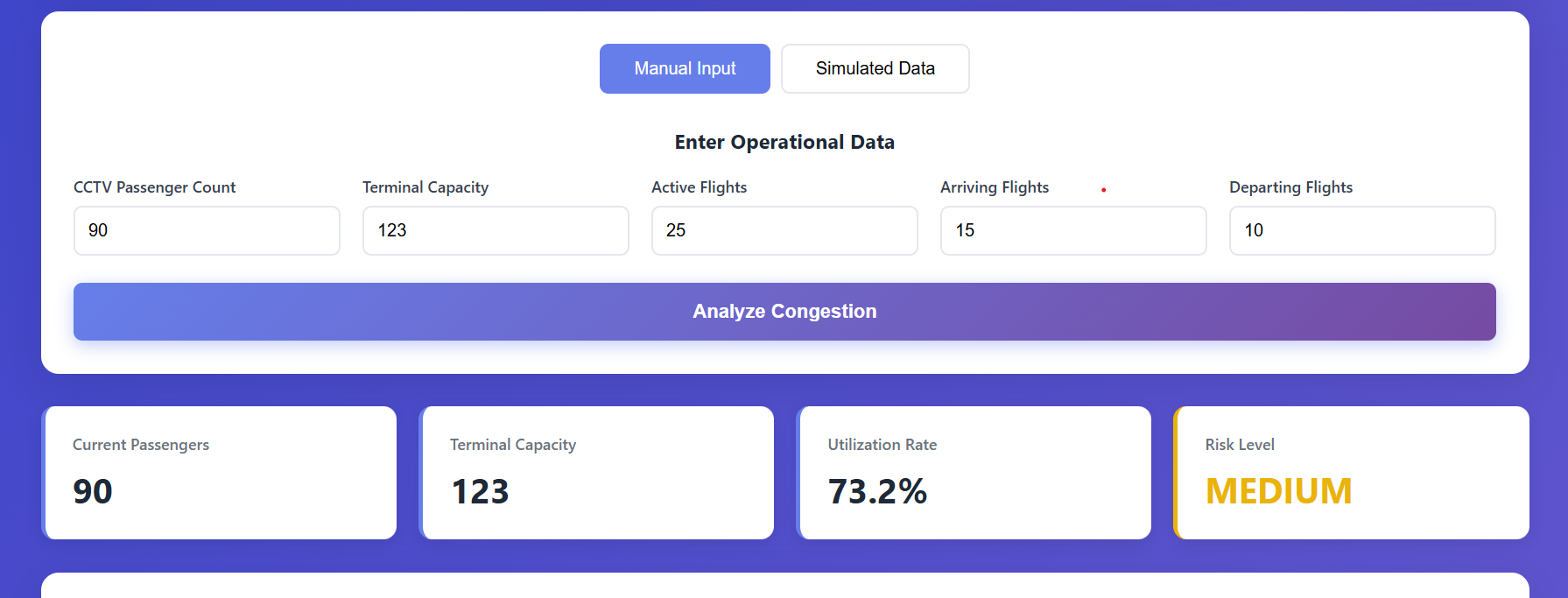
As global air passenger traffic climbs toward an expected 10.2 billion by 2026, airports are hitting a "Reactive Operations Crisis." Most current facilities still use basic threshold-based alerts that only flag a problem once a crowd has already formed. This "too little, too late" approach just can't keep up with modern travel volumes. We were driven to create a system that shifts the paradigm from reactive firefighting to proactive management. Our goal was to build a tool that identifies congestion risks early, giving staff the time they need to act before terminal capacity is ever compromised.
What it does
AirFlow AI is an intelligent monitoring and prediction platform built to help airport managers stay ahead of terminal demand. Instead of just watching what’s happening, it looks ahead. The system synthesizes multiple data streams into a single "digital twin" of the airport:
- Real-time CCTV passenger counts.
- Terminal and zone capacity constraints.
- AODB (Airport Operations Database) flight schedules.
- 6-hour passenger flow forecasts. By blending statistical ARIMA forecasting with the reasoning power of Gemini 3 Flash, AirFlow AI pinpoints upcoming peak periods. It then provides structured, actionable advice such as redeploying security staff or adjusting lane utilization grounded in both data trends and predefined operational rules.
How we built it
Data & Forecasting Engine We developed a pipeline to merge disparate data sources into a unified operational snapshot. To power our predictions, we built an ARIMA-based forecasting layer (arima.py) that generates volume predictions every 15 minutes, specifically designed to capture the unique "waves" of daily airport peaks. The "Triple-Check" Reasoning Layer To ensure the highest level of accuracy, our architecture follows a three-step validation process:
- The Statistical Check (arima.py): What does the mathematical trend say will happen?
- The Anomaly Check (anomaly_detection.py): Is the current situation "weird" compared to historical norms? This module uses Gemini to assign urgency scores and explain unexpected deviations.
- The Strategic Check (gemini_reasoning.py): Based on the math and the anomalies, what is the best operational move for the staff? Resilience & Reliability To ensure the system never goes dark, we implemented a Circuit Breaker pattern using FastAPI (app_with_circuit_breaker.py). If the Gemini API experiences downtime or errors, the system automatically triggers a local rule-based expert system. This ensures airport operators receive intelligent guidance even if the AI service is unavailable.
Challenges we ran into
API Reliability Under Load : During high-load tests, we faced intermittent 503 errors. We solved this with asynchronous retry logic and a circuit breaker to ensure a seamless fallback to local intelligence. Strict Operational Constraints : Airports require policy-compliant advice. We refined our validation layers to ensure every AI recommendation stayed within safe, realistic capacity limits. The Data Privacy Gap : Real aviation data is locked behind heavy security regulations. To solve this, we engineered a Synthetic Operational Baseline grounded in LAX October 2025 traffic statistics and IATA LoS C standards. This allowed us to stress-test the Gemini 3 model under edge cases like cascading flight delays while demonstrating high-fidelity reasoning against realistic industry constraints.
Accomplishments that we're proud of
Hybrid Intelligence Architecture: Successfully merging hard statistical math with soft contextual reasoning and rigid operational rules. High Availability Design: Building a system that degrades gracefully rather than crashing when an external API fails. Reasoning-Based Anomalies: Our anomaly detection doesn't just say "volume is high"; it explains why it thinks something is wrong, helping human operators make better decisions.
What we learned
We learned that for critical infrastructure, reliability is just as important as intelligence. While the LLM provides incredible reasoning, the ARIMA models provided the stable mathematical floor we needed. Most importantly, we learned that AI must be designed to "fail well" by building in fallbacks from day one, we ensured the system remains a tool operators can trust 24/7.
What's next for AirFlow AI
Advanced Forecasting: Incorporating even deeper anomaly detection to identify non-standard patterns like unscheduled charter surges or sudden equipment failures. Digital Twin Expansion: Moving the simulation into a full-scale airport digital twin for disruption and emergency scenario testing. Multi-Agent Support: Introducing specialized AI agents for different departments—Security, Ground Ops, and Terminal Services—all operating in sync.
Built With
- arima
- fastapi
- github
- google-ai
- javascript
- node.js
- pydanticv2
- python
- react
- typescript


Log in or sign up for Devpost to join the conversation.