-
-
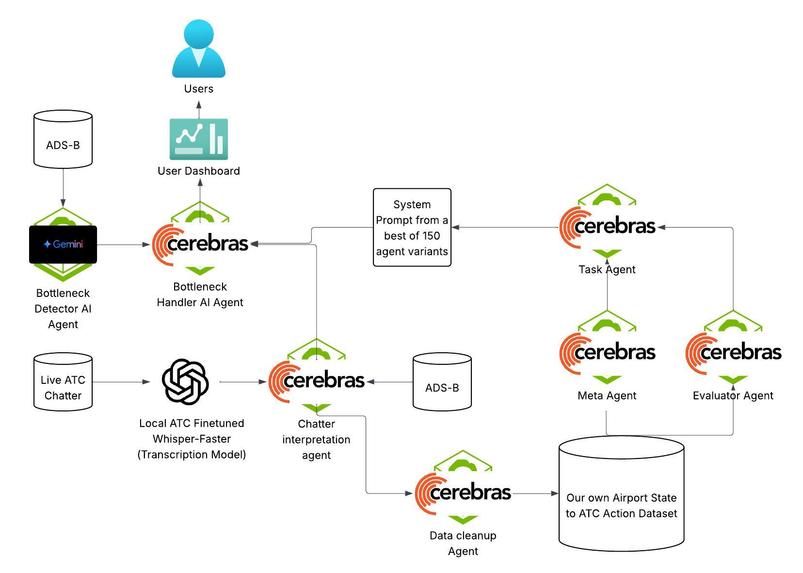
sys architecture
-
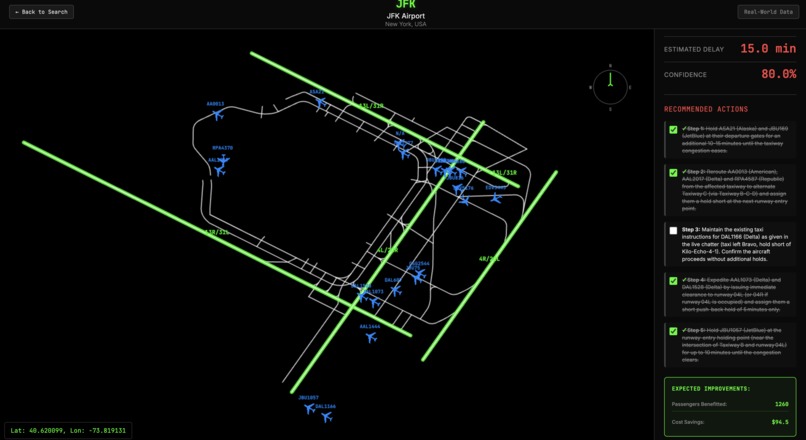
a sample view based on real live data just before the submission deadline
Inspiration
Having traveled extensively for the past year to various hackathons, a few of us were disappointed in how often flights would experience delays on the tarmac, often waiting hours while taxying or finding a gate. Upon doing more research into how airports manage traffic, we learned that ERAM (En Route Automation Modernization) is the current system that allows air traffic controllers to manage airspace for incoming flights. However, there was no support for ground traffic controllers, who often had to rely on manual signals and poor communication methods to direct traffic. Additionally, there has also been a huge understaffing crisis in recent years, making the application of new technologies here more important than ever. We looked into this field and its issues extensively, ultimately inspiring us to improve ground traffic control with AirFlow.
What it does
AirFlow is an AI system that helps traffic controllers manage ground situations easier. AirFlow works from your airport: simply put in your airport code and get an instant map highlighting all current ground traffic and incoming flights. AirFlow will then calculate potential bottlenecks, while also finding information about the total time, number of passengers affected and fuel wasted. Then, our proprietary AI agent assesses the bottleneck and develops an action plan. This action plan allows a traffic controller to easily mitigate congestion, accomplishing this more than 15 minutes before they typically would.
How we built it
We built a frontend app with HTML/JS/CSS while using Open Street Map to grab the taxiway and runway layout for all airports. From here, we also use the ADS-B API to get information on all flights within 5 miles from the airport, specifically longitude, latitude and velocity for incoming and taxied flights. With these numbers, we then built and trained a Multilayer Perceptron model in Python to analyze intersections of flight taxi paths, which were estimated with sklearn, identifying various bottlenecks and their severities while alerting the controller on the main page. Lastly, we built a self-supervised agent to assess these bottlenecks, such that a controller can easily see what steps and reroutes to communicate to pilots.
Challenges we ran into
We really struggled finding the flight data and being able to predict flight paths on the ground. A lot of the data was protected due to FAA regulations, meaning we did not have any validation data. So, we made our own. Our team came up with a transcription engine that would decode pilots' broadcasts to air traffic control, getting insight on flight destinations, and even a general understanding model of the airport itself with basic contextual history and no other aid.
Accomplishments that we're proud of
We were super proud of our transcription engine using Cerebras API, which gave us super fast insights. Our engine was so fast, that we learned about a certain flight's path faster than their own passengers would. Additionally, we were really happy with how we scaled the project to apply to any international airport, giving us a tool that could genuinely improve the travel experience of billions of people a year. Lastly we found great joy in being able to work with such cutting edge technology that of the 10 or so research papers we seriously considered we ended up exploring things that were discovered as early as two months ago.
What we learned
Truthfully, we learned the most about the aviation industry. We spent about 8 hours doing market research trying to identify what the current issues in air travel were. It was extremely insightful to learn about already existing technologies such as ADS-B flight tracker, ERAM, FlightKeys, and Jeppessen for flight information. It was great to think through and develop our MVP, while also exploring new technologies like AI predictive engines and inference to improve our system.
What's next for AirFlow
We would love to get even faster data and inference to train our models and deliver faster results. Our hope is that by legitimizing this venture, we can partner with federal aviation databases to get more accurate results and actually deploy AirFlow to ground controllers around the world!
We have already shown good proof that there is room to use the transcription of ATC chatter, to pair up with airport states to create a truly novel data set describing the actions taken by air traffic controllers per airport state.


Log in or sign up for Devpost to join the conversation.