-
-
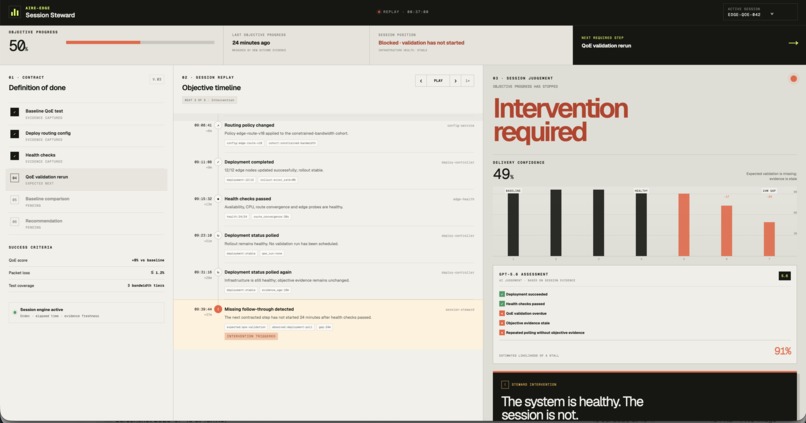
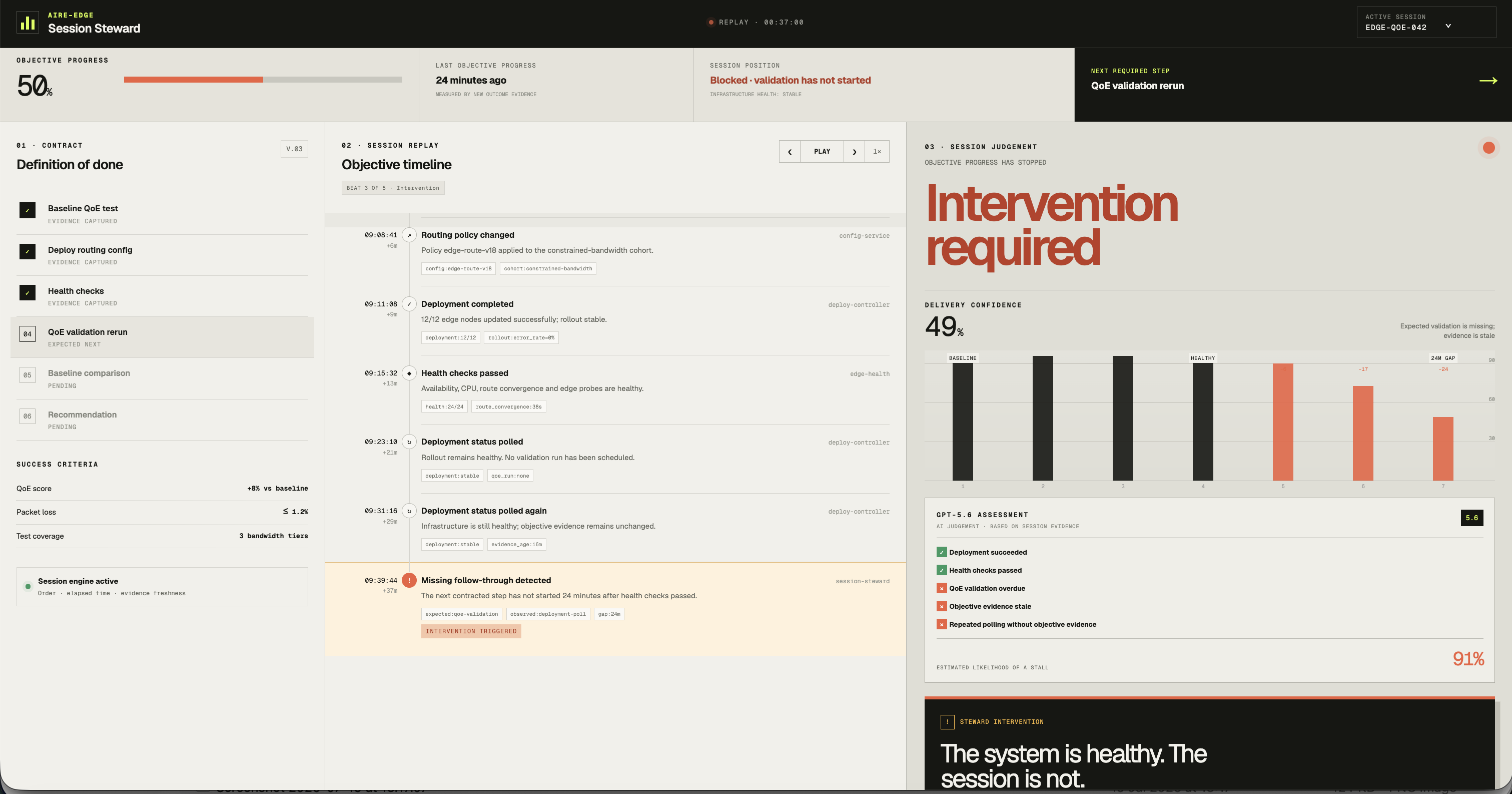
Intervention required: the system is healthy, but the session stalls after missing contracted QoE validation
-
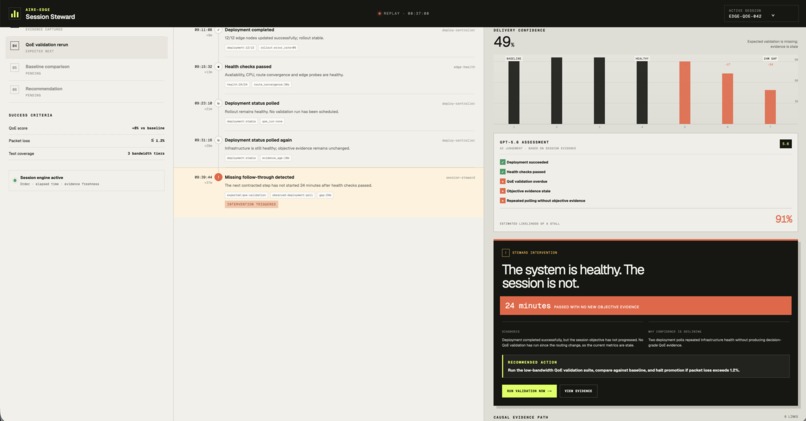
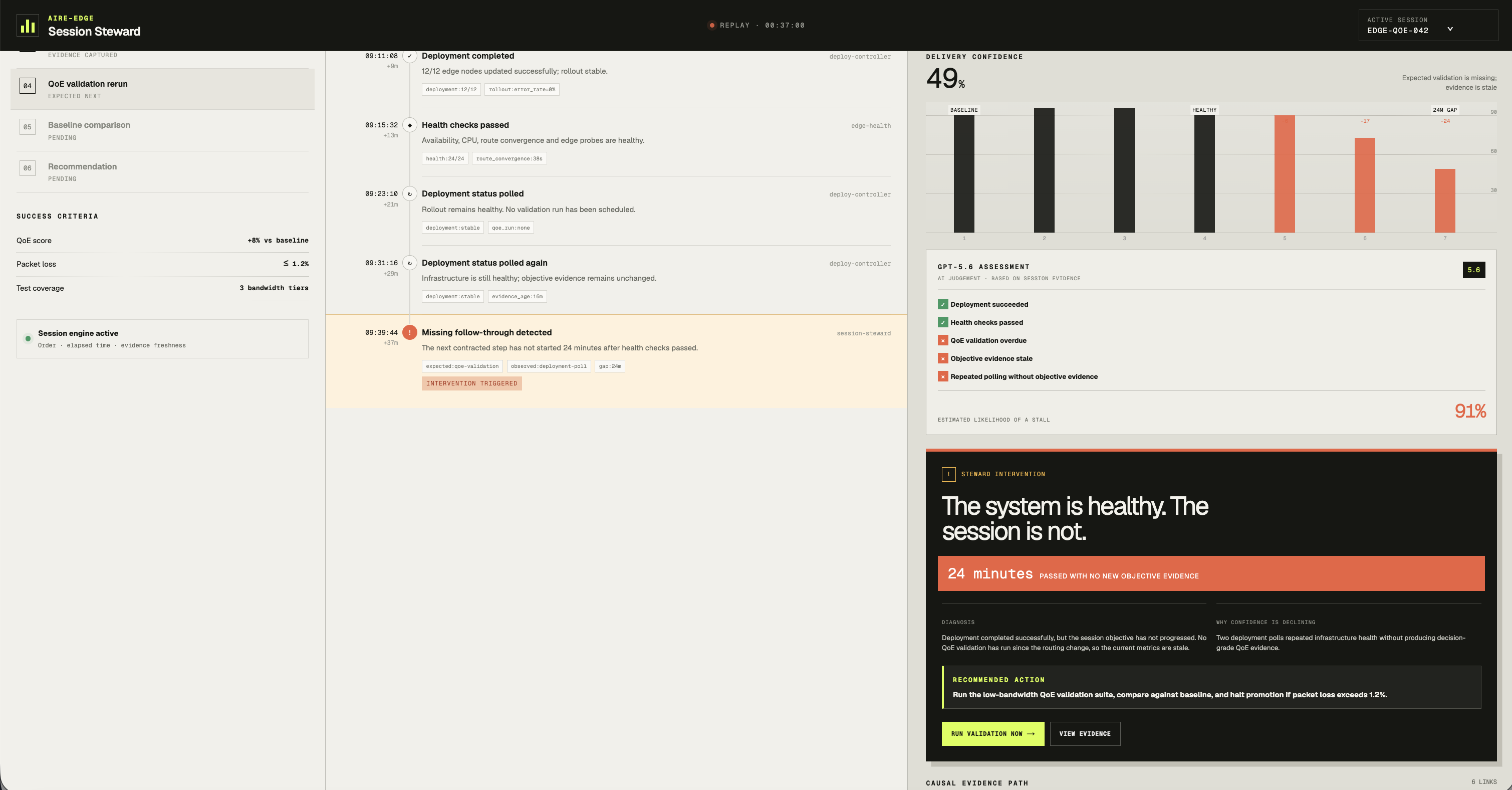
Steward intervention: recommends a single guarded action — rerun low-bandwidth QoE validation to restore objective progress
-
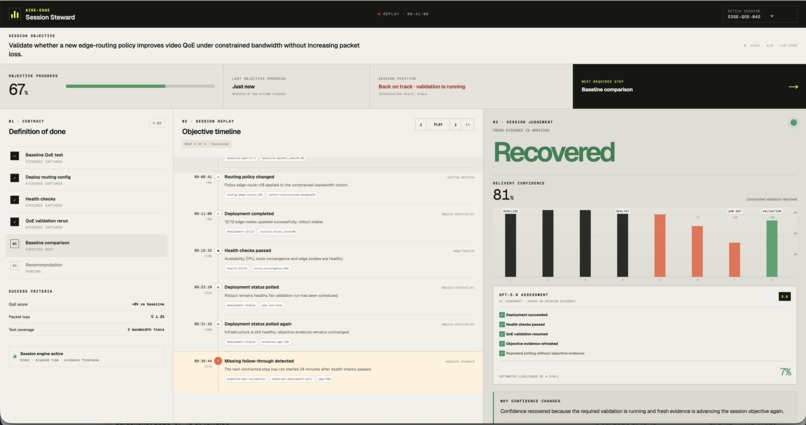
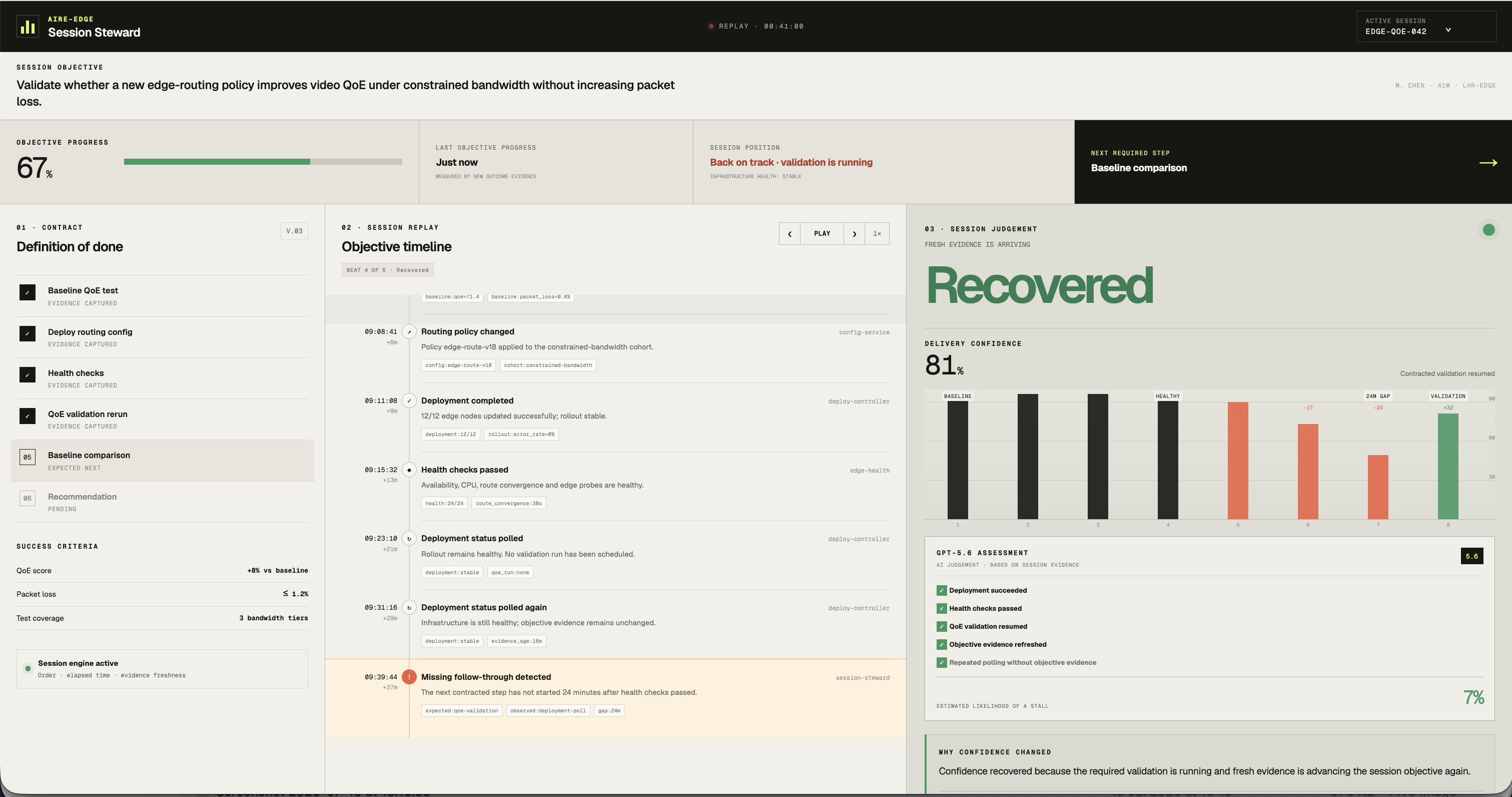
Recovered: validation resumes, fresh evidence arrives, and confidence returns as the session objective advances again
-
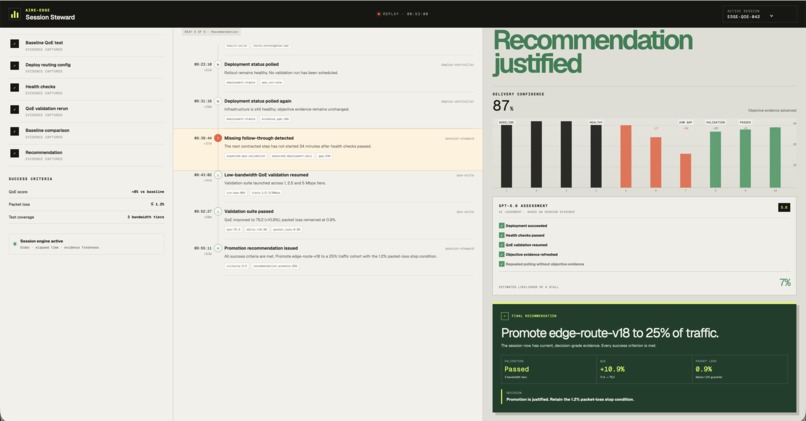
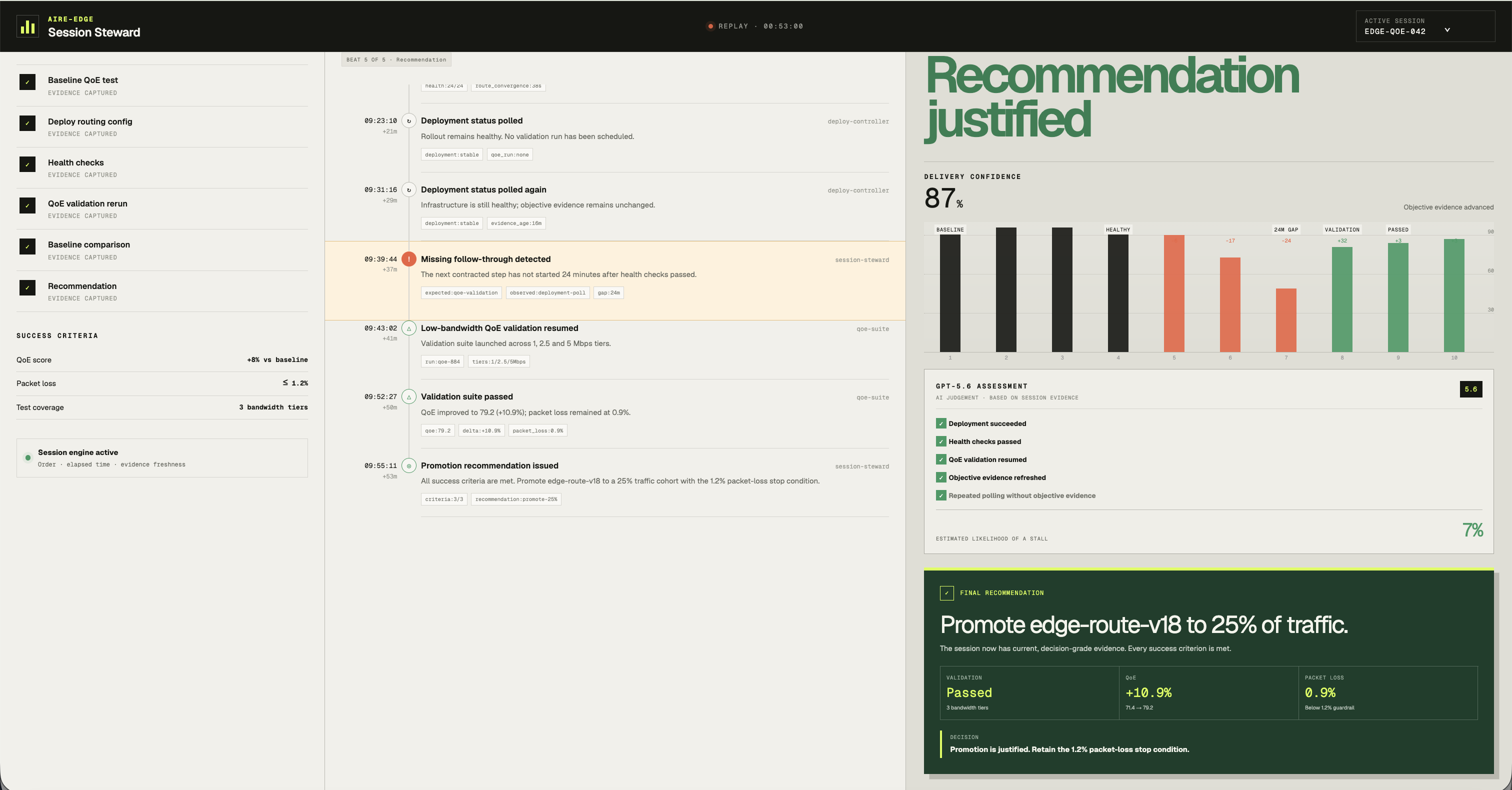
Recommendation justified: the steward promotes the routing change to a 25% cohort only after decision-grade evidence meets success criteria
Inspiration
Modern observability tools are excellent at telling teams what is happening inside infrastructure, but they are much weaker at answering a more important question:
Is the work still moving toward its objective?
That gap becomes painful in long-running technical workflows such as AI experiments, deployment rollouts, validation pipelines, and edge-routing changes. A system can remain healthy while the actual session quietly stalls. Deployment can succeed, health checks can pass, and dashboards can stay green, yet the evidence required to justify the next decision never arrives.
AIRE-Edge Session Steward was built to detect that moment.
The product introduces objective-aware session intelligence: a way to monitor not only whether systems are healthy, but whether a session is still progressing toward a declared outcome. Instead of treating all activity as equal, it evaluates whether recent events materially advance the contract of work.
The core product idea is captured in one sentence:
The system is healthy. The session is not.
What it does
AIRE-Edge Session Steward is a replayable product MVP that monitors long-running technical sessions and evaluates whether they are still advancing toward their objective.
The seeded demo follows an edge-routing experiment with a clear goal:
Validate whether a new edge-routing policy improves video QoE under constrained bandwidth without increasing packet loss.
The session contract requires six steps:
- Run a baseline QoE test.
- Deploy the new routing configuration.
- Complete infrastructure health checks.
- Rerun the QoE validation suite.
- Compare the result against the baseline.
- Produce a promotion recommendation.
The replay initially progresses normally. The baseline test completes, the routing policy changes, deployment succeeds across 12 edge nodes, and health checks pass.
Then the failure mode appears.
The infrastructure remains healthy, but the expected QoE validation does not begin. Instead, the system keeps polling deployment status without producing new objective evidence. Activity continues, but the objective stops advancing.
Session Steward detects that gap by combining:
- a session contract with ordered steps and measurable success criteria;
- deterministic evaluation of event order, elapsed time, and evidence freshness;
- confidence drift based on whether recent activity actually advances the work;
- an intelligence layer that explains the current state and recommends the next action.
When the steward detects missing follow-through, it raises an intervention, explains why confidence has declined, shows the causal evidence path, and recommends a single guarded next action.
Once validation resumes, the session recovers, fresh evidence is produced, and the stakeholder brief can justify a controlled promotion.
How it was built
The product is intentionally split into two layers.
The deterministic session engine owns safety-relevant facts:
- event ordering;
- expected-step progression;
- elapsed-time windows;
- stale evidence detection;
- missing follow-through detection;
- session-state transitions;
- success-criteria evaluation.
On top of that, an intelligence service boundary interprets the current state for different audiences. It explains why confidence changed, drafts the intervention, produces engineer and stakeholder narratives, and turns evidence into judgement.
This separation was important by design. GPT-5.6 is used where reasoning and explanation help most, but it does not control event order, threshold breaches, evidence age, or state transitions. Those remain deterministic, testable, and auditable.
The MVP was implemented in TypeScript with a replayable product UI, seeded technical events, a typed session model, and a local intelligence-service boundary so the full demo works offline without depending on a live model provider.
Challenges
The hardest challenge was not building another observability dashboard.
The real challenge was designing a product that clearly communicates a new category of value: objective-aware session intelligence.
That required solving several problems at once:
- defining a session contract that is concrete enough to evaluate;
- distinguishing meaningful progress from infrastructure activity;
- showing confidence decline in a way that feels operational rather than arbitrary;
- making GPT reasoning visible without letting the model own deterministic facts;
- presenting the same session state differently for engineers and stakeholders;
- keeping the interaction simple enough to demo in a few minutes.
Another challenge was product design. The interface needed to feel like a workflow rather than a monitoring console. The final structure — contract, timeline, and judgement — was shaped to make the product readable as a decision system, not a dashboard.
What makes it different
Most monitoring products are logs-first or metrics-first.
Session Steward is objective-first.
It starts from the declared goal, the expected sequence of work, and the evidence needed to justify progress. That lets it detect a subtle but important failure mode: technically healthy systems producing no decision-grade advancement.
Instead of saying only:
the deployment is healthy
it can say:
the deployment is healthy, but the session objective is at risk because the contracted validation never happened.
That distinction is the entire product thesis.
What was learned
This project reinforced an important idea:
There is a major difference between system health and objective progress.
For AI systems, edge workflows, and technical operations, teams increasingly need products that reason about whether work is actually advancing, not just whether services are up.
The project also showed that GPT-style reasoning is most useful when it is grounded in deterministic evidence rather than replacing it. The strongest product pattern was not “AI decides everything,” but “deterministic engine establishes facts, and the model interprets them clearly.”
Use of Codex and GPT-5.6
Codex was used as an implementation partner throughout the build. It helped translate the product thesis into a typed domain model, shape the replay scenario, implement and refine the session engine, improve the interface structure, and sharpen the final submission copy.
GPT-5.6 fits at the intelligence boundary. In a connected version, it receives the immutable session contract, deterministic session state, confidence history, and evidence IDs. It then judges whether activity is meaningful, explains confidence changes, drafts interventions, and produces narratives for engineers, stakeholders, and retrospectives.
The result is a product that combines deterministic reliability with model-assisted interpretation.
Why this matters
AIRE-Edge Session Steward is not an AI summary layer for DevOps logs.
It is a system for detecting when technically healthy activity has stopped producing meaningful progress toward a declared outcome.
That is the idea behind the demo, the architecture, and the intervention moment that defines the product:
The system is healthy. The session is not.
Built With
- cloudflare-workers
- codex
- css
- github
- gpt-5.6
- next.js
- node.js
- react
- typescript

Log in or sign up for Devpost to join the conversation.