-
-
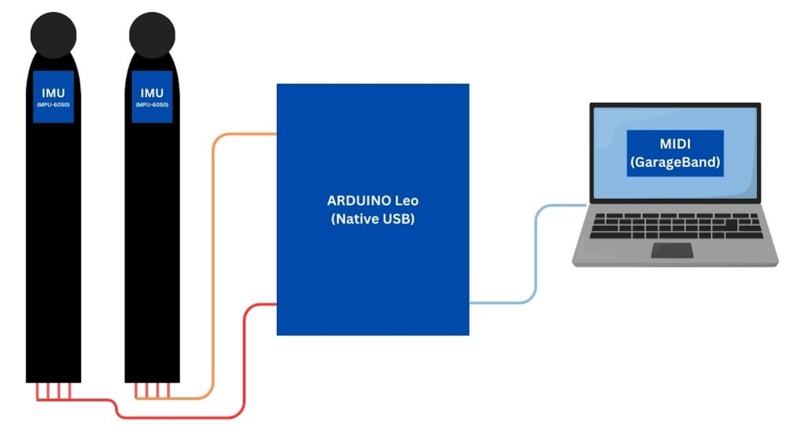
concept diagram
-
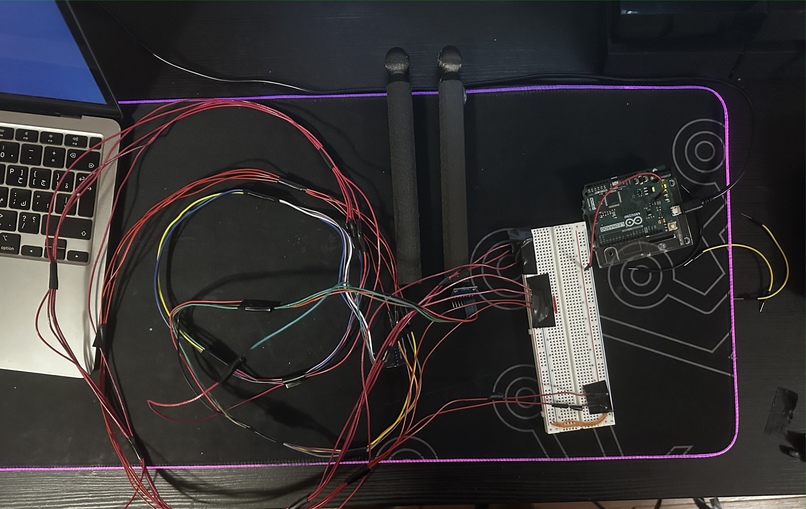
components assembly
Inspiration
Ever wished you could take your drum set everywhere without lugging around heavy hardware? That’s what sparked the idea for AirBeats. As someone who recently started learning how to drum, I wanted something lighter, more portable, and more futuristic than a traditional kit—or even an electronic one.
What It Does
AirBeats consists of 3D-printed drumsticks equipped with MPU-6050 sensors that detect motion in real time. When you swing these sticks, the built-in code interprets each movement and translates it into MIDI signals, effectively replicating the sounds of a standard drum kit. This means you can drum anywhere—no physical kit required—while still producing lifelike percussion sounds through your favorite music software.
How It Was Built
- 3D-Printed Drumsticks: I designed and printed lightweight sticks that house an MPU-6050 sensor each, enabling motion tracking.
- Arduino-Powered: Leveraging Arduino’s capabilities, I programmed the sensors to detect acceleration and rotation, then translated those readings into MIDI signals.
- MIDI Connectivity: Through custom Arduino code, each drumstick sends note-on and note-off MIDI messages to simulate drum hits. It connects seamlessly with digital audio workstations or drum samplers.
- Rapid Iteration: I tested and refined sensor thresholds and timing logic to ensure reliable drum hit detection. Even with minimal motion, the system remains responsive.
Challenges
- Calibration & Sensitivity: Finding the perfect balance between detecting a real “hit” and ignoring small movements was tricky. I had to filter out noise and set precise thresholds.
- Hardware Limitations: Power constraints and the physical design of the sticks required multiple iterations of the 3D models for comfort and durability.
- Short Demo Video: While the prototype works, capturing its full potential in a brief video is difficult—hence this detailed description to highlight future possibilities.
Accomplishments
- Seamless Motion-to-Sound Conversion: I tuned sensor thresholds and latency so each hit responds naturally, delivering a tight, realistic feel.
- Lightweight & Portable Design: By leveraging 3D printing, the sticks remain both robust and travel-friendly, allowing drummers to jam on the go.
- Minimal Hardware Complexity: With just two MPU-6050 sensors and an Arduino setup, it was possible to eliminate heavy, expensive drum components.
What I Learned
- Hardware-Software Integration: Designing a 3D-printed solution and programming the MPU-6050 sensors taught me how to merge physical prototypes with code effectively.
- MIDI and Sensor Data: I explored the MIDI protocol and real-time sensor data processing to handle accelerometer and gyroscope readings.
- Creative Problem-Solving: Simplifying the code to trigger accurate drum hits required iterative testing, fine-tuning thresholds, and understanding sensor drift.
What's Next for AirBeats: The Portable Air-Drumming Experience
Imagine adding foot pedals, advanced haptic feedback, or even a companion mobile app to customize drum kits and sound settings on the fly. With ongoing refinements in motion tracking and expanded sensor arrays, AirBeats can evolve into a full-fledged, ultra-portable drumming solution for pros and hobbyists alike.
Built With
- arduinoide
- autodesk-fusion-360
- c
- leonardo
- midi.js

Log in or sign up for Devpost to join the conversation.