Inspiration
Air quality is something we often notice only after it becomes uncomfortable. Cooking, smoke, dust, poor ventilation, and high occupancy can cause indoor air quality to change rapidly, while people may have no idea that conditions are deteriorating. Most basic air-quality monitors simply display sensor readings. We wanted to build something more proactive: What if an air-quality system could understand what is normal, detect unusual changes, predict deterioration, and take action? That question inspired AirAware.
What it does
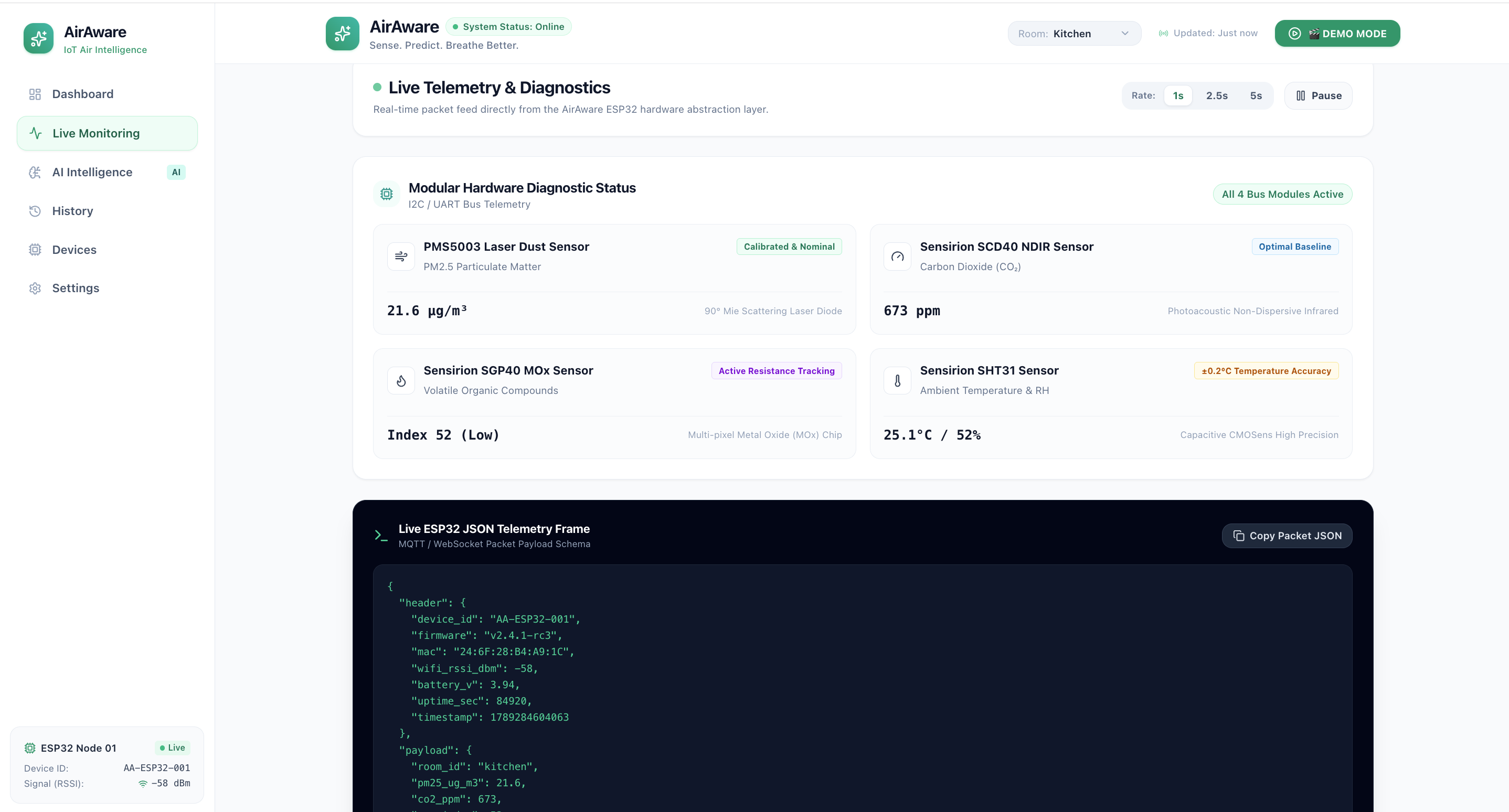
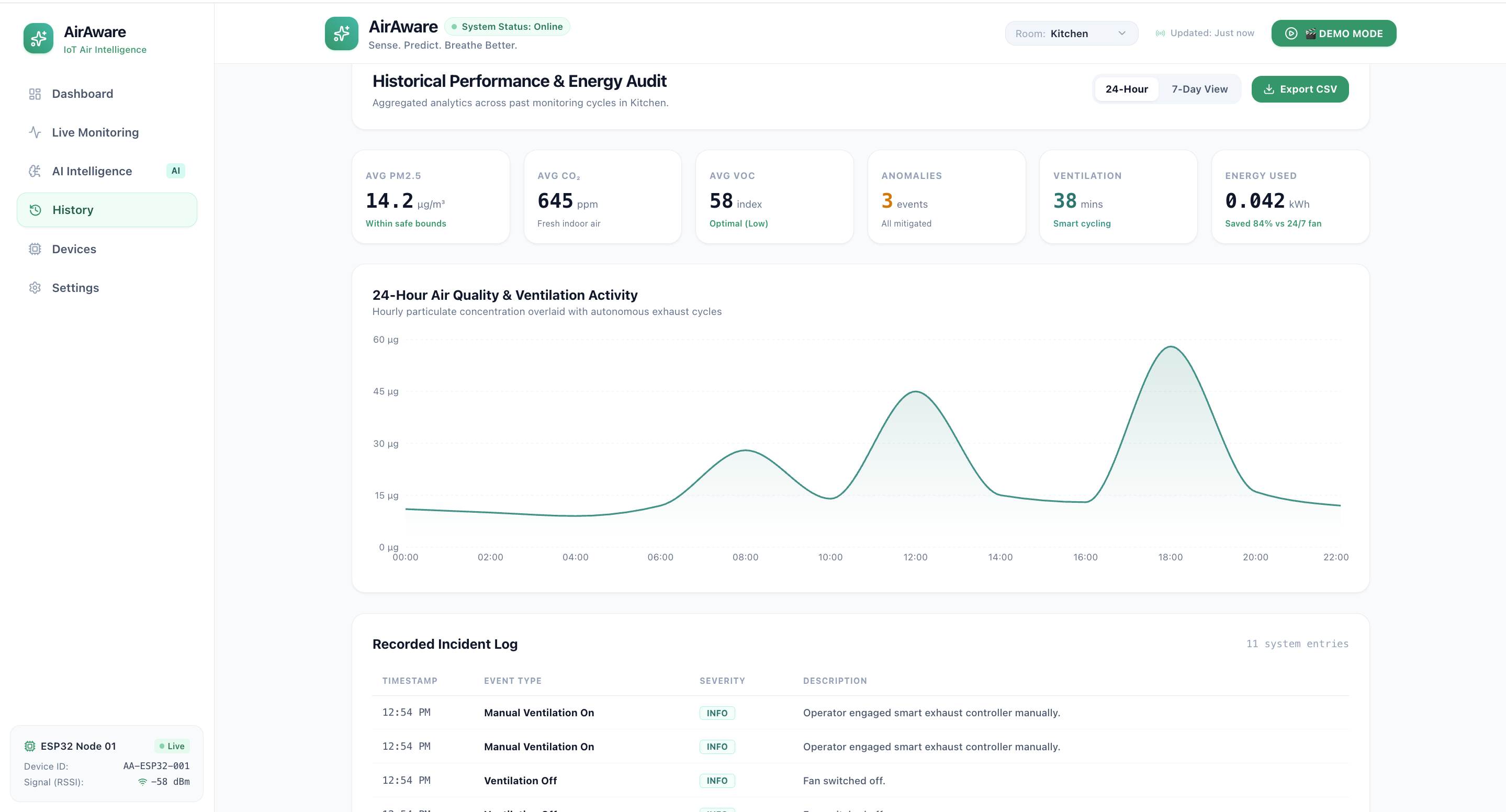
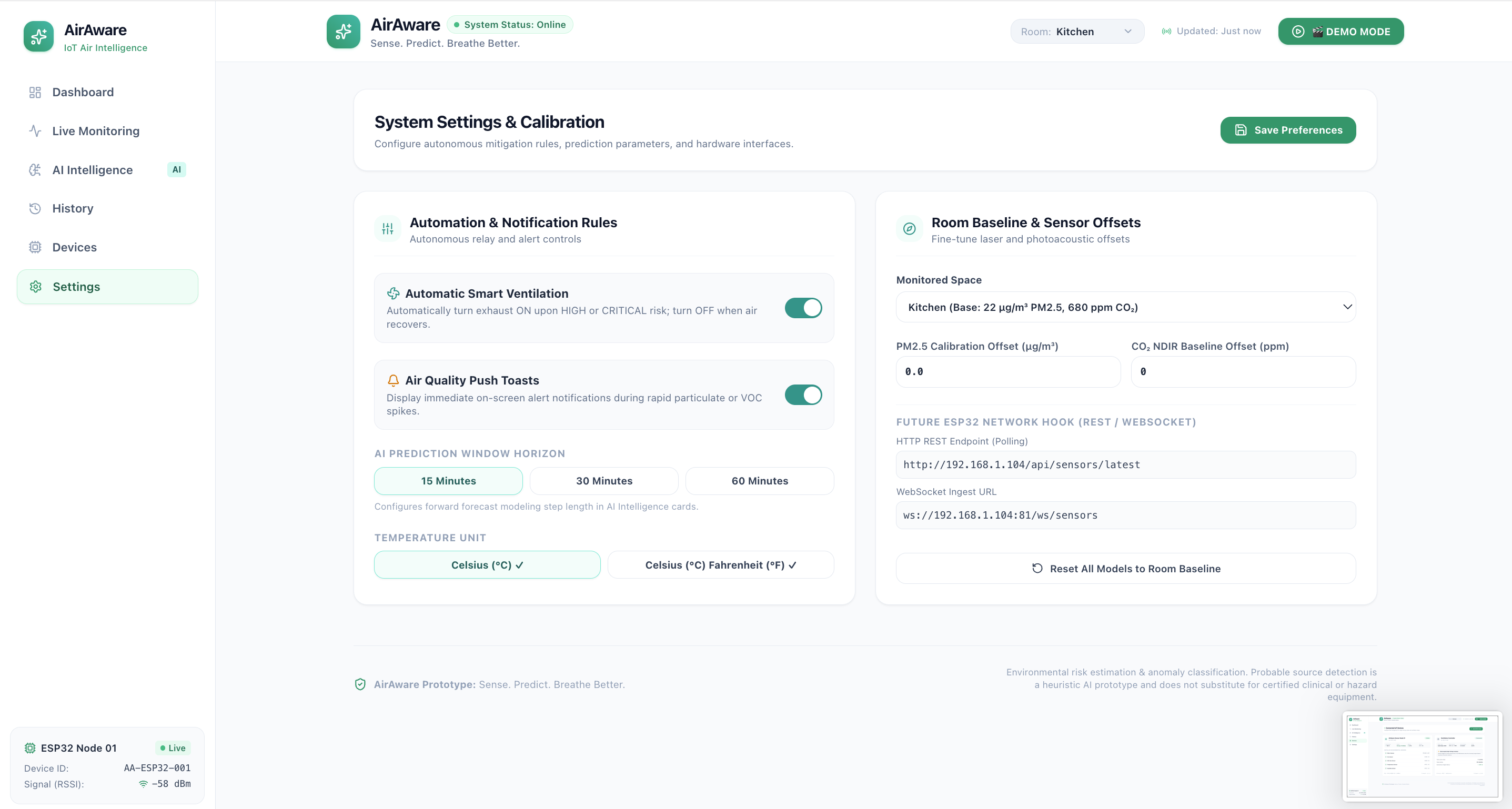
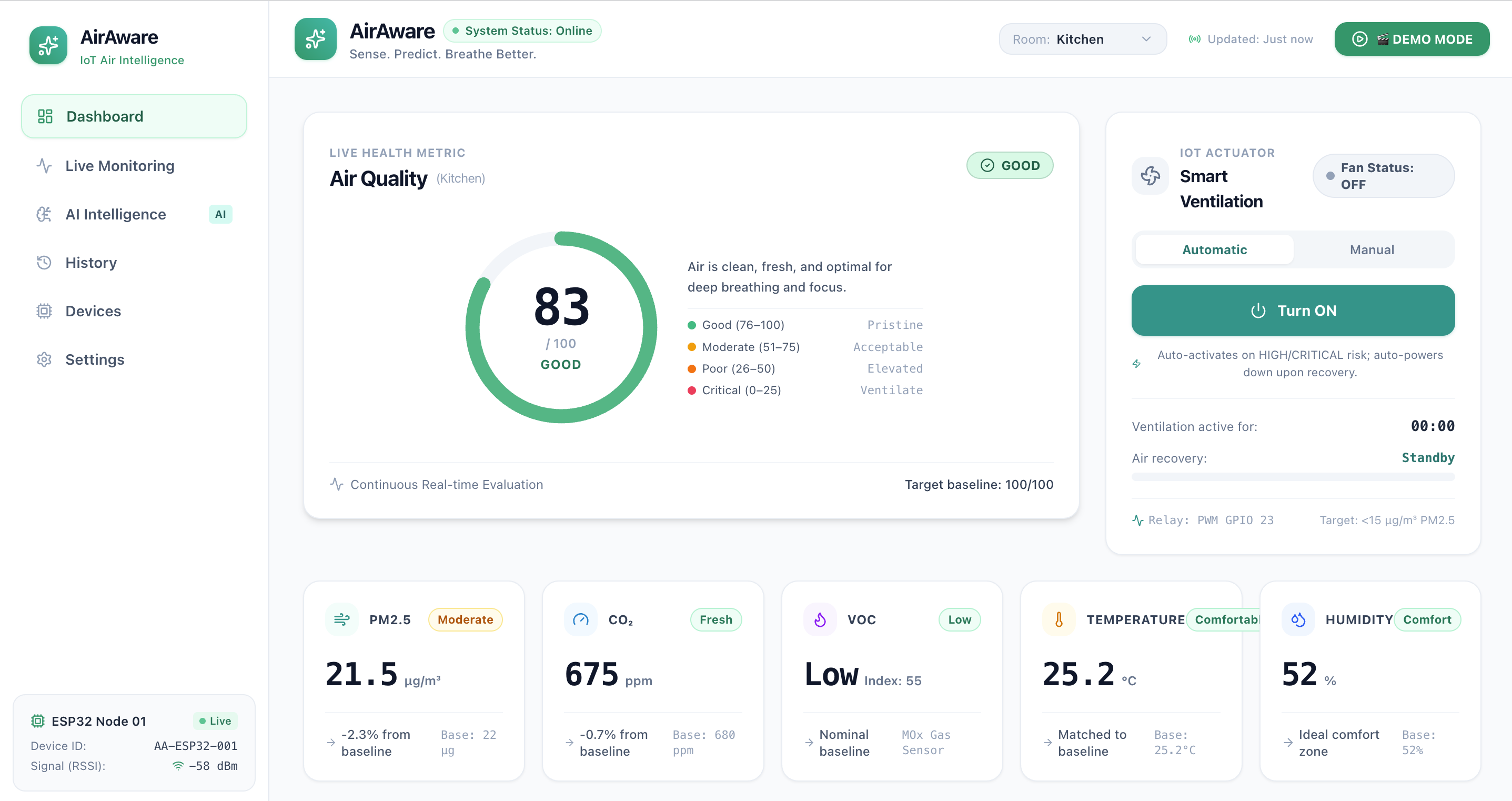
AirAware is an AI-powered IoT system for intelligent indoor air-quality monitoring. It combines environmental sensors, an ESP32, machine learning, real-time analytics, and automated ventilation to create a system that can: Monitor PM2.5, CO₂, VOCs, temperature, and humidity Learn normal environmental patterns Detect unusual air-quality changes Predict potential deterioration Identify probable pollution-source patterns Provide actionable alerts Automatically activate ventilation when required Instead of simply answering "What is the air quality now?", AirAware aims to answer: "What is happening, why might it be happening, what could happen next, and what should I do?"
How we built it
The system is divided into four major layers:
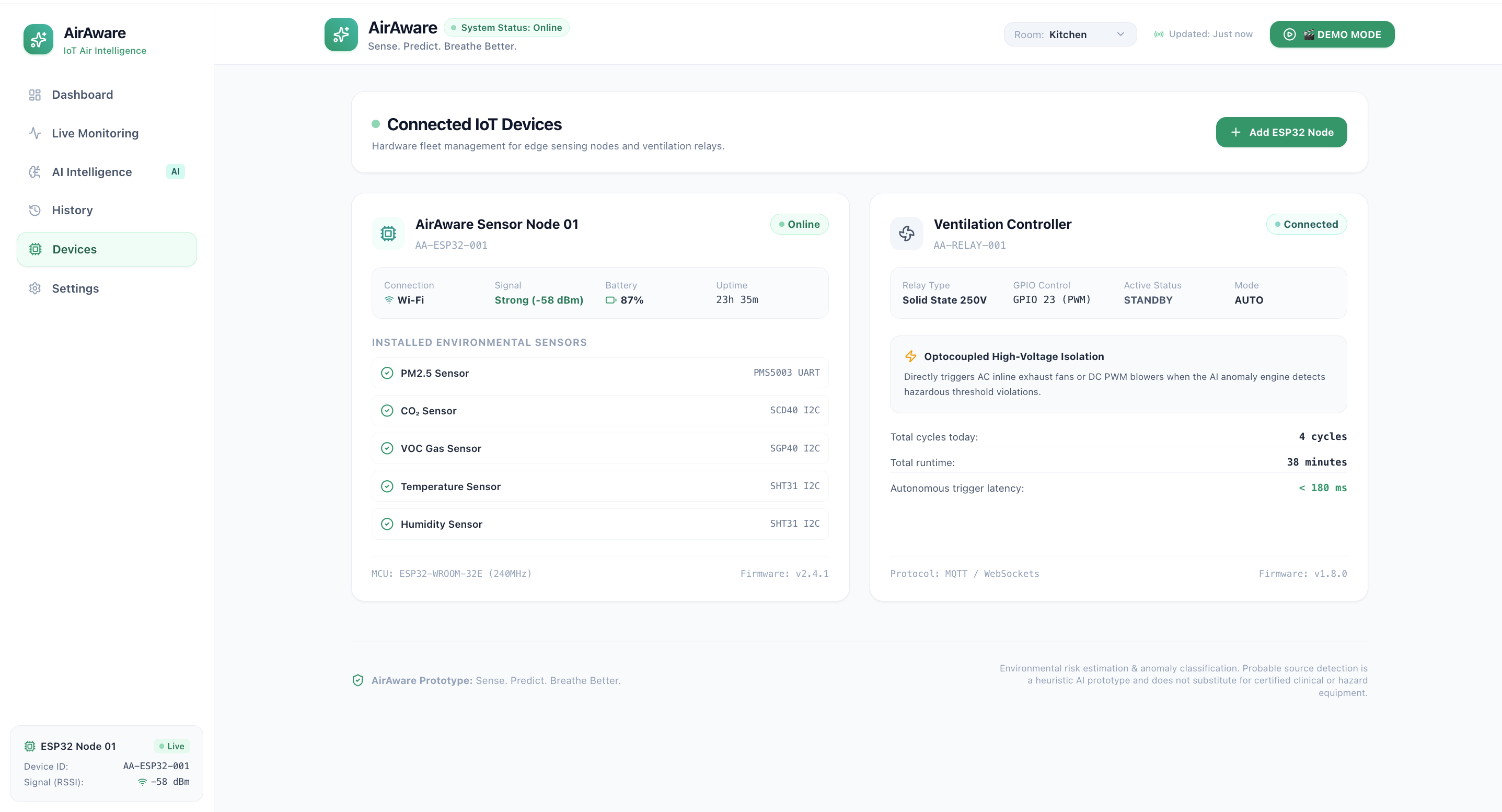
- Sensing Layer Environmental sensors continuously collect air-quality and environmental measurements. An ESP32 acts as the central IoT controller and collects the sensor readings.
- IoT & Backend Layer The ESP32 sends sensor data over Wi-Fi to our backend. We use Python and FastAPI to receive and process the incoming data, while historical measurements are stored for analysis.
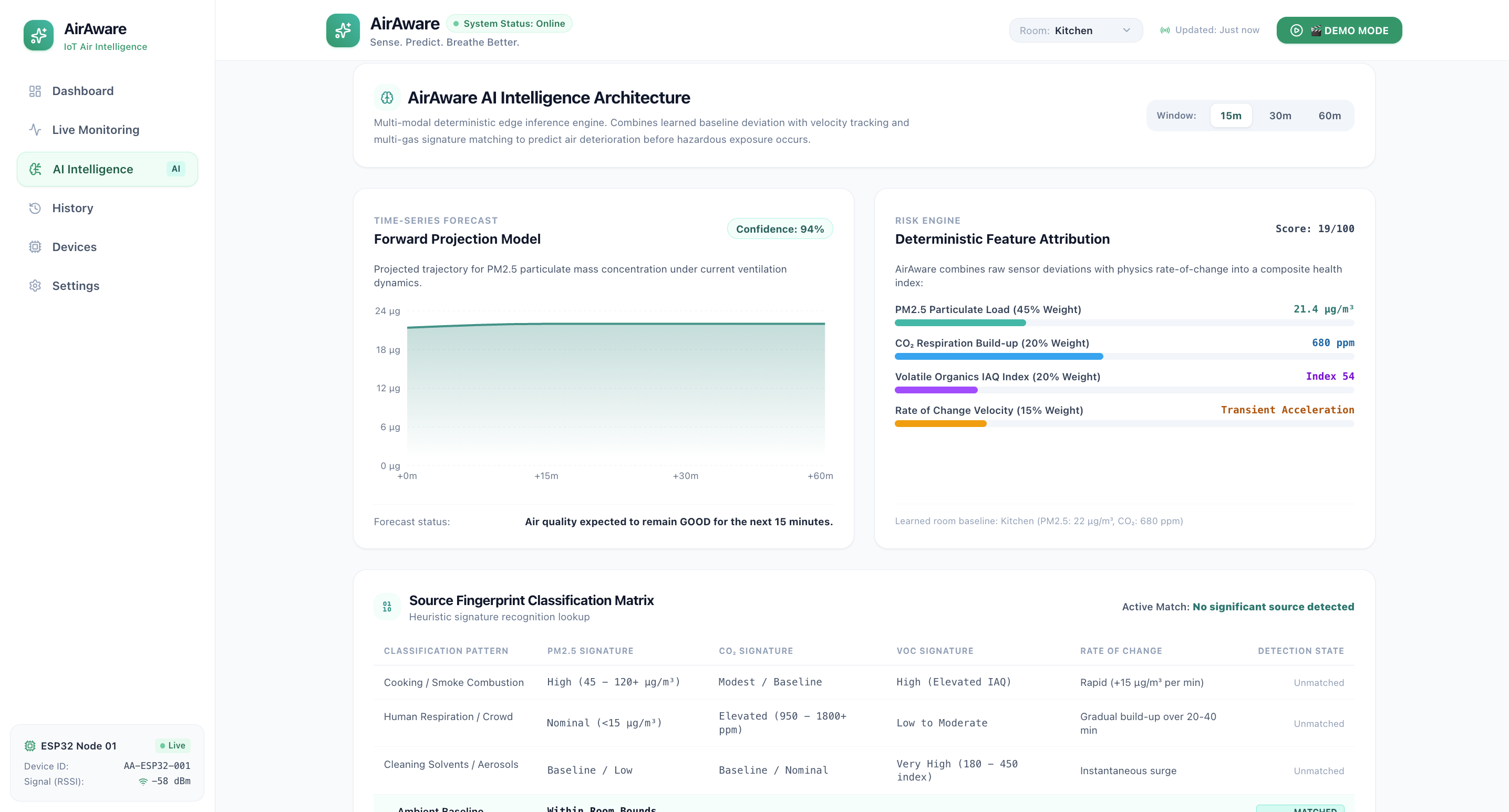
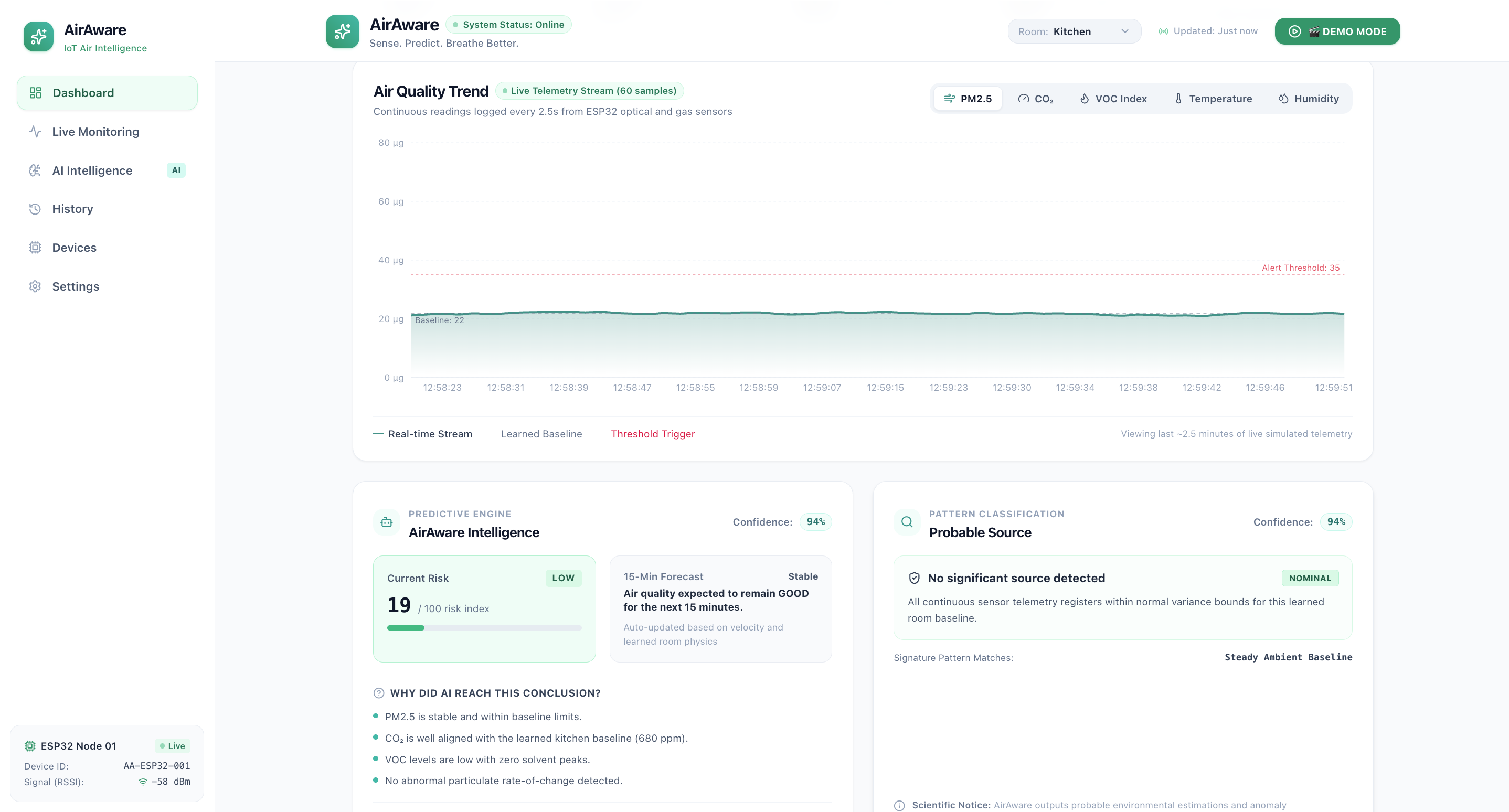
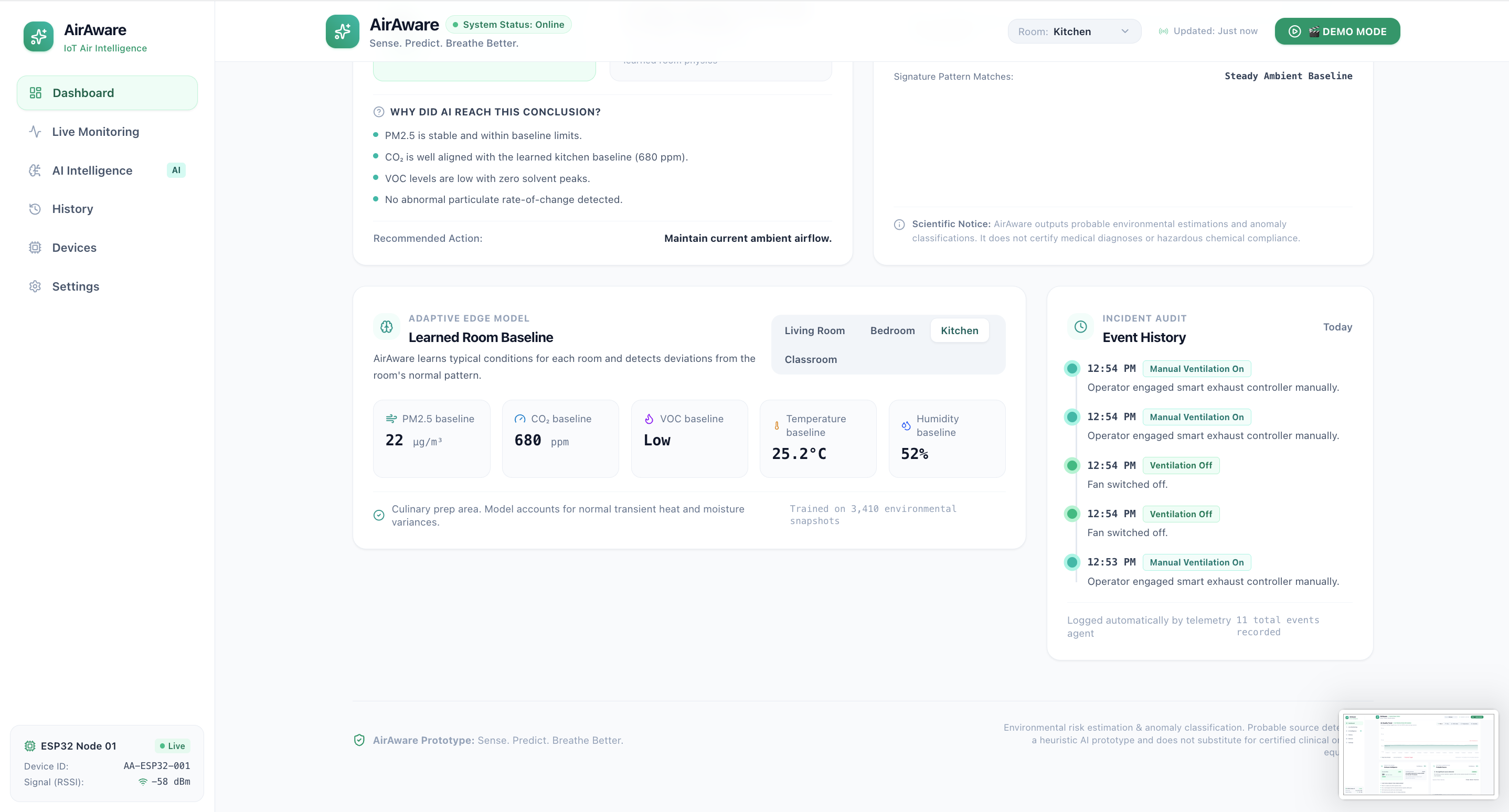
- AI Layer The AI engine analyzes both current measurements and historical patterns. Instead of relying only on fixed thresholds, AirAware looks at: Current sensor values Rolling averages Rate of change Historical room behavior Time-of-day patterns Relationships between different sensors This allows the system to distinguish normal fluctuations from unusual environmental behavior. For anomaly detection, we use machine-learning techniques such as Isolation Forest, which is well suited for identifying unusual patterns without requiring large amounts of labelled fault data.
- Action Layer When AirAware identifies a significant deterioration in air quality, it can activate a connected ventilation fan through the ESP32 and relay/control circuit. The system continues monitoring the environment and can stop ventilation once conditions improve. This creates a complete feedback loop: Sense → Analyze → Predict → Act → Verify Example Imagine a room where PM2.5 normally stays around 10–15 µg/m³. AirAware observes: 12 → 15 → 21 → 29 → 40 → 52 At the same time, VOC levels begin increasing. Rather than waiting for a simple threshold to be crossed, the system recognizes the rapid change and raises an alert: Air quality is deteriorating rapidly. Possible source: smoke/cooking activity. If automatic ventilation is enabled, the fan is activated and the system continues monitoring until the readings begin returning toward normal.
Challenges we ran into
Our biggest challenge was turning fluctuating sensor readings into reliable and meaningful predictions. Simple threshold-based logic can easily create false alarms because environmental conditions naturally change. We addressed this by combining current readings with historical behavior, rolling statistics, rate-of-change features, and anomaly detection. Another challenge was integrating the complete pipeline: Sensors → ESP32 → Wi-Fi → Backend → AI → Dashboard → Hardware Making each component work individually was relatively straightforward; making the entire system work together in real time was the harder engineering problem.
Accomplishments that we're proud of
We’re proud of turning AirAware from an idea into an end-to-end AI + IoT prototype. We successfully connected environmental sensing, real-time data processing, anomaly detection, a user-friendly dashboard, and automated ventilation into one system. Most importantly, we built a solution where AI insights lead to a real-world physical action.
What we learned
Building AirAware taught us that developing an IoT + AI system is very different from working with clean datasets. Real-world sensor data is noisy and constantly fluctuates. A single unusual reading does not necessarily mean that something is wrong. We learned how to: Process and clean streaming sensor data Work with real-time IoT communication Build anomaly-detection pipelines Establish environmental baselines Connect machine-learning decisions to physical hardware Design dashboards that make complex data understandable Build a closed-loop system instead of a passive monitoring application The biggest lesson was that AI becomes much more useful when it is connected to the physical world and leads to an actionable decision.
What's next for AirAware
Future Scope We see several possibilities for future versions: Multi-room air-quality monitoring Mobile notifications More advanced time-series prediction Improved pollution-source classification Smart HVAC integration Energy-aware ventilation optimization Building-level air-quality mapping Personalized exposure summaries Our long-term vision is to make intelligent environmental monitoring affordable, accessible, and actionable.
Built With
- artificial
- embedded
- environmental
- esp32
- fastapi
- intelligence
- iot
- learning
- machine
- monitoring
- python
- react
- scikit-learn
- sensors
- systems


Log in or sign up for Devpost to join the conversation.