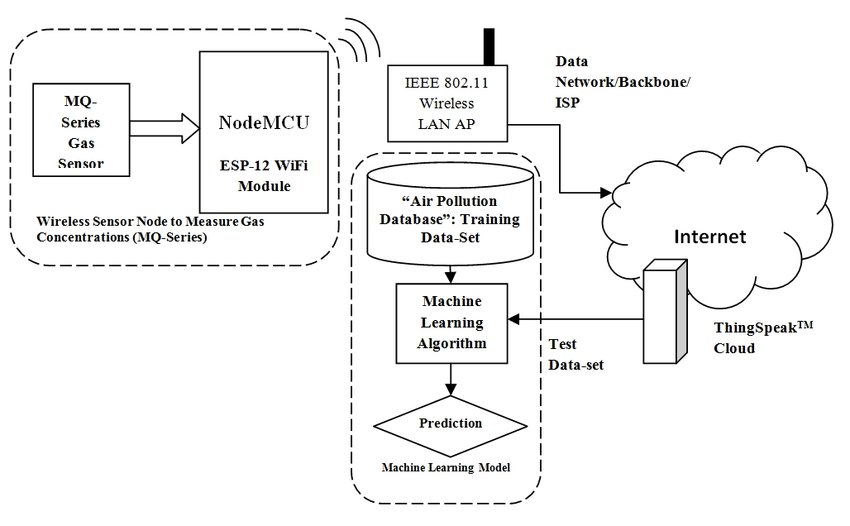
An IoT based Air pollution monitoring system includes a MQ Series sensor interfaced to a NodeMCU equipped with a ESP8266 WLAN adaptor to send the sensor reading to a ThingSpeak cloud. Further scope of this work includes a suitable machine learning model to predict the air pollution level and a forecasting model, which is basically a subset of predictive modeling. We will be using out IoT device as a prototype to collect the data, and for expanding our model we used an authorized open source dataset provided by US Govt. The paper is mainly to monitor, visualize the pollution data and its forecasting. Specifically three machine learning (ML) algorithms were implemented to find out the best predictive model and a forecasting model for calculating AQI of four different gases: Carbon Monoxide (CO), Nitrogen Dioxide (NO2), Sulfur Dioxide (SO2) and Ozone (O3). The ML algorithms used over here are Linear Regression, Random Forest and XGBoost for predictive modeling and ARIMA model for time-series forecasting. The performance metrics was based on Root Mean Square Error (RMSE) and Mean Absolute Error (MAE). It was observed that Random Forest had the best performance. From this paper, the model can thus be deployed in real-world in areas with high-pollution.
Built With
- pythonmeachinelearning

Log in or sign up for Devpost to join the conversation.