Inspiration
As music lovers and tech geeks, we were intrigued with the idea of doing cool things with speakers—specifically—the mini speakers provided by the Hackathon. Asking ourselves the question, how can we make something great, better? We wanted people to feel the GROOVE of being a DJ while not be bound by clunky hardware! We wanted to create something bigger, something more lasting.
What it does
Air DJ is a touchless music machine! It detects your hand motions and plays different pitches depending on where you want it to be. For example, you can put your hand high in the sky to play a high note or put your hand lower to play a lower note! In addition, you can use filters, adjust volume, and more in combination with pitching!
How we built it
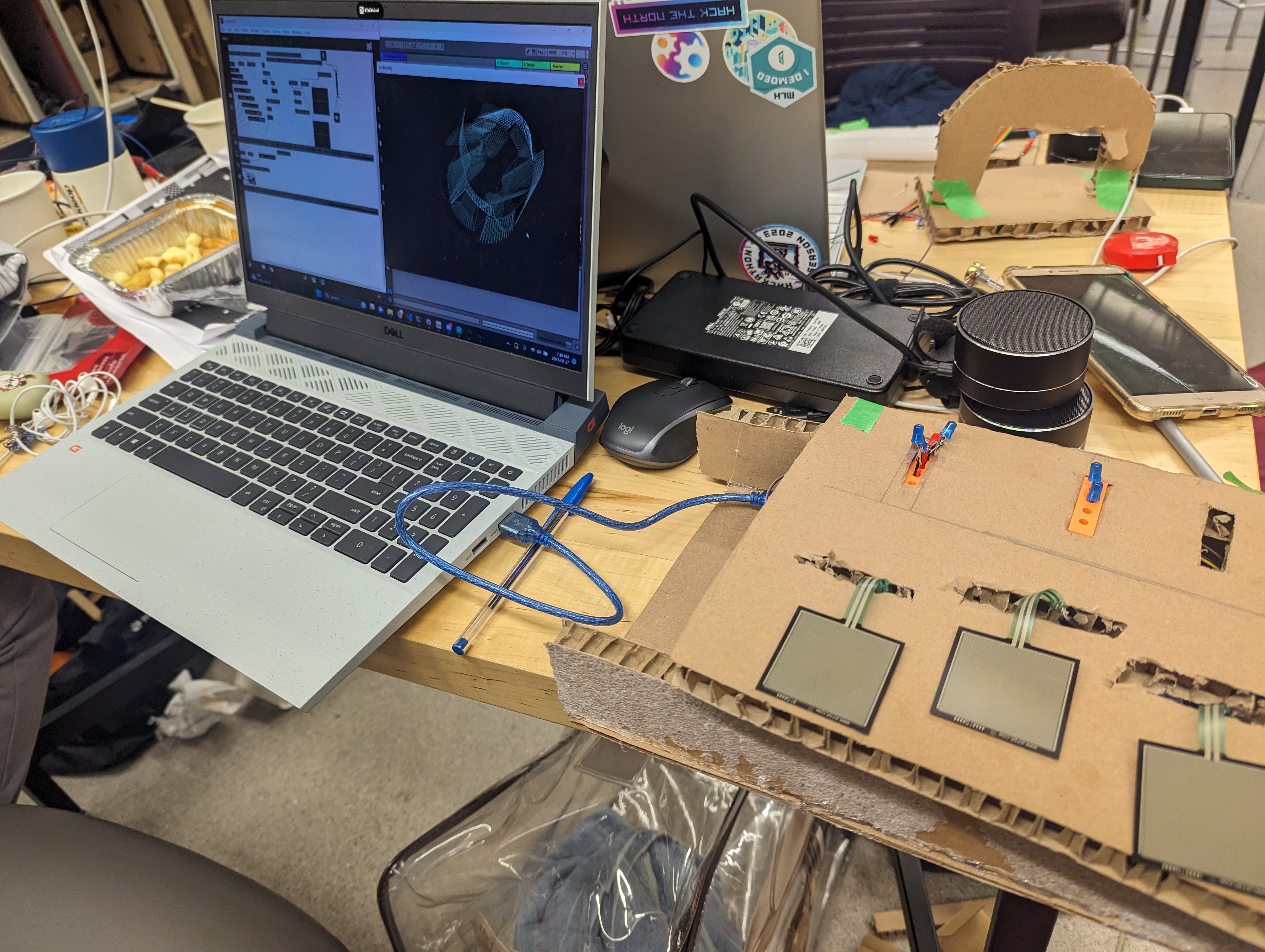
We started by converting serial data from the Arduino into useable data for adjusting audio effects in Ableton Live, using Hairless Midi Serial Bridge. At this stage, we used other sensors to control the resistance which sent serial data to the Arduino as our hardware had not yet been delivered. While waiting, we decided to work on a visualizer to make the experience more user-friendly and more engaging. Since we could not retrieve the data from the same Arduino, we directly used numbers from Ableton using Max for Live to create shapes that corresponded with the music. After our hardware arrived in, we implemented an ultrasonic sensor to measure the distance between the sensor and the highest point above it (the user's hand), and matching that to serial data which could be converted into music through a few calculations! We also incorporated pressure sensors to easily control volume, rgb, and other effects.
Challenges we ran into
We ran into challenges every step of the way. We were not very familiar with using Ableton, so we put up a huge struggle to figure out how it worked and how to connect it to our hardware. Another challenge was not being sure whether we would be able to receive our hardware. Since we had not booked it in advance, and our project was almost entirely reliant on Ultrasonic sensors, we were greatly stressed that we would not be able to accomplish our goal due to a lack of hardware. Luckily, we ended up attaining one sensor. In the future, we believe it would be useful to plan out the hardware that we want to request in advance to prevent the worst-case scenario from happening, or making the project less reliant on one piece of hardware to allow for flexibility.
Accomplishments that we're proud of
We are very proud of complexity and versatility. Hardware was a part of engineering where we had never explored before. Going into this project was a huge leap of faith; simply being able to come out of these 36 hours with a functioning, practical product is something we are extremely proud of.
What we learned
Since most of us were not very familiar with hardware or Ableton, this project was a massive learning experience for us. We all learned how to navigate and hack Ableton, and combine different softwares to convert data from one type to another. The first method that we tried for these new things we tried almost never worked out, yet we remained persistent always finding an alternative. In doing so, we can proudly say each and every group member has learned valuable skills, whether through mentors, trial and error, or the internet!
What's next for Air DJ
In the future, we plan on adding more interactive features to Air DJ to make music even more fun. For one, we hope to find a way to combine all the visualizers from Max for Live into one webpage. This would enhance the user experience by allowing to see the value of every effect at the same time. Another feature would be adding a keypad that allows users to play percussive beats, adding more rhythm and GROOVE to the music.
Built With
- ableton
- arduino
- javascript
- max
- python


Log in or sign up for Devpost to join the conversation.