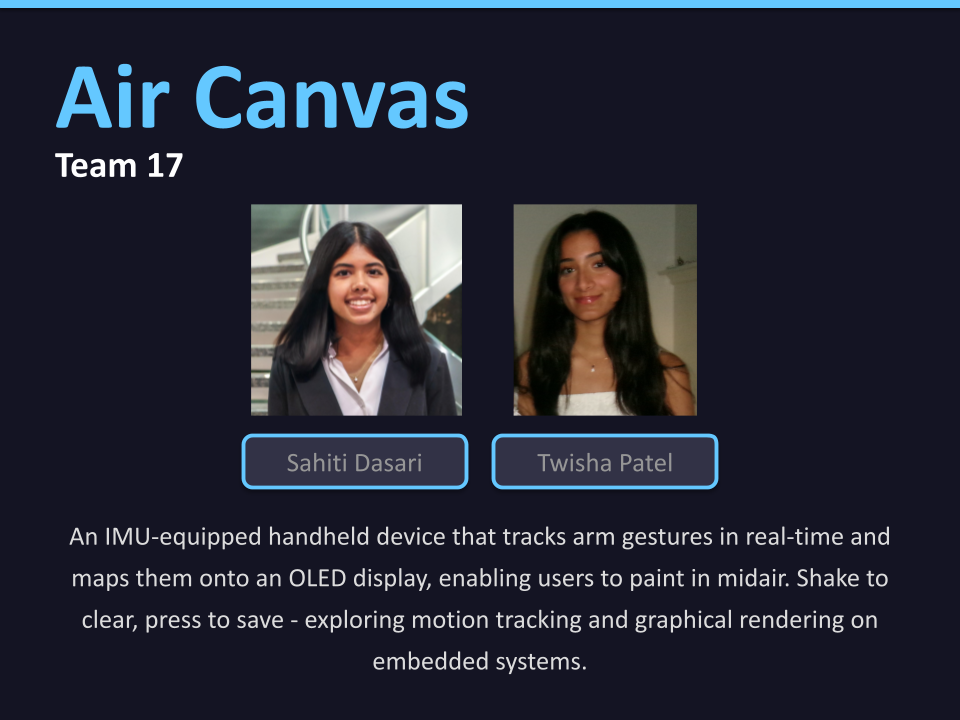
Air Canvas
Inspiration
We've all been in a meeting or class wishing we could just draw something in the air to explain an idea. Whiteboards are great, but they're not exactly portable. We wanted to build something that turns your hand into a paintbrush with zero surface required. The idea of capturing raw human motion and translating it into art felt like the perfect intersection of hardware and creativity, so Air Canvas was born.
What it does
Air Canvas is a handheld device that lets you draw in midair. An onboard IMU tracks your wrist rotation in real time and maps it onto a TFT display, so wherever your hand tilts, a stroke follows. Shake the device to clear the canvas and start fresh. It's drawing, untethered.
How we built it
We built around an Arduino Uno paired with a GY-521 (MPU-6050) IMU and an ST7735 TFT display. The gyroscope streams rotation data over I2C, which we read raw, apply a dead zone filter to cut jitter, and integrate into cursor coordinates that get drawn as continuous lines on the 160x128 screen over SPI. Shake detection runs in parallel using the accelerometer, and when total acceleration exceeds a threshold, the canvas wipes and resets to center.
Challenges we ran into
Gyroscope drift accumulates fast. Small errors in each reading stack up over time and the cursor wanders even when the device is still, so tuning the dead zone threshold was critical. We also had to balance update speed vs. display lag since the TFT line draws and IMU reads are both happening in the same loop, and timing that 20ms cycle took iteration.
Accomplishments that we're proud of
Getting real-time gyro-to-pixel rendering that actually feels like drawing is harder than it looks. We're also proud of the shake-to-clear working reliably without false triggers during normal drawing motion, which required carefully isolating the gravity component from actual shake acceleration.
What we learned
We got hands-on experience with raw IMU register reads over I2C, SPI display driving, and the signal processing tradeoffs involved in making noisy sensor data feel smooth and intentional to a user.
What's next for Air Canvas
Complementary or Kalman filtering for drift-free long-session tracking, a button for controlled canvas clear, multi-color brush modes, and a proper handheld enclosure to make it feel like a real drawing instrument.

Log in or sign up for Devpost to join the conversation.