-
-
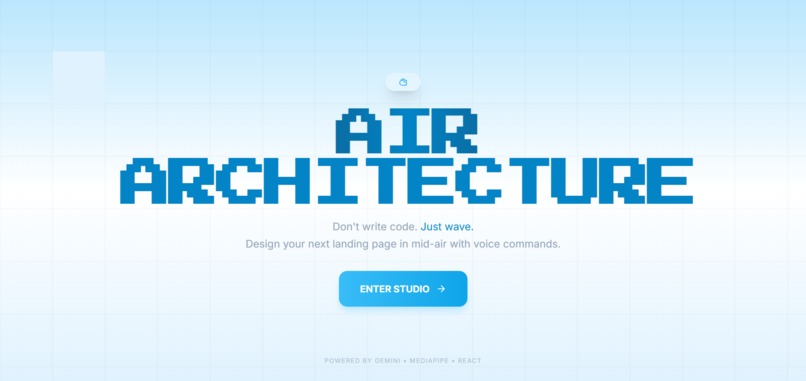
Home Page
-
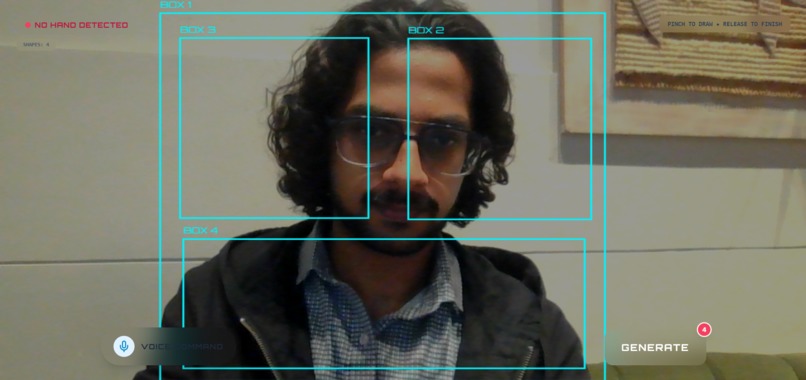
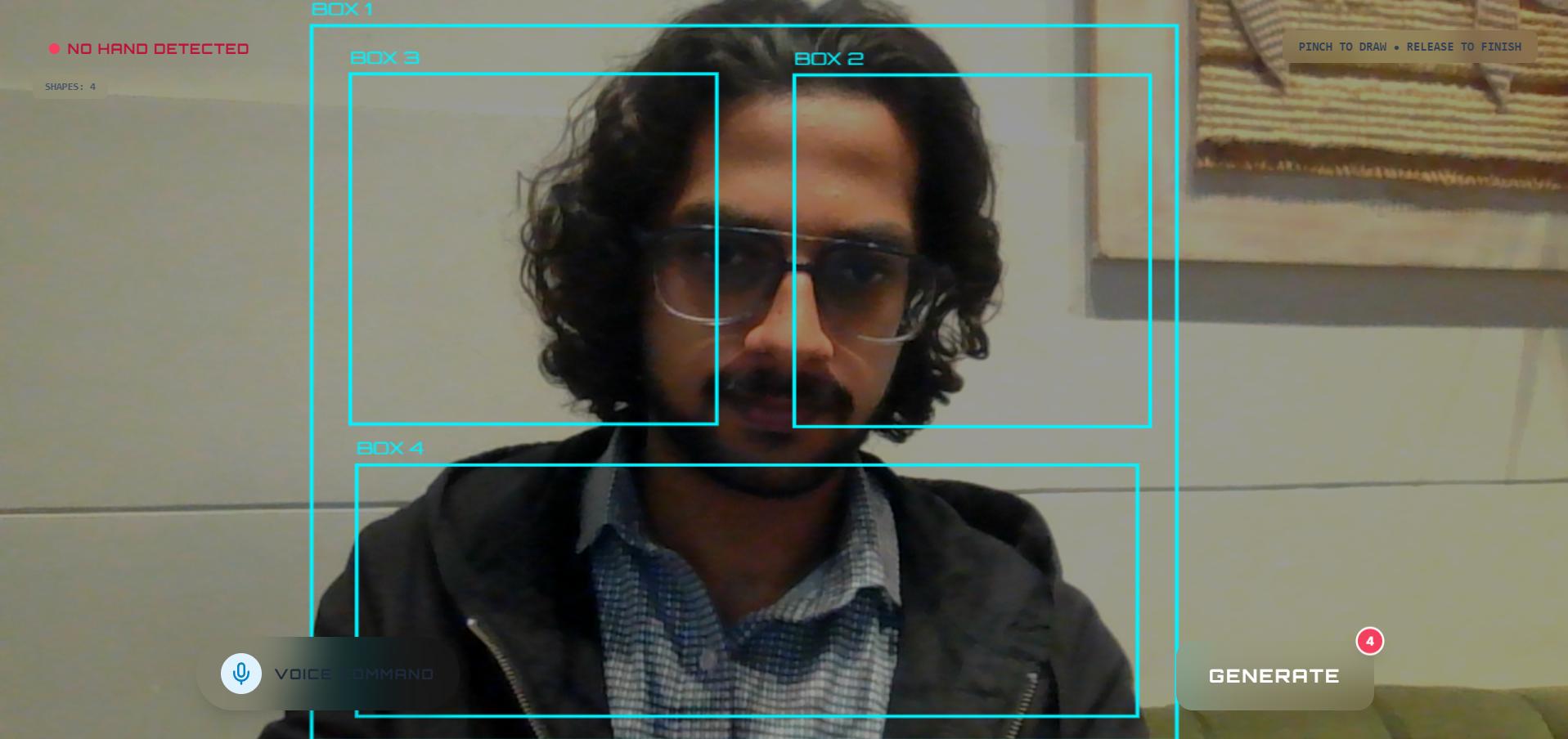
Studio Page
-

Result Page

💡 Inspiration
The gap between a mental model and a digital prototype has always felt too wide. I usually have the idea clearly in my head—"I want a header here, a hero image there, and three feature cards below"—but translating that into code requires context switching between design tools and IDEs.
I wanted to remove the keyboard and mouse from the initial equation. What if you could just "show" the computer what you want? Inspired by the concept of "Spatial Computing," I built Air Architect to turn natural human behavior—pointing, gesturing, and speaking—into immediate digital reality.
🏗️ How I Built It
The project is a fusion of classic web technologies and a dual-model AI architecture.
1. The "Eyes": Computer Vision
I used Google MediaPipe for real-time hand tracking. The system calculates the Euclidean distance between the thumb tip ($P_4$) and index finger tip ($P_8$) to detect pinch gestures:
$$D = \sqrt{(x_8 - x_4)^2 + (y_8 - y_4)^2}$$
If $D < \text{Threshold}$, the system recognizes a "drawing" state and converts raw finger strokes into clean geometric <div> blocks.
2. The "Ears": Voice Command
Using the MediaRecorder API, I capture user intent (e.g., "Make the header dark blue"). This audio is blobbed and sent to Gemini 3, which I chose specifically for its superior speed and accuracy in speech-to-text tasks.
3. The "Brain": Multimodal AI
I use Google Gemini 3 as the reasoning engine to process a multimodal prompt containing:
- A snapshot of the user's hand-drawn wireframe.
- The transcribed text from the voice model.
Gemini 3 analyzes the spatial layout of the boxes in the image and mimics it structurally, while applying the styling rules from the voice command to generate production-ready HTML + Tailwind CSS code.
🚧 Challenges I Faced
- Coordinate Mapping: Aligning the webcam's mirrored coordinate system to the browser canvas was tricky. I implemented a custom transformation matrix to ensure the "digital ink" appeared exactly where the physical finger hovered.
- Multimodal Sync: Organizing the UX to handle simultaneous voice and gesture inputs required a robust state machine (Idle -> Drawing -> Generating) to prevent race conditions.
- Prompt Engineering: I had to iteratively refine the system prompts to ensure Gemini prioritized the spatial information of the wireframe while using the voice input specifically for stylistic choices.
🧠 What I Learned
- AI is a spatial thinker: Models like Gemini are surprisingly proficient at understanding 2D spatial relationships from abstract line drawings.
- Intent-Based Computing: We are moving away from explicit pixel-pushing. The future of UI development lies in users providing a rough "intent" (gestures + voice) and AI handling the implementation details.

Log in or sign up for Devpost to join the conversation.