-
-
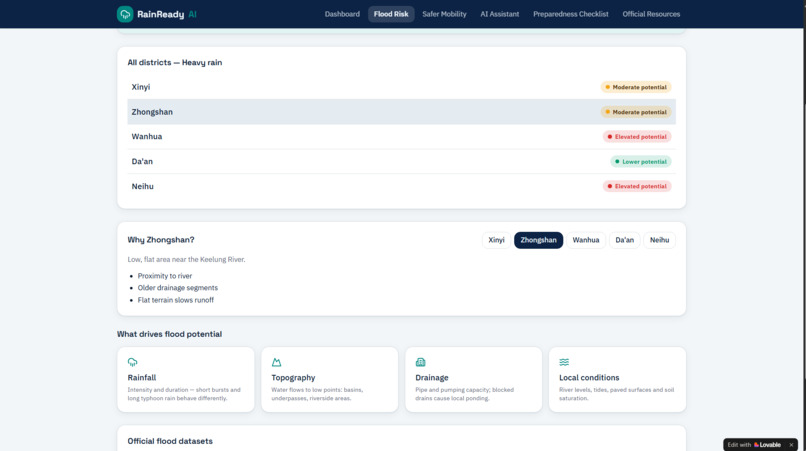
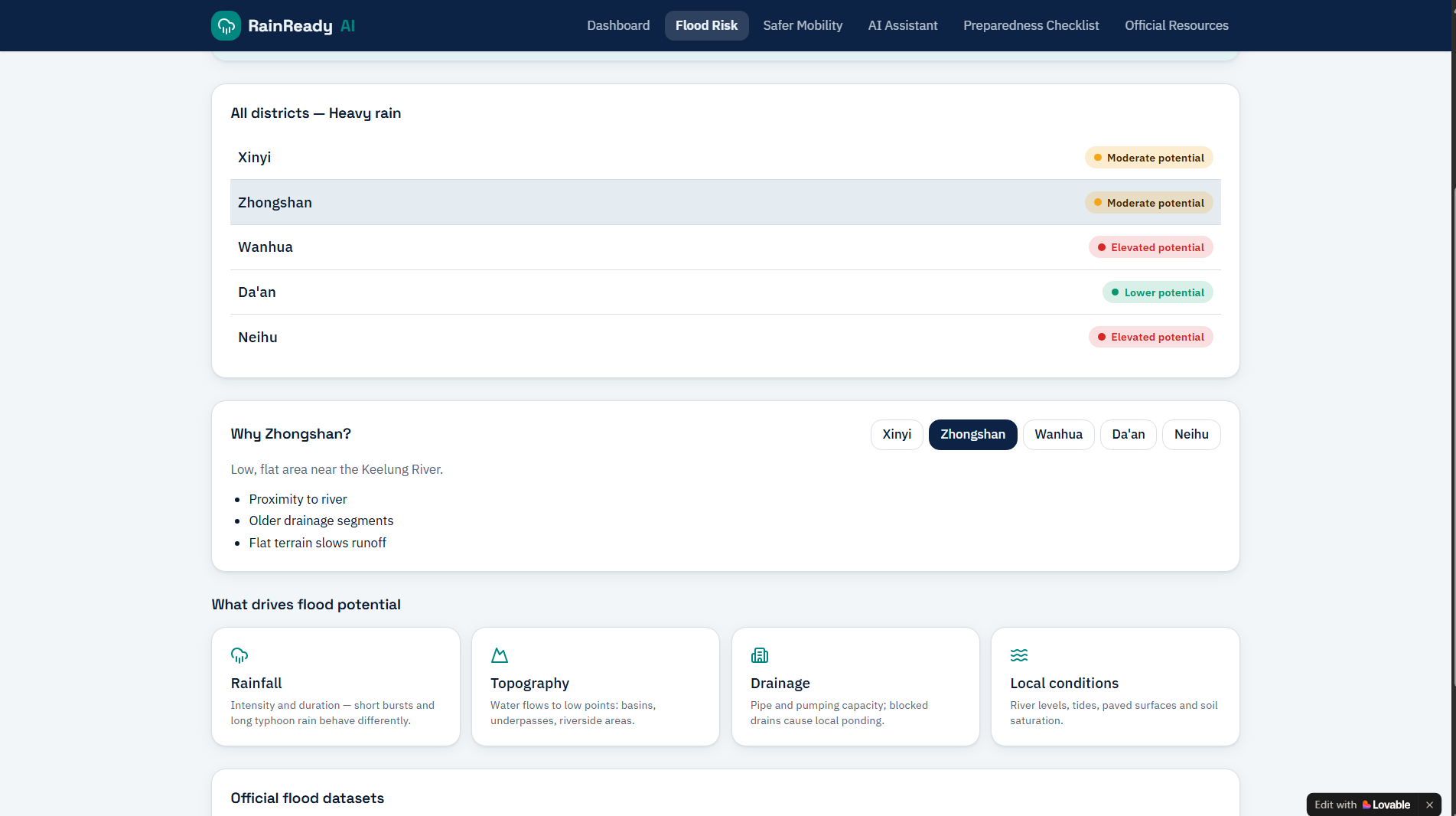
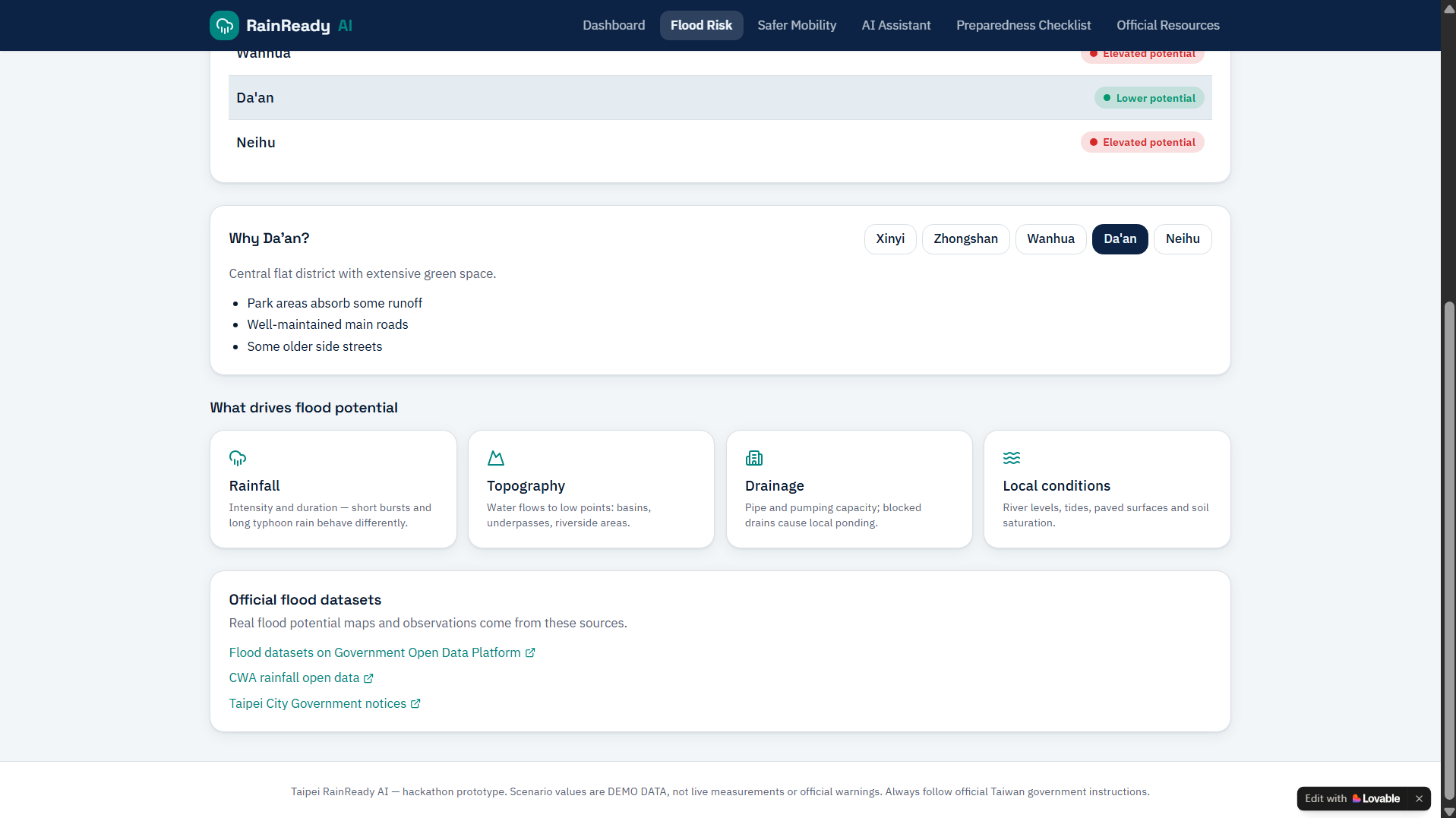
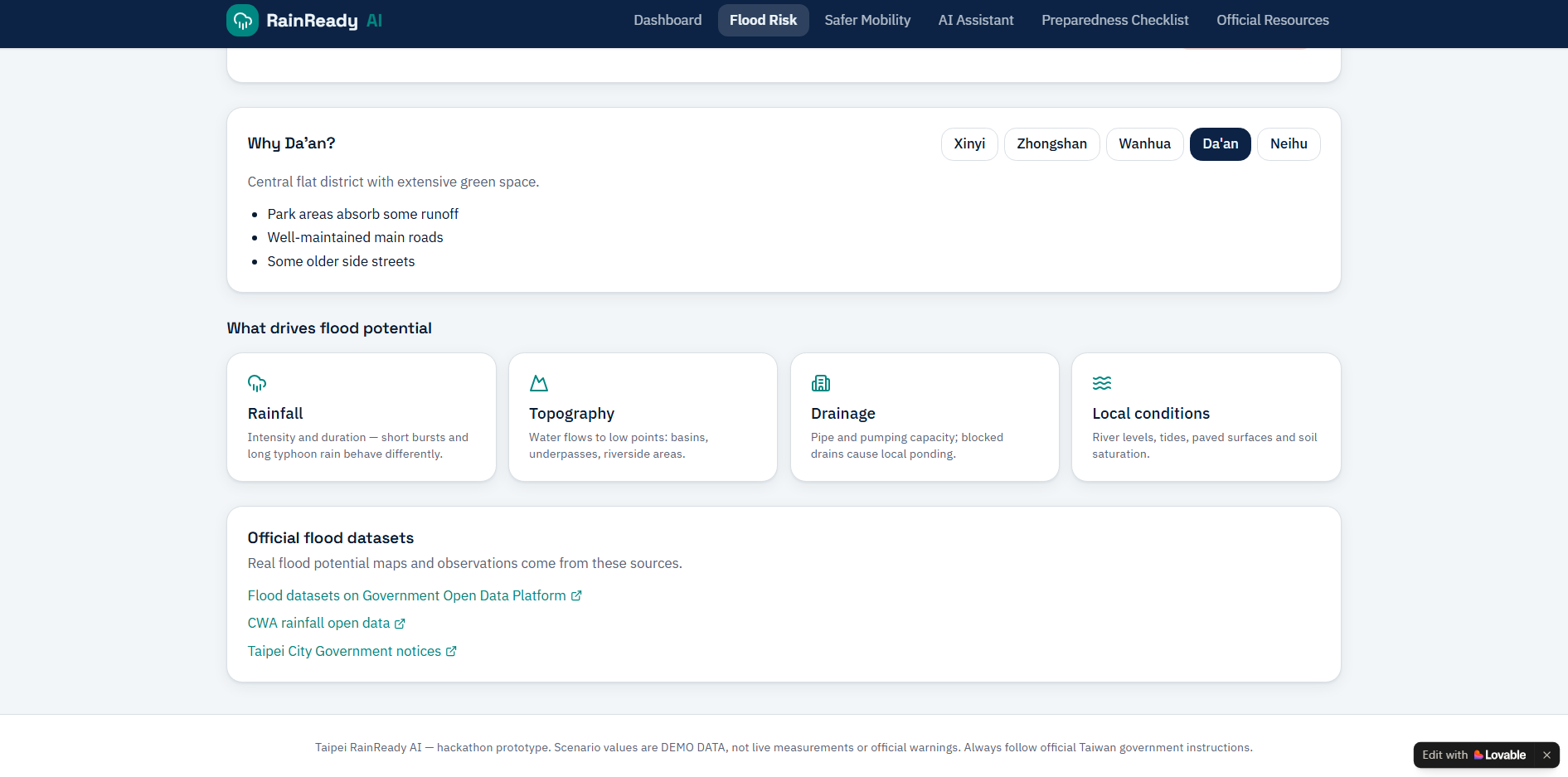
Explore district-wise flood potential and factors like rainfall, topography, and drainage
-
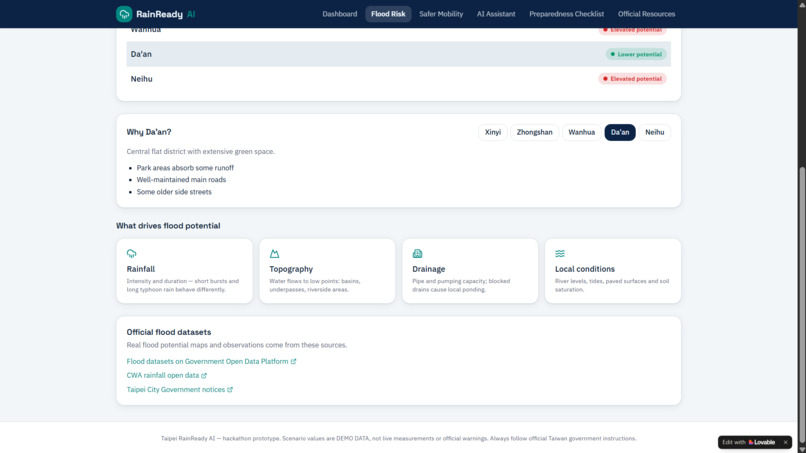
Understand how district-specific geography and drainage conditions may influence flood potential.
-
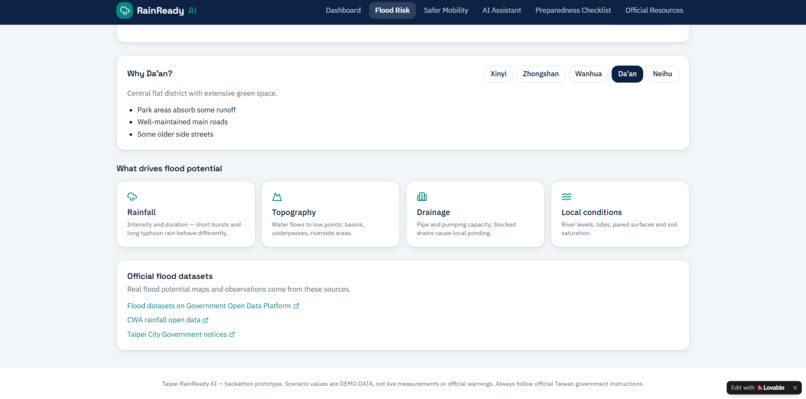
Explore how rainfall, topography, drainage, and local conditions affect flood potential, with links to official data sources.
-
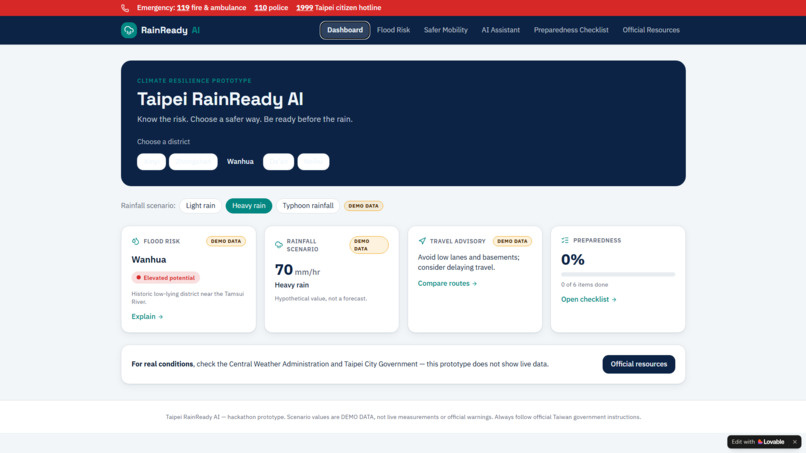
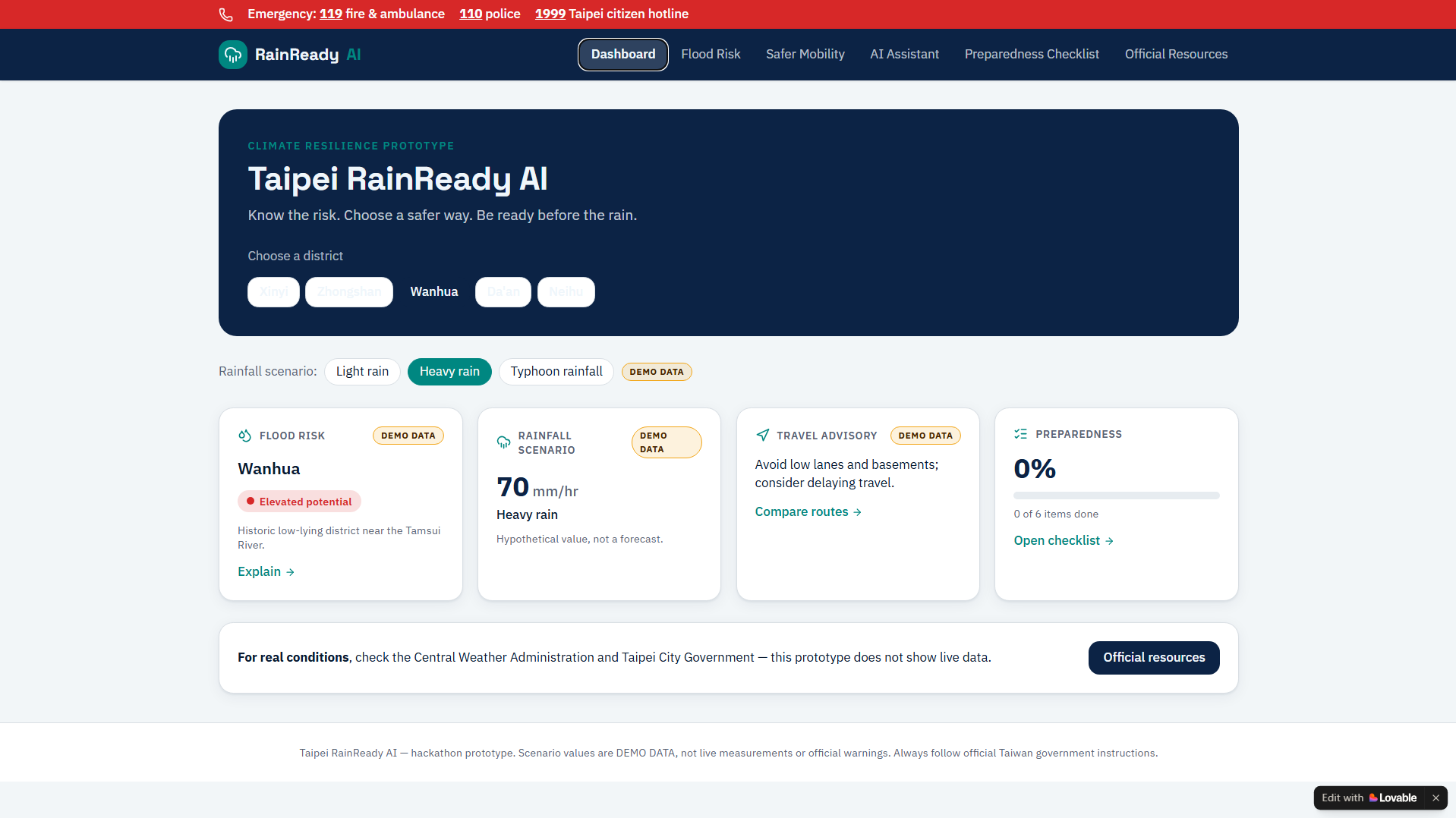
Overview of Taipei flood potential, rainfall scenarios, travel advisories, and emergency preparedness.
-
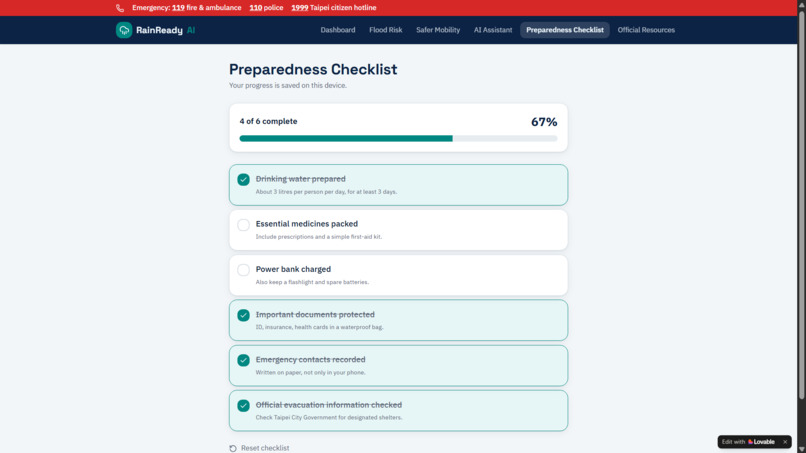
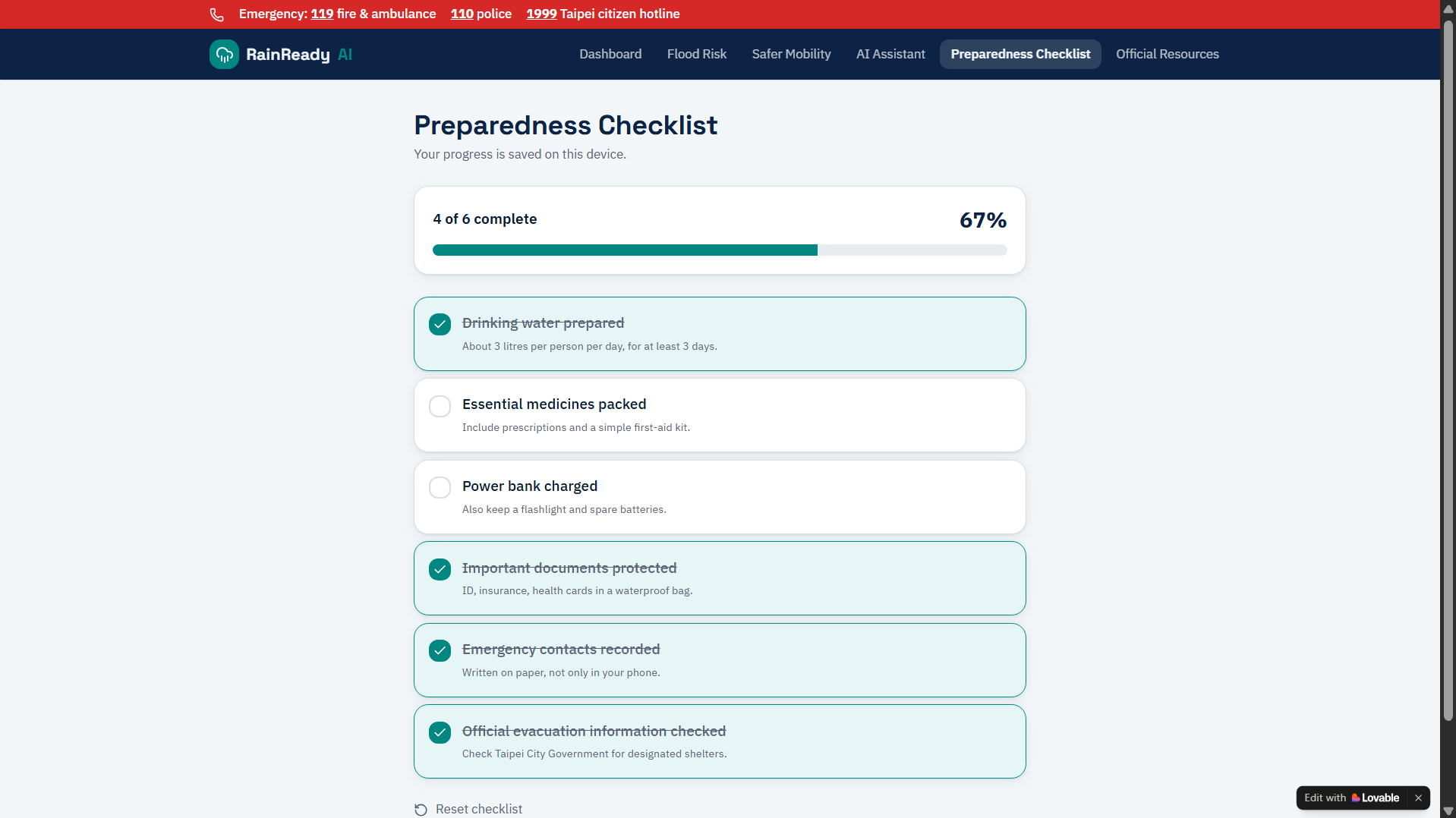
Track essential emergency supplies, medicines, important documents, and safety preparations.
-
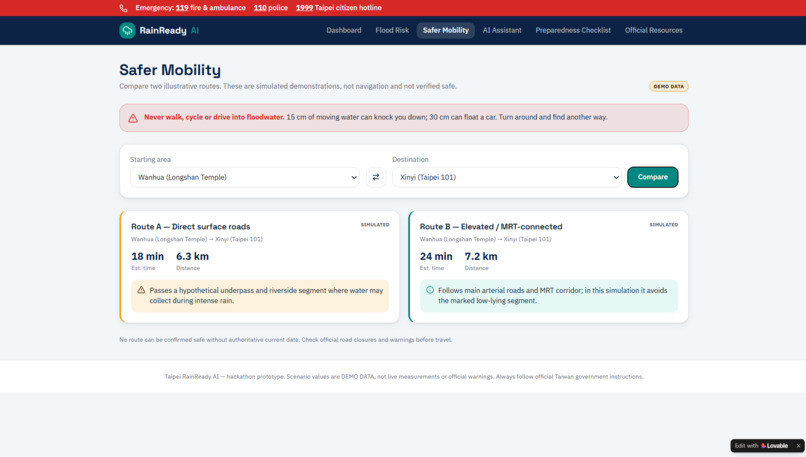
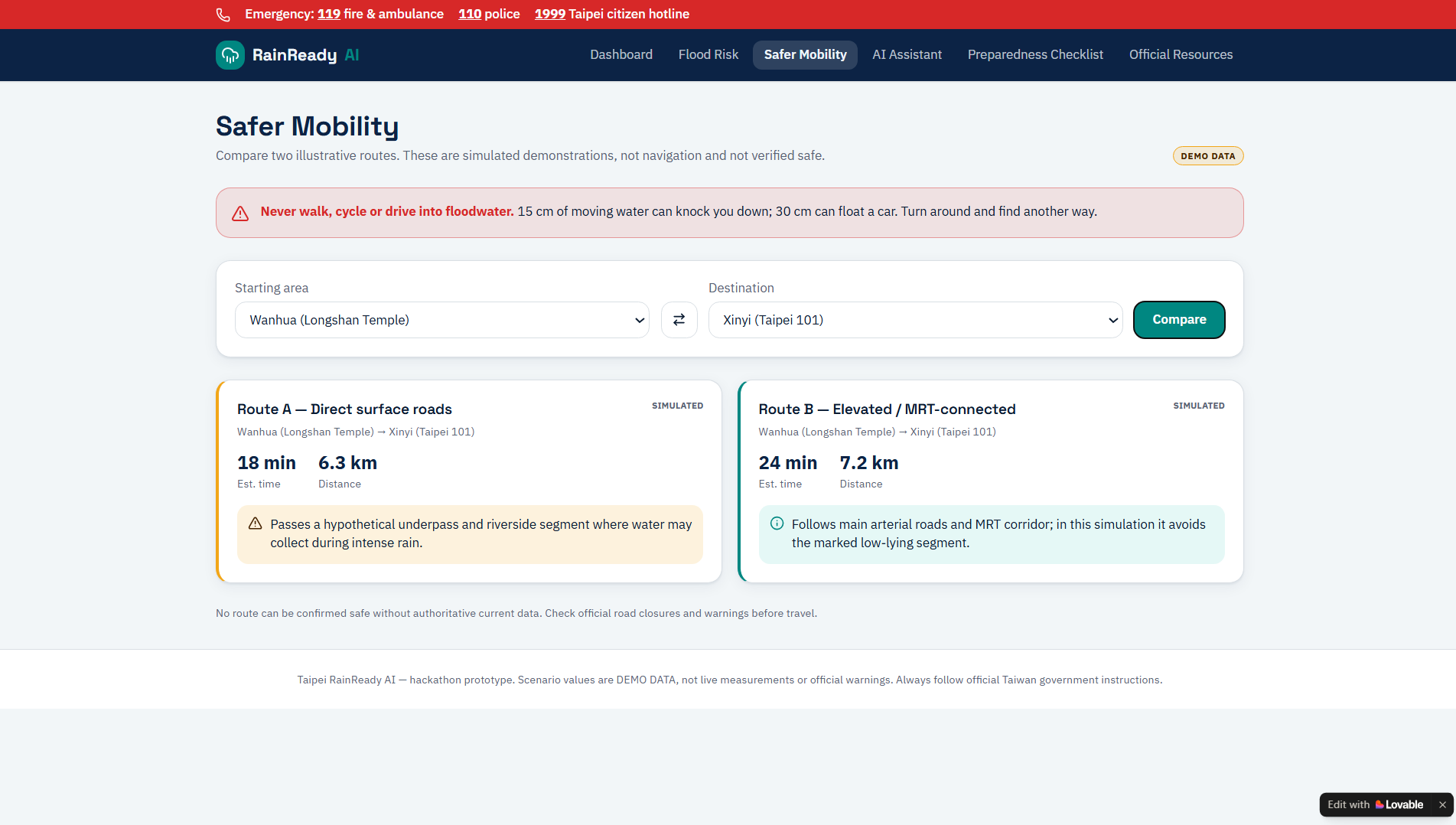
Compare simulated routes and identify potential flood hazards before travelling.
-
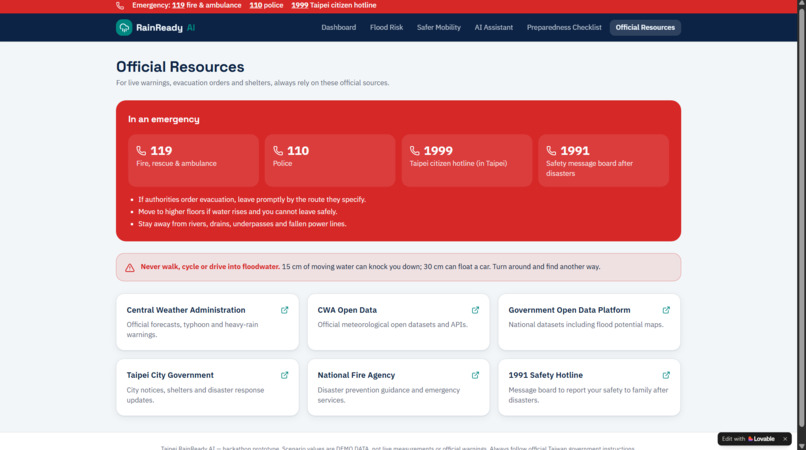
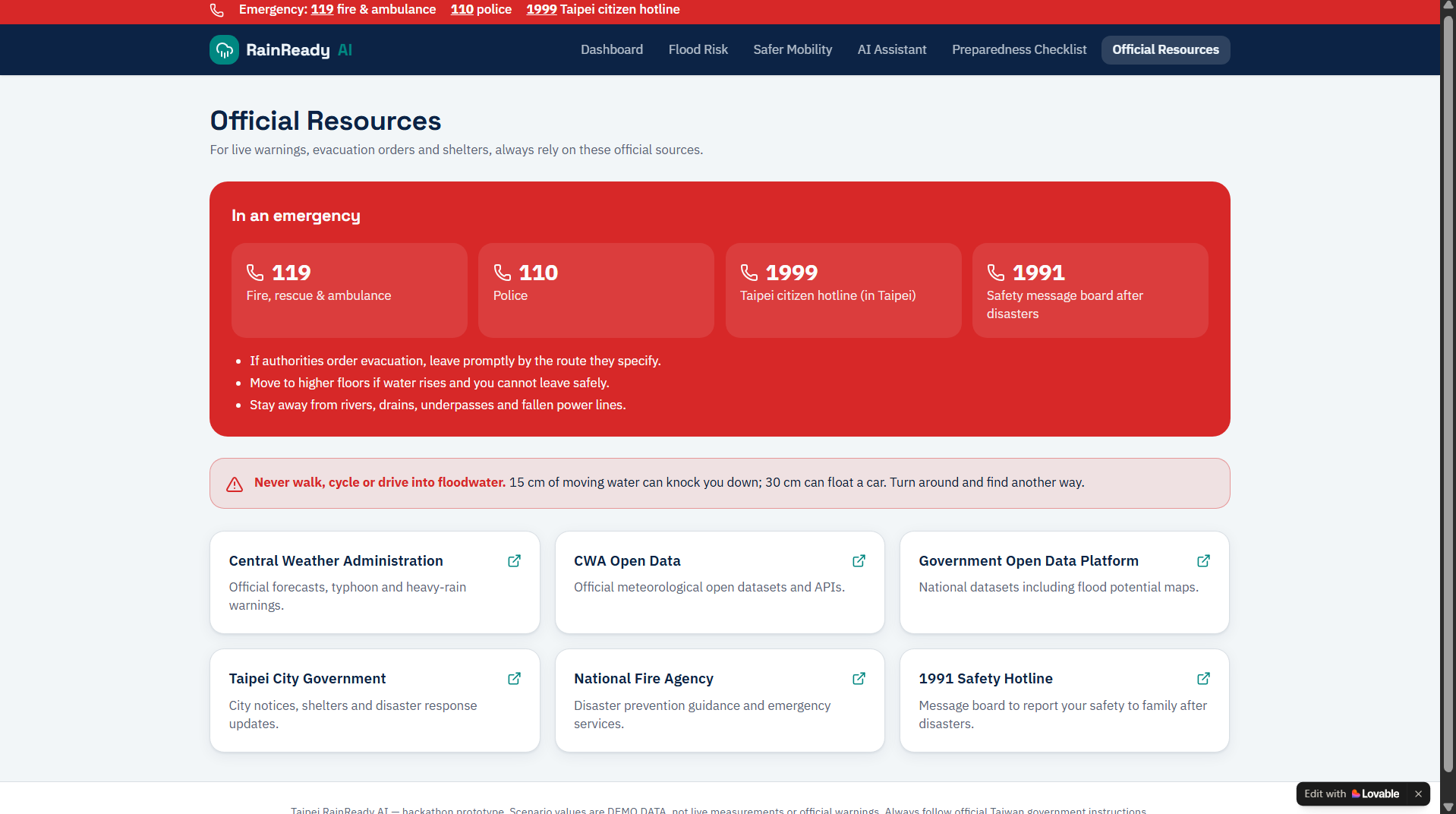
Access emergency contacts, government resources, weather updates, and disaster guidance.
-
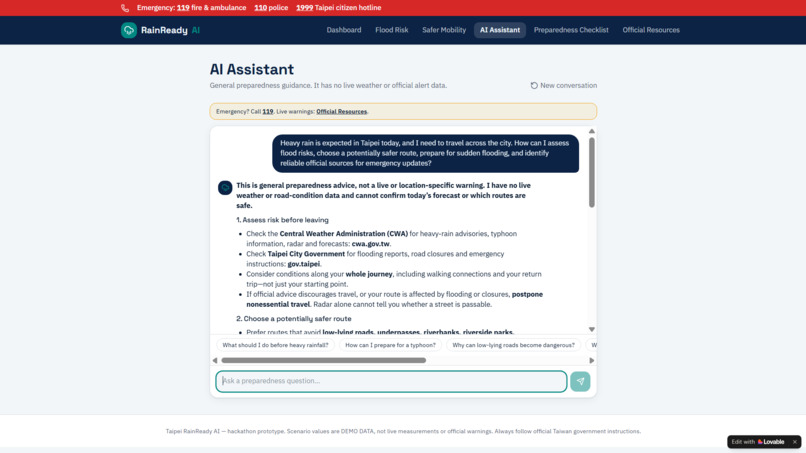
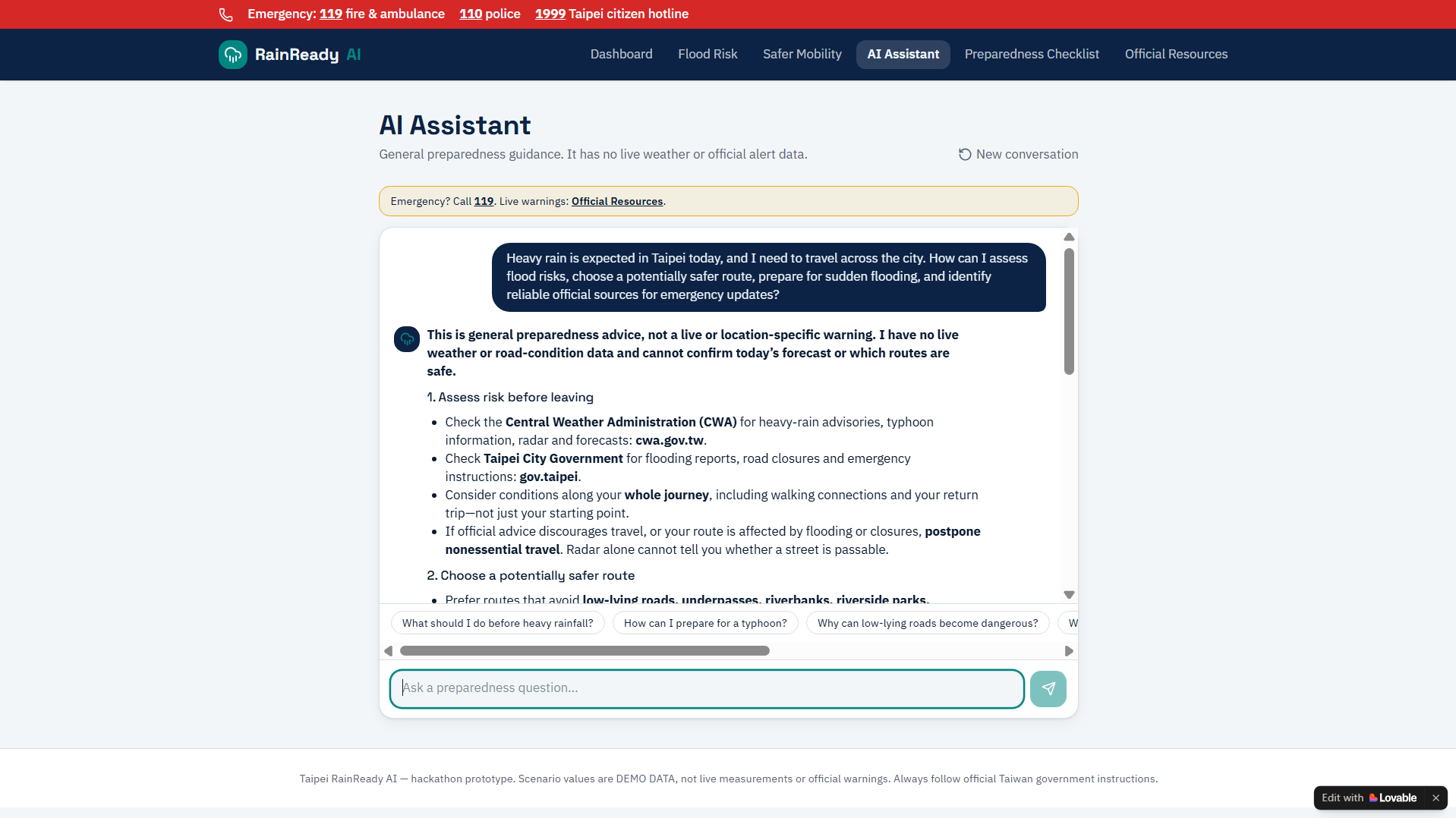
Get practical guidance on heavy rain, typhoon safety, flood preparedness, and official resources.
Inspiration When heavy rain hits a city, people need more than a weather forecast. They need to understand the potential risks around them, consider how their journeys could be affected, and know what steps to take before an emergency occurs.
Taiwan faces environmental challenges such as typhoons, intense rainfall, and urban flooding. During these situations, finding understandable and actionable information can be difficult, especially when relevant resources are spread across different platforms.
This inspired us to explore a simple but important question:
What if people could understand potential flood risks, make more informed mobility decisions, and prepare for severe weather through one accessible platform?
That question became the foundation of Taipei RainReady AI, a climate-resilience project built to make disaster preparedness more understandable, accessible, and practical for Taipei residents.
Our goal is not to replace official warnings or emergency services. It is to help people better understand potential risks and take preparedness seriously before severe weather arrives.
What It Does
Taipei RainReady AI brings flood-risk awareness, mobility considerations, AI-assisted safety guidance, and emergency preparedness into one web application.
The current prototype includes five main features:
Flood Risk Dashboard: Explore Taipei districts and rainfall scenarios to understand how potential flood risks can vary across different situations. Demonstration values are clearly identified as sample data rather than live flood measurements.
AI Safety Assistant: Explore guidance about heavy rainfall, typhoon preparedness, flood safety, and emergency precautions through an accessible question-and-answer interface.
Safer Mobility: Compare illustrative travel scenarios and understand why low-lying or potentially flood-prone roads may present additional risks during heavy rainfall.
Emergency Preparedness Checklist: Track essential tasks such as preparing drinking water, packing necessary medicines, charging a power bank, protecting important documents, and checking official emergency information.
Official Resources: Access relevant weather information, government resources, and emergency contacts from one place.
Together, these features demonstrate how a focused digital tool can help make disaster-related information easier to navigate and translate awareness into practical preparation.
How We Built It
We used Lovable, an AI-assisted development platform, to turn our idea into a publicly accessible web prototype.
Rather than spending our limited development time building every component from scratch, we focused on defining the user experience, organizing the core features, and using AI-assisted development to bring the application together quickly.
The application is organized around six main areas: the dashboard, flood-risk information, safer mobility, the AI assistant, the preparedness checklist, and official resources.
Our design prioritizes clarity and accessibility. District selectors and rainfall scenarios help demonstrate how risk information could be presented, while the preparedness checklist and resource directory provide practical actions users can explore.
The prototype uses clearly labelled demonstration scenarios to communicate the concept without misrepresenting sample values as current environmental conditions.
We also made the application publicly accessible so that people can explore the concept directly through a browser.
Try the live prototype: https://taipei-rainready-ai.lovable.app/
Challenges We Ran Into
One of our biggest challenges was balancing an ambitious problem with the limited time available for development.
A comprehensive urban flood-resilience system could involve live weather feeds, validated flood models, geographic information systems, road-network data, and reliable emergency notifications. Building and validating all of those components would require substantially more time than a rapid hackathon prototype allows.
We therefore narrowed our scope to the features that best communicate our idea: flood-risk awareness, mobility scenarios, accessible safety guidance, emergency preparedness, and official information resources.
Another important challenge was communicating risk responsibly.
A simulated rainfall scenario cannot establish whether a particular neighbourhood is flooding right now. Similarly, an illustrative route comparison cannot guarantee that a road is safe during an emergency.
We addressed this distinction by identifying demonstration data clearly and directing users towards official sources for current weather information and emergency instructions.
This approach allowed us to demonstrate the intended user experience while being transparent about what the current prototype can and cannot establish.
Accomplishments That We're Proud Of
We are proud to have transformed a climate-resilience idea into a publicly accessible web prototype.
The project brings several related needs together in one interface rather than treating weather awareness, travel considerations, and emergency preparation as completely separate tasks.
We are particularly proud of three aspects:
- A focused, practical concept: The application is designed around real decisions people may face during severe weather.
- A working product experience: Users can explore the application's main sections and interact with its preparedness-oriented interface.
- Responsible risk communication: The prototype distinguishes illustrative scenarios from verified live conditions instead of presenting unvalidated information as an official warning.
Most importantly, the project gives us a foundation that can be tested, improved, and extended beyond the initial hackathon.
What We Learned
Building Taipei RainReady AI reinforced the importance of starting with a human problem rather than technology alone.
AI can help make complex information easier to understand, but an effective public-safety application also needs trustworthy sources, clear communication, and careful handling of uncertainty.
We also learned the value of rapid prototyping. By concentrating on a small number of connected features, we could demonstrate the core concept without attempting to build an entire disaster-management infrastructure.
Finally, we learned that transparency is essential when working on environmental risk. Users should be able to distinguish sample scenarios, general safety advice, and verified information from official sources.
These principles will guide our future development of the project.
What's Next?
Taipei RainReady AI is a starting point, and several opportunities could make it more useful over time.
Our future plans include:
- Live data integration: Connect reliable weather observations and relevant government flood datasets, with clear timestamps and source attribution.
- Improved risk visualizations: Explore validated geographic information to provide more meaningful neighbourhood-level context.
- Grounded AI assistance: Improve the assistant so that its responses draw on authoritative information and clearly distinguish general guidance from current official warnings.
- More informative mobility scenarios: Investigate how verified road, geographic, and flood-related data could support better-informed travel decisions.
- Accessibility and localization: Improve support for English and Traditional Chinese and make the interface easier to use for people with different accessibility needs.
- Community feedback: Evaluate the prototype with potential users and use their feedback to guide future improvements.
These are future development goals, not capabilities we claim to have fully implemented in the current version.
Our Vision
Preparedness starts with understanding.
With Taipei RainReady AI, we want to explore how AI-assisted technology and accessible public information can help people become better prepared for extreme weather.
Our vision is a Taipei where residents can more easily understand potential environmental risks, find relevant guidance, and take practical steps towards protecting themselves and their communities.
By starting with a focused, transparent prototype, we hope to lay the groundwork for a more informed and resilient approach to urban disaster preparedness.
Built With
- css3
- html5
- javascript
- lovable
- opendata
- react
- tailwind
- typescript
- vite
- weatherdata


Log in or sign up for Devpost to join the conversation.